
Saints Spouse of the Blessed Virgin Mary and Patron of the Catholic Church · Solemnity March 19
Saint Joseph
Feast 19 March
A craftsman of Nazareth took the Blessed Virgin Mary as his wife at an angel's word, carried her child into Egypt and home again, raised him in a carpenter's house, and in 1870 AD was declared Patron of the Catholic Church.
Begin the life
In brief
Saint Joseph, also called Joseph of Nazareth, was the husband of the Blessed Virgin Mary and the foster-father of Jesus. He was a craftsman of Nazareth, of the house of David, and Pope St. John Paul II noted that the Gospels record no word he spoke. Blessed Pius IX declared him Patron of the Catholic Church on December 8, 1870 AD.
-
Nazareth, before the Nativity
The just man and the dream
St. Joseph finds his betrothed expecting a child, decides to send her away quietly, and is stopped by an angel in a dream.
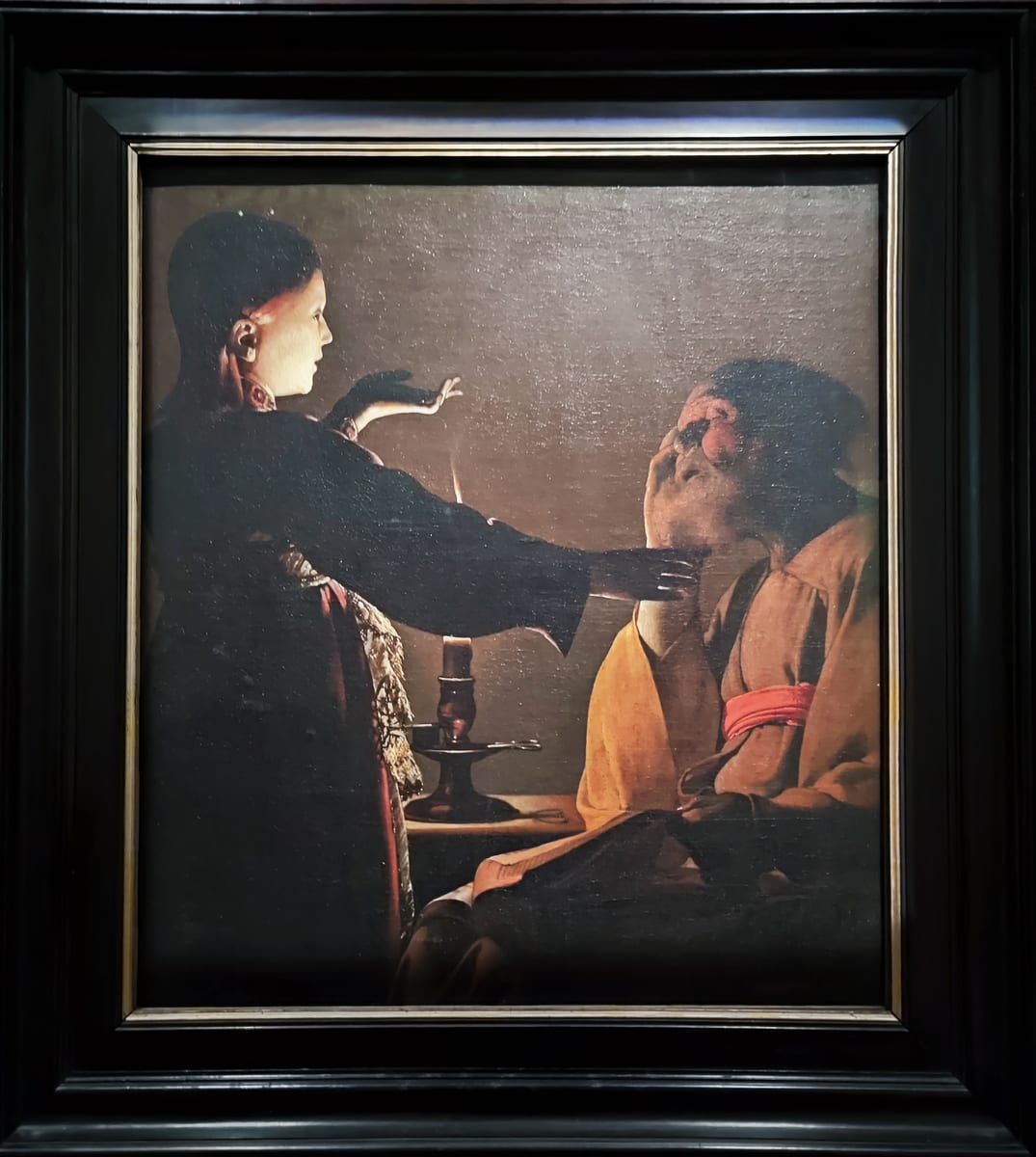
The Dream of St. Joseph, Georges de La Tour, c. 1640 AD Georges de La Tour, Musée d’arts de Nantes St. Joseph, a man of the house of David, was betrothed to the Blessed Virgin Mary at Nazareth, and by Jewish custom that already made him her husband before he took her into his home. Before they lived together, she was found to be expecting a child by the Holy Spirit. St. Joseph was a just man and would not put her to shame, so he resolved to send her away quietly.
St. Augustine praised a justice that could neither keep her nor bring itself to punish and expose her. In a dream an angel of the Lord told St. Joseph not to be afraid to take the Blessed Virgin Mary as his wife, and told him to name her son Jesus. When he woke he did as the angel commanded and took her into his home, and when her son was born St. Joseph gave him that name.
“Joseph, son of David, do not fear to take Mary your wife, for that which is conceived in her is of the Holy Spirit; she will bear a son, and you shall call his name Jesus, for he will save his people from their sins.”
An angel of the Lord to St. Joseph, in a dream, as he considered sending Our Lady away -
Bethlehem, the Nativity
No room in the inn
St. Joseph is enrolled in the census together with the Blessed Virgin Mary, his betrothed, who is expecting her child.
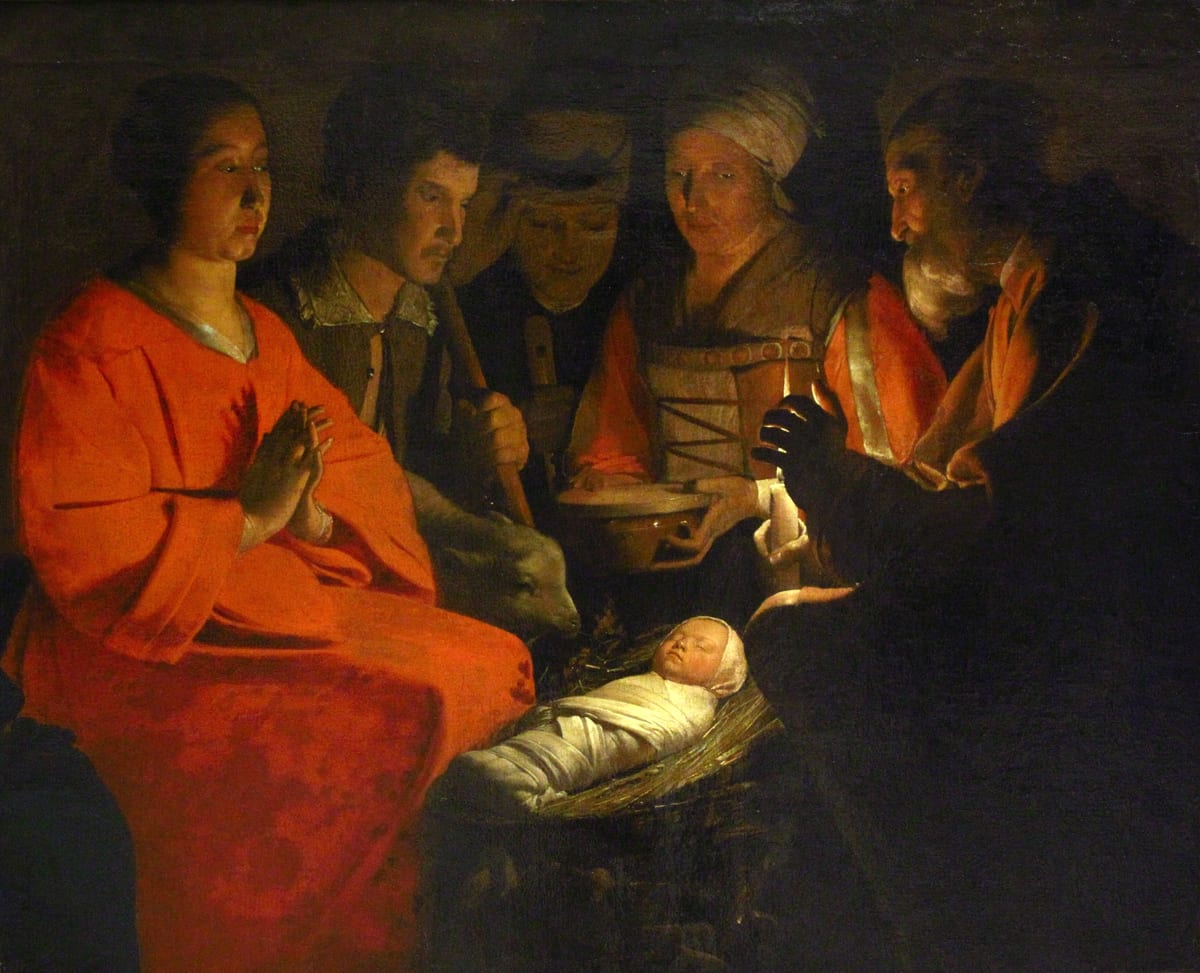
The Adoration of the Shepherds, Georges de La Tour, c. 1644 AD Georges de La Tour, Musée du Louvre, Paris When Caesar Augustus ordered a census of the whole world, St. Joseph went from Nazareth to Bethlehem, King David's town, to be registered, because he was descended from David. Our Lady went with him, expecting her child. There was no room for them at the inn, and she laid her newborn son in a manger.
Pope Francis writes that St. Joseph took a stable and made it as welcoming a home as he could. Shepherds came in haste after an angel told them a Savior had been born, and found Our Lady and St. Joseph with the baby lying in the manger. Wise men from the East found the child with his mother in a house and worshipped him.
“il s'en va en son pais et en sa ville de Bethlehem. et nul n'est rejette de tous les logis que luy (he went into his own country and to his own town of Bethlehem, and, as far as we know, he alone was refused admittance into any of the inns)”
St. Francis de Sales to the Visitation nuns at Annecy, Entretien XIX, on St. Joseph's humility -
Jerusalem, the Temple
The father's duty in the Temple
St. Joseph and Our Lady bring the child to the Temple, where St. Joseph fulfils a father's duty and a man named Simeon takes the boy in his arms.
When the time came for the purification the law of Moses required, St. Joseph and Our Lady brought the child to the Temple in Jerusalem to present him to the Lord. Ransoming, or buying back, a first-born son was a father's duty, and St. John Paul II writes that St. Joseph fulfilled it.
A man named Simeon took the child in his arms and blessed God. St. Joseph and Our Lady were amazed at what Simeon said about the child, and Simeon blessed them.
“Lord, now lettest thou thy servant depart in peace, according to thy word; for mine eyes have seen thy salvation which thou hast prepared in the presence of all peoples, a light for revelation to the Gentiles, and for glory to thy people Israel.”
Simeon to God, taking the child into his arms in the Temple at the presentation -
Bethlehem, Egypt and Nazareth
By night into Egypt
Warned that the king means to kill the child, St. Joseph takes his family abroad, and brings them back only when the danger has passed.
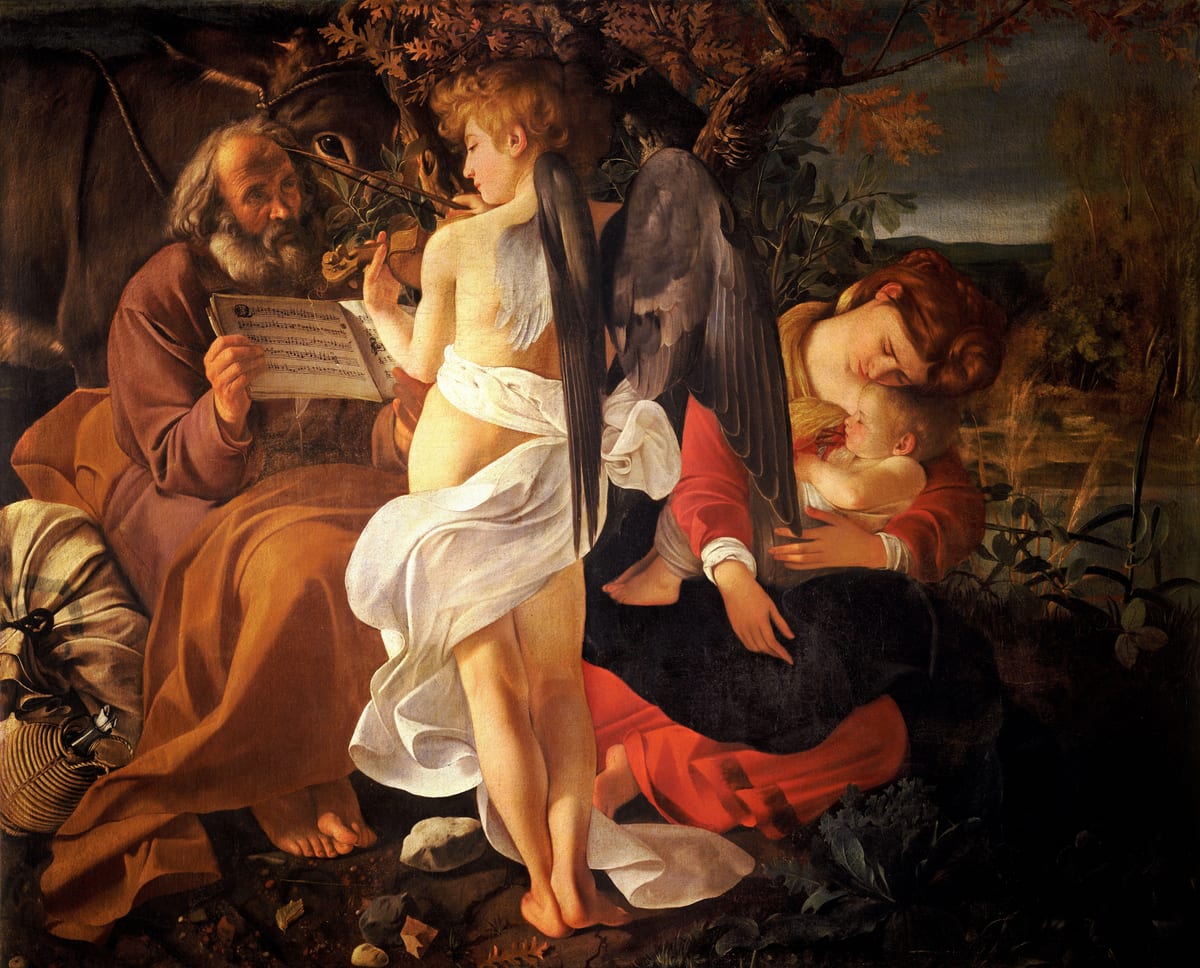
Rest on the Flight into Egypt, Michelangelo Merisi da Caravaggio, c. 1596–1597 AD Michelangelo Merisi da Caravaggio, Galleria Doria Pamphilj, Rome After the wise men left, an angel warned St. Joseph in a dream that Herod would soon hunt for the child to kill him. He rose and took the child and his mother to Egypt by night. Herod then had the boys of Bethlehem two years old and under killed.
When Herod died, an angel came to St. Joseph in a dream in Egypt and sent the family back to the land of Israel. Herod's son Archelaus now ruled Judea, and St. Joseph was afraid to go there. Warned in another dream, he took them to Galilee and settled in Nazareth.
“Per difendere Gesù da Erode, soggiornò da straniero in Egitto (cfr Mt 2,13-18). (To protect Jesus from Herod, Joseph dwelt as a foreigner in Egypt (cf. Mt 2:13-18).)”
Pope Francis, Patris Corde, on the flight into Egypt, December 8, 2020 AD -
Jerusalem and Nazareth, the hidden years
Three days of searching
The twelve-year-old Jesus stays behind in Jerusalem, and St. Joseph and Our Lady search for three days before they find him in the Temple.
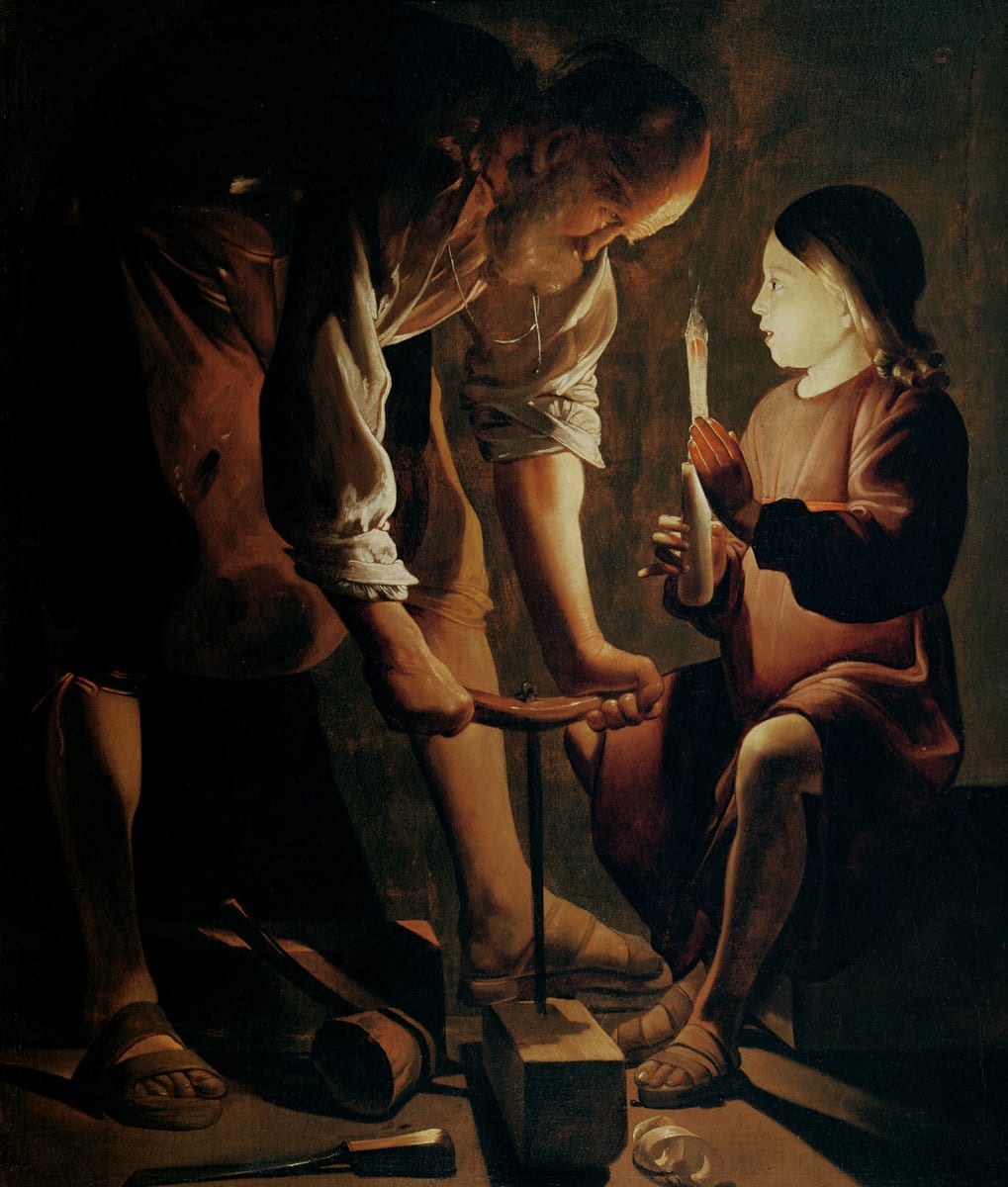
Saint Joseph the Carpenter, Georges de La Tour, c. 1642–1644 AD Georges de La Tour, Musée du Louvre, Paris St. Joseph and Our Lady went up to Jerusalem every year for the Passover, and when Jesus was twelve he stayed behind in the city without their knowing it. They looked for him among their relatives and friends, then went back to Jerusalem to search for him. After three days they found him in the Temple, sitting among the teachers, listening to them and asking them questions.
Our Lady spoke to him and called St. Joseph his father, and Jesus answered that he must be in his Father's house. The Catechism of the Catholic Church teaches that neither of them understood the answer, but they accepted it in faith. He went home with them to Nazareth and was obedient to them, and years later the people of Nazareth still called him the carpenter's son.
“Son, why have you treated us so? Behold, your father and I have been looking for you anxiously.”
Our Lady to the boy Jesus, finding him in the Temple after three days' search -
The Fathers, and the Tradition of his death
St. Augustine names St. Joseph a father in love
St. Augustine calls St. Joseph a true father in love, St. Jerome sets aside the stories of an old widower, and Tradition remembers his death beside Jesus and Our Lady.
St. Augustine taught that St. Joseph was truly the Lord's father, not in the flesh but in love. According to longstanding Catholic Tradition, told in the apocryphal Protoevangelium of James, he was an old widower, picked from among the widowers to take Our Lady into his keeping when a dove flew out of his staff onto his head. St. Jerome called such stories baseless dreams, and taught that St. Joseph stayed a virgin for Our Lady's sake.
The Catholic Encyclopedia judges that St. Joseph died before Jesus began his public ministry, most likely at Nazareth. An apocryphal account of his last days, as Tradition tells it, has him fall ill at Nazareth and die with Jesus beside him, while the people of Nazareth weep for him. The Church invokes him as patron of a happy death.
“and to entrust ourselves to St. Joseph, the patron of a happy death.”
The Catechism of the Catholic Church (§1014), on preparing for the hour of death, 1992 AD -
Ávila and Annecy
St. Teresa could not recall a request he did not grant
St. Teresa of Ávila, unable to walk, takes St. Joseph as her patron and names a monastery for him; St. Bernardine of Siena writes of him and St. Francis de Sales preaches on him.
St. Teresa of Ávila could not walk when she took St. Joseph for her patron, and she credited him with making her able to rise and walk again. St. Teresa wrote that she always asked him for something on his feast and always received it. She named her new monastery at Ávila St. Joseph's, as she wrote Our Lord had told her to, and recorded that St. Joseph appeared to her to promise money for the workmen.
St. Bernardine of Siena noted that the finding in the Temple is the only place where Our Lady calls St. Joseph the father of Jesus, and said it was because his sorrow showed a father's love. Preaching to the Visitation nuns at Annecy on a feast of St. Joseph, St. Francis de Sales said St. Joseph obeyed the order to flee at once, his tools on his back.
“á otros santos parece les dió el Señor gracia para socorrer en una necesidad, á este glorioso santo tengo experiencia que socorre en todas (To other Saints, our Lord seems to have given grace to succour men in some special necessity; but to this glorious Saint, I know by experience, to help us in all)”
St. Teresa of Ávila, her Life, chapter 6 -
1870–2021 AD
Patron of the whole Church
Bishops gathered in Rome ask the Pope to name St. Joseph protector of the whole Church, and later Popes give him a workers' feast and a place in the Mass.
At the First Vatican Council, 153 bishops asked that St. Joseph be given a higher place in the liturgy, and 43 heads of religious orders asked that he be proclaimed Patron of the universal Church. The decree that followed described the Church as beset by enemies on every side. On December 8, 1870 AD, Blessed Pius IX granted the request and declared St. Joseph Patron of the Catholic Church.
Pope Leo XIII followed on August 15, 1889 AD with the encyclical Quamquam pluries, ordering a prayer to St. Joseph said with the Rosary every October. In 1955 AD Pope Pius XII announced to workers in St. Peter's Square a feast of St. Joseph the Worker on May 1, and during the Second Vatican Council Pope St. John XXIII added St. Joseph's name to the Roman Canon of the Mass. Pope St. John Paul II followed with Redemptoris Custos in 1989 AD, and Pope Francis marked the patronage's 150th year with Patris Corde in 2020 AD and approved seven new titles for the Litany of St. Joseph.
“Difficilibus quindem Ecclesiae temporibus cum Pontifex Romanus Pius IX cuperet praesidio eam perculiari patriarchae sancti Iosephi concredere, ipsum illum “Catholicae Ecclesiae Patronum” declaravit (At a difficult time in the Church's history, Pope Pius IX, wishing to place her under the powerful patronage of the holy patriarch Joseph, declared him "Patron of the Catholic Church.")”
Pope St. John Paul II, Redemptoris Custos, on the declaration of 1870, August 15, 1989 AD


Pray with the Church
Prayer to St. Joseph
Written by Pope Leo XIII and printed with his encyclical Quamquam pluries, August 15, 1889 AD, to be said with the Rosary in October.
Ad te, beate Ioseph, in tribulatione nostra confugimus, atque, implorato Sponsae tuae sanctissimae auxilio, patrocinium quoque tuum fidenter exposcimus. (To thee, O blessed Joseph, we have recourse in our affliction, and having implored the help of thy thrice holy Spouse, we now, with hearts filled with confidence, earnestly beg thee also to take us under thy protection.)Per eam, quaesumus, quae te cum immaculata Virgine Dei Genitrice coniunxit, caritatem, perque paternum, quo Puerum Iesum amplexus es, amorem, supplices deprecamur, ut ad haereditatem, quam Iesus Christus acquisivit sanguine suo, benignus respicias, ac necessitatibus nostris tua virtute et ope succurras. (By that charity wherewith thou wert united to the Immaculate Virgin Mother of God, and by that fatherly love with which thou didst cherish the Child Jesus, we beseech thee and we humbly pray that thou wilt look down with gracious eye upon that inheritance which Jesus Christ purchased by His blood, and wilt succor us in our need by thy power and strength.)Tuere, o Custos providentissime divinae Familiae, Iesu Christi sobolem electam; (Defend, O most watchful guardian of the Holy Family, the chosen off-spring of Jesus Christ.)prohibe a nobis, amantissime Pater, omnem errorum ac corruptelarum luem; (Keep from us, O most loving Father, all blight of error and corruption.)propitius nobis, sospitator fortissime, in hoc cum potestate tenebrarum certamine e caelo adesto; (Aid us from on high, most valiant defender, in this conflict with the powers of darkness.)et sicut olim Puerum Iesum e summo eripuisti vitae discrimine, ita nunc Ecclesiam sanctam Dei ab hostilibus insidiis atque ab omni adversitate defende: (And even as of old thou didst rescue the Child Jesus from the peril of His life, so now defend God's Holy Church from the snares of the enemy and from all adversity.)nosque singulos perpetuo tege patrocinio, ut ad tui exemplar et ope tua suffulti, sancte vivere, pie emori, sempiternamque in caelis beatitudinem assequi possimus. Amen. (Shield us ever under thy patronage, that, following thine example and strengthened by thy help, we may live a holy life, die a happy death, and attain to everlasting bliss in Heaven. Amen.)