
Saints Doctor of the Church · 354–430 AD
Saint Augustine of Hippo
Feast 28 August · Born 354 AD, Thagaste, proconsular Numidia (Souk Ahras, Algeria) · Died 430 AD, Hippo Regius, Numidia (Annaba, Algeria)
A provincial teacher of rhetoric who was seized by a congregation, held Hippo for thirty-four years, and died inside a Vandal siege.
Begin the life
In brief
Saint Augustine of Hippo, commonly known as Augustine, was born at Thagaste in Roman North Africa on November 13, 354 AD. He was baptized by Saint Ambrose at Milan in 387 AD, after nine years among the Manichaeans. Pope Benedict XVI calls him the greatest Father of the Latin Church.
-
354–370 AD
The boy at Thagaste
A councillor's son in a small Numidian town, signed with the cross in infancy and sent away to school.
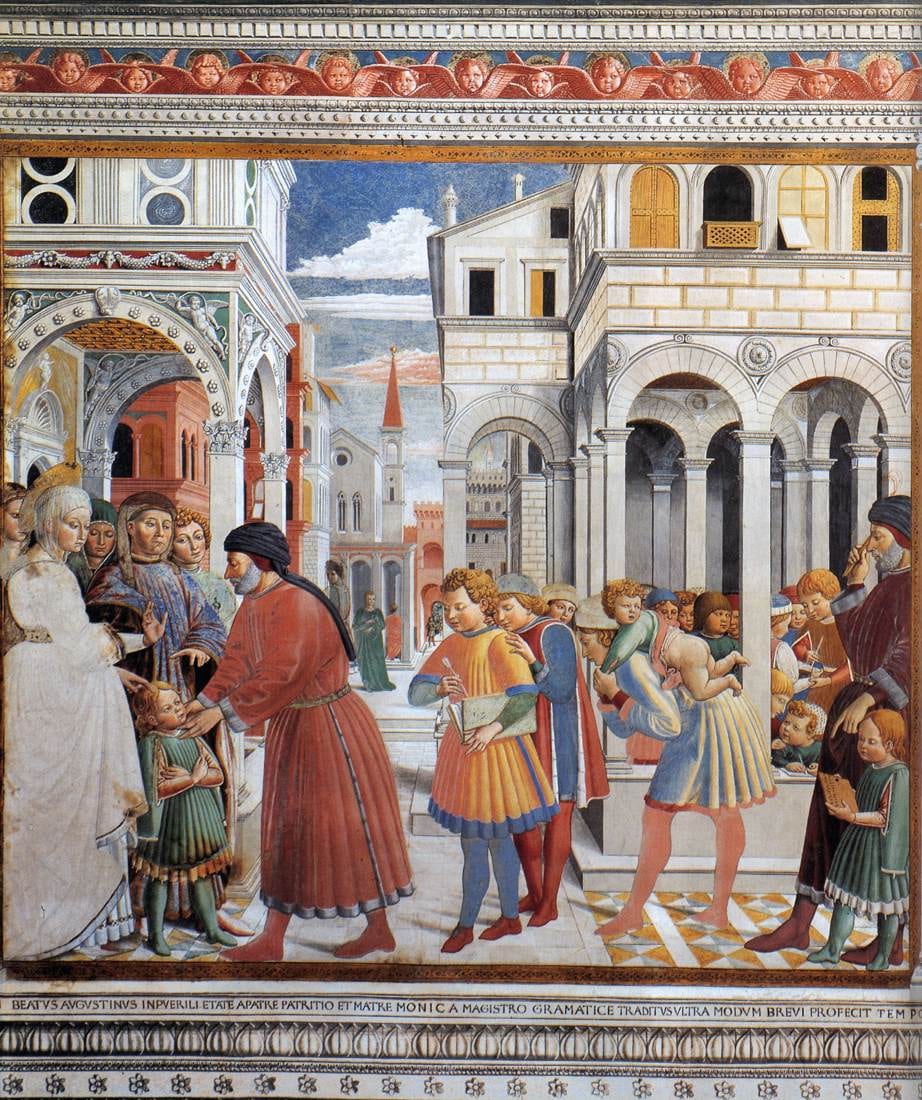
The School of Tagaste (scene 1, north wall), from the Life of St Augustine, Benozzo Gozzoli, 1464–1465 AD Benozzo Gozzoli, Apsidal chapel, Sant'Agostino, San Gimignano Saint Augustine of Hippo was born at Thagaste to Patricius, a pagan town councillor, and Saint Monica, a Christian. St. Monica had him signed with the cross and enrolled among the catechumens as an infant.
A sudden illness brought him to the point of death, and he begged for baptism. He recovered quickly, and the sacrament was deferred. He learned grammar at Thagaste, went on to school at Madaura, and never learned Punic.
“For as a boy I began to pray to You, my help and my refuge, and in invoking You broke the bands of my tongue, and entreated You though little, with no little earnestness, that I might not be beaten at school.”
St. Augustine of Hippo -
370–373 AD
Carthage
Rhetoric, a son born to a woman he never names, and the book that turned him toward philosophy.
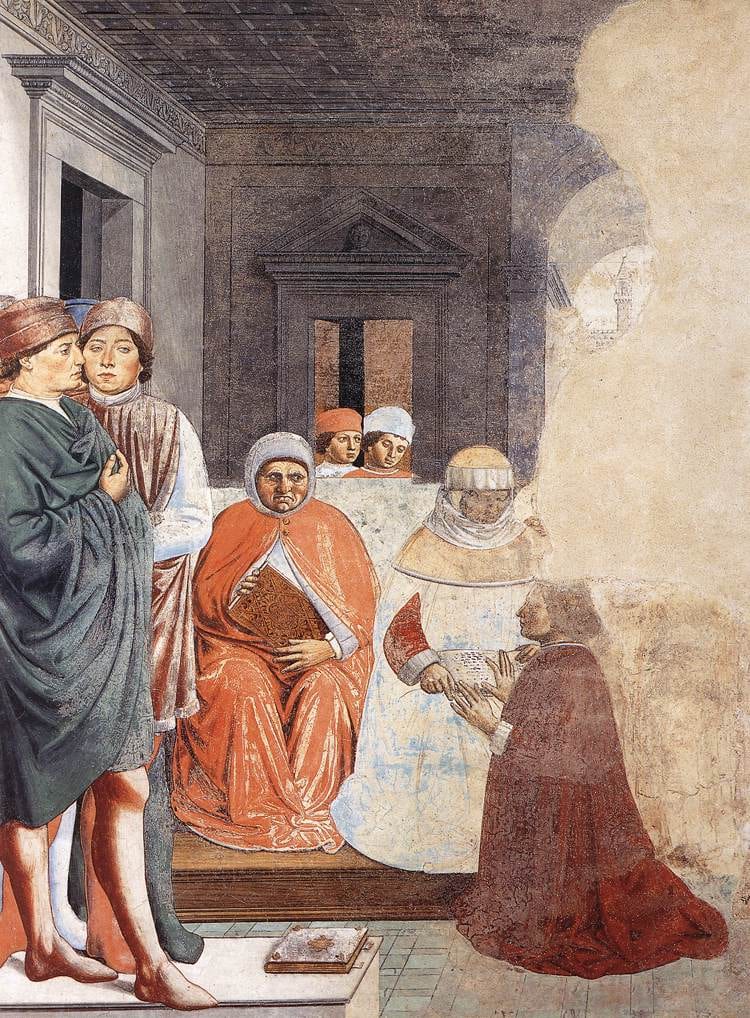
St Augustine at the University of Carthage (scene 2, north wall), from the Life of St Augustine, Benozzo Gozzoli, 1464–1465 AD Benozzo Gozzoli, Apsidal chapel, Sant'Agostino, San Gimignano St. Augustine reached Carthage towards the end of 370 AD to study rhetoric. Within two years he had formed a union with a woman who bore him a son. He named the boy Adeodatus, and never names the mother anywhere in his writings.
In 373 AD he read Cicero's exhortation to philosophy, the Hortensius, a book now lost. It turned his prayers to God, and in the same year he joined the Manichaeans.
“This book, in truth, changed my affections, and turned my prayers to Yourself, O Lord, and made me have other hopes and desires. Worthless suddenly became every vain hope to me; and, with an incredible warmth of heart, I yearned for an immortality of wisdom, and began now to arise that I might return to You.”
St. Augustine of Hippo -
374–383 AD
The nine years
His mother shut him out of her house; a bishop refused to argue with him; the sect's great man had no answers.
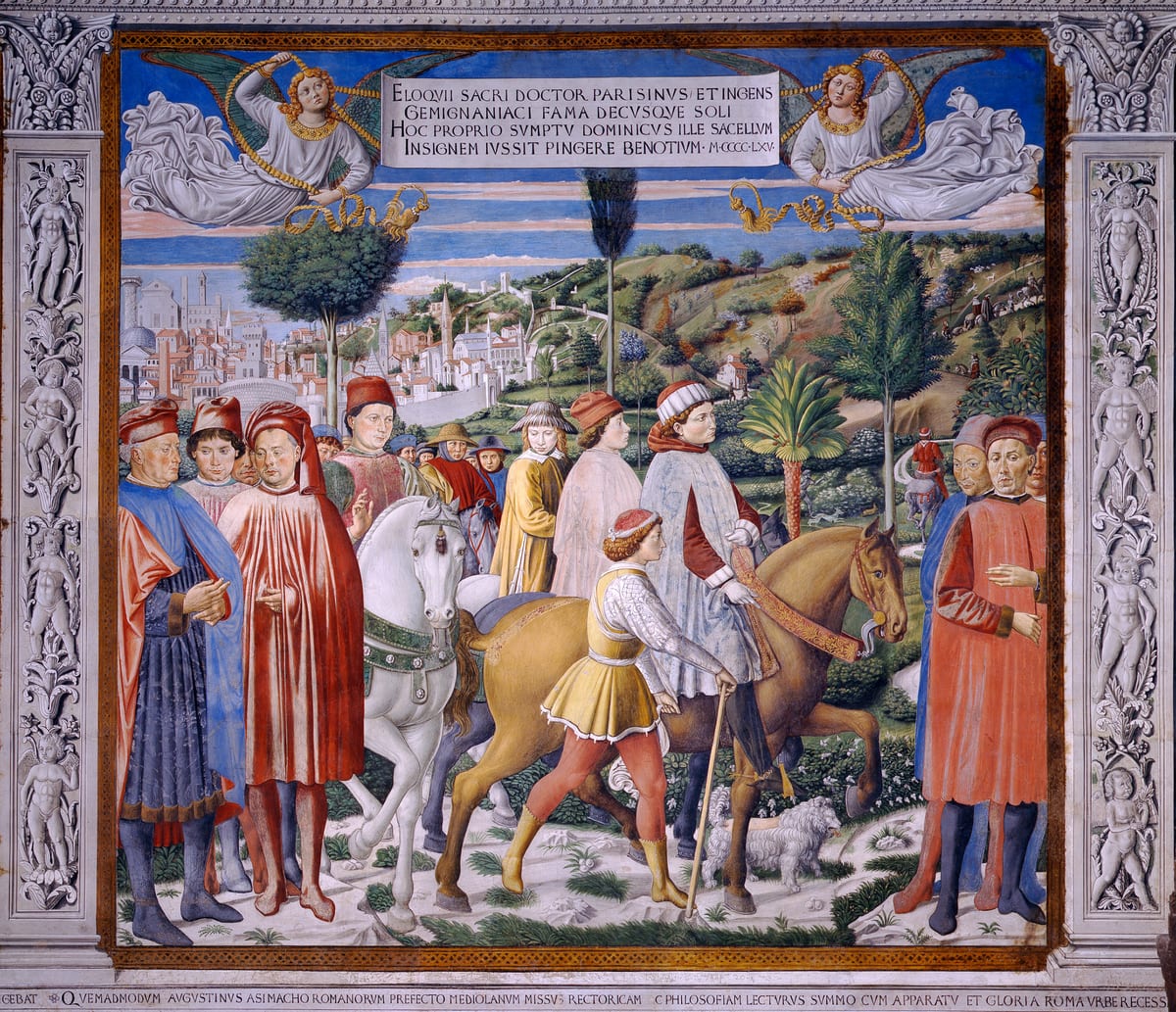
Partenza di sant'Agostino per Roma (the departure for Rome; catalogued by the Web Gallery of Art as scene 3, 'St Augustine Leaving his Mother'), Benozzo Gozzoli, 1465 AD Benozzo Gozzoli, Apsidal chapel, Sant'Agostino, San Gimignano St. Augustine went back to Thagaste to teach grammar, and St. Monica would not receive him at her table. She begged a bishop to argue her son out of the heresy, and he refused.
Faustus, the Manichaean bishop he had been told to wait for, came to Carthage in 382 AD. St. Augustine questioned him and found an elegant speaker who was a stranger to the sciences. In 383 AD he lied to his mother at the harbour and sailed for Rome by night.
“Go your way, and God bless you, for it is not possible that the son of these tears should perish.”
An African bishop -
384–387 AD
The garden at Milan
A court post, a bishop's preaching, a household broken up for a marriage, and a book opened at random.
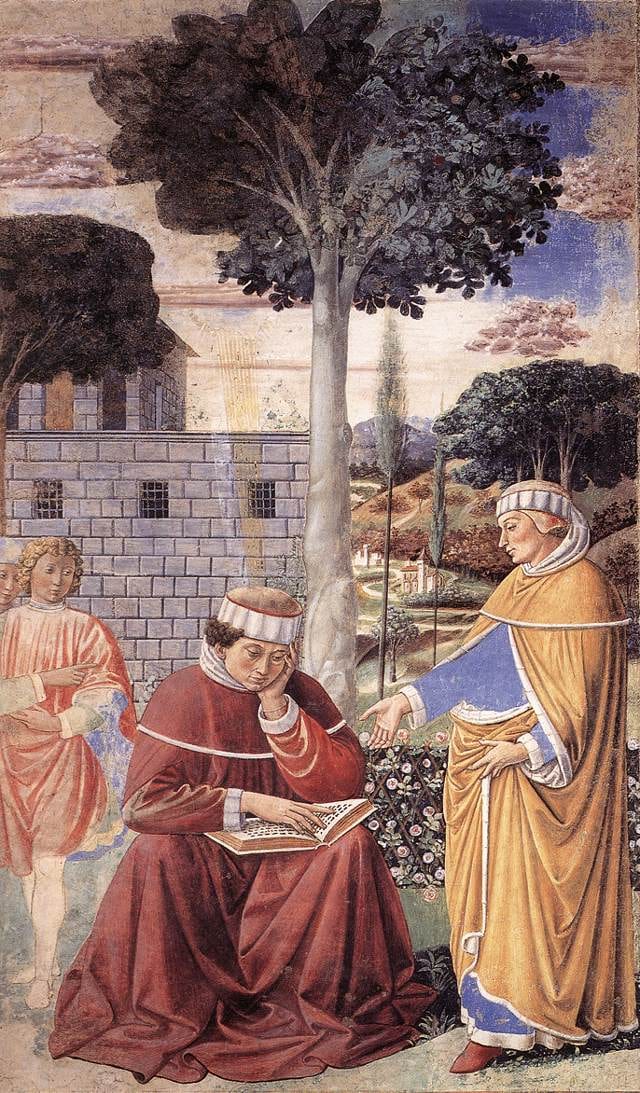
St Augustine Reading the Epistle of St Paul, 'Tolle lege' (scene 10), from the Life of St Augustine, Benozzo Gozzoli, 1464–1465 AD Benozzo Gozzoli, Apsidal chapel, Sant'Agostino, San Gimignano Symmachus sent St. Augustine to Milan in 384 AD as the city's public teacher of rhetoric. He went to hear St. Ambrose in order to weigh his eloquence, and was held by the matter. A marriage was arranged, and the woman who had been with him fifteen years went back to Africa without her son.
In 386 AD, weeping under a fig tree in a garden, he heard a child chanting in a neighbouring house. He opened the letters of the apostle, read the thirteenth chapter of Romans, and read no further. St. Ambrose baptized him with Adeodatus and St. Alypius on the night of Holy Saturday, April 24, 387 AD.
“I heard the voice as of a boy or girl, I know not which, coming from a neighbouring house, chanting, and oft repeating, Take up and read; take up and read.”
St. Augustine of Hippo, 386 AD -
387–391 AD
Ostia, and a church at Hippo
His mother died waiting for the boat home; four years later a congregation took hold of him and would not let go.
Waiting at Ostia for the crossing to Africa, St. Augustine and his mother talked at a window of eternal life. Five days later St. Monica was prostrated by fever, and she died on its ninth day. She asked only to be remembered at the Lord's altar, wherever her sons might be.
At Thagaste he sold his goods, gave the money to the poor, and lived in common for nearly three years. In 391 AD the people of Hippo laid hands on him in church and demanded that Bishop Valerius ordain him. He wept, and told St. Possidius afterwards that he saw the dangers of governing a church.
“Lay this body anywhere, let not the care for it trouble you at all. This only I ask, that you will remember me at the Lord's altar, wherever you be.”
Saint Monica, 387 AD -
391–426 AD
Bishop of Hippo
Thirty-four years of lawsuits, sermons, common life and books, in a house that owned almost nothing.
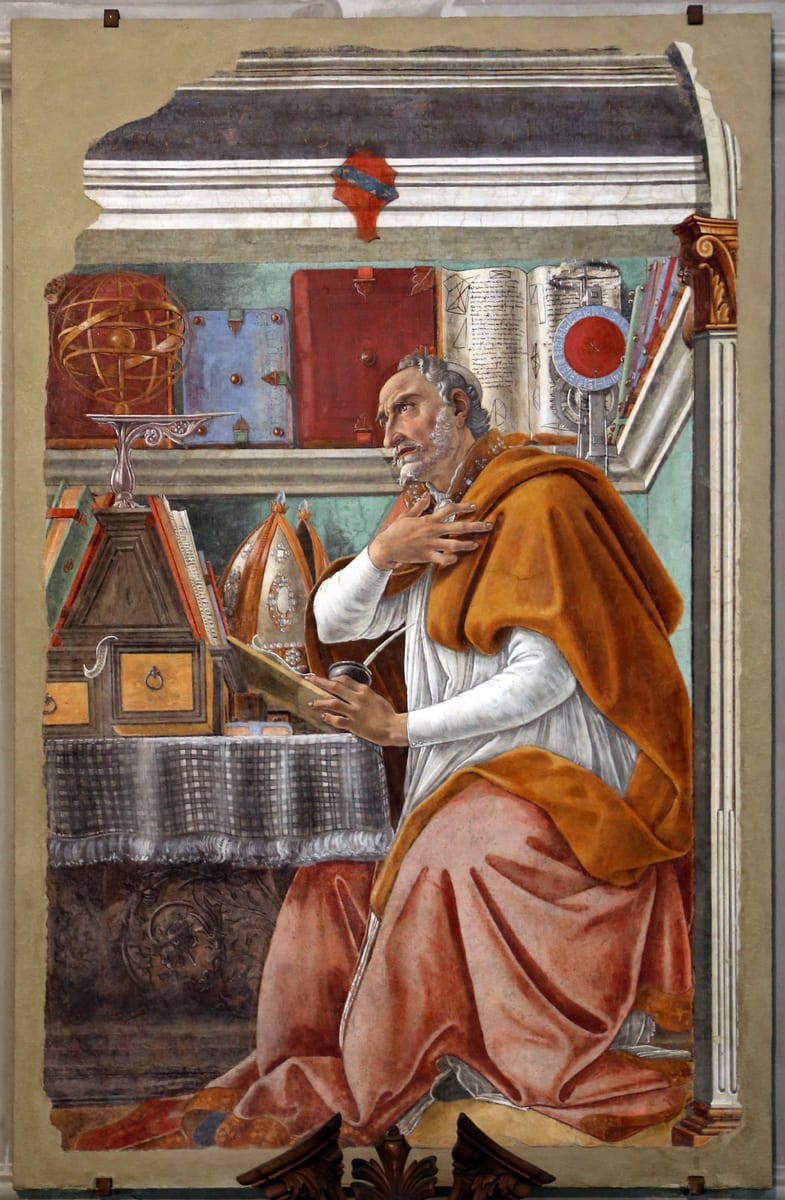
Sant'Agostino nello studio (Saint Augustine in his Study), from the former choir of the Umiliati friars, Sandro Botticelli (1445-1510 AD); photograph by Sailko, c. 1480 AD; fresco, 152 x 112 cm Sandro Botticelli (1445-1510 AD); photograph by Sailko, Church of Ognissanti, Florence St. Augustine was consecrated bishop of Hippo Regius in 395 AD and held the see for some thirty-four years. He turned his own house into a monastery and lived in common with his clergy. He heard lawsuits until he sometimes fasted all day, and he would never buy land.
When the church's money failed he told the people plainly that he had nothing to give the poor. For the sake of captives he ordered the holy vessels broken up and melted down. He began the Confessions about 397 AD and finished the City of God in 426 AD.
“Who injures the name of an absent friend / May not at this table as guest attend.”
St. Augustine of Hippo, 396–430 AD -
426–428 AD
Naming a successor
He had seen what follows a bishop's death, so he settled his own succession in front of everybody, with the notaries writing.
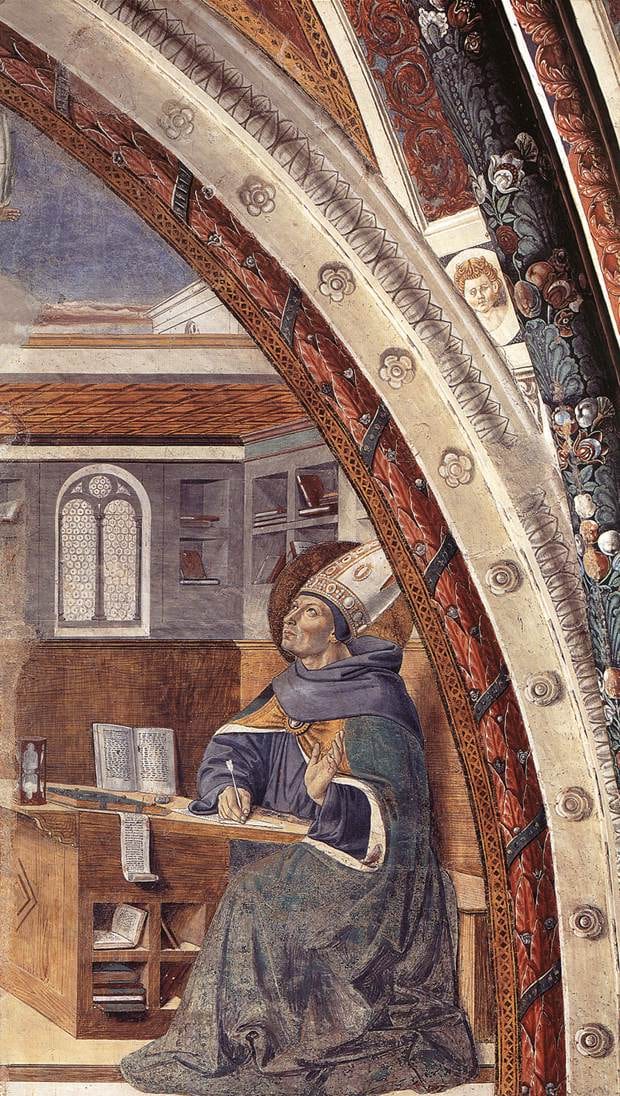
St Augustine's Vision of St Jerome (scene 16, east wall), from the Life of St Augustine, Benozzo Gozzoli, 1464–1465 AD Benozzo Gozzoli, Apsidal chapel, Sant'Agostino, San Gimignano St. Augustine had just been to Milevis, where a bishop had named his successor to the clergy but not to the people. On September 26, 426 AD, in the Church of Peace at Hippo, he named the presbyter Eraclius. The notaries took down his words and counted the people's acclamations.
He told the congregation that his own consecration had broken a canon of Nicaea. He refused to have Eraclius consecrated while he himself lived. Asked whether bishops might withdraw before the barbarians, he answered that the flock must not be deserted.
“I came to this town — for such was the will of God — when I was in the prime of life. I was young then, but now I am old.”
St. Augustine of Hippo -
429–430 AD
The siege
Africa was overrun, Hippo was shut up, and the bishop asked God for one of three things.
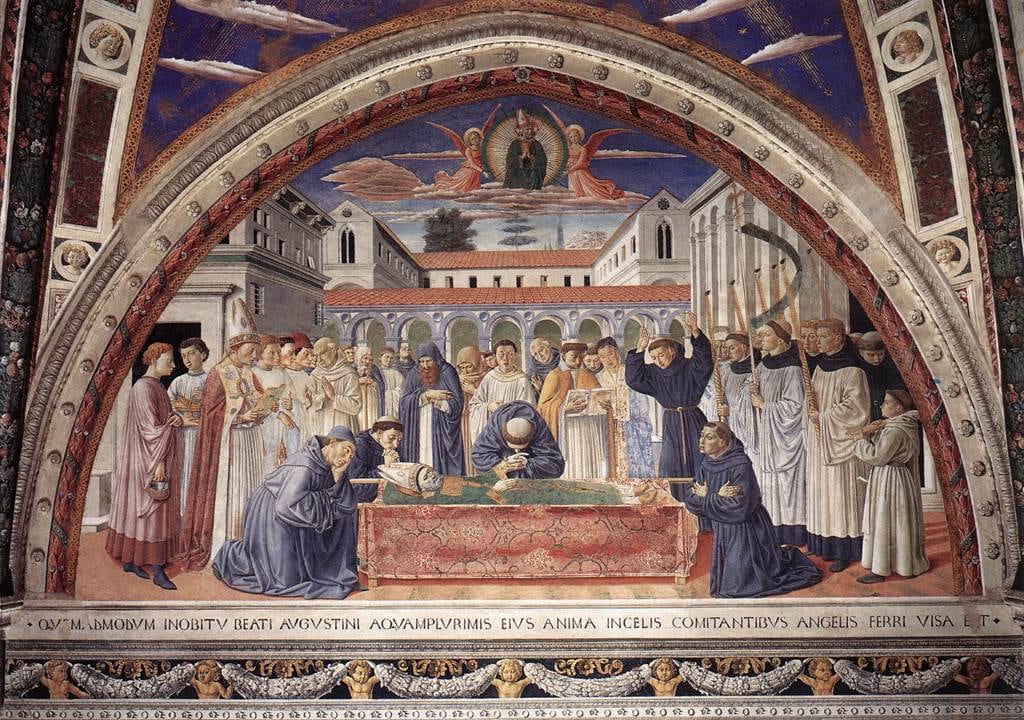
Funerali di sant'Agostino (Funeral of St Augustine, scene 17), from the Life of St Augustine, Benozzo Gozzoli, 1464–1465 AD Benozzo Gozzoli, Apsidal chapel, Sant'Agostino, San Gimignano Vandals and Alans crossed from Spain and overran Africa, sparing neither age nor the churches. Of the innumerable churches of Africa, St. Augustine saw only Carthage, Hippo and Cirta survive. About the end of May 430 AD the enemy shut up Hippo and blockaded its coast.
At table he taught the bishops sheltering in his house the prayer he was making for the city. In the third month of the siege he took to his bed, the penitential psalms hung where he could read them. He died on August 28, 430 AD, and made no will, having nothing to leave.
“He commanded that the shortest penitential Psalms of David should be copied for him, and during the days of his sickness as he lay in bed he would look at these sheets as they hung upon the wall and read them; and he wept freely and constantly.”
St. Possidius of Calama, 430 AD


_-_WGA10285.jpg)
_-_WGA10287.jpg)


_-_WGA10310.jpg)

Pray with the Church
The prayer St. Augustine made under siege
The three petitions St. Augustine spoke at table in besieged Hippo Regius in 430 AD and taught to the bishops sheltering in his house, recorded by St. Possidius of Calama, who was seated with him.
I would have you know that in this time of our misfortune I ask this of God:either that He may be pleased to free this city which is surrounded by the foe,or if something else seems good in His sight, that He make His servants brave for enduring His will,or at least that He may take me from this world unto Himself.
All 12 reports on Saint Augustine of Hippo

About this picture
AI-generated image, in the manner of fresco, from the paper's reference portrait based on St Augustine's Vision of St Jerome (Benozzo Gozzoli, 1464-1465, Apsidal chapel, Sant'Agostino, San Gimignano) View source artwork.
St. Augustine names his successor, but keeps him a priest for now

About this picture
AI-generated image, in the manner of a buon fresco on lime plaster, from the paper's reference portrait based on Funerali di sant'Agostino (Funeral of St Augustine, scene 17), from the Life of St Augustine (Benozzo Gozzoli, 1464-1465, apsidal chapel, Sant'Agostino, San Gimignano) View source artwork.
In besieged Hippo, St. Augustine asks God for his own death

About this picture
AI-generated image, in the manner of buon fresco on lime plaster, from the paper's reference image based on The School of Tagaste (scene 1, north wall), from the Life of St Augustine (Benozzo Gozzoli, 1464-1465, apsidal chapel of Sant'Agostino, San Gimignano) View source artwork.
Patricius is baptised at Thagaste and dies, his son's fees unpaid

About this picture
AI-generated image, in the manner of a buon fresco on lime plaster, from the paper's reference image based on St Augustine's Vision of St Jerome (scene 16, east wall), from the Life of St Augustine (Benozzo Gozzoli, 1464-1465, apsidal chapel, Sant'Agostino, San Gimignano) View source artwork.
Bishop who lived beside Saint Augustine for forty years writes his life

St. Augustine talks about his mother, ten years after her death

About this picture
AI-generated image, in the manner of a buon fresco on lime plaster, from the paper's reference portrait based on Fresco of Augustine, Lateran, Rome (Anonymous, c. 550-600 AD, The Lateran, Rome) View source artwork.

Hippo Regius, three months blockaded: an empty harbour and a crowded house

About this picture
AI-generated image, in the manner of a buon fresco on lime plaster, from the paper's reference portrait based on St Augustine's Vision of St Jerome (scene 16, east wall), from the Life of St Augustine (Benozzo Gozzoli, 1464-1465, apsidal chapel, Sant'Agostino, San Gimignano) View source artwork.
St. Augustine goes to Milevis to settle a bishop's succession

About this picture
AI-generated image, in the manner of a buon fresco on lime plaster, from the paper's reference portrait based on Sant'Agostino nello studio (Saint Augustine in his Study) (Sandro Botticelli, c. 1480; photograph by Sailko, CC BY 3.0, Church of Ognissanti, Florence) View source artwork.
Book IX: what St. Augustine wrote down about the window at Ostia

Pope John Paul II calls St. Augustine common father of Christian Europe

About this picture
AI-generated image, in the manner of a buon fresco on lime plaster, from the paper's reference portrait based on Funerali di sant'Agostino (Funeral of St Augustine, scene 17), from the Life of St Augustine (Benozzo Gozzoli, 1464-1465, apsidal chapel, Sant'Agostino, San Gimignano). View source artwork.
Saint Augustine dies at Hippo in the third month of the siege

About this picture
AI-generated image, in the manner of a buon fresco on lime plaster, from the paper's reference portrait based on St Augustine's Vision of St Jerome (scene 16, east wall), from the Life of St Augustine (Benozzo Gozzoli, 1464-1465, apsidal chapel, Sant'Agostino, San Gimignano). View source artwork.
The man who watched St. Augustine die: St. Possidius on forty years

About this picture
AI-generated image, in the manner of Italian quattrocento buon fresco, from the paper's reference portrait based on Death of St Monica (scene 13, south wall) (Benozzo Gozzoli (1420-1497), 1464-1465 AD, Sant'Agostino, San Gimignano, Italy) View source artwork.
_-_WGA10306.jpg)