
Saints Widow of Tagaste · died 387 AD
Saint Monica
Feast 27 August · Born 331 AD, Tagaste, proconsular Numidia (Souk Ahras, Algeria) · Died 387 AD, Ostia, at the Tiber mouth, Italy
She kept the peace with a violent pagan husband, wept for years over a son lost to a sect, and followed him across the sea.
Begin the life
In brief
Saint Monica was a wife and mother of Tagaste in Roman North Africa, married to a pagan with a violent temper. For years she wept and prayed over her son Saint Augustine while he followed the Manichaean sect, and when he sailed for Italy she went after him. She lived to see him baptized at Milan in 387 AD, and died that same year at Ostia on the journey home.
-
Girlhood at Tagaste
The girl in the cellar
St. Monica was raised under an old servant's strict rule, and a servant's taunt broke her of tasting the wine she drew from the cask.
St. Monica grew up at Tagaste in a Christian family. Her upbringing fell largely to an old servant who had carried St. Monica's father on her back when he was a baby. The servant would not let St. Monica and her sisters drink even water between meals, however thirsty they were.
Sent down to draw wine from the cask, St. Monica took to tasting it first. She took a little more each day, until she was drinking almost a whole small cup. Then another servant, a maid who went down to the cellar with her, quarrelled with her and mocked her for the habit, and St. Monica gave it up on the spot.
“You drink water only because you have not control of wine; but when you have come to be married, and made mistresses of storeroom and cellar, you will despise water, but the habit of drinking will remain.”
The nurse of her father’s house -
Tagaste, to 370 AD
A pagan husband and a firstborn son
St. Monica kept the peace with a violent husband and enrolled her eldest son among those preparing for baptism.
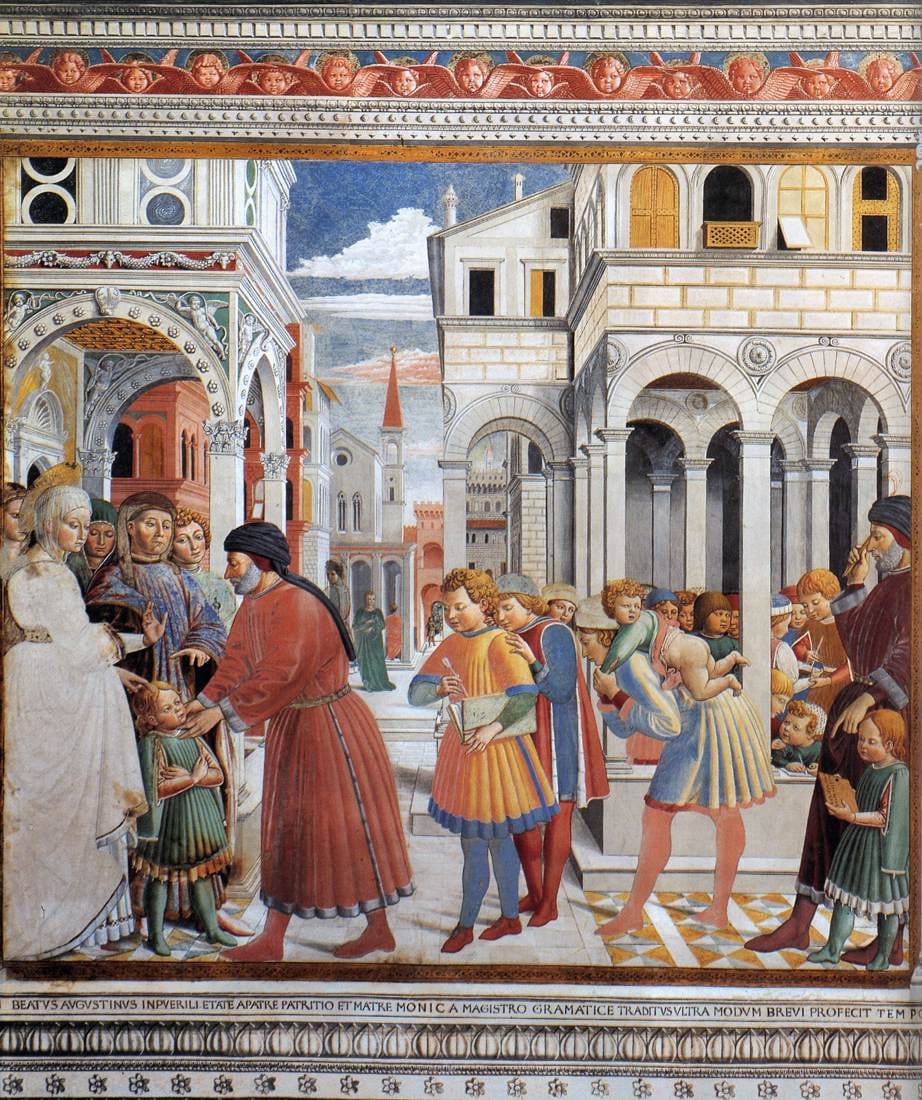
The School of Tagaste (scene 1, north wall), Benozzo Gozzoli (1420-1497 AD), 1464-1465 AD Benozzo Gozzoli (1420-1497 AD), Sant'Agostino, San Gimignano, Italy (apsidal chapel); reproduction from the Web Gallery of Art When she was old enough, St. Monica was married to Patricius, a pagan member of the town council. He had a violent temper and was unfaithful to her, but she never quarrelled with him over it, and when he raged she kept silent until he had calmed down. Other wives in the town, whose milder husbands still left bruises on their faces, asked her privately why Patricius never struck her, and she told them, half in jest, to think of the marriage contract read out to them as the paper that had made them servants.
Her eldest son, St. Augustine, was born on November 13, 354 AD, and a second son, Navigius, and a daughter followed. She did not have him baptized as a baby but had him signed with the cross and given salt, the rite that enrolled a child as a catechumen. At fifteen, idle at home, he was warned by her in private against sleeping with women, and he dismissed it as a woman's advice.
“it had never been reported, nor appeared by any indication, that Patricius had beaten his wife, or that there had been any domestic strife between them, even for a day”
Augustine of Hippo -
371–383 AD
St. Augustine joins the Manichaeans
St. Monica was widowed, her son joined a sect, and a bishop sent her away with a promise.
St. Monica won Patricius for the faith near the end of his life, and he was baptized about 371 AD and died soon after. In 373 AD St. Augustine, by then a student at Carthage, joined the Manichaeans, a sect he stayed with for about nine years. She wept for him more than mothers weep over a child's death, and for a time would not let him live or eat in her house.
In a dream she stood grieving on a wooden rule and saw her son standing beside her on it, and after the dream she took him back. She then begged a bishop to argue him out of the sect, but he told her to leave the young man alone and pray, because he would find the error for himself by reading. She kept pressing him with tears until, a little annoyed, he sent her away with a blessing, and she took his answer as a voice from heaven.
“Go your way, and God bless you, for it is not possible that the son of these tears should perish.”
An African bishop -
383–385 AD
The night at the harbour
St. Augustine slipped away to Italy while his mother prayed near the ship, and she sailed after him.
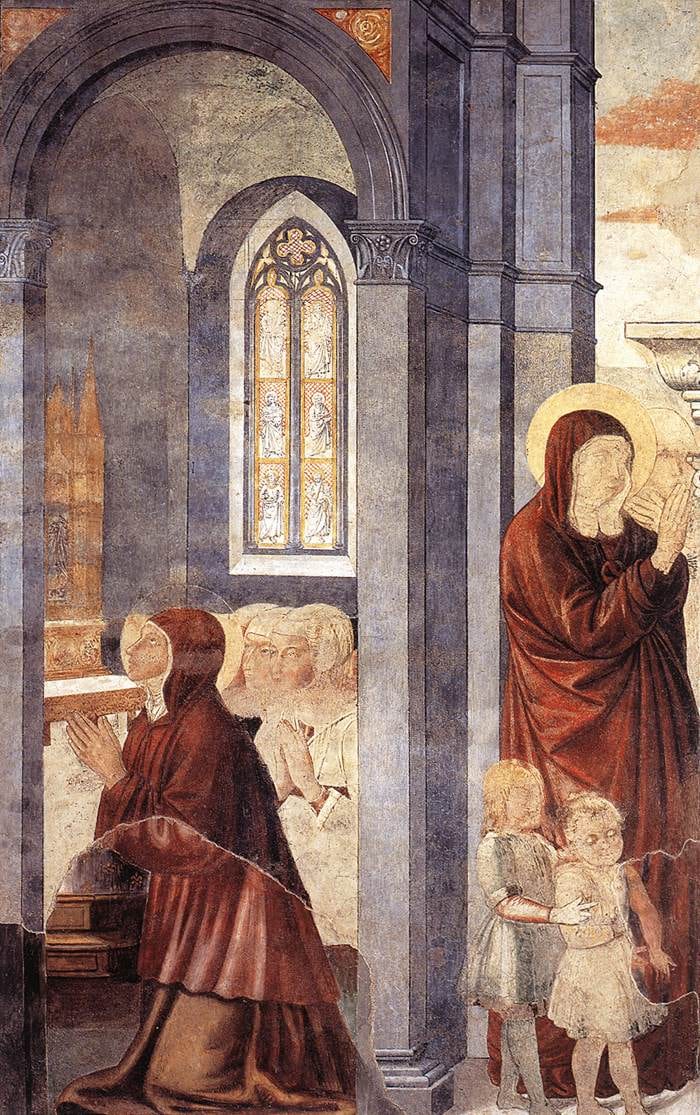
St Augustine Leaving his Mother (scene 3, east wall), Benozzo Gozzoli (1420-1497 AD), 1464-1465 AD Benozzo Gozzoli (1420-1497 AD), Sant'Agostino, San Gimignano, Italy (apsidal chapel); reproduction from the Web Gallery of Art In 383 AD St. Augustine resolved to sail from Carthage to Italy, and his mother, grieving, followed him down to the sea. She held on to him, wanting either to keep him home or to go with him, so he pretended he had to wait with a friend for a good wind. She agreed to spend the night close to the ship, in a chapel in memory of St. Cyprian, and there she prayed that he would not sail.
He sailed in the dark, and in the morning she stood on the shore, beside herself with grief, with his ship out of sight. Later she sailed after him, and when the sea turned dangerous she calmed the sailors, because a vision had told her they would arrive safely. She found him at Milan no longer a Manichaean but not yet a Catholic, and told him calmly that she believed she would see him one before she died.
“And I lied to my mother — and such a mother! — and got away.”
Augustine of Hippo -
385–386 AD
Milan, and the news from the garden
St. Monica gave up an old custom as soon as she learned the bishop of Milan had banned it, and her son came in from a garden to tell her he had turned.
At Milan St. Monica went to church twice a day and listened eagerly to the sermons of the bishop, Saint Ambrose. In Africa she had taken cakes, bread and wine to the shrines of the martyrs, but at Milan the doorkeeper turned her away. When she learned that St. Ambrose had banned the custom, she gave it up at once and blamed her own habit rather than question him.
In 386 AD, in a garden at Milan, her son read a passage from the Letter to the Romans and his doubts left him. He and his companion St. Alypius, who had read on and joined him, went straight in to tell her, and she leapt for joy and blessed God. She saw that God had given her more than all her prayers had asked, since her son now wanted neither a wife nor anything else the world could offer.
“he would often, when he saw me, burst forth into her praises, congratulating me that I had such a mother”
Augustine of Hippo -
387 AD
The font, and a window at Ostia
St. Monica's son was baptized at Easter, and on the road home mother and son talked alone at a window.
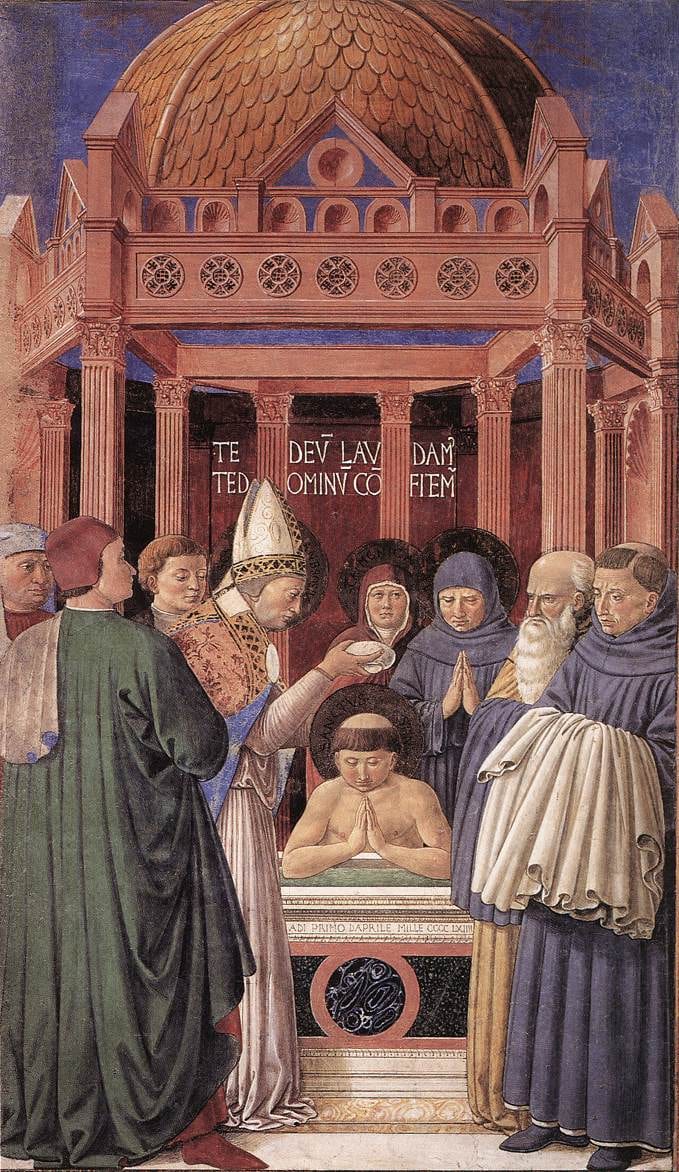
Baptism of St Augustine (scene 11, east wall), Benozzo Gozzoli (1420-1497 AD), 1464-1465 AD Benozzo Gozzoli (1420-1497 AD), Sant'Agostino, San Gimignano, Italy (apsidal chapel); reproduction from the Web Gallery of Art At Easter, on April 25, 387 AD, St. Ambrose baptized St. Augustine at Milan, together with St. Alypius and Adeodatus, St. Augustine's son. The Order of Saint Augustine counts it St. Monica's great joy to have witnessed that baptism. St. Augustine, his mother and their companions then set out for Africa and stopped at Ostia to wait for a ship.
There mother and son stood alone at a window over the garden of the house, resting after the long journey. They talked about what the eternal life of the saints would be like, and St. Augustine wrote that for a moment they touched eternal Wisdom with all the effort of their hearts, then sighed and came back to the sound of their own voices. She then told him she had wanted to live only to see him a Catholic Christian, that God had given her far more than that, and that she no longer knew why she was still here.
“Son, for myself, I have no longer any pleasure in anything in this life. What I want here further, and why I am here, I know not, now that my hopes in this world are satisfied. There was indeed one thing for which I wished to tarry a little in this life, and that was that I might see you a Catholic Christian before I died. My God has exceeded this abundantly, so that I see you despising all earthly felicity, made His servant — what do I here?”
St. Monica -
387 AD
The grave she gave up
St. Monica fell ill at Ostia and let go of the grave she had kept ready beside her husband.
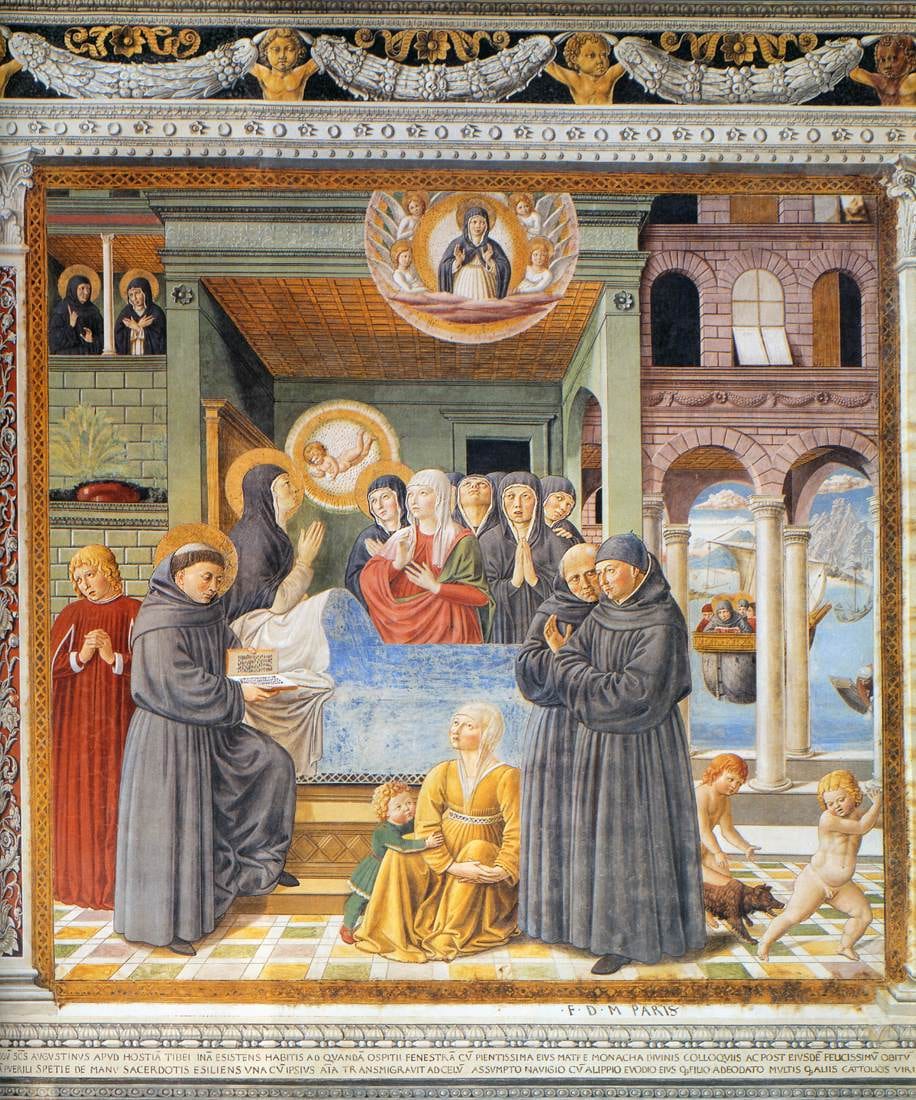
Death of St Monica (scene 13, south wall), Benozzo Gozzoli (1420-1497 AD), 1464-1465 AD Benozzo Gozzoli (1420-1497 AD), Sant'Agostino, San Gimignano, Italy (apsidal chapel); reproduction from the Web Gallery of Art Less than a week after the talk at the window, St. Monica fell ill with a fever. One day she fainted, and when she came round she looked at her sons, St. Augustine and Navigius, and told them to bury her there. Navigius wished aloud that she might die in her own country rather than abroad, and she stopped him with a look.
For years she had kept a grave ready beside her husband's body, and had wanted people to speak of the two of them lying together. St. Augustine was glad to see that the wish had left her. She died on the ninth day of the fever, at the age of fifty-five.
“Lay this body anywhere, let not the care for it trouble you at all. This only I ask, that you will remember me at the Lord's altar, wherever you be.”
St. Monica -
387–1430 AD
What she asked for instead
St. Monica wanted no monument, only her name said at the altar.
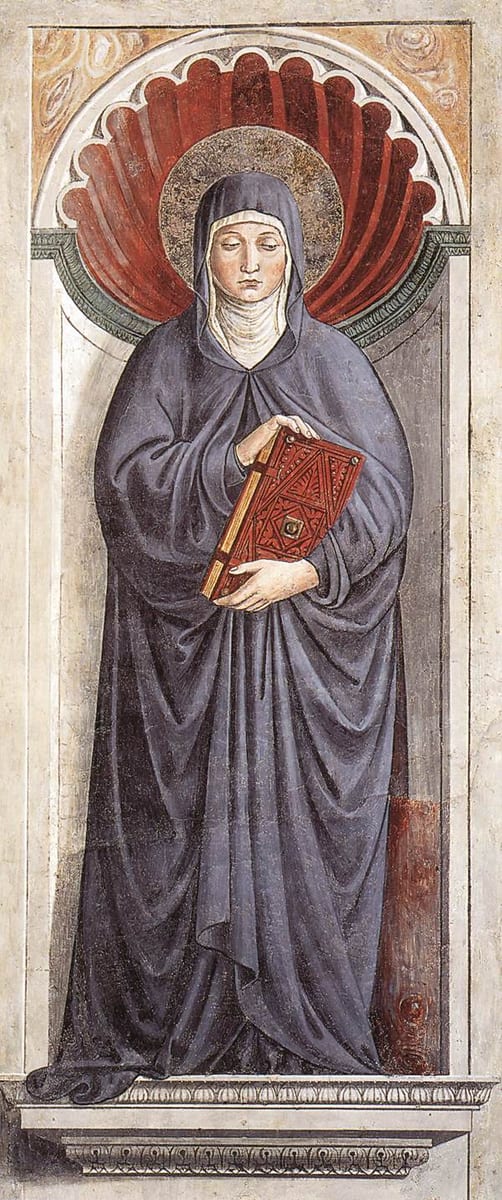
St Monica (on the pillar), Benozzo Gozzoli (1420-1497 AD), 1464-1465 AD Benozzo Gozzoli (1420-1497 AD), Sant'Agostino, San Gimignano, Italy (apsidal chapel pillar); reproduction from the Web Gallery of Art When she had died, Evodius, a young man of St. Augustine's own town who had joined them, took up the book of psalms and began to sing, and everyone in the house sang the responses. She was buried at Ostia, near the church of the martyr St. Aurea. Writing the Confessions about ten years later, St. Augustine asked every reader to remember her at the altar.
In 1430 AD Pope Martin V had her relics carried from Ostia to Rome, and miracles occurred along the way. They rest today in the Basilica of Saint Augustine in Campo Marzio, in a green marble urn beneath the altar of her chapel.
“we revere him for his conversion even more than for his wisdom. In this rebirth, providentially accompanied by the tears of his mother, Saint Monica, he found himself”
Pope Leo XIV, April 14, 2026 AD


_-_WGA10285.jpg)
_-_WGA10288.jpg)

_-_WGA10306.jpg)

Pray with the Church
The prayer St. Augustine made for his mother
The petition St. Augustine set down for St. Monica in the ninth book of the Confessions, written at Hippo about ten years after her death at Ostia, in place of recounting her merits.
I then, O my Praise and my Life, Thou God of my heart, putting aside for a little her good deeds, for which I joyfully give thanks to You, do now beseech You for the sins of my mother.Hearken unto me, through that Medicine of our wounds who hung upon the tree, and who, sitting at Your right hand, makes intercession for us.I know that she acted mercifully, and from the heart forgave her debtors their debts; do Thou also forgive her debts, whatever she contracted during so many years since the water of salvation.Forgive her, O Lord, forgive her, I beseech You; enter not into judgment with her.Let Your mercy be exalted above Your justice, because Your words are true, and You have promised mercy unto the merciful; which You gave them to be who will have mercy on whom You will have mercy, and will have compassion on whom You have had compassion.
All 11 reports on Saint Monica

St. Augustine talks about his mother, ten years after her death

Augustinians elect their 97th Prior General in Rome

Pope Leo XIV opens the Augustinian chapter over St. Monica's relics

About this picture
AI-generated image, in the manner of a buon fresco on lime plaster, from the paper's reference portrait based on Sant'Agostino nello studio (Saint Augustine in his Study) (Sandro Botticelli, c. 1480; photograph by Sailko, CC BY 3.0, Church of Ognissanti, Florence) View source artwork.

Book IX: what St. Augustine wrote down about the window at Ostia

About this picture
AI-generated image, in the manner of a buon fresco on lime plaster, from the paper's reference portrait based on Funerali di sant'Agostino (Funeral of St Augustine, scene 17), from the Life of St Augustine (Benozzo Gozzoli, 1464-1465, apsidal chapel, Sant'Agostino, San Gimignano). View source artwork.

Saint Augustine dies at Hippo in the third month of the siege

Pope Francis, over St. Monica's relics, preaches St. Augustine's three restlessnesses

About this picture
AI-generated image, in the manner of Italian quattrocento buon fresco, from the paper's reference portrait based on Death of St Monica (scene 13, south wall) (Benozzo Gozzoli (1420-1497), 1464-1465 AD, Sant'Agostino, San Gimignano, Italy) View source artwork.
Saint Monica dies at Ostia on the ninth day of her fever

About this picture
AI-generated image, in the manner of Italian quattrocento buon fresco, from the paper's reference portrait based on Death of St Monica (scene 13, south wall) (Benozzo Gozzoli, 1464-1465 AD, Sant'Agostino, San Gimignano, Italy) View source artwork.
At an Ostia window, St. Monica has nothing left to want

About this picture
AI-generated image, in the manner of Italian quattrocento buon fresco, from the paper's reference portrait based on Death of St Monica (scene 13, south wall) (Benozzo Gozzoli (1420-1497), 1464-1465 AD, Sant'Agostino, San Gimignano, Italy) View source artwork.
'Nothing is far to God': an hour with Saint Monica at Ostia

About this picture
AI-generated image, in the manner of Italian quattrocento buon fresco, from the paper's reference portrait based on Death of St Monica (scene 13, south wall) (Benozzo Gozzoli, 1464-1465 AD, Sant'Agostino, San Gimignano) View source artwork.
Saint Evodius sings the psalm over Saint Monica's body
