
Saints Carmelite reformer and Doctor of the Church · 1515–1582 AD
Saint Teresa of Ávila
Feast 15 October · Born 1515 AD, Ávila, Old Castile, Spain · Died 1582 AD, Alba de Tormes, Spain
She entered Carmel at twenty and was paralysed for about three years. Later she founded seventeen monasteries of nuns in twenty years and became the first woman named a Doctor of the Church.
Begin the life
In brief
Saint Teresa of Ávila, also called Teresa of Jesus, was born at Ávila in Old Castile on March 28, 1515 AD. She founded seventeen monasteries of nuns in twenty years and wrote the Life, the Way of Perfection and the Interior Castle. Pope Paul VI declared her a Doctor of the Universal Church on September 27, 1970 AD, the first woman so named.
-
1515–1522 AD
A house of twelve at Ávila
St. Teresa grew up in a house of twelve children at Ávila, and at seven she set out to be beheaded in the land of the Moors.
St. Teresa was the third of the nine children of Don Alonso Sánchez de Cepeda and his second wife, Doña Beatriz Dávila y Ahumada. With her father's three children by his first marriage, the house held twelve. Her father kept devotional books in Spanish so the children could read them, and he refused to keep slaves.
At about seven she read the Lives of the Saints with her brother Rodrigo, four years older, and longed to die a martyr. The two left Ávila by the Adaja gate for the country of the Moors, meaning to be beheaded there, but an uncle met them beyond the bridge and brought them home. Turned back, they built hermitages of piled stones in the orchard, which fell down at once.
“He and I used to read Lives of Saints together. When I read of martyrdom undergone by the Saints for the love of God, it struck me that the vision of God was very cheaply purchased”
St. Teresa of Ávila, 1562–1565 AD -
From 1528 AD
St. Teresa loses her mother and leaves her father
St. Teresa lost her mother young, and at twenty she left home for Carmel against her father's wishes.
Her mother, Doña Beatriz Dávila y Ahumada, made her will on November 24, 1528 AD. Doña Beatriz was thirty-three when she died. When St. Teresa understood her loss, she went to an image of Our Lady of Charity in the hospital church at Ávila and begged her, in tears, to be her mother.
Later an uncle introduced her to the Letters of St. Jerome, and reading them made her decide to become a nun, less from any attraction to the life than as the safest course. At twenty, when her father refused his consent, she left his house without telling him and entered the Carmelite convent of the Incarnation at Ávila. She compared the pain of that parting to death for the rest of her life, but her father gave way at once and she took the habit.
“I have by experience found the royal Virgin help me whenever I recommended myself to her; and at last she has brought me back to herself.”
St. Teresa of Ávila, 1562–1565 AD -
1538–1542 AD
A grave stands open at the Incarnation
A village cure nearly killed St. Teresa, and she came out of it paralysed for three years.
At the Incarnation she watched a nun die of a painful disease and prayed for the same patience, and within two years she fell ill herself. Her father took her to a woman at Becedas who was famous as a healer, and three months of that treatment nearly killed her. Brought home, she was given up by the doctors, lay unconscious for about four days, and was anointed and more than once taken for dead.
For a day and a half a grave stood open in her monastery, waiting for her body. When she came round she could move nothing but one finger of her right hand. She stayed paralysed about three years, and when she rose and walked again she gave the credit to St. Joseph and took him for her patron.
-
Until 1554 AD
The parlour, and the wounded Christ
After her father died, St. Teresa went back to mental prayer at Fray Vicente Barrón's command, and she never gave it up again.
The Incarnation did not keep its nuns strictly enclosed, and St. Teresa was expected in the parlour, because the visitors who came to see her gave the house large alms. Afraid that this talk made her unworthy of the graces she received in prayer, she gave up mental prayer for a year and more. She nursed her father through his last illness, and he died in the middle of the Creed, which he was reciting.
Her father's confessor, the Dominican Fray Vicente Barrón, then told her never to leave off prayer, and she never gave it up again. In Lent 1554 AD, at thirty-nine, she saw a picture of Christ covered in wounds in the oratory, and felt so keenly how badly she had repaid them that she thought her heart was breaking. She threw herself down beside it in tears, told Christ she would not get up until he strengthened her never to offend him again, and dated her lasting change from that day.
“It was the most fearful delusion into which Satan could plunge me--to give up prayer under the pretence of humility.”
St. Teresa of Ávila, 1562–1565 AD -
1557–1562 AD
Ávila's people are troubled by reports of her visions
St. Teresa founded a small, poor, enclosed convent at Ávila, and the magistrates of Ávila went to court to close it.
Reports of her visions troubled the whole city; in prayer she understood that she was being shown the place in hell that her sins had deserved, and in a vision she saw an angel pierce her heart with a golden spear. Some confessors she consulted put her experiences down to the devil, but St. Francis Borgia, St. Peter of Alcántara and, later, two Dominican friars, Pedro Ibáñez and Domingo Báñez, judged that God was at work in her. After Communion one day she understood that the Lord wanted her to work with all her might for a new convent, to be called St. Joseph's.
It was to hold no more than thirteen nuns, strictly enclosed and living on alms without any fixed income, like the nuns of the barefoot orders. On August 24, 1562 AD four poor orphans, taken without dowries, received the habit there, and with them the reform of Carmel began. The nuns of the Incarnation were angry with her, and the magistrates of Ávila went to court to close the new house, but nothing came of it.
“O my Lord, how is it that Thou commandest me to do that which seems impossible?--for, though I am a woman, yet, if I were free, it might be done; but when I am tied in so many ways, without money, or the means of procuring it, either for the purpose of the Brief or for any other,--what, O Lord, can I do?”
St. Teresa of Ávila, 1562–1565 AD -
1567–1568 AD
Permission to found, and a friar at Medina
The head of the Carmelites let St. Teresa found convents across Castile, and she went looking for friars to carry her reform.
On April 27, 1567 AD the general, Rubeo, gave her written permission to found convents of nuns anywhere in Castile. That August he allowed her two houses of friars keeping the primitive rule as her nuns kept it at St. Joseph's. She founded her second convent at Medina del Campo on August 15, 1567 AD.
At Medina she met St. John of the Cross, then called Fray Juan de San Matías, a newly ordained priest who was set on joining the Carthusians. She spent a night in prayer begging God to give him to her, and he promised to begin the reform among the friars if she did not keep him waiting long. In July 1568 AD she went to see a house offered for the friars at Duruelo, and there, with St. John of the Cross, she set up the first house of her reformed friars that year.
“I thought that the porch might be made into a church, the garret into a choir, which would do well, and the friars could sleep in the room.”
St. Teresa of Ávila, 1573–1582 AD -
1575–1580 AD
Four years of persecution against the reform
Ordered to found no more and sent to Toledo, St. Teresa began the Interior Castle while the friars fought over her reform.
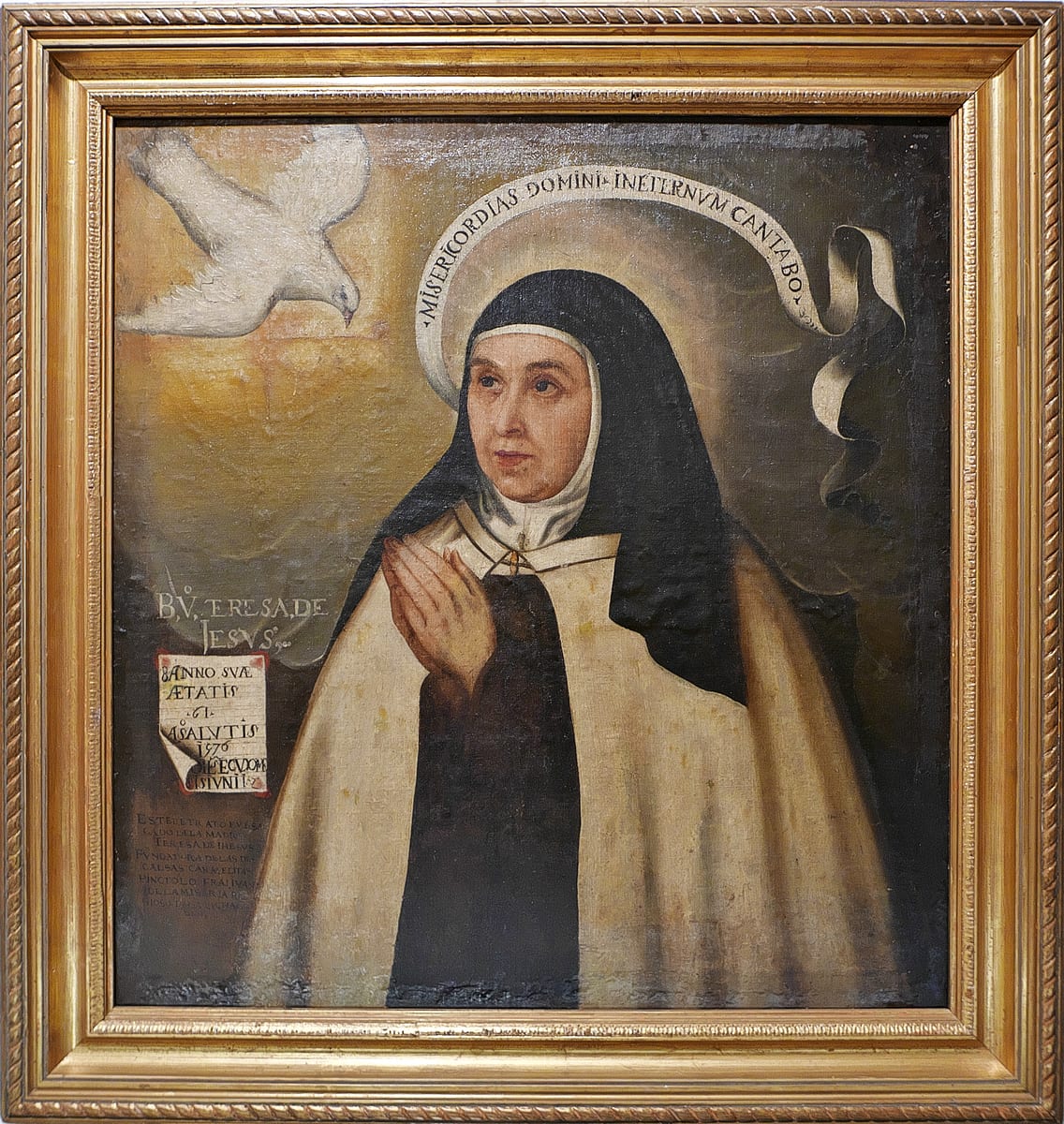
Retrato de Santa Teresa de Jesús, Fray Juan de la Miseria (c. 1526-1616 AD), Discalced Carmelite lay brother, 1576 AD (June 2), painted from life at Seville Fray Juan de la Miseria (c. 1526-1616 AD), Discalced Carmelite lay brother, Convento de las Teresas, Seville In May 1575 AD the Carmelite general chapter at Piacenza resolved to act against her friars, removing the superiors who had been appointed without the order's permission. Eight days later she founded a convent at Seville, in Andalusia, a province the general had closed to her. The friars of the old observance, the Carmelites who had not taken up her reform, wanted their authority over its houses back; she was ordered to found no more, and in 1576 AD the general sent her to stay at Toledo.
At Toledo on June 2, 1577 AD she began the Interior Castle, and she finished it at Ávila on November 29. That December friars of the old observance seized St. John of the Cross by night and shut him in a cell at Toledo on bread and water, and on Christmas Eve St. Teresa fell and broke her arm. On June 22, 1580 AD Pope Gregory XIII issued bulls making the reform's friars a separate, self-governing province.
“I thought of the soul as resembling a castle, formed of a single diamond or a very transparent crystal, and containing many rooms, just as in heaven there are many mansions.”
St. Teresa of Ávila, 1577 AD -
1582 AD
The last road, to Alba de Tormes
Sent to Alba de Tormes instead of home to Ávila, St. Teresa died there among her nuns.
She left Burgos, the last of her seventeen convents, at the end of July 1582 AD, ill for months with a fever and an open wound in her throat. At Medina del Campo she was ordered to Alba de Tormes instead of home to Ávila, because the Duchess of Alba wanted her there while the Duchess's daughter-in-law gave birth. On the road her companion, Anne of St. Bartholomew, could find her nothing to eat all day but dried figs, and they reached Alba on the evening of September 20.
The day before she died she asked for the Viaticum, her last Communion, and though two nuns had been needed to lift her, she rose by herself and knelt on the mattress to receive it. She thanked God again and again for making her a daughter of the Church, and on her last day she lay fourteen hours without moving, a crucifix in her hand and her head in Anne of St. Bartholomew's arms. She died at nine that night, October 4, 1582 AD, aged sixty-seven, and was buried at Alba in the vault beneath the choir grating, which she had set aside years before.
“O my Bridegroom, my Master! at last the longed-for hour has come ! now it is time for us to see one another ! My Master, it is time to set forth ! Blessed be this hour, and may Thy will be done !”
St. Teresa of Ávila, October 3, 1582 AD


Pray with the Church
Saint Teresa's Bookmark
The verses found in her breviary, in the wording Pope Benedict XVI gave them at his General Audience of February 2, 2011 AD.
Let nothing disturb you,Let nothing frighten you,All things are passing away:God never changes.Patience obtains all things.Whoever has God lacks nothing;God alone suffices
All 12 reports on Saint Teresa of Ávila

About this picture
AI-generated image, in the manner of Spanish Golden Age oil painting, from the paper's reference portrait based on Retrato de Santa Teresa de Jesús (Fray Juan de la Miseria, 1576, Convento de las Teresas, Seville) View source artwork.
St. Teresa, too weak to turn in bed, kneels unaided for Communion

St. Teresa of Ávila becomes the Church's first woman Doctor

About this picture
AI-generated image, in the manner of Spanish Golden Age oil painting, from the paper's reference portrait based on Retrato de Santa Teresa de Jesús (Fray Juan de la Miseria, 1576, Convento de las Teresas, Seville) View source artwork.
Told she will not recover, St. Teresa rises at the usual hour

About this picture
AI-generated image, in the manner of Spanish Golden Age oil painting, from the paper's reference portrait based on Retrato de Santa Teresa de Jesús (Fray Juan de la Miseria, 1576, Convento de las Teresas, Seville) View source artwork.
St. Teresa arrives at Alba de Tormes too ill for the castle

Ordered to Alba de Tormes, St. Teresa leaves Medina fasting

About this picture
AI-generated image, in the manner of a Spanish Golden Age oil painting, from the paper's reference portrait based on Retrato de Santa Teresa de Jesús (Fray Juan de la Miseria, 1576, Convento de las Teresas, Seville) View source artwork.
Insulted over her brother's will, St. Teresa leaves Valladolid blessing the nuns

About this picture
AI-generated image, in the manner of Spanish Golden Age oil painting, from the paper's reference portrait based on Retrato de Santa Teresa de Jesús (Fray Juan de la Miseria, 1576, Convento de las Teresas, Seville) View source artwork.
Saint Teresa is elected to run her first convent, and refuses

About this picture
AI-generated image, in the manner of Spanish Golden Age oil painting, from the paper's reference portrait based on Retrato de Santa Teresa de Jesús (Fray Juan de la Miseria, Discalced Carmelite lay brother, 1576, Convento de las Teresas, Seville). No person is depicted. View source artwork.
Carmelite superior who authorised St. Teresa's reform dies at Rome

About this picture
AI-generated image, in the manner of Spanish Golden Age oil painting, from the paper's reference portrait based on Santa Teresa Escritora (Saint Teresa Writing) (Anonymous, Spanish; of the Juan de la Miseria portrait type, undated; after 1582, Monasterio de la Anunciación, Alba de Tormes). No person is depicted. View source artwork.
.jpg)
St. Teresa's writings are printed, the book the Inquisition held among them

About this picture
AI-generated image, in the manner of Spanish Golden Age oil painting, from the paper's reference portrait based on Retrato de Santa Teresa de Jesús (Fray Juan de la Miseria, 1576, Convento de las Teresas, Seville). View source artwork.
St. Teresa finishes a book that pictures the soul as a castle

About this picture
AI-generated image, in the manner of Spanish Golden Age oil painting, from the paper's reference portrait based on Retrato de Santa Teresa de Jesús (Fray Juan de la Miseria, 1576, Convento de las Teresas, Seville) View source artwork.
Nuns forbidden to elect Saint Teresa of Ávila elect her twice

About this picture
AI-generated image, in the manner of Spanish Golden Age oil painting, from the paper's reference portrait based on Retrato de Santa Teresa de Jesús (Fray Juan de la Miseria, 1576, Convento de las Teresas, Seville) — see the original. No person is depicted. View source artwork.