
Saints Priest, translator of the Scriptures and Doctor of the Church · Feast September 30
Saint Jerome
Feast 30 September · Born Stridon, on the border of Dalmatia and Pannonia · Died 420 AD, Bethlehem
St. Jerome lived at Bethlehem for thirty-four years, heading a monastery, translating the Old Testament from the Hebrew and then writing commentaries on Scripture until his death in 420 AD.
Begin the life
In brief
Saint Jerome, also called Eusebius Hieronymus, was born in the 340s AD at Stridon, on the border of Dalmatia and Pannonia. Trained in rhetoric at Rome and long devoted to secular books, he turned to the Scriptures and gave his last thirty-four years at Bethlehem to studying and translating them. He died there on September 30, 420 AD, and the Roman Martyrology names him a priest and Doctor of the Church.
-
340s–370s AD
From Stridon to Aquileia
A boy from the Dalmatian border studies at Rome, is baptised there, and joins a circle of ascetics at Aquileia before setting out for the East.
St. Jerome was born at Stridon into a Christian family, the son of a man named Eusebius. Soon after the Emperor Julian died, he went to Rome with his boyhood friend Bonosus to study rhetoric. On Sundays he and his classmates went down into the catacombs to visit the martyrs' tombs.
He was baptised at Rome as an adult, as was the custom, and afterwards chose a life of self-denial. Later he went to Aquileia to live that life with a circle of fervent Christians, among them Rufinus, a friend from his youth. Towards 373 AD he set out for the East, giving up home, parents and sister, but he could not bring himself to part with the library he had built at Rome.
-
Mid-370s AD
Before the judgment seat
On the road east the young scholar loses a friend, falls ill in Lent, and dreams that Christ judges him.
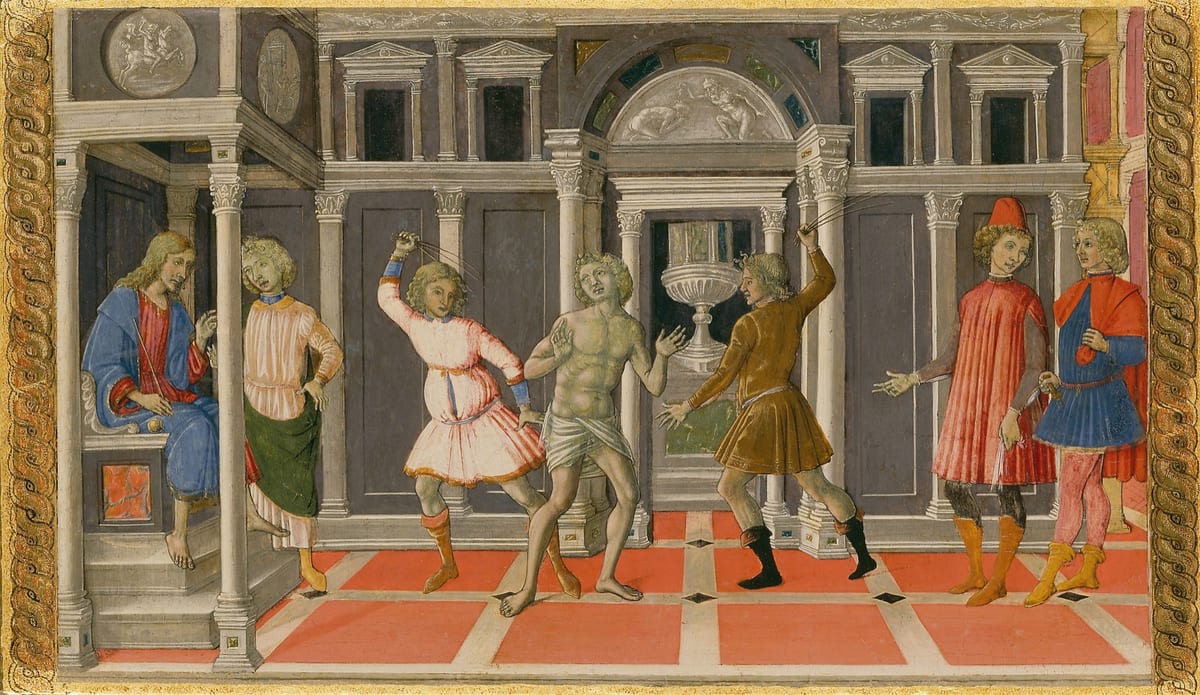
The Dream of Saint Jerome, Matteo di Giovanni, 1476 AD Matteo di Giovanni, Art Institute of Chicago, 1933.1018 (Mr. and Mrs. Martin A. Ryerson Collection) On the road east St. Jerome would fast so that he could read Cicero afterwards. When he did open the prophets, their rough style put him off. The long journey overland wore him down, and in Syria his friend Innocent died of a sudden fever.
About the middle of one Lent a fever wasted him to skin and bone, and in it, St. Jerome later wrote, he was dragged before the judgment seat of Christ. The Judge rejected his claim to be a Christian, and he was scourged and swore never again to own or read the secular books he loved. He woke in tears with his shoulders black and blue, and from then on he gave the Scriptures more zeal than he had ever given the classics.
“You lie. You are a follower of Cicero and not of Christ. For 'where your treasure is, there will your heart be also.'”
The Judge to St. Jerome, in his vision, in his Lenten fever -
374–379 AD
A hermit learning Hebrew
In the Syrian desert he fights temptation, takes up Hebrew, and is branded a heretic by the monks around him.
From about 374 AD St. Jerome lived as a hermit in the desert of Chalcis, south of Aleppo. He wore sackcloth and worked with his own hands for his food, yet his mind kept going back to the pleasures of Rome. When fasting did not quiet his temptations, he asked a Jewish convert to teach him Hebrew.
Three rival bishops claimed the Church of Antioch, and St. Jerome wrote to Pope Damasus to ask which of them he should be in communion with. Arians pressed him to accept their formula for the Trinity, and when he refused, the desert monks called him a heretic and demanded his confession of faith every day. He left the desert for Antioch, where St. Paulinus, bishop of the city, ordained him a priest.
“What a toil it was! How difficult I found it! How often I was on the point of giving it up in despair, and yet in my eagerness to learn took it up again! Myself can bear witness of this, and so, too, can those who had lived with me at the time. Yet I thank God for the fruit I won from that bitter seed.”
St. Jerome, recalling how he learned Hebrew in the desert of Chalcis -
Early 380s AD
The Pope's secretary
At Rome Pope Damasus makes St. Jerome his secretary and sets him to revising the Latin Gospels.
After studying Scripture at Constantinople under St. Gregory Nazianzen, St. Jerome went to Rome. Pope Damasus made him his secretary and counsellor, and asked him to revise the Latin Gospels against the Greek original. He completed the revised Latin Gospels in 384 AD.
St. Paula, a Roman noblewoman, became his devoted disciple and friend. He also guided St. Marcella and the Roman women of her circle, who learned Hebrew so that they could pray and sing the psalms in it. In 384 AD he wrote to St. Paula's daughter, St. Eustochium, on the vowed life of a virgin, and in that letter he told the story of his fever vision.
“Damasus, of blessed memory, spoke no words but mine.”
St. Jerome to Asella, recalling his standing in Rome under Pope Damasus -
384–385 AD
Driven from Rome
When Pope Damasus dies, the enemies St. Jerome has made in Rome force him out of the city.
St. Jerome's satire had offended almost every class of people in Rome. When St. Paula's young widowed daughter Blesilla died, people believed the hard life prescribed for her had hastened her end. At her funeral the crowd turned on him.
Pope Damasus, his protector, died on December 11, 384 AD, and St. Jerome's enemies set out to ruin him. They spread slanders about his friendship with St. Paula and St. Eustochium, and within a few months he was forced to leave Rome. In August 385 AD he sailed for the East, and St. Paula and St. Eustochium also left Rome, travelling through Syria, Egypt and Palestine before settling at Bethlehem.
“Men called me holy, humble, eloquent.”
St. Jerome to Asella, recalling his standing in Rome -
386–404 AD
The Hebrew Bible at Bethlehem
St. Jerome settles near the place of Christ's birth and translates the Old Testament from the Hebrew.
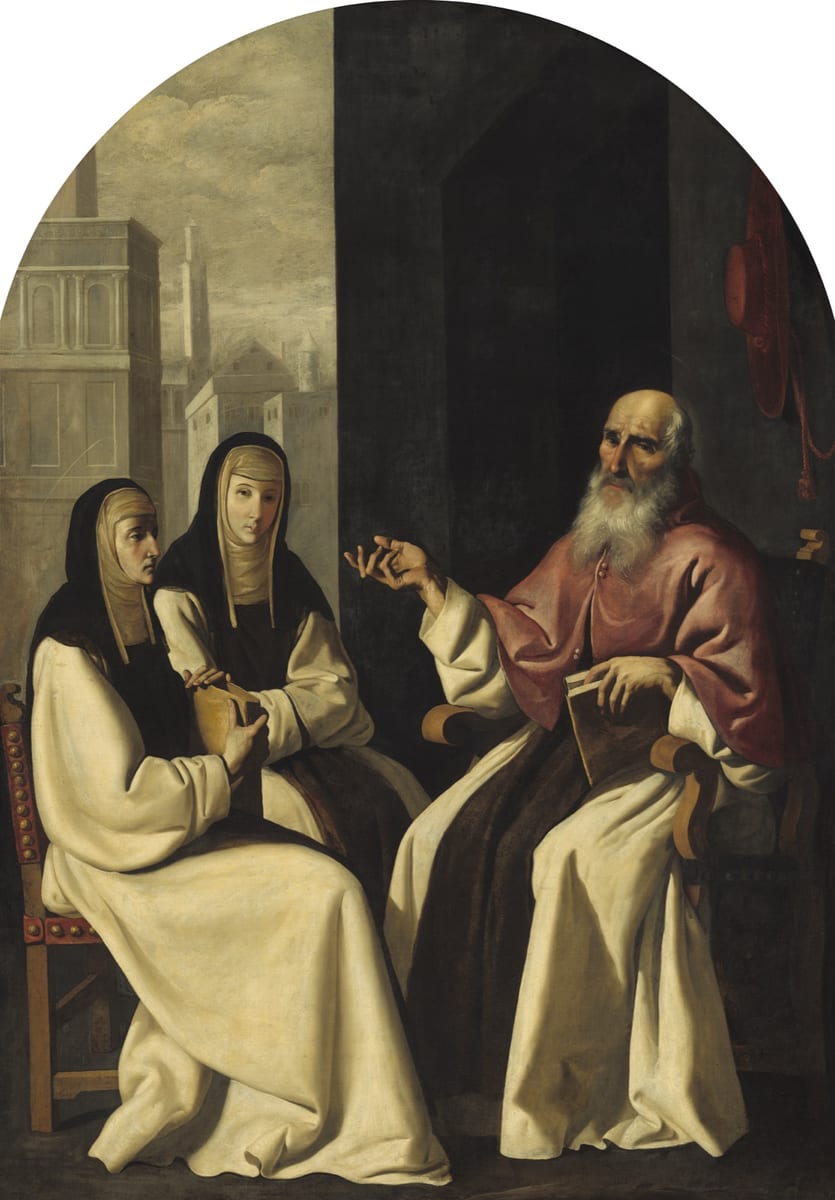
Saint Jerome with Saint Paula and Saint Eustochium, Francisco de Zurbarán and Workshop, c. 1640-1650 AD Francisco de Zurbarán and Workshop, National Gallery of Art, Washington, 1952.5.88 (Samuel H. Kress Collection) In 386 AD St. Jerome settled for good at Bethlehem. St. Paula paid for a monastery for men, another for women, and a hospice for pilgrims. He led the men's house, and St. Paula and then St. Eustochium led the women's.
About 391 AD he began translating the Old Testament from the Hebrew. A Jewish teacher came to him by night to help him perfect the language. He finished about 404 AD, and the work became the core of the Latin Bible the Church calls the Vulgate.
“First read, then, my Samuel and Kings; mine, I say, mine. For whatever by diligent translation and by anxious emendation we have learnt and made our own, is ours.”
St. Jerome, the 'Helmeted Preface' to Samuel and Kings, 391 AD -
397–404 AD
A broken friendship and a death
A reconciliation with his friend from youth breaks down, and St. Paula dies at Bethlehem.
St. Jerome and Rufinus fell out over Origen, whose biblical learning St. Jerome admired but whose teaching he never accepted. Melania, a Roman noblewoman living at Jerusalem, brought the two to join hands after Mass there in 397 AD, but by 402 AD each had written a defence of himself that attacked the other.
St. Paula died at Bethlehem in 404 AD, and St. Eustochium was chosen abbess in her place. St. Jerome wrote St. Paula's life as a long letter to console St. Eustochium.
“The bishops lifted up the dead woman with their own hands, placed her upon a bier, and carrying her on their shoulders to the church in the cave of the Saviour, laid her down in the centre of it.”
St. Jerome to St. Eustochium, of St. Paula's funeral, 404 AD -
410–420 AD
The fire and the last years
Rome falls, attackers burn the Bethlehem monasteries, and the old translator dies near the Grotto of the Nativity.
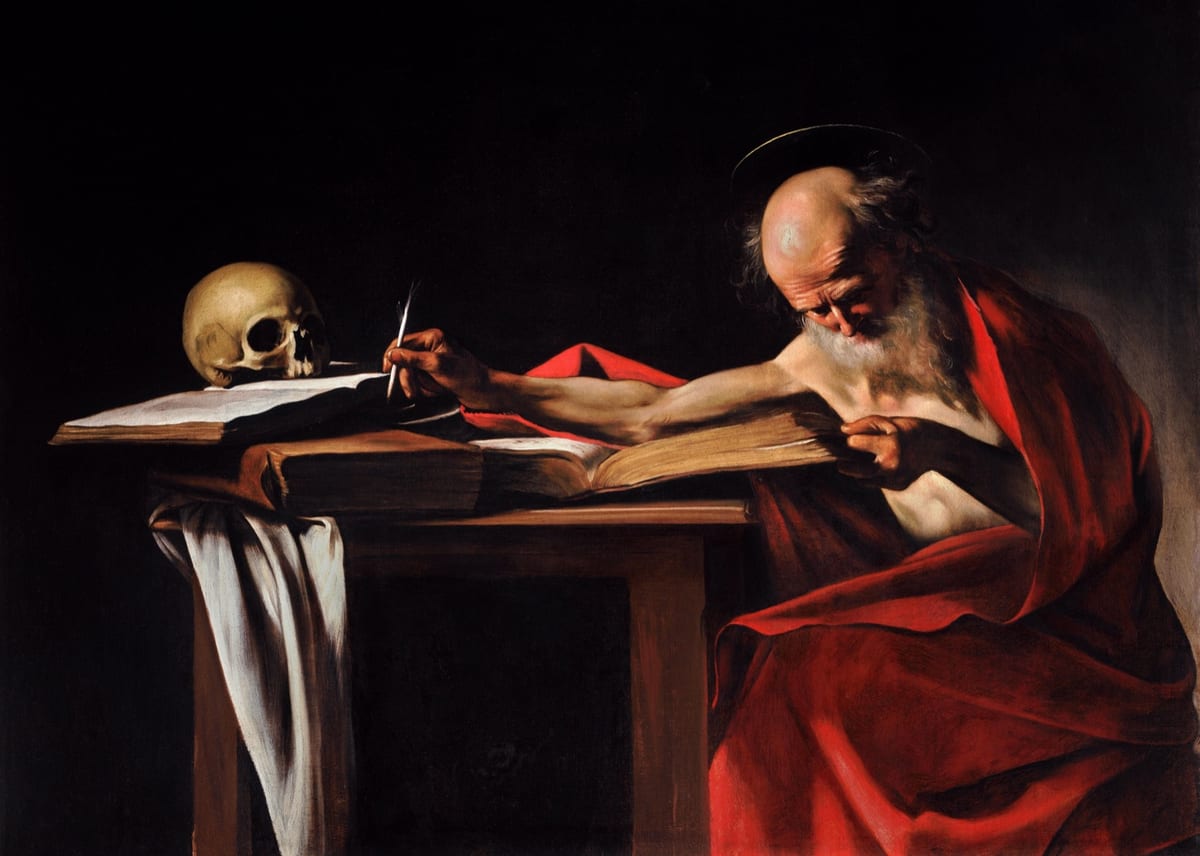
Saint Jerome Writing (San Girolamo scrivente), Michelangelo Merisi da Caravaggio, c. 1605-1606 AD Michelangelo Merisi da Caravaggio, Galleria Borghese, Rome, inv. 056 In 410 AD Alaric's Goths sacked Rome, and refugees from Rome and Italy crowded into Bethlehem. Later, followers of Pelagius, whose teaching on grace St. Jerome had written against, attacked the Bethlehem monasteries and burned St. Eustochium's house. They killed some of the community, and St. Jerome survived by sheltering in the one tower they did not destroy.
In his last years he was poor, his eyesight failed, and St. Eustochium died before him. His last illness stopped his Commentary on Jeremiah at chapter 32. He died of a fever on September 30, 420 AD, in his cell near the Grotto of the Nativity.
“I rejoice when I hear that my children are fighting for Christ. May He in whom we believe confirm our zeal so that we may gladly shed our blood for His faith. Our very home is - as far as worldly belongings go - completely ruined by the heretics; yet through Christ's mercy it is filled with spiritual riches. It is better to have to be content with dry bread than to lose one's faith.”
St. Jerome, after the Pelagians laid waste the monastery at Bethlehem, 416 AD


.jpg)
Pray with the Church
Have mercy upon me, O Lord
St. Jerome's cry under the scourge in his vision, as he recorded it in Letter 22 to St. Eustochium, written at Rome in 384 AD.
Have mercy upon me, O Lord: have mercy upon me.
All 1 report on Saint Jerome

About this picture
AI-generated image, in the manner of Baroque oil painting, from the paper's reference portrait based on Saint Jerome Writing (Michelangelo Merisi da Caravaggio, c. 1605-1606, Galleria Borghese, Rome) View source artwork.