Saints Pope · 1920–2005 AD
Saint John Paul II
Feast 22 October · Born 1920 AD, Wadowice, Poland · Died 2005 AD, Apostolic Palace, Vatican City
A boy from Wadowice in Poland who had lost his mother, brother and father by the age of 20 trained for the priesthood in secret under German occupation, was elected Pope in 1978 AD, forgave the man who shot him and died at the Vatican in 2005 AD.
Begin the life
In brief
Saint John Paul II, born Karol Wojtyła in Wadowice, Poland, led the Church as Pope for more than 26 years. Before his election he had been a student actor, a quarry labourer, a seminarian trained in secret, a university teacher of ethics and Archbishop of Kraków. He wrote poems as a student, as a priest and, days before the conclave that elected him, as a cardinal.
-
1920–1938 AD
The flat beside the church
A boy in a Polish town loses his mother at eight and his brother at 12, and is left with a father he finds praying at night.
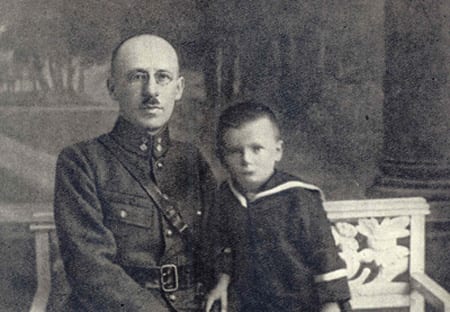
Karol Wojtyła z ojcem (Karol Wojtyła with his father), the 1920s Wikimedia Commons (source given as pokolenie-jp2.pl) St. John Paul II was born on May 18, 1920 AD, in a flat beside the parish church of Wadowice, on what is now Kościelna Street. A sister, Olga, had died just after her birth in 1916 AD. His mother, the Servant of God Emilia Wojtyłowa, died on April 13, 1929 AD, when he was eight; he made his First Communion in that church on May 25.
His brother, Edmund, a young doctor, caught scarlet fever from a patient he was trying to save and died in December 1932 AD. At secondary school St. John Paul II served at the altar and acted in plays, taking the part of Haemon in Sophocles' Antigone. At home he was alone with his father, a retired soldier, and sometimes woke in the night to find him on his knees.
“My prayer is for so many people who have died, beginning with my parents, my brother and my sister, whose memory is linked for me with this city.”
St. John Paul II to the people of Wadowice, June 7, 1979 AD -
1938–1941 AD
Home from work, his father dead in the flat
War closes the university where St. John Paul II is studying and sends him to a quarry, and he comes home from work one day to find his father dead.
In 1938 AD St. John Paul II and his father moved to a basement flat in Kraków, where he studied Polish language and literature at the Jagiellonian University and joined a theatre group. He went to confession at Wawel Cathedral on September 1, 1939 AD, as the first bombs of the war fell on the city. The Germans closed the university, and in September 1940 AD he took a labourer's job in a limestone quarry, which kept him from deportation to forced labour in Germany.
That year Jan Tyranowski, a tailor who gathered young men of the parish in a circle called the Living Rosary, gave him St. John of the Cross to read. On February 18, 1941 AD, he came home from work and found his father dead. He spent the night in prayer with a friend beside him; he had no immediate family left.
“Nigdy tak jak tamtego dnia nie czułem się samotny. (I never felt so lonely)”
St. John Paul II, recalling the day he came home and found his father dead -
1948–1958 AD
Across the fields to Niegowić
Back from Rome, St. John Paul II walks across the fields to his first country parish, then is given Kraków's university students and a teaching post in Lublin.
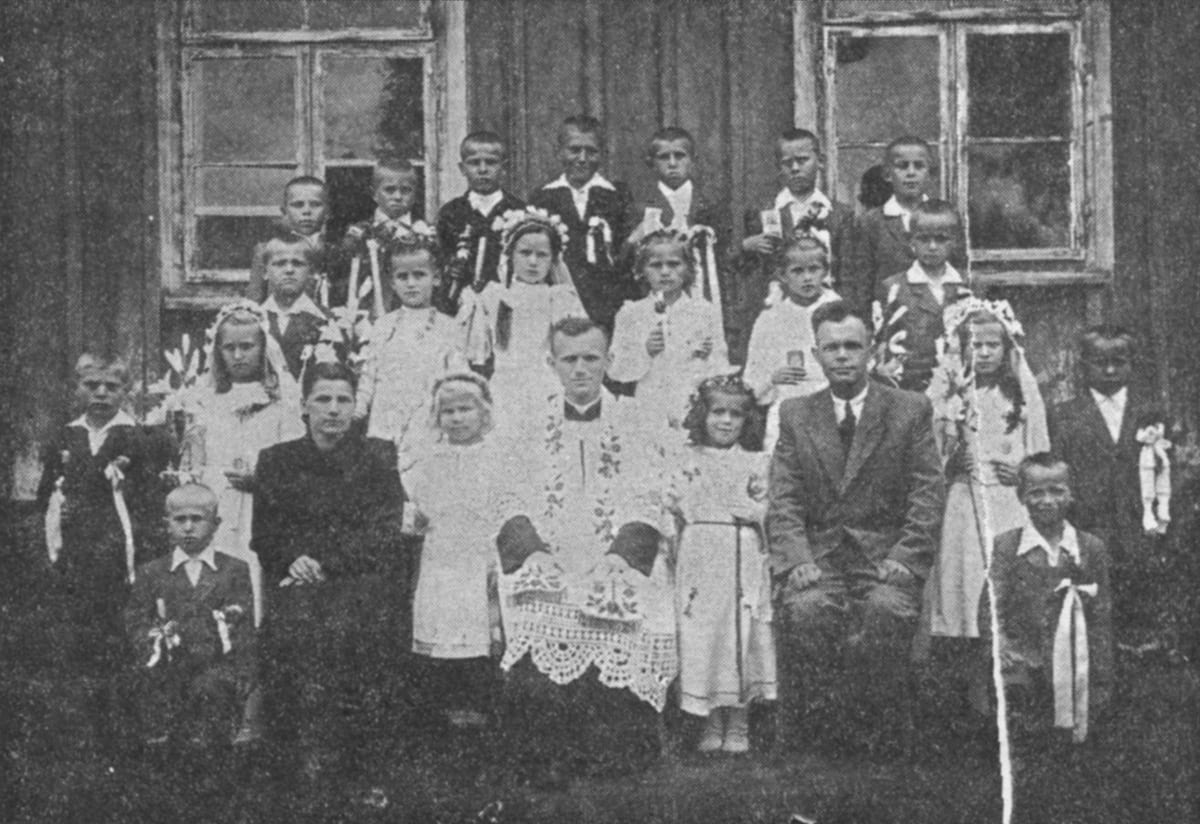
Karol Wojtyła - wikary w Niegowici (Karol Wojtyła as curate at Niegowić), 1948 AD Wikimedia Commons, scanned from Mieczysław Maliński, Najchętniej grał na bramce (Warsaw 1985 AD) In July 1948 AD, back from his studies in Rome, St. John Paul II was sent as assistant priest to the country parish of Niegowić. He went by bus and on a farmer's cart, then on foot across the fields, and when he reached parish land he knelt and kissed the ground, following the example of St. John Vianney. He taught religion in five village schools and was driven to them by cart.
In March 1949 AD he was moved back to Kraków, to St. Florian's parish, and put in charge of its work with university students, to whom he gave a talk every Thursday on the existence of God and the human soul. After the communist authorities closed Kraków's theology faculty in 1954 AD, he went to teach at the Catholic University of Lublin, where he lectured on ethics. In the summer of 1958 AD he was on a kayak holiday with young people on the rivers of Mazury.
“It is necessary to organize life in such a way that the whole of life can glorify God”
St. John Paul II, said as a student priest in Rome, as one of his companion priests reported it -
1958–1978 AD
Summoned from the river
Called off a kayak holiday to be made a bishop at 38, St. John Paul II becomes Archbishop of Kraków, consecrates a church in a district where people had fought the authorities over a cross, and is elected Pope.
Summoned to Warsaw, St. John Paul II left the river by kayak, rode a truck loaded with sacks of flour to Olsztynek and waited for the night train. In Warsaw Blessed Stefan Wyszyński, the cardinal who led the Church in Poland as its Primate, told him that Pope Pius XII had named him an assistant bishop in Kraków; he objected that at 38 he was too young, then accepted. He was consecrated in Wawel Cathedral on September 28, 1958 AD, took part in the Second Vatican Council, and became Archbishop of Kraków in 1964 AD and a cardinal in 1967 AD.
People in Nowa Huta, a district of Kraków, clashed with the communist authorities in 1960 AD to defend a cross on the site meant for a church; the authorities later allowed one on another site, and he broke ground for it in 1967 AD and consecrated it on May 15, 1977 AD. On October 16, 1978 AD, after the death of Pope John Paul I, the cardinals elected him Pope, and he took the name John Paul II. That evening he told the crowd in St. Peter's Square that he had been afraid to accept, and asked them to correct his Italian.
“Więc powiedziałem jedno słowo: „Przyjmuję”. (So I said one word: “I accept.”)”
St. John Paul II to Cardinal Stefan Wyszyński, in the Primate's study in Warsaw, accepting the nomination, July 1958 AD -
1978–1979 AD
A Polish Pope goes home
St. John Paul II, newly elected, tells the crowd in St. Peter's Square not to be afraid, writes to Poland that he must leave Kraków for Rome, and the following June returns on a visit and says Mass in Warsaw.
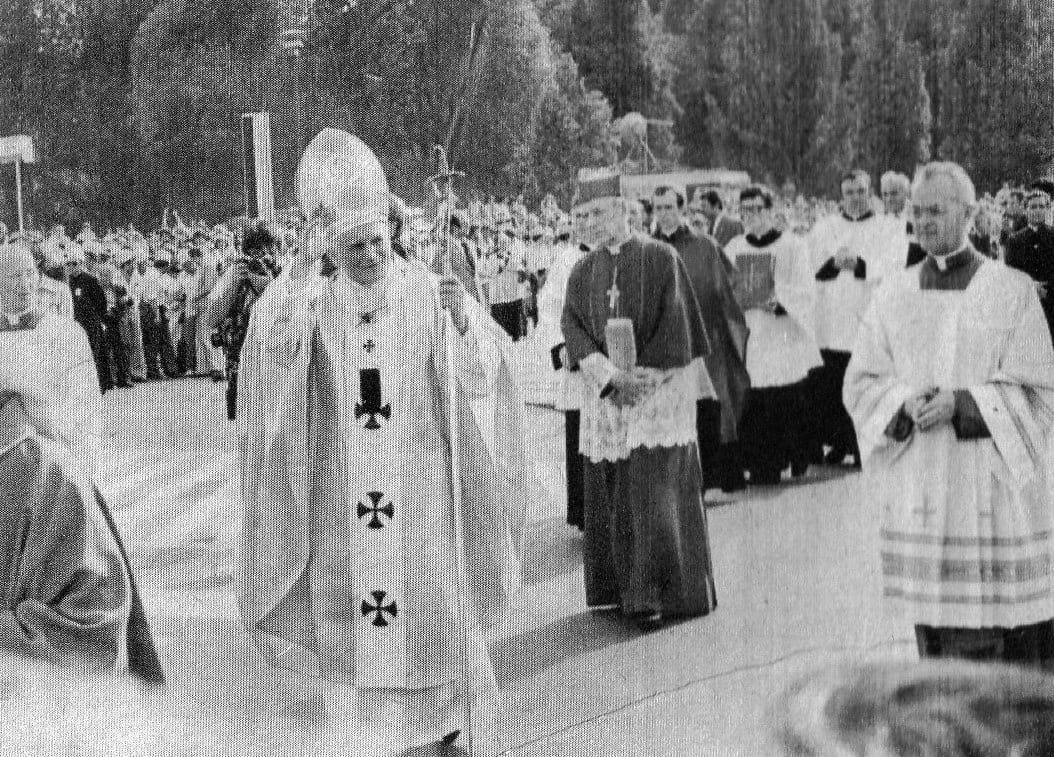
Pope John Paul II and Cardinal Stefan Wyszyński on their way to Victory Square, Warsaw, June 2, 1979 AD Wikimedia Commons St. John Paul II opened his pontificate with Mass in St. Peter's Square on October 22, 1978 AD, telling the crowd not to be afraid to welcome Christ. At the end of the Mass Blessed Stefan Wyszyński knelt to kiss his hand, and the Pope stood up and kissed the cardinal's hands in front of everyone. In a letter to the people of Poland dated the next day, he wrote that he had to leave Kraków, where he had been archbishop, for Rome, and that it was not easy to give up returning to his country.
In January 1979 AD he went to Mexico, his first journey as Pope, and presented a diadem to the image of Our Lady of Guadalupe. On June 2 he began his first visit to Poland as Pope at the Tomb of the Unknown Soldier on Victory Square in Warsaw, and at Mass on the same square he prayed that the Holy Spirit would come down and renew the face of the earth and of this land, Poland. On June 7 he was in Wadowice, where he kissed the font at which he had been baptised.
“Non abbiate paura! Aprite, anzi, spalancate le porte a Cristo! (Do not be afraid! Open, open wide the doors to Christ!)”
St. John Paul II to the faithful in St. Peter's Square, October 22, 1978 AD -
1981–1983 AD
The shooting and the forgiveness
Shot in St. Peter's Square, St. John Paul II forgives the gunman from hospital four days later and, more than two years on, meets him in prison.
On May 13, 1981 AD, Ali Ağca, a Turkish gunman, shot St. John Paul II during the general audience in St. Peter's Square and gravely wounded him; two other people were wounded in the same shooting. Four days later the Pope recorded a message in the Gemelli hospital in Rome, and it was played to the crowd in the square that day: he was praying for the brother who had shot him, he said, and had sincerely forgiven him. He did not hold another general audience until October 7, when he thanked the hospital's doctors and nursing sisters for helping to save his life.
On May 13, 1982 AD, he said Mass at Fátima in Portugal to give thanks for his life, because he had been shot on the anniversary of the first apparition of Our Lady there. On December 27, 1983 AD, he visited Rebibbia prison in Rome, where Ağca was held, met him and repeated his forgiveness. He told the other prisoners that day that the meeting had not been planned, and that the two had met as men and as brothers.
“it was a mother's hand that guided the bullet's path and in his throes the Pope halted at the threshold of death.”
St. John Paul II to the Italian bishops, May 13, 1994 AD -
2002–2014 AD
The window
St. John Paul II gives his last blessing from his window on Easter Sunday 2005 AD and dies six days later; in 2014 AD the Church declares him a saint.
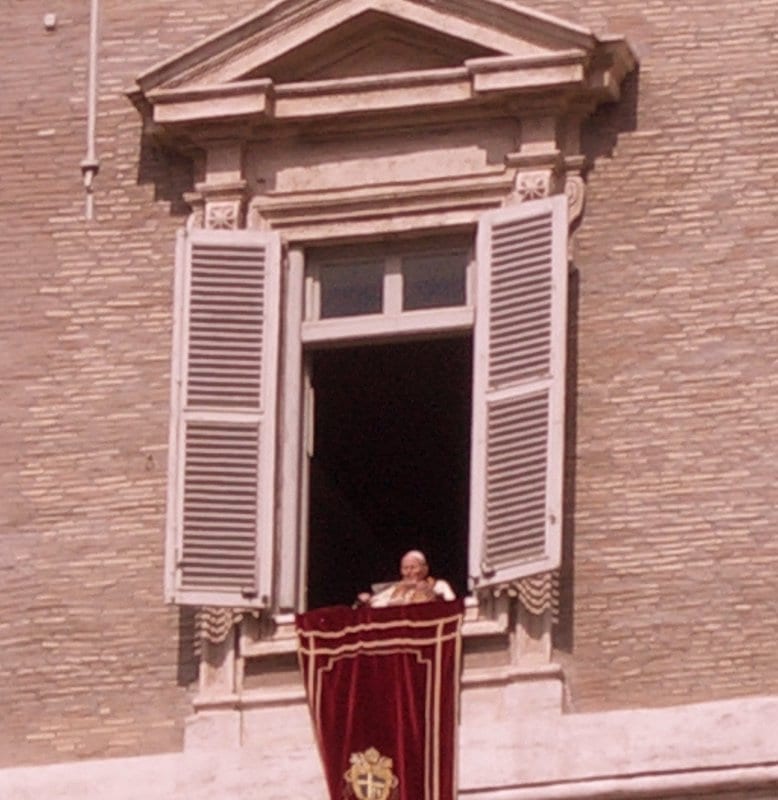
Pope blessing the crowd at St. Peter's, Easter Sunday, March 27th 2005 AD, Bob Garland Bob Garland, Flickr (https://www.flickr.com/photos/garland/8524227/), via Wikimedia Commons St. John Paul II made his last visit to Poland in August 2002 AD and said Mass at Kalwaria, a shrine his father had taught him to love. On Easter Sunday, March 27, 2005 AD, visibly suffering, he came once more to the window of the Apostolic Palace and blessed the city and the world for the last time; on April 1 Cardinal Joseph Ratzinger found him in his room in great pain, with doctors and friends around him. St. John Paul II died in his apartment in the palace at 9:37 p.m. the next day, April 2, the eve of Divine Mercy Sunday, a feast he had instituted.
More than three million pilgrims came to Rome between his death and his funeral in St. Peter's Square on April 8. The Church normally waits five years after a death before opening the inquiry that can lead to sainthood; Cardinal Ratzinger, who succeeded him as Pope Benedict XVI, lifted that wait and declared him Blessed on May 1, 2011 AD. Pope Francis declared him a saint in St. Peter's Square on April 27, 2014 AD, Divine Mercy Sunday, together with Pope St. John XXIII.
“I continue to ask you: do not stop praying - once again I repeat it - as long as I am alive and after my death.”
St. John Paul II to the pilgrims of Kalwaria, August 19, 2002 AD


Pray with the Church
A prayer from his last message
From the Regina Caeli text St. John Paul II prepared for Divine Mercy Sunday, read at the Mass for the repose of his soul on April 3, 2005 AD, the day after he died.
Lord, who reveal the Father's love by your death and Resurrection, we believe in you and confidently repeat to you today: Jesus, I trust in you, have mercy upon us and upon the whole world.
All 1 report on Saint John Paul II

About this picture
AI-generated drawing, in the manner of reportage ink and wash, of the Zakrzówek quarry in 1940, based on a photograph of the quarry by Hippocampus (2006, Wikimedia Commons, CC BY-SA 2.5). No person in it is St. John Paul II. View source artwork.
-kamieniolom.jpg)