Saints Pope, papal diplomat and Patriarch of Venice · 1881–1963 AD
Saint John XXIII
Feast 11 October · Born 1881 AD, Sotto il Monte, Bergamo, Italy · Died 1963 AD, Apostolic Palace, Vatican City
A sharecroppers' son from near Bergamo served the Church as a bishop's secretary, an army chaplain, a papal envoy and Patriarch of Venice, was elected Pope late in life, opened the Second Vatican Council, and died in 1963 AD as a crowd prayed below his window.
Begin the life
In brief
Saint John XXIII was born Angelo Giuseppe Roncalli on November 25, 1881 AD, to a family of sharecroppers at Sotto il Monte, near Bergamo. He was a priest of Bergamo, an army chaplain, a papal diplomat in Bulgaria, Turkey, Greece and France, and Patriarch of Venice before he was elected Pope in 1958 AD and took the name John. He announced and opened the Second Vatican Council, and the Church keeps his optional memorial on October 11, the day it opened in 1962 AD.
-
1881–1895 AD
A sharecroppers' son at Sotto il Monte
Born in a poor farmhouse, baptised the same evening, and sent at eleven to the seminary.
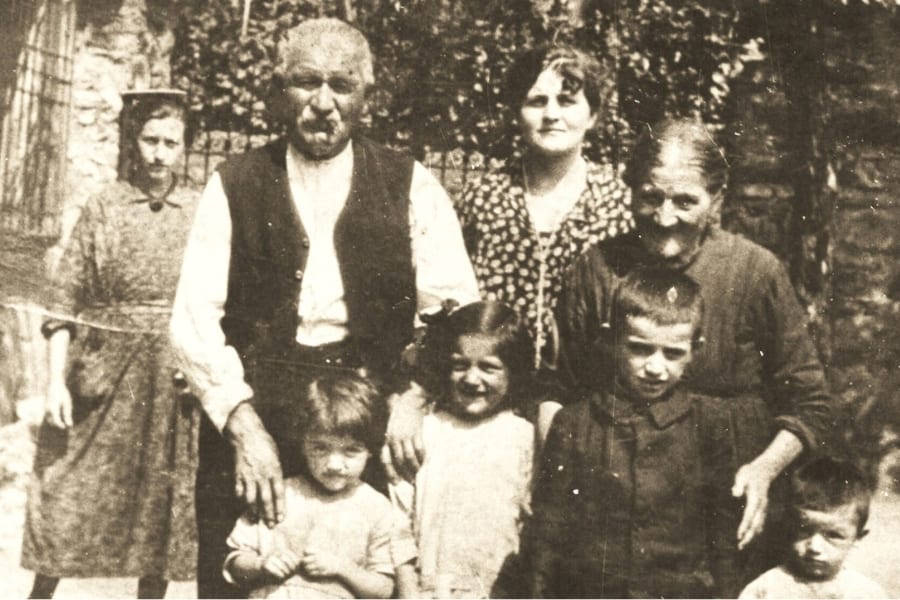
Angelo Roncalli's family (future pope John XXIII) circa 1890 AD, unknown photographer unknown photographer, Wikimedia Commons, from solfano.it and papagiovanni.org St. John XXIII was born at a quarter past ten in the morning, in a poor farmhouse in the hamlet of Brusicco. He was the first son, after three daughters, of Giovanni Battista Roncalli and Marianna Mazzola, who farmed land owned by the Morlani counts. That evening the parish priest, Father Francesco Rebuzzini, baptised him, and his great-uncle and godfather, Zaverio, consecrated him to the Sacred Heart at the font.
At the bishop's college of Celana, among older boys from better-off homes, he fell behind for the first time and in July 1892 AD did not sit his final examinations. After a summer of hard study with Father Rebuzzini, he entered the diocesan seminary of Bergamo at eleven. In June 1895 AD, not yet fourteen, he received the cassock of a cleric. That November, at fourteen, he began the spiritual notes later published as the Journal of a Soul.
-
1900–1904 AD
A year in the army, then the altar at St. Peter's tomb
A year in the army for a brother's sake, then ordination in Rome and a first Mass at St. Peter's tomb.
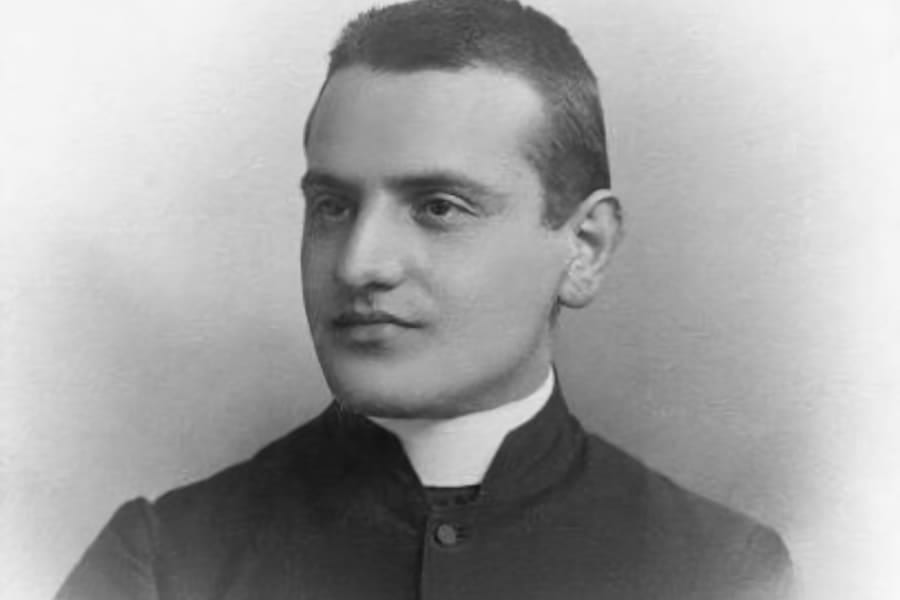
Angelo Roncalli – Pope John XXIII – as a priest in 1905 AD Wikimedia Commons (source given as gettyimages.it) In September 1900 AD, on his way home from the Jubilee in Rome, the young seminarian received Communion at Loreto and prayed there for a long time. Sixty-two years later, back at Loreto as Pope, he told Our Lady that his heart had not changed since that first visit.
In November 1900 AD his superiors chose him to finish his studies at the Pontifical Roman Seminary, and in 1901 AD he volunteered for a year in the army so that his brother, also named Zaverio, could keep working the family's fields. He left the army a sergeant in 1902 AD and went back to Rome, where he was ordained a priest on August 10, 1904 AD, in Santa Maria in Monte Santo. The next day he said his first Mass in the Vatican Grottoes, beside the tomb of St. Peter.
-
1905–1914 AD
At the side of the Bishop of Bergamo
Secretary to Bishop Radini Tedeschi of Bergamo from 1905 AD until the bishop died in 1914 AD.
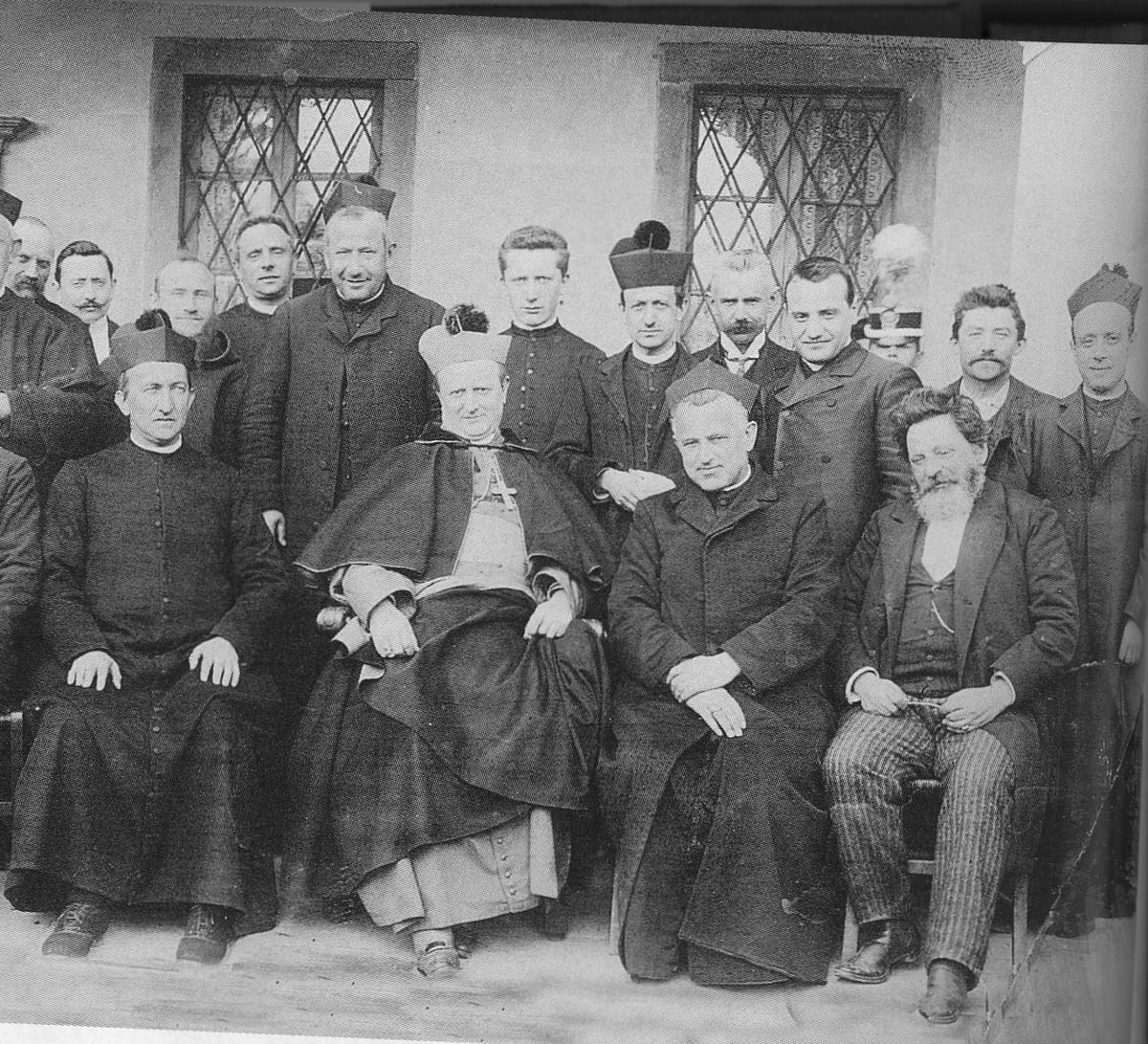
Bishop Radini Tedeschi with Angelo Giuseppe Roncalli, circa 1910 AD Wikimedia Commons, scanned from M. Benigni and G. Zanchi, Giovanni XXIII. Biografia ufficiale (San Paolo, 2000 AD) In February 1905 AD the new Bishop of Bergamo, Giacomo Maria Radini Tedeschi, chose St. John XXIII as his secretary. The appointment cut short the young priest's study of canon law in Rome. From 1909 AD the young priest also planned and edited the diocesan paper, La Vita Diocesana. From 1910 AD the bishop gave him the pastoral care of Bergamo's Catholic women.
Bishop Radini Tedeschi died in August 1914 AD, and his secretary's post ended with him. St. John XXIII stayed in Bergamo, teaching in the seminary and serving as spiritual adviser to several Church associations.
-
1915–1918 AD
Sergeant and chaplain in the war hospitals
Recalled when Italy went to war, a sergeant of the medical corps became chaplain to the wounded in hospitals behind the lines.
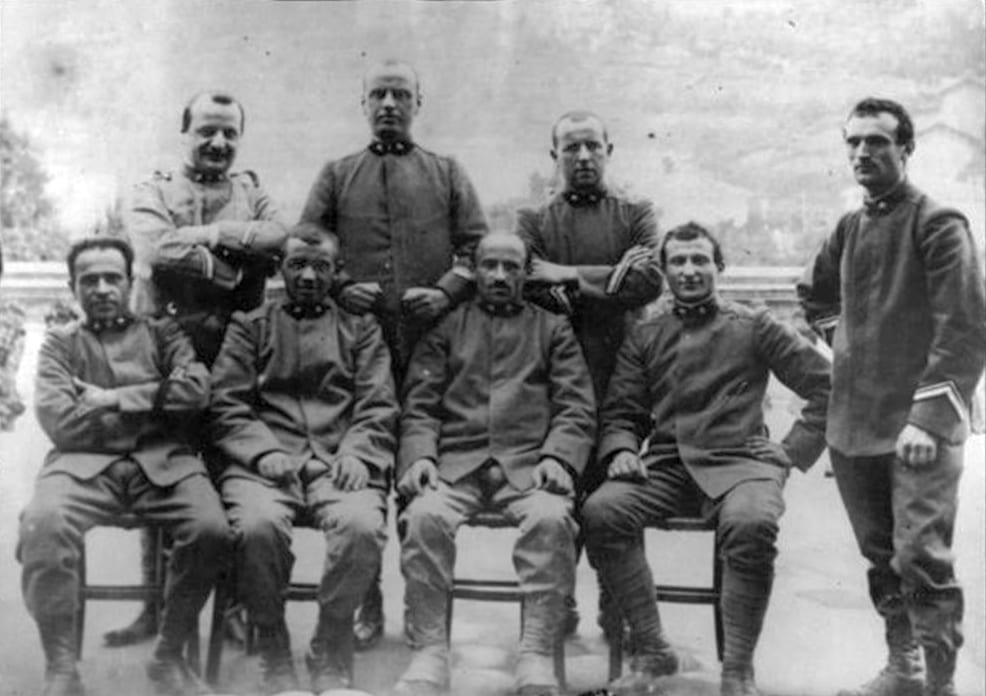
In 1915 AD Father Roncalli was called up by the Army … with other priests, unknown photographer unknown photographer, Wikimedia Commons (source given as IMS Vintage Photos) On May 23, 1915 AD, as Italy entered the First World War, St. John XXIII was recalled to the army as a sergeant in the medical corps. The next day he reported to the depot of Sant'Ambrogio in Milan and was posted to Bergamo. From March 28, 1916 AD he served as a military chaplain with the rank of lieutenant.
He never served at the front. Until 1918 AD he was chaplain to wounded soldiers in the military hospitals behind the lines, among them the reserve hospital of Bergamo called the Ricovero nuovo.
-
1919–1953 AD
The Pope's envoy in Sofia, Istanbul and Paris
A visit of a few months to Bulgaria opened a long career as the Pope's envoy in Sofia, Istanbul and Paris.
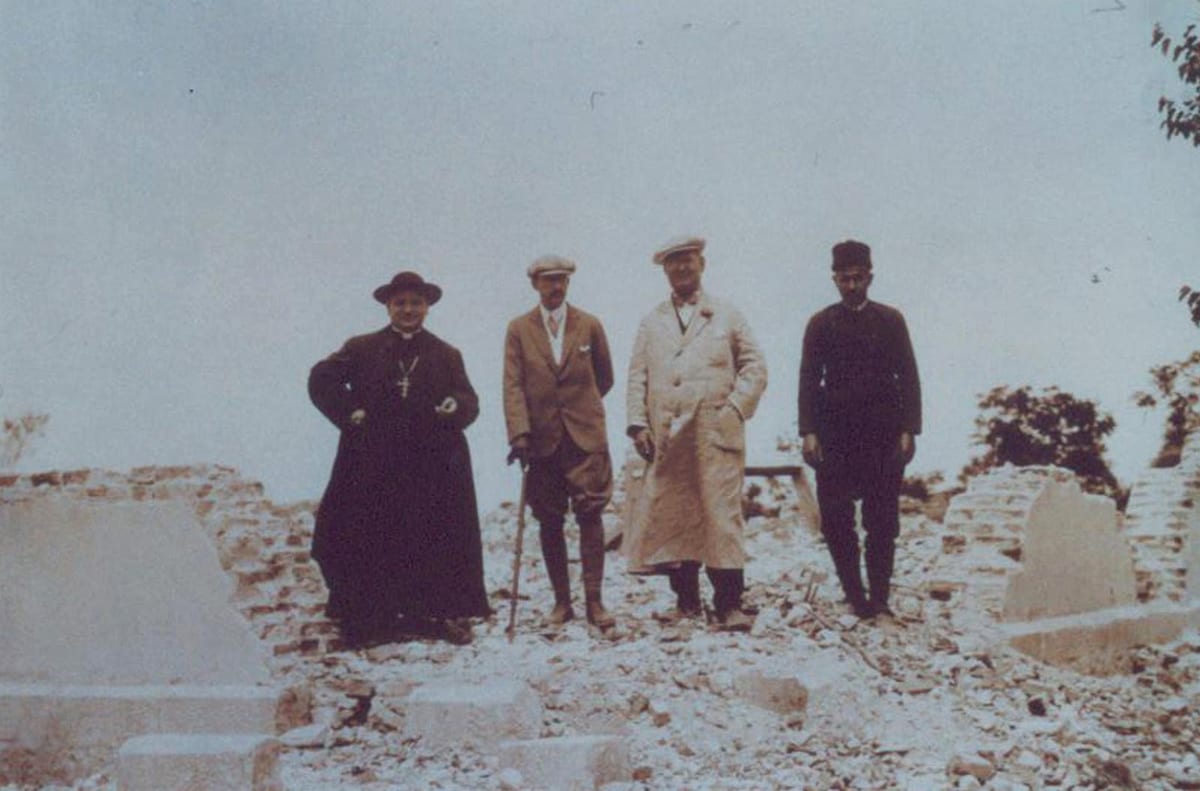
Mons. Angelo Giuseppe Roncalli with King Boris III in Belozem, after the earthquake of April 1928 AD, unknown photographer unknown photographer, Wikimedia Commons, from the Storie Bulgare collection (storiebulgare.blogspot.com) From 1919 AD St. John XXIII was spiritual director of the Bergamo seminary until Pope Benedict XV called him to Rome in 1921 AD to lead the Propagation of the Faith in Italy. In February 1925 AD, without warning, he was asked to go to Bulgaria for a visit of a few months. Pope Pius XI made him a bishop and the Holy See's Apostolic Visitor there, and he entered Sofia on April 25, 1925 AD.
He stayed in Bulgaria until 1934 AD, and when an earthquake struck the country in 1928 AD he was there in person and gave the victims help at once. As the Holy See's delegate to Turkey and Greece he then lived at Istanbul, where he set up an office to trace prisoners of war. In December 1944 AD a telegram called him to France as Pope Pius XII's nuncio, and he reached Paris on December 30.
-
1953–1958 AD
Patriarch of Venice, called to the conclave
Cardinal and Patriarch of Venice from 1953 AD, until the conclave of 1958 AD elected St. John XXIII Pope.
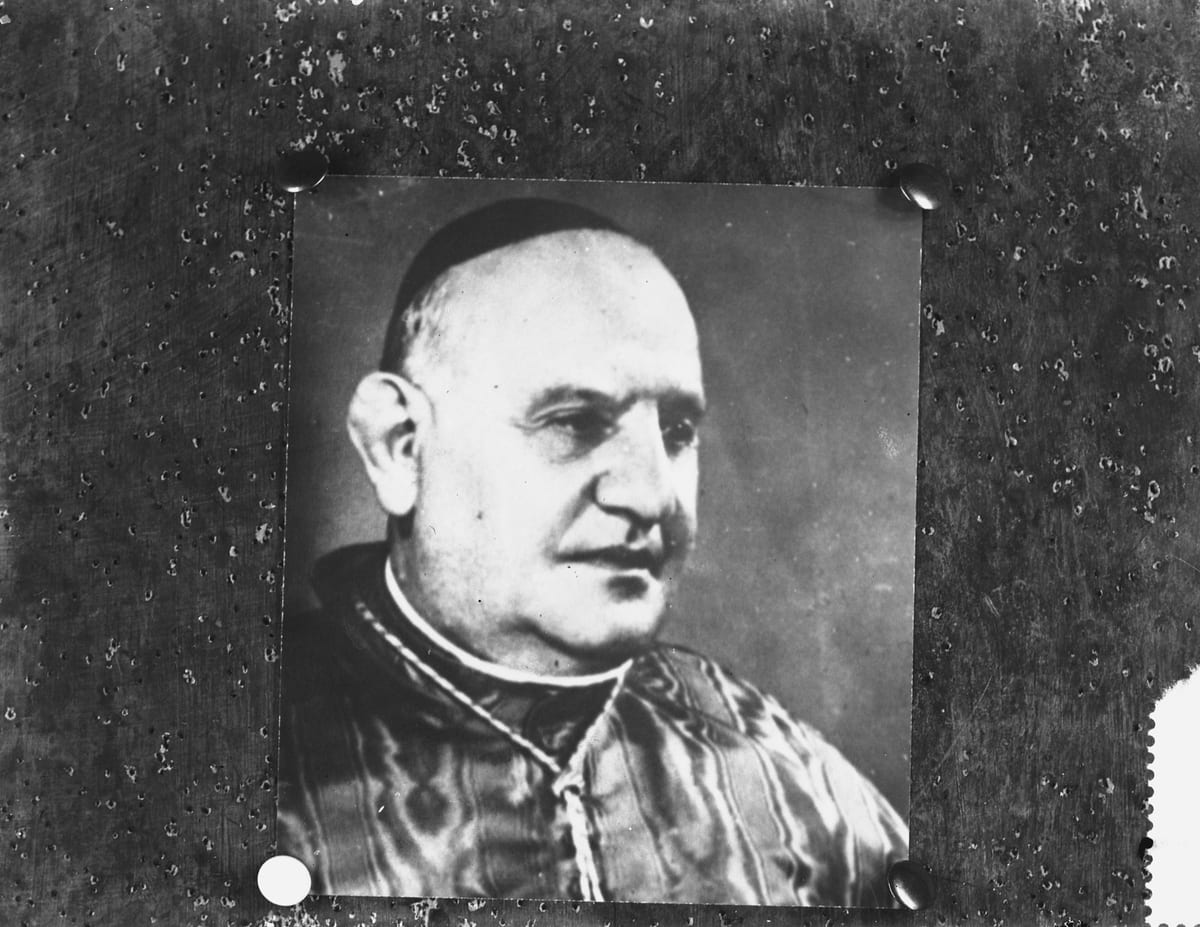
Cardinal Angelo Giuseppe Roncalli, Patriarch of Venice, Anefo, 1958-1910 AD-28 (filed on the day of the election; the portrait itself is earlier) Anefo, Nationaal Archief, The Hague Pope Pius XII made St. John XXIII a cardinal on January 12, 1953 AD, and in the same year named him Patriarch of Venice. Three days after the consistory, on January 15, 1953 AD, the President of France, Vincent Auriol, used a right long held by French heads of state and placed the cardinal's red biretta on him at the Élysée Palace. He arrived in Venice on March 15, 1953 AD, and formally took charge of the diocese.
After Pope Pius XII died, a large crowd went with the cardinal to Venice station on October 12, 1958 AD, as he left for the conclave. On October 28 the cardinals elected him Pope, a month short of his seventy-seventh birthday. His age surprised everyone, and many expected a pontificate of transition.
-
1958–1962 AD
St. John XXIII and the Council
The new Pope took the name John, visited Rome's sick children and prisoners, and called the world's bishops to the Second Vatican Council.
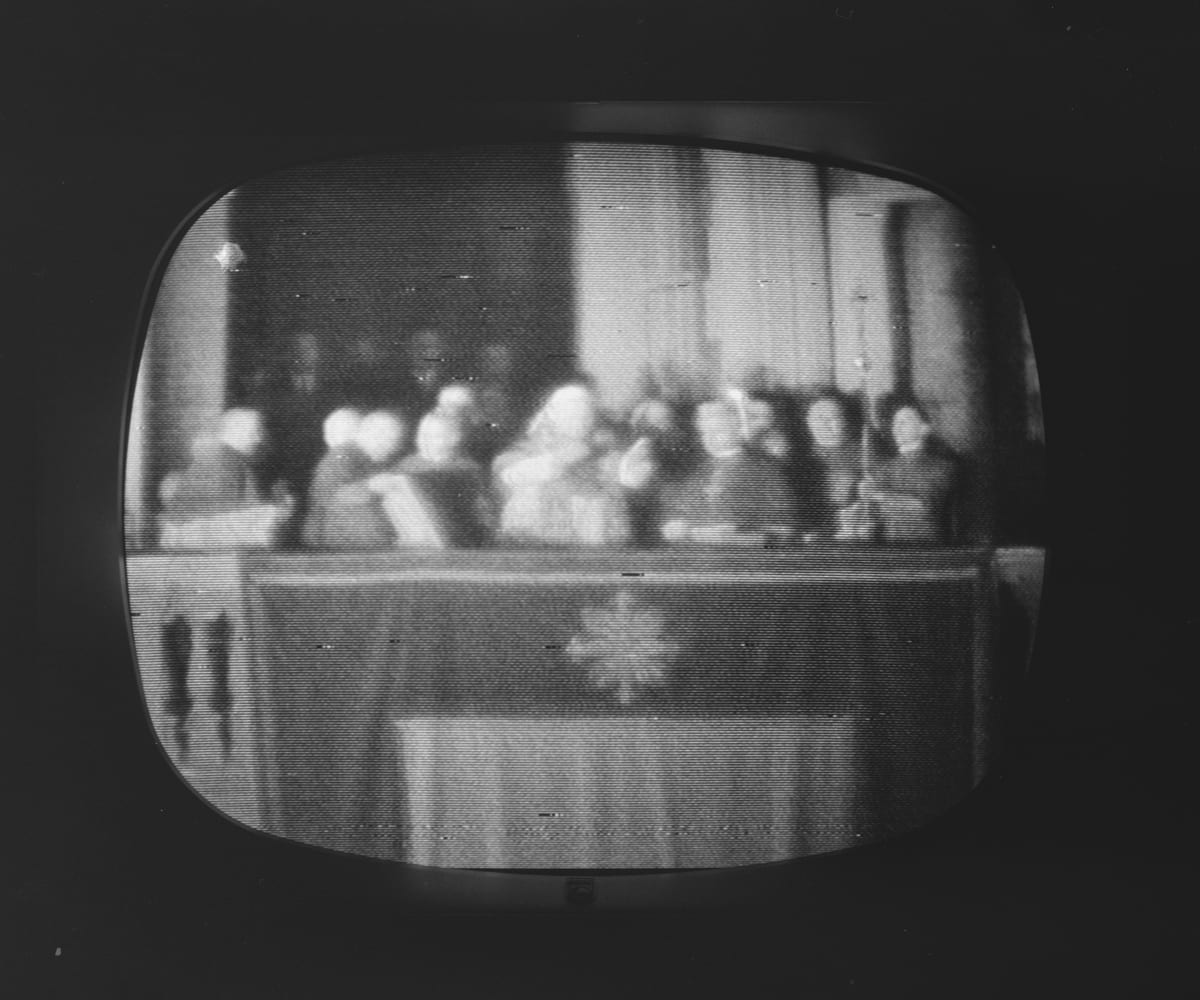
Nieuwe Paus Johannes XXIII op televisie (new Pope John XXIII on television), Daan Noske / Anefo, October 28, 1958 AD Daan Noske / Anefo, Nationaal Archief, The Hague (Anefo, 909-9369 AD), via Wikimedia Commons Accepting the election, St. John XXIII told the cardinals in Latin that he would be called John. At his first Christmas as Pope he visited sick children in the hospitals of Santo Spirito and the Bambino Gesù, and the next day the prisoners of Regina Coeli. On January 25, 1959 AD, to general surprise, he announced to the cardinals at St. Paul Outside the Walls an ecumenical council of the whole Church.
On October 11, 1962 AD, he opened the Second Vatican Council in St. Peter's before about two thousand bishops, and told them its main purpose was not to debate this or that doctrine but to guard the Church's teaching and present it in a way that met the needs of the time. That night a torchlit crowd filled the square, and from his window, without a text, he told them the basilica had never seen a sight like that morning's in four centuries. Two weeks later, at the height of the crisis over Cuba, he broadcast a radio appeal to those who govern nations to keep the peace.
“What above all concerns the Ecumenical Council is this: that the sacred deposit of Christian doctrine be safeguarded and taught more effectively […] Therefore, the principal purpose of this Council is not the discussion of this or that doctrinal theme… a Council is not required for that… [but] this certain and immutable doctrine, which is to be faithfully respected, needs to be explored and presented in a way which responds to the needs of our time”
St. John XXIII to the Fathers of the Second Vatican Council, October 11, 1962 AD -
1962–2014 AD
Death in the Apostolic Palace, and sainthood
Death of St. John XXIII in June 1963 AD as Mass was said for him in the square below; beatification in 2000 AD and canonization in 2014 AD.
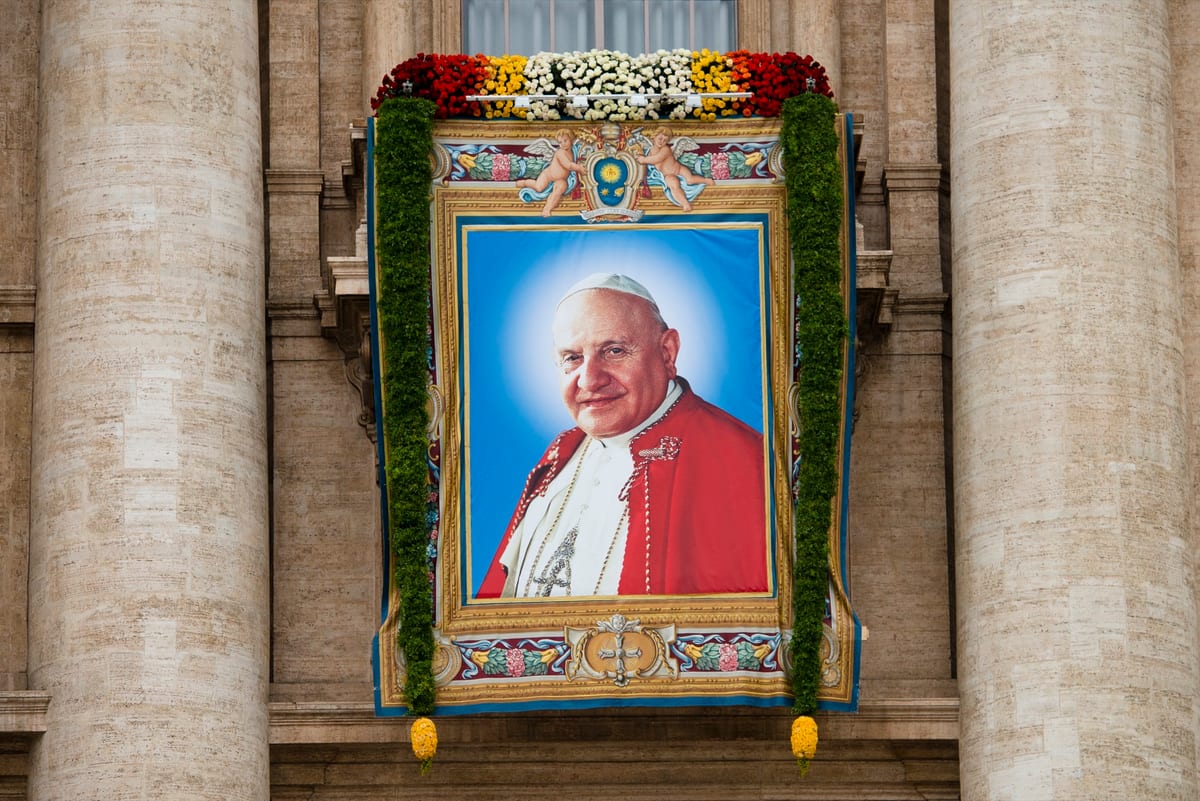
Canonization 2014 AD - The Canonization of Saint John XXIII and Saint John Paul II, Aleteia Image Department Aleteia Image Department, Aleteia, via Flickr and Wikimedia Commons The stomach cancer that killed St. John XXIII came to light in November 1962 AD. He died in the Apostolic Palace at 7.45 on the evening of June 3, 1963 AD, while a great crowd prayed for him in St. Peter's Square below. A Mass was being said for him in the square, and he died at its closing words, *Ite missa est* (*Go, the Mass is ended*).
In 1966 AD a Daughter of Charity, Sister Caterina Capitani, was suddenly healed at Naples, and Pope St. John Paul II later approved the healing as a miracle. Pope St. John Paul II beatified St. John XXIII on September 3, 2000 AD. Pope Francis canonized him in St. Peter's Square on April 27, 2014 AD, together with Pope St. John Paul II.
“Ciò che più vale nella vita è Gesù Cristo benedetto, la sua Santa Chiesa, il suo Vangelo, la verità e la bontà (What counts the most in life is blessed Jesus Christ, his holy Church, his Gospel, truth and goodness)”
St. John XXIII to the whole Church, in his spiritual testament


Pray with the Church
Collect for the optional memorial of Saint John XXIII
The Roman Missal, Collect for the optional memorial of Pope Saint John XXIII on October 11; English translation of the liturgical texts © 2017 AD International Commission on English in the Liturgy Corporation, confirmed by the Congregation for Divine Worship and the Discipline of the Sacraments on September 21, 2019 AD.
Almighty ever-living God,who in Pope Saint John the Twenty-Thirdhave given a living example of Christ, the Good Shepherd,to shine throughout the whole world,grant us, we pray,that, through his intercession,we may joyfully pour outan abundance of Christian charity.Through our Lord Jesus Christ, your Son,who lives and reigns with you in the unity of the Holy Spirit,God, for ever and ever.
All 2 reports on Saint John XXIII

Pope John XXIII tells torchlit crowd to give their children his caress
