
Saints Bishop of Geneva and Doctor of the Church · 1567–1622 AD
Saint Francis de Sales
Feast 24 January · Born 1567 AD, Château de Sales, parish of Thorens, Duchy of Savoy (now Thorens-Glières, Haute-Savoie, France) · Died 1622 AD, Lyon, France
A Savoy nobleman's eldest son gave up the law for the priesthood, preached on foot in Calvinist country south of Lake Geneva, governed his diocese in exile at Annecy as Bishop of Geneva, founded an order of nuns and died at Lyon in 1622 AD.
Begin the life
In brief
Saint Francis de Sales, also called François de Sales, was born at the Château de Sales in the Duchy of Savoy on August 21, 1567 AD. He was Bishop of Geneva from 1602 AD, but the city had turned Calvinist, so he governed the diocese in exile from Annecy. He preached in the Calvinist Chablais, guided people in the spiritual life through his letters, wrote the Introduction to the Devout Life and founded the Visitation, an order of nuns, with St. Jane Frances de Chantal.
-
Paris, 1580s AD
The student who believed he was damned
In Paris the eldest son of a Savoy noble family fell into weeks of despair over his salvation, and found peace praying before Our Lady.
St. Francis de Sales was the eldest of the thirteen children of François de Sales de Boisy and Françoise de Sionnaz, both of old Savoy noble families. His father meant him for the law and sent him with his tutor, Jean Déage, to the Jesuit college of Clermont in Paris.
Pope Benedict XVI writes that reading St. Augustine and St. Thomas Aquinas led him to doubt his own salvation and God's plan for him. For weeks he barely ate or slept, and St. Jane Frances de Chantal testified that he grew thin and yellow as wax. Then, in the church of Saint-Étienne-des-Grès, he said a prayer he found pasted on a board before an altar of Our Lady, and when he got up the despair had left him.
“C'est par la même raison qui me fait parler souvent à mon régent et à mon précepteur; Notre-Seigneur est mon maître dans la science des saints; je vais souvent à lui afin qu'il me l'apprenne; car je me soucierais fort peu d'être savant si je ne devenais saint. (For the same reason for which I often consult my master and my tutor. Our Lord is my master in the science of the saints, and I go to him often that he may teach me that science. For I care very little about becoming learned unless I also become holy.)”
St. Francis de Sales, asked why he received Communion so often, as a student -
1591–1593 AD
A doctor of law turns down a senator's seat
A new doctor of law refused the career and the marriage his father had planned, and was ordained a priest in 1593 AD.
St. Francis de Sales received his doctorate in civil and canon law at the University of Padua on September 5, 1591 AD. Back in Savoy, the Duke offered him a senator's seat, and his father had chosen one of the noblest heiresses of Savoy as his wife. He refused both and declared that he meant to enter the Church.
On the road from Chambéry, he told his tutor that his will had long been set on serving God as a cleric, and that he was waiting only for his father's consent. His parents were deeply distressed, but his father gave way once the post of provost of the cathedral chapter of Geneva, the highest office in the diocese after the bishop's, was secured for him. Bishop Claude de Granier of Geneva ordained him a priest on December 18, 1593 AD.
“Je ne veux point me partager entre Dieu et le monde: je veux être ecclésiastique et rien autre chose. (I do not want to divide myself between God and the world. I want to be an ecclesiastic and nothing else.)”
St. Francis de Sales to Antoine Favre, refusing the senator's seat -
1594–1598 AD
On foot into the Chablais
A young priest walked into Calvinist country south of Lake Geneva, preached to four or five listeners and saw Catholic worship restored there in 1598 AD.
The Duke of Savoy had recovered the Chablais, the Calvinist lands south of Lake Geneva, and asked the Bishop of Geneva to restore the Catholic faith there. The father of St. Francis de Sales, M. de Boisy, refused to bless the mission. In September 1594 AD St. Francis de Sales set out anyway, on foot, with no companion but his cousin Louis de Sales.
For the first six months he spent every night in the fortress of Allinges for safety, and only four or five people came to his first Advent sermons at Thonon. In January 1595 AD he began writing leaflets for the people of Thonon who would not come to hear him, later printed as the Controversies. A large part of the people of the Chablais returned to the Church in 1597 AD and 1598 AD, and in 1598 AD the Duke ordered public Catholic worship restored throughout the region.
“J'y fus en ce temps-là trois ans tout seul à y prêcher la foi catholique, et Dieu m'a fait avoir en ce voyage une consolation entière; car, au lieu que je n'y trouvai que cent catholiques en tout le Chablais, je n'y ai pas maintenant trouvé cent huguenots. (For three years I was quite alone there, preaching the Catholic Faith, and God has granted me on this journey the very fullest consolation, for whereas formerly I could only find a hundred Catholics in the whole of the Chablais, I was now not able to find a hundred Huguenots.)”
St. Francis de Sales to St. Jane Frances de Chantal, letter after visiting the Chablais -
1599–1602 AD
Bishop of Geneva, in exile at Annecy
Chosen against his will to succeed his bishop, the young priest turned down a king's offers and was consecrated Bishop of Geneva in 1602 AD.
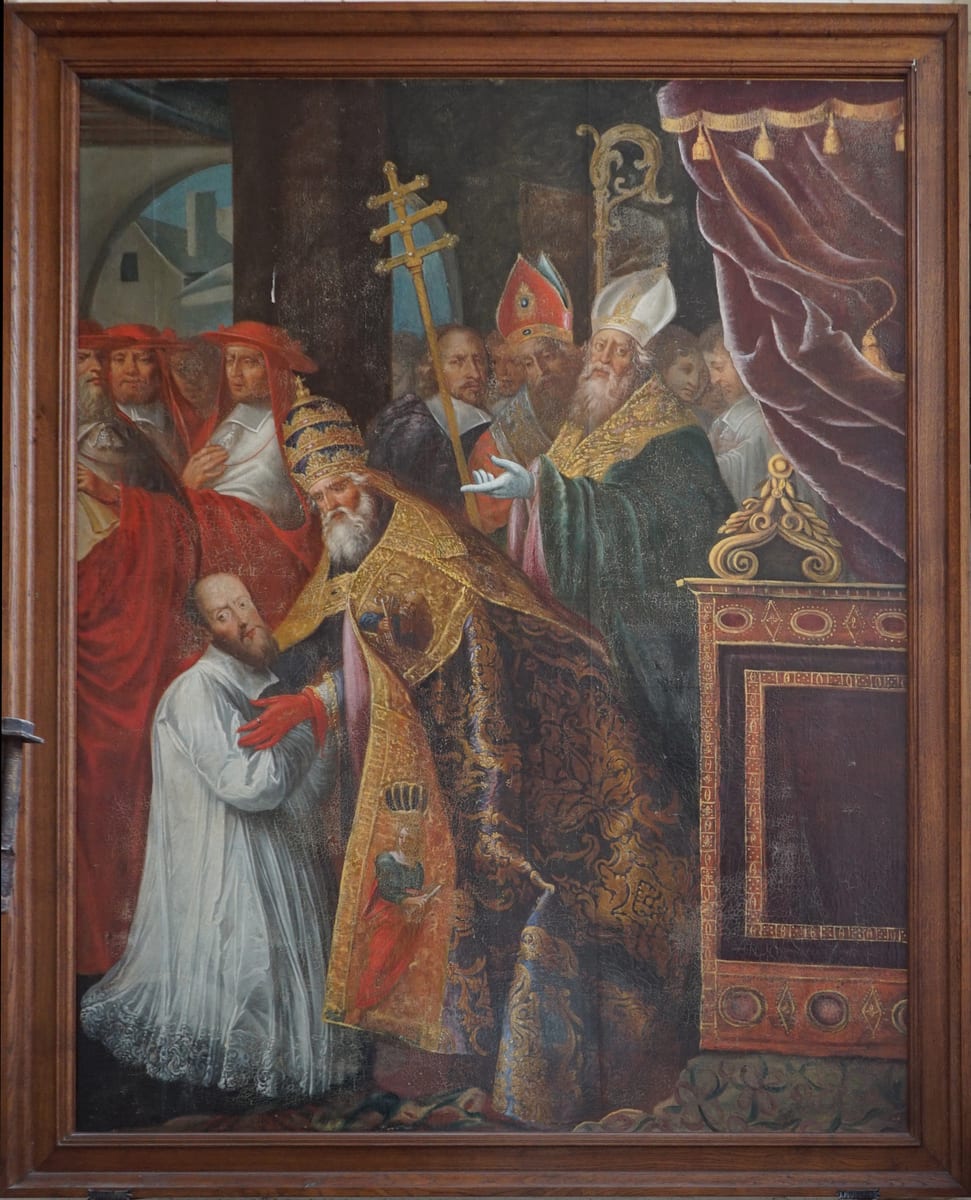
Saint François de Sales devant le pape Clément VIII, Anonymous, 17th century Anonymous, Église Saint-Jean-au-Marché, Troyes (Monument historique, Palissy PM10002403) In 1596 AD St. Francis de Sales wrote that he did not want to become coadjutor, the bishop named to succeed Bishop de Granier in the see. Bishop de Granier chose him anyway, and in Rome in March 1599 AD he sat a public examination for the office of bishop before Pope Clement VIII. He wrote afterwards that God had kept him from being put to shame.
In 1602 AD he went to Paris to work for the return of the Catholic faith in the district of Gex, and preached before King Henri IV. The King pressed him five separate times to stay in France, offering him good appointments and church posts with large incomes, and he refused each time. Bishop de Granier died that September, and St. Francis de Sales was consecrated Bishop of Geneva on December 8, 1602 AD, the feast of the Immaculate Conception.
“Sire, je prie Votre Majesté de m'excuser, je ne puis accepter ses offres. Je suis marié, j'ai épousé une pauvre femme, je ne puis la quitter pour une plus riche. Si Votre Majesté a quelque bienveillance pour moi, je ne lui demande autre chose que le rétablissement de la religion catholique et de ses églises dans le pays de Gex. (Sire, I beg Your Majesty to excuse me, but I cannot accept your offer. I have married a poor wife and I cannot quit her for one that is richer. If Your Majesty has any kind feeling towards me, I ask nought else of you than the re-establishment of the Catholic religion and of its churches in the country of Gex.)”
St. Francis de Sales to King Henri IV of France, declining the King's offer to keep him in France, 1602 -
1604–1610 AD
A widow at Dijon, a convent at Annecy
Preaching at Dijon, the new bishop met a widowed baroness, became her spiritual director and founded an order of nuns with her in 1610 AD.
While preaching the Lent of 1604 AD at Dijon, he met St. Jane Frances de Chantal, a widowed baroness. That August at Saint-Claude she confessed the sins of her whole life to him and vowed to obey him as her spiritual director. The next summer she had to meet the man who had shot her husband in a hunting accident, and St. Francis de Sales wrote to tell her how to receive him.
On June 6, 1610 AD, Trinity Sunday, the two of them founded the Order of the Visitation at Annecy. It was meant for girls and widows who were not strong enough for the hard penances of the older orders. Six months later he told her to receive Communion every day, and in 1641 AD she wrote that she had done so for thirty-one years.
“Je veux que vous y porties vostre cœur doux, gracieux et compatissant. Je sçai que sans doute, il se remuera et renversera, que vostre sang bouillonnera ; mais qu'est cela ? (I wish you to keep your heart gentle, gracious, and compassionate towards him. I know that beyond all doubt your heart will experience the deepest emotion and reluctance, and that your blood will seethe within you: but what does that matter?)”
St. Francis de Sales to the Baroness de Chantal, advising her how to meet the man who killed her husband -
1605–1616 AD
Two books: one grown from letters, one written in early mornings and late evenings
Letters of advice to a woman in Annecy became the Introduction to the Devout Life, and the Treatise on the Love of God was written in early-morning and late-evening hours.
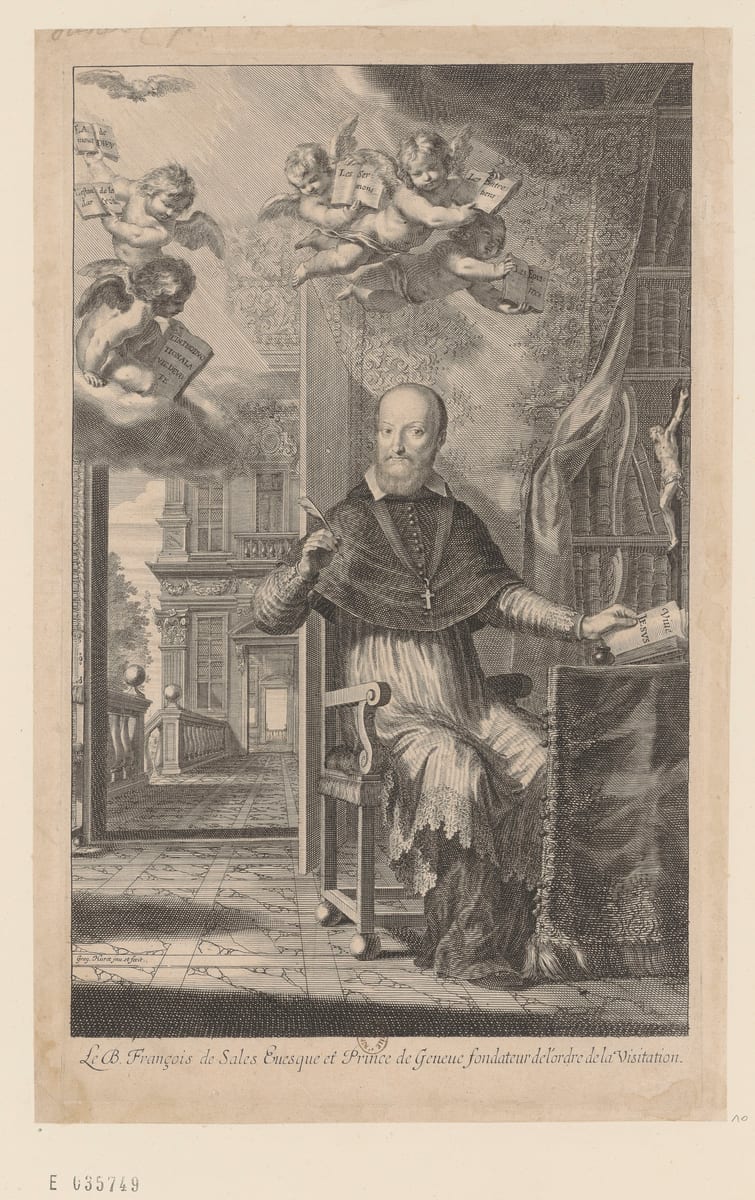
Le B. François de Sales Euesque et Prince de Geneue fondateur de l'ordre de la Visitation (Saint François de Sales assis à son bureau), Grégoire Huret (designer and engraver, 1606–1670 AD), 1641 AD Grégoire Huret (designer and engraver, 1606–1670 AD), Bibliothèque nationale de France, Estampes et photographie; Gallica btv1b53254730k In 1605 AD Madame de Charmoisy heard St. Francis de Sales preach at Annecy and asked him to be her spiritual director. His letters to her lay behind the Introduction to the Devout Life, which the Jesuit Jean Fourier pressed him to print. He dated its preface at Annecy on July 22, 1609 AD, the feast of St. Mary Magdalene.
That year he planned a second book, to show the love of God not in theory but in keeping the commandments. He wrote this Treatise on the Love of God mostly early in the morning and before going to bed, and its printing was finished on July 31, 1616 AD.
“Ceux qui ont traitté de la dévotion ont presque tous regardé l'instruction des personnes fort retirées du commerce du monde, ou au moins ont enseigné une sorte de dévotion qui conduit a cette entière retraitte. Mon intention est d'instruire ceux qui vivent es villes, es mesnages, en la cour, et qui par leur condition sont obligés de faire une vie commune quant a l'extérieur (Almost all those who have treated of devotion have sought to instruct persons living apart from the world, or at least they have taught a kind of devotion that leads to such isolation. I intend to offer my teachings to those who live in cities, in families, at court and who, by virtue of their state in life, are obliged to live in the midst of others.)”
St. Francis de Sales, Preface to the Introduction to the Devout Life -
December 1622 AD
The gardener's lodge at Lyon
At Lyon, St. Francis de Sales gave the Visitation sisters his last conference, and he died two days later.
In 1622 AD the Duke of Savoy sent him to Avignon to greet King Louis XIII, and he made his will before setting out. Back at Lyon on his way home from Avignon, he lodged in the gardener's lodge of the Visitation, so as not to be a burden to anyone. On the evening of December 26 he gave the sisters there his last conference.
The next day, after saying a long Mass, he had a stroke while writing a letter and was left paralysed. When he was urged to pray for his own recovery, he refused. He died at about eight in the evening on December 28, 1622 AD, the feast of the Holy Innocents.
“I said everything in just two words, when I told you to refuse nothing and to desire nothing; I have nothing more to say to you.”
St. Francis de Sales to the Visitation sisters of Lyon, his last days at Lyon -
1623–1923 AD
Saint, Doctor and patron of writers
The bishop buried at Annecy was declared a saint in 1665 AD, a Doctor of the Church in 1877 AD and patron of all writers in 1923 AD.
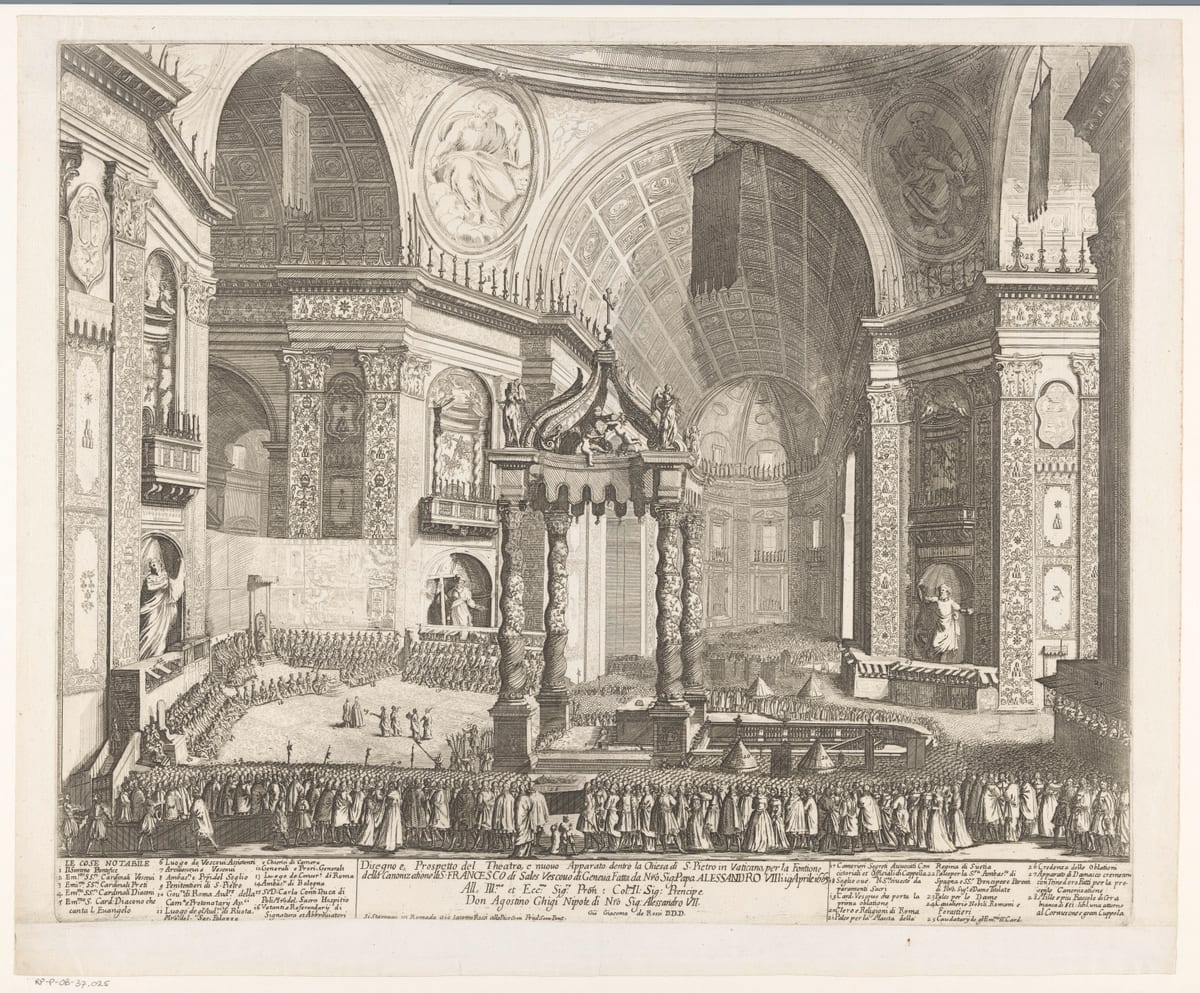
Disegno e Prospetto del Theatro, e nuovo Apparato dentro la Chiesa di S. Pietro in Vaticano, per la Fontione della Canonizatione di S. Francesco di Sales, Anonymous etcher; published by Giovanni Giacomo de' Rossi, 1665 AD or later Anonymous etcher; published by Giovanni Giacomo de' Rossi, Rijksmuseum, Amsterdam, RP-P-OB-37.025 His body was carried from Lyon to Annecy, and people from the places along the road came out to venerate it. The Roman Martyrology keeps his memorial on January 24, the day of his burial at Annecy. Pope Alexander VII declared him a saint at St. Peter's on April 19, 1665 AD.
Pope Pius IX confirmed him as a Doctor of the Church on November 16, 1877 AD. Pope Pius XI declared him the heavenly patron of all writers on January 26, 1923 AD.


_(Seul_%C3%A9tat_connu)_-_Gr._Huret_jnu_et_fecit_-_btv1b53254730k.jpg)

Pray with the Church
Prayer of St. Francis de Sales in his Paris crisis
His own prayer at the height of his crisis of despair in Paris, recorded in the canonisation process and quoted by Pope Benedict XVI in his General Audience of March 2, 2011 AD; the ellipses are the Pope's.
Whatever happens, Lord, you who hold all things in your hand and whose ways are justice and truth;whatever you have ordained for me... you who are ever a just judge and a merciful Father, I will love you Lord....I will love you here, O my God, and I will always hope in your mercy and will always repeat your praise....O Lord Jesus you will always be my hope and my salvation in the land of the living
All 1 report on Saint Francis de Sales

About this picture
AI-generated image, in the manner of 17th-century Savoyard oil painting, from the paper's reference portrait based on Saint François de Sales devant le pape Clément VIII (Anonymous, 17th century, Église Saint-Jean-au-Marché, Troyes) View source artwork.