Saints Friar, priest and Doctor of the Church
Saint Thomas Aquinas
Feast 28 January · Born 1225 AD, Roccasecca, Kingdom of Sicily (Lazio, Italy) · Died 1274 AD, Fossanova Abbey, Priverno, Italy
His family meant him for an abbot and held him in a castle keep when he chose the begging friars; he came out, took a chair at Paris, and laid aside his pen three months before he died.
Begin the life
In brief
Saint Thomas Aquinas, also called the Angelic Doctor, was a son of the count of Aquino. His father meant him for the abbacy of Monte Cassino, but St. Thomas took a beggar's habit instead, and his brothers seized him on the road and locked him in a castle keep. He died on the road to a general council, with the Summa theologiae, his book of theology, unfinished.
-
Boyhood, to 1236 AD
A count's son is given to the monks
He was born at Roccasecca and handed as a small boy to the Benedictines of Monte Cassino, where his uncle was abbot.
Saint Thomas Aquinas was born at Roccasecca. His father was Landulph, count of Aquino. His mother, Theodora, countess of Teano in her own right, came of the Norman princes.
At about five he was handed to the Benedictine monks of Monte Cassino, where the abbot was his own uncle. He spoke very little there, as he did all his life, but he asked his master over and over what God is.
-
1236–1243 AD
He takes the begging friars' habit at Naples
Sent to the emperor's university, he asked the Dominicans for their habit and was told to wait three years; his father had meant him for an abbey.
In the autumn of 1236 AD St. Thomas entered the University of Naples. A law of the Emperor Frederick II forbade his subjects to study anywhere else, so Count Landulph had no other choice to make.
At the Dominican convent the prior and the preacher Father John of St Julian told him to wait three years before taking the habit. He was clothed as a Friar Preacher at Naples in August 1243 AD. His father had intended him instead for the abbacy of Monte Cassino.
“But I am not worthy, and is not my age an obstacle?”
St. Thomas Aquinas to the prior of San Domenico, Naples, 1244 AD -
1243–1245 AD
His brothers seize him and shut him in a keep
His mother sent her soldier sons after him; they took him on the road north of Rome and held him eighteen months or two years in a family castle.
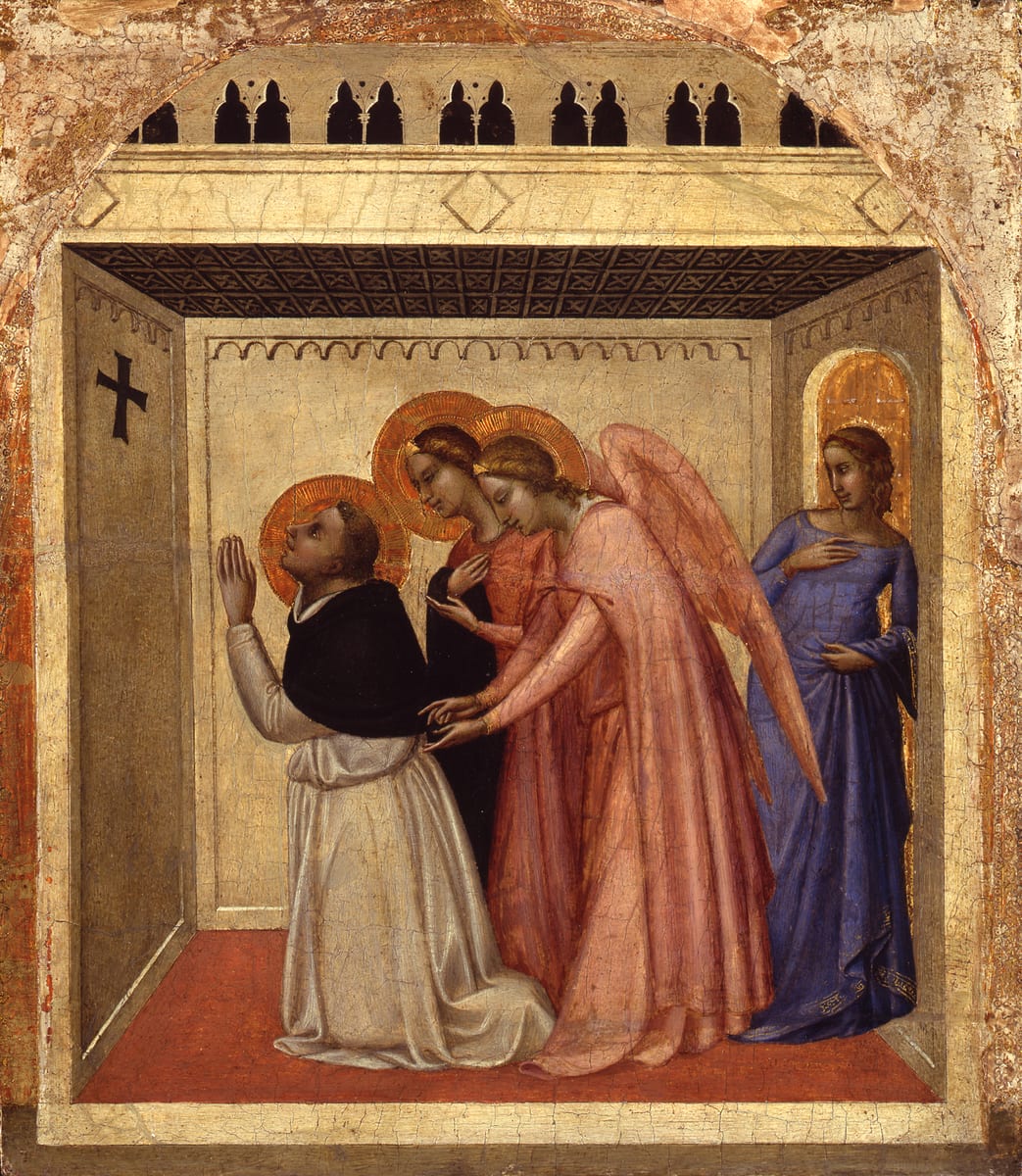
The Temptation of St Thomas Aquinas, predella panel from the altarpiece of Saints Dominic, Peter Martyr and Thomas Aquinas painted for Santa Maria Novella, Florence, Bernardo Daddi, 1338 AD Bernardo Daddi, Gemaldegalerie, Staatliche Museen zu Berlin His entry into the Order displeased his mother and his brothers, and the master general sent him out of Italy toward Paris with a few other friars. His mother sent a mounted courier to her elder sons, who commanded the emperor's forces in Tuscany. They overtook the friars on the road north of Rome and carried St. Thomas off by force. His brothers half-tore the friar's frock from his back on the road, and the attempt to strip it off was dropped.
They shut him in the keep of the castle of Monte San Giovanni for eighteen months or two years, and his parents, brothers and sisters worked by various means to break his vocation. When his brothers sent a woman into the room, he snatched a burning brand from the fire and drove her out. According to longstanding Catholic Tradition, recorded in the depositions for his canonisation, two angels then girded him with a cord of chastity as he slept.
-
1245–1252 AD
The Pope rules for him, and the Order sends him north
He came out of the castle at last, made his vows at Naples, and went to Cologne to study under St. Albert the Great.
He left the castle at last, let down from a window in a basket into the arms of the Dominicans. He made solemn profession at Naples in January 1245 AD. Pope Innocent IV examined his motives, dismissed him with a blessing, and forbade any further interference with his vocation.
The master general took him out of Italy, beyond his family's reach, to St. Albert the Great at Cologne. The students there called him the dumb ox, and his master told them his bellowing would one day be heard through the whole world. Conrad of Hochstaden, archbishop of Cologne, ordained him priest in 1250 AD.
“It was because I had not yet learned to speak before such a mind as Albert.”
St. Thomas Aquinas, asked later in life why he had been silent so long at Cologne, 1248 AD -
1252–1257 AD
He takes the doctor's cap at Paris
He went back to Paris to lecture in the middle of the fight over whether friars could hold chairs of theology at all, and came out of it a master.
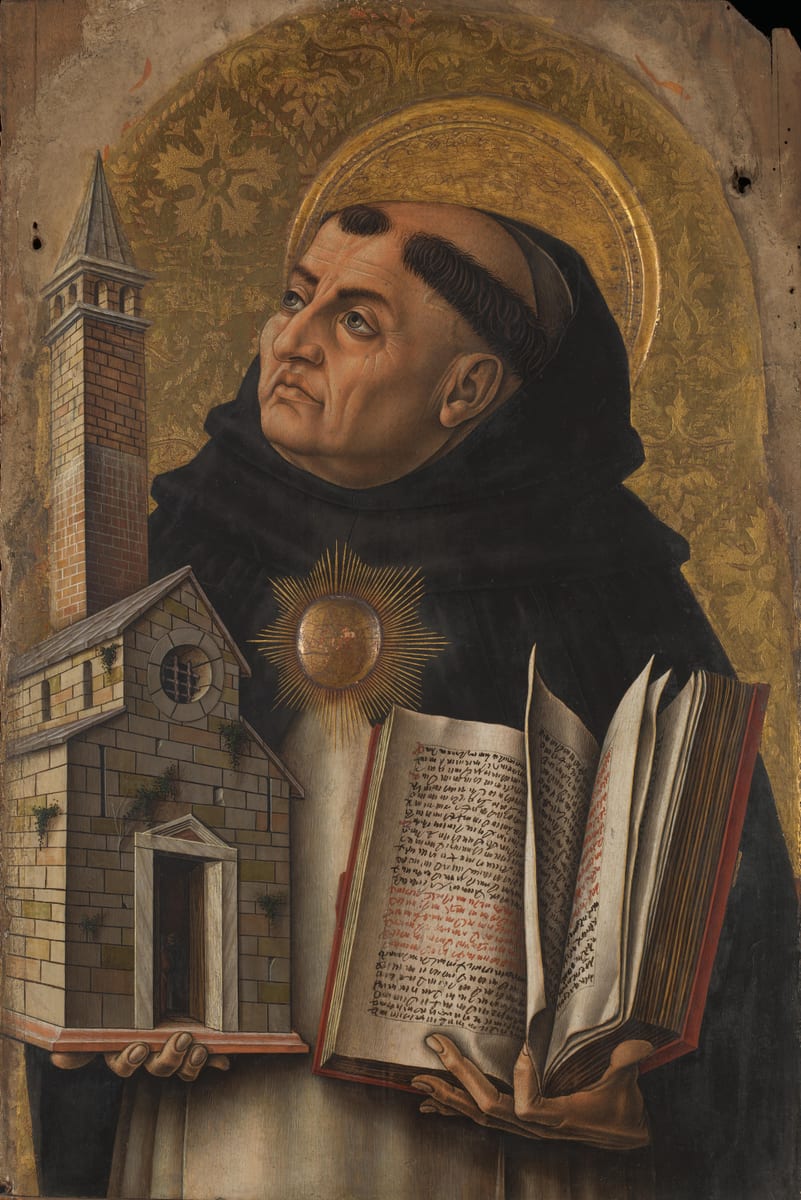
Saint Thomas Aquinas, from the Demidoff Altarpiece, Carlo Crivelli, 1476 AD Carlo Crivelli, The National Gallery, London (NG788.9) The Order sent St. Thomas back to Paris in 1252 AD to lecture as bachelor in its own house of studies. The university's secular masters were fighting to shut the mendicant friars out of the chairs of theology. A university proctor walked into his Palm Sunday sermon and read out a letter against the friars.
He said nothing until the man had finished, then took up the sermon again. St. Thomas was one of those who read their answers to William of Saint-Amour's book against the friars before Pope Alexander IV at Anagni. The Pope condemned the book on October 5, 1256 AD, and ordered that the friars be admitted to the doctorate. St. Thomas was received with cap and ring as a Doctor of Paris on October 23, 1257 AD.
“Have no fear, my brethren, for I have examined it, and find it to be captious, perfidious, and erroneous.”
St. Thomas Aquinas to the General Chapter, reporting on William of Saint-Amour's book against the friars, 1256 AD -
1272–1273 AD
He lays aside his pen at Naples
Back in the city where he had first studied, he carried the Summa theologiae into its Third Part, preached daily through Lent, and then stopped writing for good.
In August 1272 AD St. Thomas left Rome for Naples to teach, because Charles, King of Sicily, asked for him. There he carried the Summa theologiae into its Third Part, on Christ and the sacraments. Through the whole of Lent in 1273 AD he preached every day in the cathedral on the angel's greeting to Our Lady.
According to longstanding Catholic Tradition, three of the friars saw him lifted in ecstasy that year and heard a voice from the crucifix on the altar say that he had written well of Him and ask what reward he would have, and he answered that he would have the Lord himself. On December 6, 1273 AD, after a long ecstasy at Mass, he laid aside his pen and wrote no more. The Summa was left broken off in the treatise on Penance.
“I can write no more. I have seen things which make all my writings like straw.”
St. Thomas Aquinas to Reginald of Piperno, when Reginald pressed him again to take up the Summa, December 1273 AD -
1274 AD
He dies at Fossanova on the road to Lyons
The Pope called him to a general council; he set out on foot, collapsed near Terracina, and died a few weeks later in a Cistercian guest room.
Blessed Pope Gregory X summoned him to a general council opening at Lyons on May 1, 1274 AD. St. Thomas left Naples on foot on January 28, 1274 AD. The Pope had ordered him to bring his treatise against the errors of the Greeks. His strength failed him near Terracina, and he was taken to the castle of his niece at Maenza.
The Cistercian monks of Fossanova pressed their hospitality on him, and he was carried to their abbey and put to bed. He received the last sacraments there and died in the early morning of March 7, 1274 AD. According to longstanding Catholic Tradition, his old master St. Albert the Great wept at table in Cologne that day and told the friars at table that St. Thomas, his son in Christ, had died.
“I receive You, price of my soul's redemption and food for my journey. For You have I studied, watched and toiled. I have preached You and taught You. Nothing have I ever said against You, or, if I did, it was in ignorance and I disown it. If I have ever spoken wrongly of this or the other Sacraments, I submit it all for correction to the Holy Roman Church as whose loyal son I now pass from this life.”
St. Thomas Aquinas, as his earthly life drew to its close, receiving the Viaticum, March 1274 AD -
1274–1880 AD
His body goes to Toulouse, and his name to the schools
The monks who held his grave hid the body rather than give it up, and the friars won it back only in 1368 AD; the Church canonised him, made him a Doctor, and gave every Catholic school into his patronage.
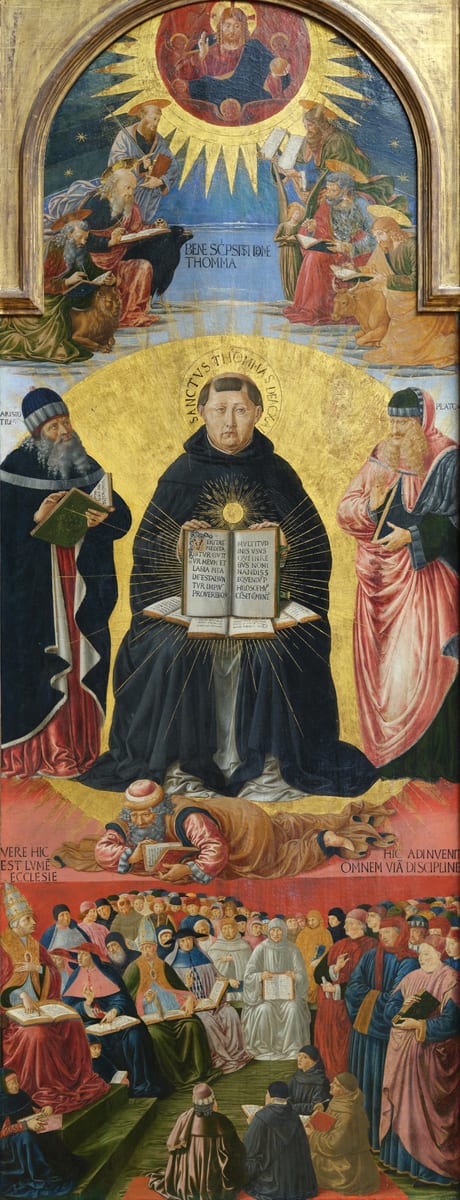
Le Triomphe de saint Thomas d'Aquin (The Triumph of St Thomas Aquinas), painted for the cathedral of Pisa, Benozzo Gozzoli, c. 1470-1475 AD Benozzo Gozzoli, Musee du Louvre, Paris (INV 104 AD ; MR 255 AD) Early in 1304 AD the Cistercians of Fossanova cut off his head and hid the body rather than give up the grave. Pope John XXII enrolled him among the saints at Avignon on July 18, 1323 AD. The relics were borne into the Dominican church at Toulouse on January 28, 1369 AD, the day the Church now keeps his memorial.
Pope St. Pius V proclaimed him a Doctor of the Universal Church in 1567 AD. Pope Leo XIII called in 1879 AD for Catholic schools to restore their philosophy after the mind of St. Thomas. A year later to the day, on August 4, 1880 AD, the same Pope named him patron of every Catholic university, college and school in the world.


Pray with the Church
The Prayer of St. Thomas for Purity
The Prayer of St. Thomas for Purity, printed among the prayers of the Angelic Warfare Confraternity, the Dominican association for chastity that grew out of the girding of St. Thomas by angels, as Tradition holds, and was approved for the universal Church by Pope Benedict XIII in 1727 AD.
Dear Jesus, I know that every perfect gift, and especially that of chastity, depends on the power of Your providence.Without You a mere creature can do nothing.Therefore, I beg You to defend by Your grace the chastity and purity of my body and soul.And if I have ever sensed or imagined anything that could stain my chastity and purity, blot it out, Supreme Lord of my powers, that I may advance with a pure heart in Your love and service, offering myself on the most pure altar of Your divinity all the days of my life. Amen.
All 2 reports on Saint Thomas Aquinas

About this picture
AI-generated image, in the manner of a Trecento fresco, from the paper's reference portrait based on Saint Thomas Aquinas, from the Demidoff Altarpiece (Carlo Crivelli, 1476 AD, The National Gallery, London) View source artwork.
Pope burns the book against friars after St. Thomas Aquinas answers it

About this picture
AI-generated image in the manner of a Trecento tempera panel, based on The Temptation of St Thomas Aquinas (Bernardo Daddi, 1338 AD, Gemäldegalerie, Staatliche Museen zu Berlin) View source artwork.