
Saints Heavenly spirits sent to guard each soul · Feast: October 2
The Holy Guardian Angels
Feast 2 October
From Saint Peter's cell in Herod's prison to the evening Saint Gemma Galgani received the stigmata in Lucca, angels woke, taught, comforted and led the saints.
Begin the life
In brief
The Church keeps the feast of the Holy Guardian Angels on October 2, and the Roman Martyrology gives it first place among that day's entries. The Catechism of the Catholic Church teaches that the angels watch over every human life and pray for it, from infancy to death.
-
Acts of the Apostles, chapter 12
An angel wakes St. Peter in Herod's prison
The night before Herod meant to bring St. Peter out, an angel of the Lord appeared in his cell and a light shone there.
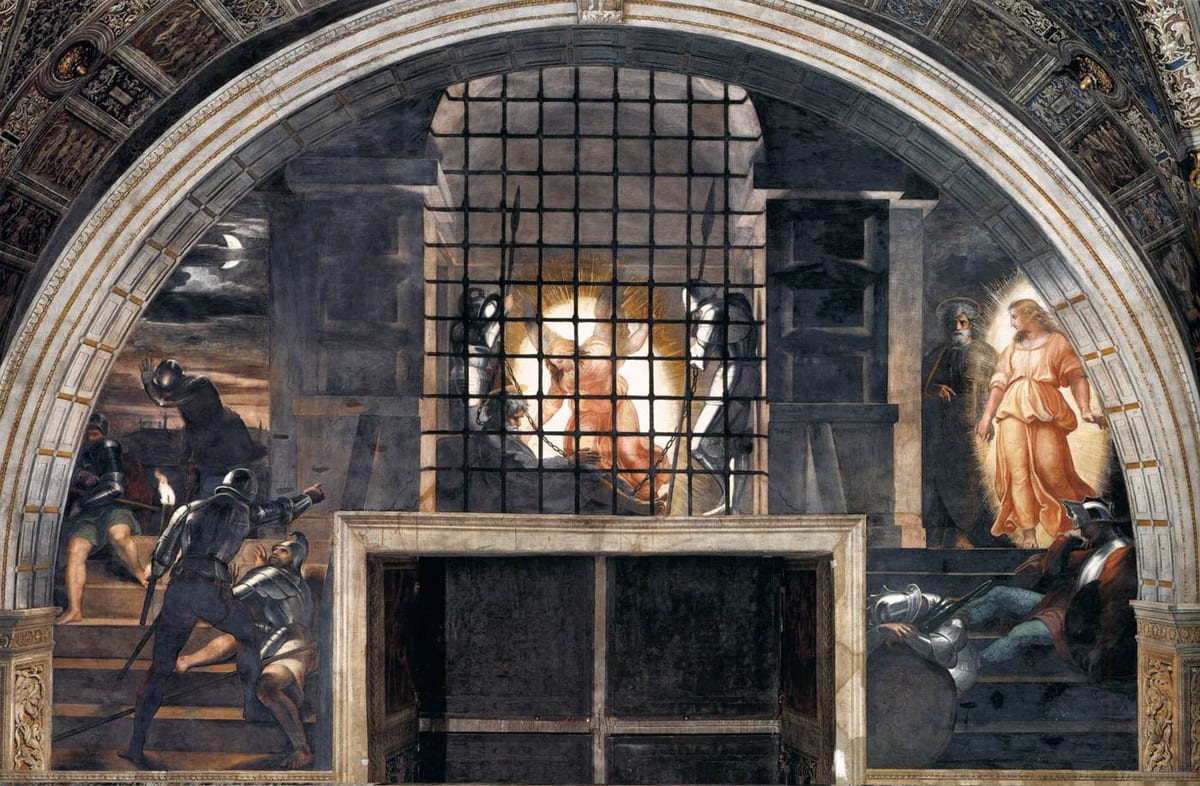
The Liberation of St. Peter, Raphael, 1514 AD Raphael, Stanza di Eliodoro, Vatican Palace King Herod had Saint James, the brother of Saint John, killed with the sword. Saint Peter was held in Herod's prison, and the night before Herod meant to bring him out, an angel of the Lord appeared in the cell and a light shone there. The angel woke St. Peter, told him to dress and follow, and led him out.
Once he was out in the street, St. Peter came to his senses and knew that the Lord had sent his angel to rescue him. He went to the house of Mary, where the disciples were gathered, and when Rhoda insisted he was at the gate they answered that it was his angel. Herod could not find him, questioned the sentries and ordered them put to death.
“Now I am sure that the Lord has sent his angel and rescued me from the hand of Herod and from all that the Jewish people were expecting.”
St. Peter, coming to himself in the street after the angel left him -
Late 13th century AD
St. Margaret of Cortona is sent a teacher
Her guardian angel came to make her ready for Christ, taught her, and came again when the Lord had withdrawn from her.
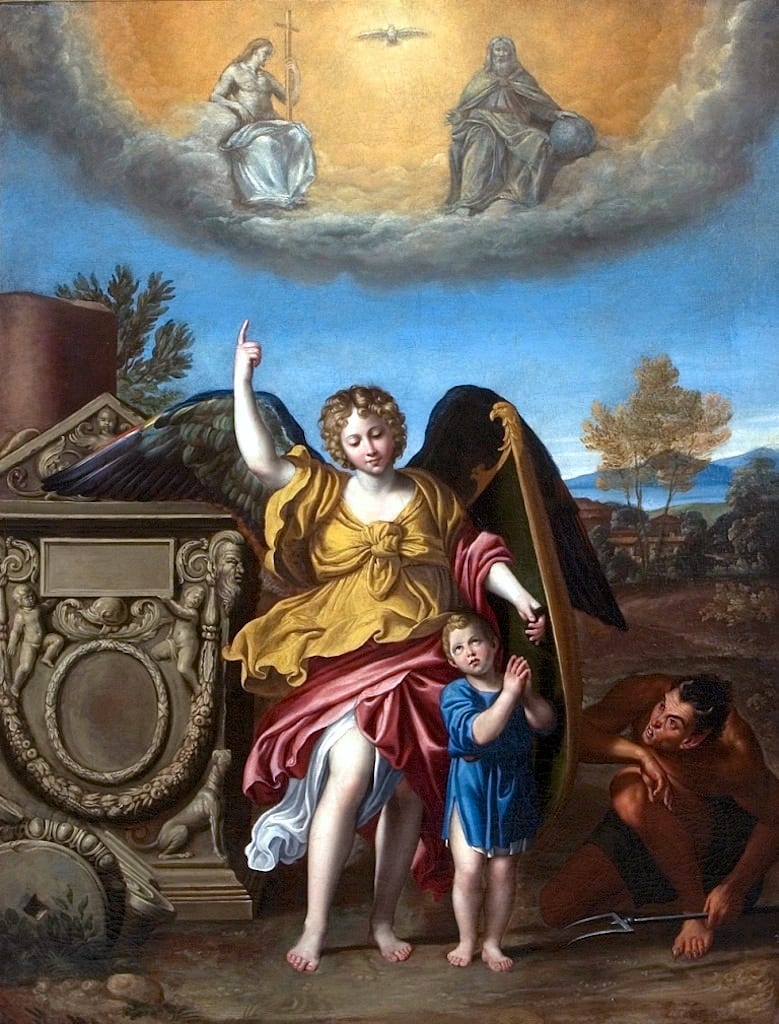
The Guardian Angel (L'angelo custode), Domenico Zampieri, 1615 AD Domenico Zampieri, Museo di Capodimonte, Naples After Christ had spoken to Saint Margaret of Cortona, the angel set apart to watch over her came to her and made her great promises. He told her he was not her Lord but the ambassador of the Great King. She told him that his words did not gladden her as the words of Christ had, and he answered that her Creator had sent him to prepare her to be a dwelling place for the Eternal King.
From then on the angel taught her and helped her root out her faults and set her soul in order, until she was filled with virtue. Once, when the Lord had withdrawn himself from her, the angel came to her instead, sent by Christ, her heavenly Spouse. He promised her great things, which she would not repeat even to her confessor, Fra Giunta.
“Thy word does not fill me with gladness as did the word of Him Whom my soul desires.”
St. Margaret of Cortona to her guardian angel, answering the angel -
October 1425 AD
St. Lydwine's angel calls her sister
Soldiers mocked her and wounded her; afterwards her angel came, called her sister, and told her she had been set in the footsteps of the Saviour, as she had begged.
Saint Lydwine of Schiedam fell on the ice at about fourteen, and from 1400 AD she never left her bed. Through the long illness that followed she very often saw an angel of light, who comforted her. In October 1425 AD, soldiers from Picardy in the Duke of Burgundy's service forced their way into her room, abused her and wounded her.
One of them held the light and mocked her: she was a beast, he said, that her guardian angel often carried off to Paradise. Afterwards the angel appeared to her and called her sister. He told her that the shameful violence done to her had set her in the footsteps of the Saviour, as she had once begged to be.
-
March 9, 1440 AD
St. Frances of Rome dies speaking of her archangel
The angel who had been at her side for twenty-four years took his leave, and a brighter one stayed at his post through her last illness.
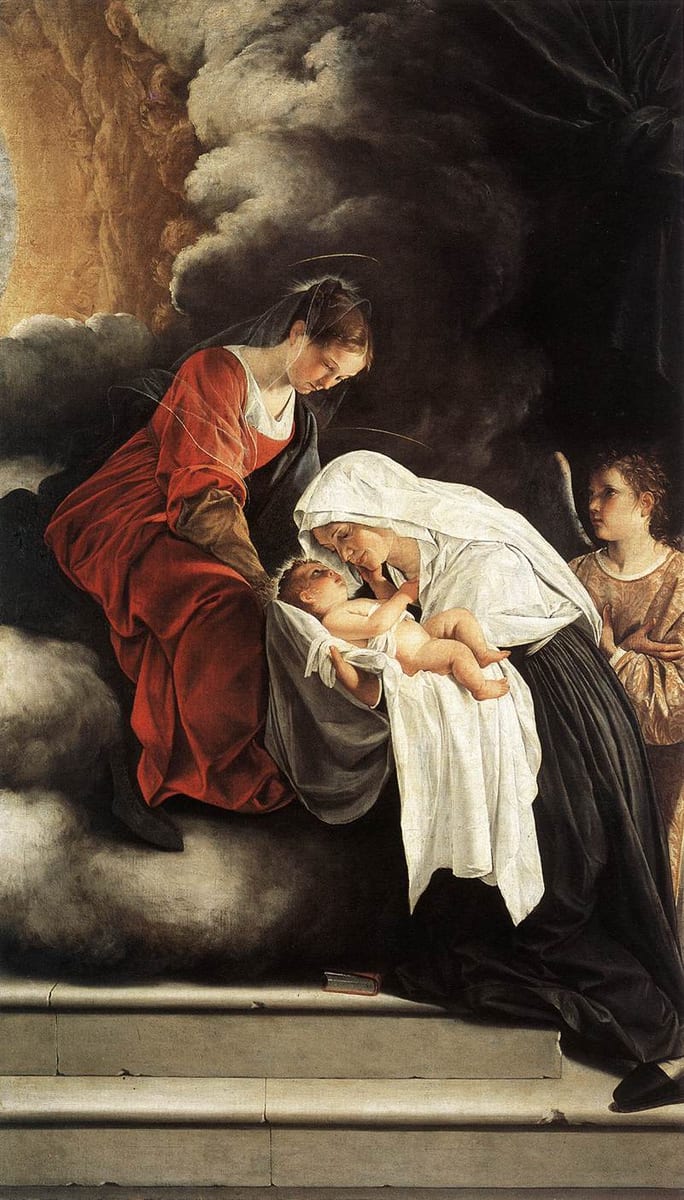
The Vision of St. Frances of Rome, Orazio Gentileschi, 1615–1619 AD Orazio Gentileschi, Galleria Nazionale delle Marche, Urbino Saint Frances of Rome, who founded a house of Oblates in 1425 AD, had an angel at her side for twenty-four years. When her community elected her its superior, that angel left her, and a brighter angel took his place.
Her last illness lasted seven days, as she had said it would, and the brighter angel, an archangel, stayed at his post beside her throughout. When her confessor asked what she saw, she told him the archangel had finished his task and was beckoning her to follow. St. Frances died on March 9, 1440 AD, at fifty-five.
“The heavens open! The angels descend! The archangel has finished his task. He stands before me. He beckons to me to follow him.”
St. Frances of Rome to her confessor, her last words, asked what her eyes beheld, March 9, 1440 AD -
December 1803 AD
In a dream, an angel writes the name JESUS
At Pisa, the night before her husband died, St. Elizabeth Ann Seton saw an angel with a pen in her sleep.
On November 8, 1803 AD Saint Elizabeth Ann Seton was at sea on the way to Italy with her gravely ill husband, William Magee Seton. At Pisa in December, on the night before he died, she fell asleep while praying for him.
In her sleep a little angel held out a sheet of white paper and wrote on it, in large letters, the name JESUS. She told her husband the dream. A few hours before he died, William Magee Seton repeated that the angel wrote Jesus.
“I saw in my slumber a little angel with a pen in one hand and a sheet of pure white paper in the other. He looked at me, holding out the paper, and wrote, in large letters, JESUS.”
St. Elizabeth Ann Seton, her journal at Pisa, the night before William Seton died, December 1803 AD -
July 18, 1830 AD
A child leads St. Catherine Labouré to Our Lady
Near midnight in Paris, a child in white woke a novice and walked her to the chapel.
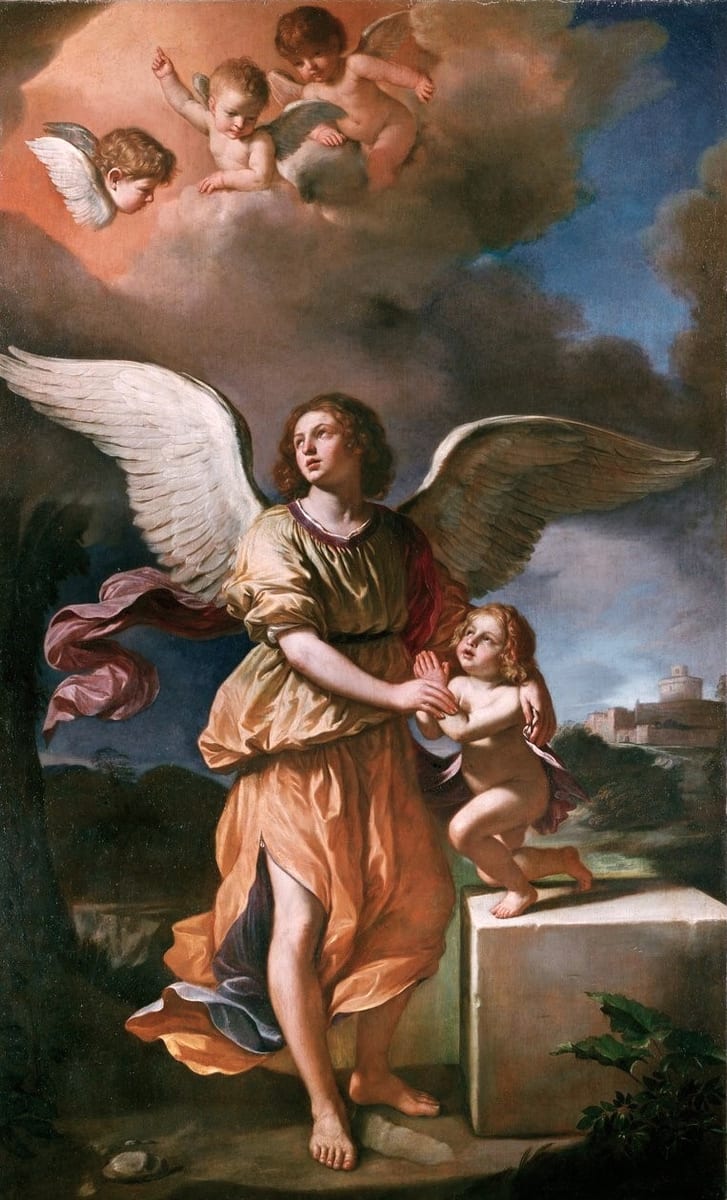
The Guardian Angel (L'angelo custode), Guercino, 1641 AD Guercino, Pinacoteca Civica, Fano Saint Catherine Labouré was a novice of the Daughters of Charity at the Rue du Bac in Paris. At half-past eleven on the night of July 18, 1830 AD, she heard herself called three times. She drew back her bed curtain and saw a child of four or five, dressed in white, who told her the Blessed Virgin was waiting for her in the chapel.
She dressed and went with him, and he kept at her left side; wherever they passed, the lamps were already lit. In the chapel the Blessed Virgin spoke with her, and afterwards the child walked her back to bed along the same lighted way. Twenty-six years later, writing under obedience to her confessor, St. Catherine said she believed the child was her guardian angel.
“I believe it was my Guardian Angel, who became visible in order to lead me to the Blessed Virgin, because I had so often begged him to obtain this favour for me.”
St. Catherine Labouré to Father Aladel, her confessor, in her written account -
1887 AD
Runaway horses on the hill above Naples
On the pilgrimage to Rome, the horses bolted on the way back from a monastery above Naples, and St. Thérèse's party got back to the hotel safely.
Saint Thérèse of Lisieux went on pilgrimage to Rome in 1887 AD. At Naples her party made the trip up to the monastery of San Martino, on a high hill above the city. On the way back, the horses bolted.
The party reached its hotel safely. In her autobiography St. Thérèse gave the credit to their guardian angels alone.
“it is solely to our Guardian Angels that I attribute our safe return to the splendid hotel”
St. Thérèse of Lisieux, recounting the runaway horses on the hill above Naples, 1887 AD -
June 8, 1899 AD
St. Gemma Galgani's angel helps her to bed
On the evening St. Gemma received the stigmata in Lucca, her guardian angel helped her into bed.
About the end of 1895 AD, at home in Lucca, the guardian angel of Saint Gemma Galgani appeared to her and rebuked her for wearing a gold watch and chain. On June 8, 1899 AD, after Communion, Our Lord told St. Gemma he would give her a great grace that evening.
That Thursday evening, the vigil of the feast of the Sacred Heart, Our Lady appeared with Jesus and with St. Gemma's guardian angel, and St. Gemma received the stigmata. When the ecstasy ended her hands were bleeding, and she covered them as well as she could before her angel helped her into bed. The pain lasted until three o'clock on the Friday, the feast of the Sacred Heart.
“Jesus has not left me alone; He makes my guardian angel stay with me always.”
St. Gemma Galgani, speaking of her angel's constant presence


Pray with the Church
Collect of the Mass for October 2
The Collect of the Mass for the memorial of the Holy Guardian Angels, October 2.
O God, who in your unfathomable providenceare pleased to send your holy Angels to guard us,hear our supplication as we cry to you,that we may always be defended by their protectionand rejoice eternally in their company.Through our Lord Jesus Christ, your Son,who lives and reigns with you in the unity of the Holy Spirit,God, for ever and ever.
All 5 reports on The Holy Guardian Angels

About this picture
AI-generated image, in the manner of an early-19th-century pen-and-ink and watercolour marine drawing. No person appears in it.
St. Elizabeth Ann Seton hears Christ's word in her child's midnight whisper

About this picture
AI-generated image, in the manner of an early-19th-century pen-and-ink and watercolour interior sketch. No person appears in it.
Anna Seton, eight, says a baby's birth is more cause for tears

About this picture
AI-generated image, in the manner of an early-19th-century pen-and-ink and watercolour marine drawing. No person appears in it.
St. Elizabeth Ann Seton dreams an angel waits past a black mountain

St. Frances of Rome reads at night by her guardian angel's light
