
Saints Saints · Paris, 1806–1876 AD
Saint Catherine Labouré
Feast 28 November · Born 1806 AD, Fain-lès-Moutiers, parish of Moutiers-Saint-Jean, Côte-d'Or, Burgundy, France · Died 1876 AD, Hospice d'Enghien, rue de Picpus, Reuilly, Paris, France
A Burgundian farmer's daughter was told to have a medal struck. She spent the next forty-six years in a hospice in eastern Paris, and nobody outside the confessional knew her name.
Begin the life
In brief
Saint Catherine Labouré, called Zoé at home in Burgundy, ran her father's farmhouse from the age of twelve. As a seminary sister in Paris she saw the Blessed Virgin in the chapel at 140 rue du Bac in 1830 AD. She then served the old and the sick in one Paris hospice for forty-six years.
-
1806–1818 AD
The farm at Fain-lès-Moutiers
A Burgundian farmhouse, a mother's death, and a girl of twelve left in charge.
St. Catherine Labouré was born on May 2, 1806 AD at Fain-lès-Moutiers in the Côte-d'Or. Her father Pierre Labouré farmed there with his wife, Louise Madeleine Goutard. Since the Revolution the village church had no priest and the tabernacle stood empty.
Her mother died in 1815 AD, aged forty-six. The child took the statue of Our Lady in her arms and asked her to be her mother. From the age of twelve she cooked for twelve or fourteen hired men and ran the house.
“Maintenant, tu seras ma maman.”
St. Catherine Labouré, 1815 AD -
1824–1829 AD
Her father refuses
A dream, a portrait in a parlour, and about a year of exile in Paris.
About her eighteenth year she dreamed of an aged priest who spoke to her. In a parlour at Châtillon-sur-Seine she recognised him in a portrait of St. Vincent de Paul. She was then eighteen, could barely read, and could not write.
On May 2, 1827 AD, the day she came of age, she told her father her vocation. He refused, and sent her to Paris to work in her brother's workmen's restaurant. Her sister-in-law won his consent in 1829 AD, and he gave no dowry.
“My daughter, it is well to nurse the sick; you fly from me now, but one day you will be happy to come to me. God has His designs upon you, do not forget it.”
Saint Vincent de Paul to St. Catherine Labouré -
1830 AD
The night of July 18
A child wakes her at half past eleven and leads her to a lighted chapel.
She reached the Seminary of the Daughters of Charity at 140 rue du Bac on April 21, 1830 AD. At half past eleven on the night of July 18 a shining child woke her. He led her to the chapel, where the candles were burning as at midnight Mass.
The Blessed Virgin came in and sat in the armchair of the Father Director. St. Catherine knelt on the altar steps with her hands resting on the Virgin's knees. She was told she would be charged with a mission and would be contradicted.
“At this moment I felt the sweetest emotion of my life, it would be impossible for me to express it.”
St. Catherine Labouré -
1830–1832 AD
The medal at rue du Bac
A command given in November, and carried out nineteen months later.
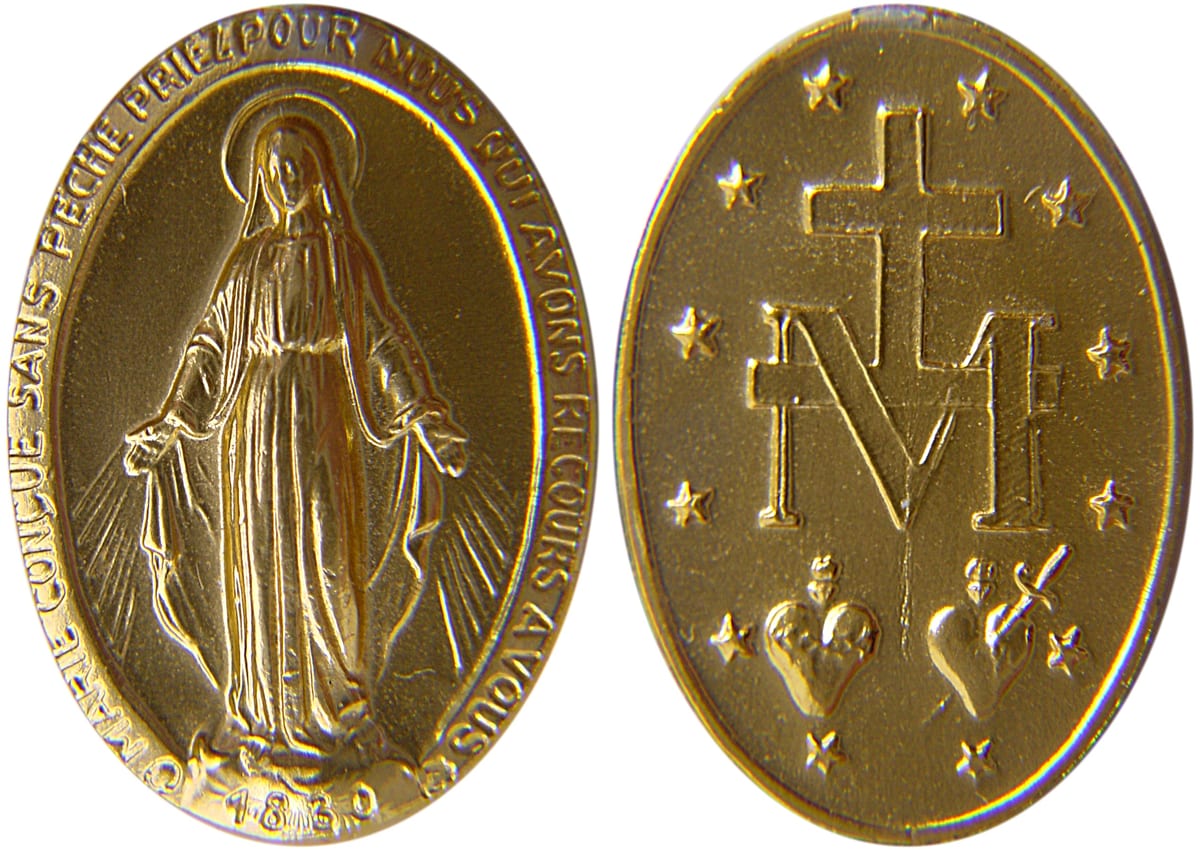
Miraculous medal, Xhienne, photographed May 18, 2007 AD; medal design of 1830 AD, first struck June 30, 1832 AD Xhienne, Wikimedia Commons Nine days after the July apparition the revolution broke out and brought down Charles X. On November 27, 1830 AD the Virgin stood on a half globe and held another in her hands. A voice told her to have a medal struck upon that model.
She left the motherhouse in January 1831 AD without so much as a hope of it. Months later the Virgin complained to her that the orders had not been carried out. The first Miraculous Medals were struck in Paris on June 30, 1832 AD.
“Now it must be disseminated.”
St. Catherine Labouré, 1832 AD -
1831–1876 AD
Forty-six years at Enghien
The kitchen, the old men's ward, and a witness who would not appear.
She arrived at the Hospice d'Enghien at Reuilly on February 5, 1831 AD. She had charge of the kitchen, then of the old men's ward and the poultry yard. Not one of the men in her care died unreconciled to God.
The Archbishop of Paris opened an inquiry into the origin of the medal on February 16, 1836 AD. She would not appear, having made her director promise that her name would never be spoken. In 1841 AD she begged him for an altar on the spot where the Virgin had appeared.
“I cannot; I see God in him.”
St. Catherine Labouré -
1870–1871 AD
The Commune at Reuilly
Siege, a tribunal in the community room, and a month in exile.
Paris was besieged in 1870 AD and the house at Reuilly was turned into a hospital. In 1871 AD the Archbishop of Paris and many other priests were shot. St. Catherine kept the lodge and gave medals to the guardsmen who came asking.
In April 1871 AD soldiers marched her before a tribunal in the community room. The sisters were driven out of the house the next day. She came back on May 31 and put the crown back on the garden statue.
“I told you, dear Mother, that I would come back to crown you on May 31.”
St. Catherine Labouré -
1876 AD
What she had never told
A morning in the parlour at Enghien, and a death at seven in the evening.
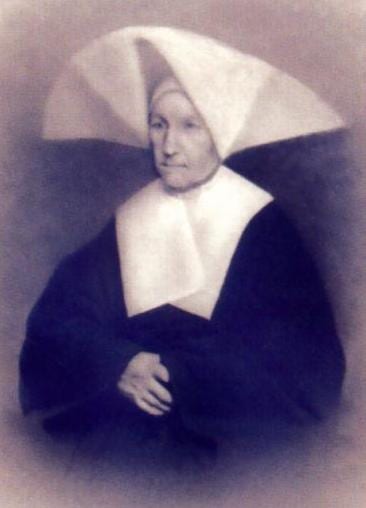
The only known photograph of Catherine Laboure, taken just before her death in 1876 AD, unidentified photographer unidentified photographer, Daughters of Charity Mother House, Paris; published by the Daughters of Charity Provincial Archives Her director had died on April 25, 1865 AD without making known that Our Lady held a globe. Knowing her end near, she asked her superior, Sister Dufès, to hear her. The two stood in the parlour at Enghien until the midday Angelus rang.
Sister Dufès warned her that people would say she had lost her mind. A statue of Mary Immaculate holding the globe was ordered, and she described the serpent for it. She died at seven in the evening on December 31, 1876 AD, without agony.
“Well, it won't be the first time they have thought so, but I shall continue to say, till my last sigh, that the Blessed Virgin appeared to me holding the globe in her hands.”
St. Catherine Labouré, 1876 AD -
1877–1947 AD
Crowds at the coffin
The funeral at Reuilly, the exhumation of 1933 AD, and a canonization in Rome.
From the morning of January 1, 1877 AD people of every age and condition filed past her body. The Daughters of Charity at rue du Bac relate that a boy crippled from birth stood up at her coffin. At the funeral on January 3, 1877 AD the poor she had nursed laid a wreath on her tomb.
The Holy See records that at her exhumation the hands that had touched Our Lady appeared preserved. Pope Pius XI beatified her on May 28, 1933 AD. Pope Pius XII canonised her in the Vatican Basilica on July 27, 1947 AD.
“Ama nesciri ! Deux mots prodigieux, stupéfiants pour le monde qui ne comprend point, béatifiants pour le chrétien qui sait en contempler la lumière, en savourer les délices. Ama nesciri ! Toute la vie, toute l'âme de Catherine Labouré est exprimée dans ces deux petits mots. (Ama nesciri! Two prodigious words, astonishing to the world that does not understand, beatifying for the Christian who knows how to contemplate their light and savour their sweetness. Ama nesciri! The whole life, the whole soul of Catherine Laboure is expressed in these two little words.)”
Pope Pius XII


Pray with the Church
A prayer in her own hand
From the notes St. Catherine Labouré wrote during an annual retreat, found among her papers after her death and printed in her confessor's 1880 AD volume on the Miraculous Medal.
O Mary, Mary, Mary, pray, pray, pray for us, poor sinners, now and at the hour of our death!Mary, O Mary!
All 4 reports on Saint Catherine Labouré

Under siege, Saint Catherine Labouré says Our Lady will guard her house

About this picture
AI-generated image, in the manner of a mid-19th-century French ink-and-wash reportage drawing. No person appears in it.
Fr Aladel's manual for Catholic girls goes through edition after edition

St. Catherine Labouré is told a great cross must rise over Paris

About this picture
AI-generated image, in the manner of a 19th-century French monochrome photograph. No person appears in the picture and no reference image of any person was used. The paper's reference photograph of St. Catherine Labouré is "The only known photograph of Catherine Laboure, taken just before her death in 1876" (unidentified photographer, 1876, Daughters of Charity Mother House, Paris). View source artwork.