
Saints Priest and founder of the Congregation of the Mission · 1581–1660 AD
Saint Vincent de Paul
Feast 27 September · Born 1581 AD, Pouy (now Saint-Vincent-de-Paul), near Dax, Landes, France · Died 1660 AD, Saint-Lazare, Paris, France
From a Gascon sheepfold to the slave market at Tunis, the galleys of France and the famine roads of Lorraine.
Begin the life
In brief
The Dicastery for the Causes of Saints records that Saint Vincent de Paul, commonly known as Monsieur Vincent, was born to a family of peasants in a small village of Gascony on April 24, 1581 AD. He kept his father's flock in the Landes before the schoolroom at Dax and the priesthood. He died at Saint-Lazare in Paris on September 27, 1660 AD.
-
1581–1600 AD
The flock, the school, the altar
A peasant boy of Pouy is sent to the friars at Dax and ordained in the diocese of Dax.
St. Vincent de Paul kept his father's sheep on the open country of the Landes. According to longstanding Catholic tradition, he prayed as a small child before a statue he had set himself in the hollow of an oak. His father decided the boy should be a priest and sent him to the Franciscan friars at Dax.
His parents sold two of their oxen to pay for the journey to the university of Toulouse. He was ordained priest on September 23, 1600 AD. At his first Mass he would have no one present but a server and a priest to direct him.
“I remember that one time when at college, being told that my father, who was only a poor peasant, was waiting for me, I refused to see him, which was a great sin.”
St. Vincent de Paul, confessing a youthful sin of shame at his father's poverty -
1605–1607 AD
Sold at Tunis
Pirates take his ship, and two years of slavery end in a small boat on the Mediterranean.
Three Turkish brigantines chased and pursued his boat in the Gulf of Lyon. He carried the arrow wound of that fight for the rest of his life. Landed at Tunis, he was sold as a slave.
A fisherman bought him first, then an old alchemist who kept ten or fifteen furnaces always burning. His third master, a renegade from Nice, returned to the Church and fled with him. They crossed in a little skiff and landed at Aigues-Mortes on June 28, 1607 AD.
“God always inspired me with an assurance of my release, through the constant prayers I offered to the Blessed Virgin, and to her intercession I attribute my deliverance.”
St. Vincent de Paul to M. de Commet, July 24, 1607 AD -
1608–1611 AD
A room in the Faubourg Saint-Germain
In Paris he drops his family name, is accused of theft, and vows himself to the poor.
In Paris he gave up his family name and had himself called by his baptismal name alone. He took a poor room near a hospital and served the sick and the dying there. A country magistrate who shared the room accused him of stealing four hundred crowns.
An apothecary's boy had taken the money. For four years he bore a temptation against faith he had asked to carry for a tormented doctor of divinity. One day, more dejected than usual, he knelt and vowed his life to Jesus Christ in the person of the poor.
“God knows the truth.”
St. Vincent de Paul to his accuser and those present, response to false accusation of theft before Father de Bérulle -
1612–1617 AD
Gannes, Folleville, Châtillon
A dying peasant's confession leads to the first mission sermon; months later a pulpit appeal at Châtillon produces the first confraternity of Charity.
He was installed as curé of Clichy on May 2, 1612 AD, his first charge of souls. A year later he became tutor to the sons of Philippe-Emmanuel de Gondi, general of the galleys. In January 1617 AD a dying peasant at Gannes made a general confession of his whole life to him.
On January 25, 1617 AD he preached on general confession at Folleville, counted as the first sermon of the mission. That August, as curé of Châtillon-les-Dombes, he appealed from the pulpit for a sick and abandoned family. The Dicastery for the Causes of Saints records that the first cell of the Vincentian Charity came to life on August 20, 1617 AD.
“Why, these good people are like sheep which have no shepherd. This is great charity, but not well directed; the poor people will be overloaded with provisions for a few days, and then they will be in as much distress as before.”
St. Vincent de Paul to those present at Châtillon, August 1617 AD -
1619–1633 AD
The galleys and the little company
Chaplain-General of the galleys, founder of the Congregation of the Mission, master of Saint-Lazare.
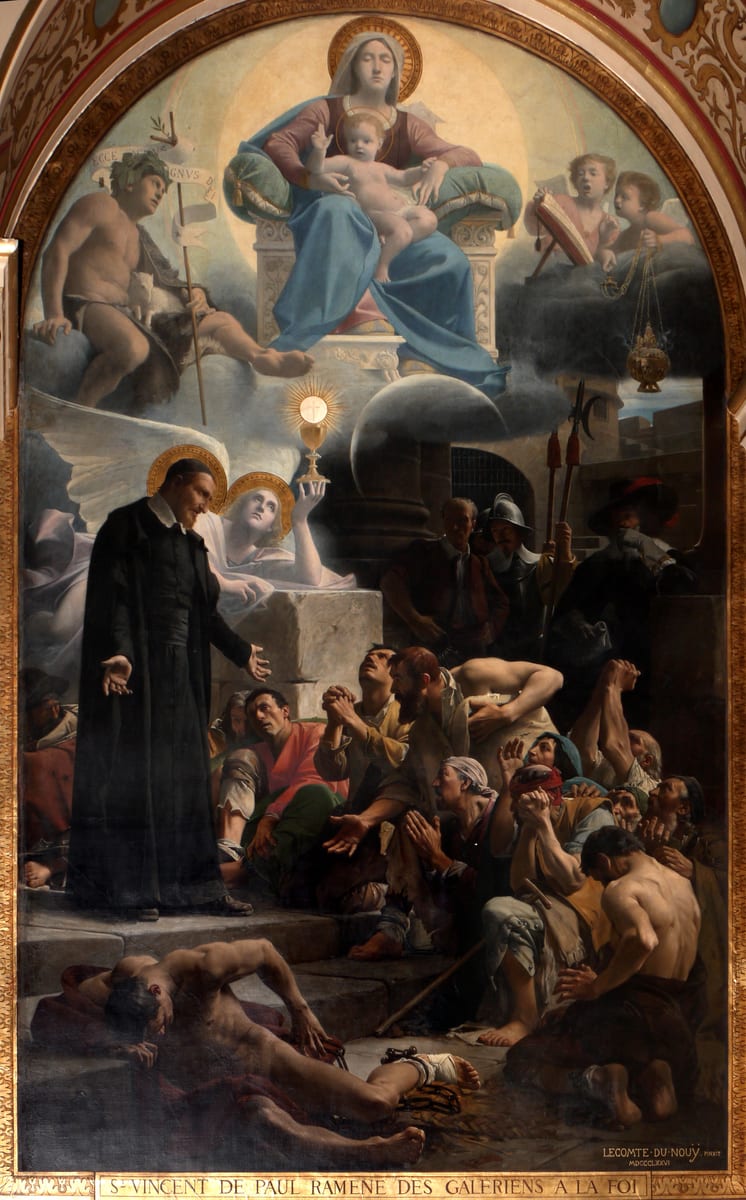
Saint Vincent de Paul ramene des galeriens a la foi, Jean-Jules-Antoine Lecomte du Nouy (1842-1923 AD), 1876 AD Jean-Jules-Antoine Lecomte du Nouy (1842-1923 AD), Chapel of Saint Vincent de Paul, eglise de la Sainte-Trinite, Paris (3) Louis XIII named him Chaplain-General of the Galleys of France on February 18, 1619 AD. He gave missions to the convicts on the galleys of Marseilles and Bordeaux. The Count and Countess de Joigny endowed his company of priests by a deed of April 17, 1625 AD.
He took possession of the priory of Saint-Lazare on January 8, 1632 AD, and it became the mother house. Pope Urban VIII erected the Congregation of the Mission by the bull Salvatoris Nostri that same month. On November 29, 1633 AD St. Louise de Marillac took four or five village girls into a house on the Rue des Fossés Saint-Victor.
“a community who had no monastery but the houses of the sick, no cells but a lodging of the poorest room, no cloisters but the streets, no grille but the fear of God, and no veil but their own modesty.”
St. Vincent de Paul, describing the Sisters of Charity -
1637–1652 AD
Lorraine, and a ride through the lines
War empties the provinces, and the old priest rides out of a besieged Paris to ask for peace.
In 1637 AD the people of Lorraine were glad to eat carcasses, and thriving villages stood deserted. From 1640 AD five hundred livres a month went to Nancy, Verdun, Metz, Toul and Bar-le-Duc. In January 1649 AD, with Paris besieged, he rode out long before daybreak with a single companion.
At Saint-Germain he spoke to Queen Anne of Austria of the state of Paris and urged Cardinal Mazarin to withdraw for the sake of peace. Five days later eight hundred soldiers broke into Saint-Lazare and destroyed what they found. In a letter of June 21, 1652 AD he set down that soup went out daily to fifteen or sixteen thousand poor of Paris.
“Your Eminence, yield to circumstances ; cast yourself into the waves rather than wreck the vessel of the State.”
St. Vincent de Paul to Cardinal Mazarin, urging Mazarin to withdraw for the sake of peace, January 13, 1649 AD -
1655–1660 AD
The rules, and the chair
He gives his priests their printed rules, loses his oldest friends, and dies at four in the morning.
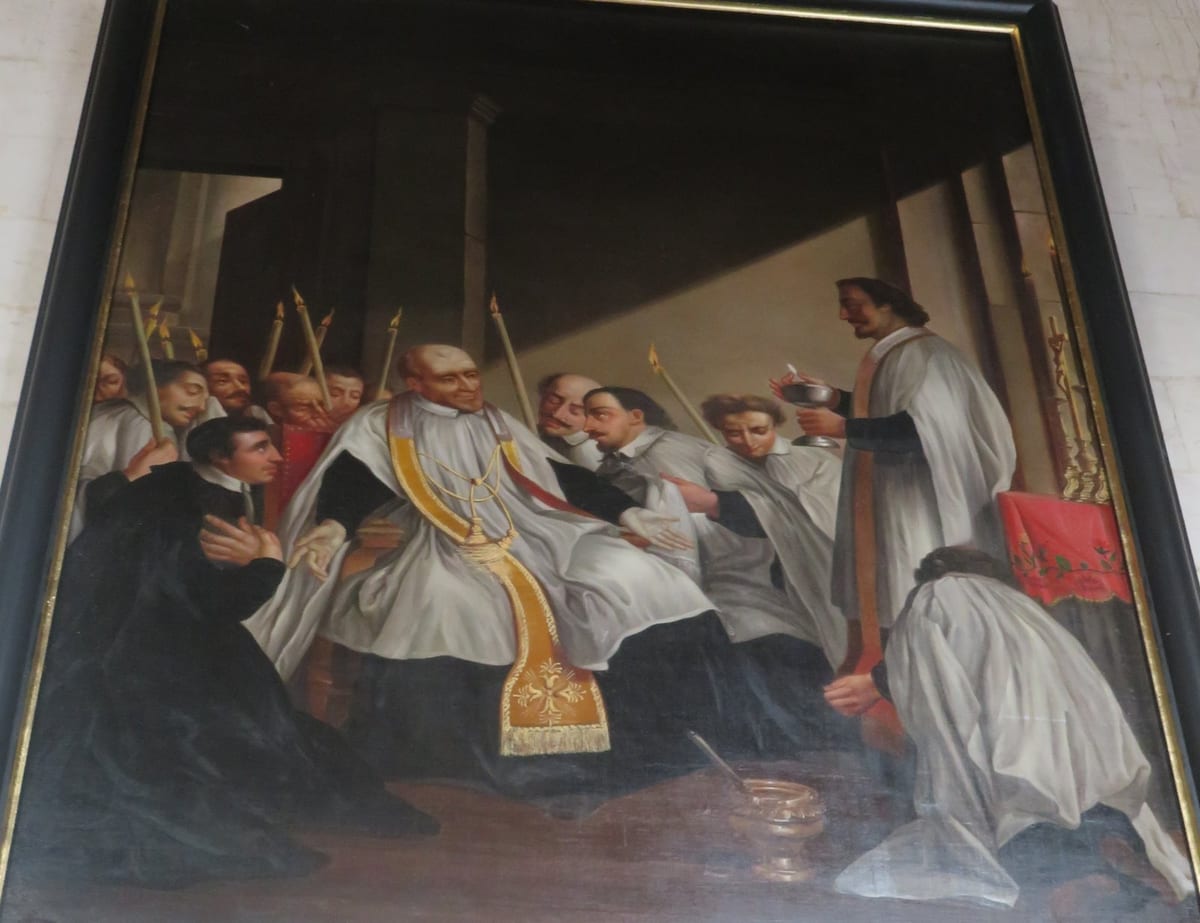
Vincent de Paul recevant les derniers sacrements, nineteenth-century copy after an earlier composition; photographed by the Wikimedia contributor Vinckie, October 20, 2020 AD, nineteenth century nineteenth-century copy after an earlier composition; photographed by the Wikimedia contributor Vinckie, October 20, 2020 AD, eglise Saint-Jacques-le-Majeur-et-Saint-Jean-Baptiste, Folleville, Somme (3) Swelling and pain in his legs had kept him inside the house since the beginning of 1650 AD. On the evening of May 17, 1658 AD he handed each of his priests a printed copy of the Common Rules. St. Louise de Marillac died in March 1660 AD, and he could not leave his room to see her.
On Sunday, September 26, 1660 AD he was carried to the chapel, heard Mass and received communion for the last time. He died about four the next morning, seated in an arm-chair, while his priests were saying matins.
“Confido — I trust”
St. Vincent de Paul, last words before dying, September 27, 1660 AD -
1660–2017 AD
Patron of charity
Paris buries him at Saint-Lazare, and Rome gives his name to the charitable works of the whole Church.
He was buried in the middle of the chancel of the church of Saint-Lazare on September 28, 1660 AD. Pope Benedict XIII inscribed him among the Blessed on August 13, 1729 AD. Pope Clement XII canonized him at Saint John Lateran on June 16, 1737 AD.
Frédéric Ozanam founded the lay Society of Saint Vincent de Paul in Paris in 1833 AD. Pope Leo XIII declared him patron of all Catholic charitable associations on May 12, 1885 AD. Pope Francis wrote to the Vincentian family on September 27, 2017 AD, on the fourth centenary of a charism the Church dates to 1617 AD.


,_%C3%A9glise_Saint-Jacques-le-Majeur-et-Saint-Jean-Baptiste,_Vincent_de_Paul_recevant_les_derniers_sacrements.jpg)
Pray with the Church
A prayer of Saint Vincent de Paul for his company
A prayer Saint Vincent de Paul made aloud in a conference to his priests, recorded by Mgr Émile Bougaud in his History of St. Vincent de Paul, volume 1.
O Lord, who seest me all covered and filled with sins, do not on my account take away Thy grace from this little company !May it continue to serve you in humility and with fidelity
All 11 reports on Saint Vincent de Paul

About this picture
AI-generated image, in the manner of French oil painting of the middle of the seventeenth century, from the paper's reference portrait based on Portrait de saint Vincent de Paul (1581-1660) (Anonymous, after a model by Simon Francois de Tours, circa 1660, Musee Carnavalet - Histoire de Paris) View source artwork.
St. Vincent de Paul takes on a priest's doubts for four years

About this picture
AI-generated image, in the manner of French oil painting of the middle of the seventeenth century, from the paper's reference portrait based on Portrait de saint Vincent de Paul (1581-1660) (Anonymous, after a model by Simon François de Tours, circa 1660, Musée Carnavalet – Histoire de Paris) View source artwork.
Princes and thousands of Paris poor bury St. Vincent de Paul at Saint-Lazare

St. Vincent de Paul dies at four, his hour of prayer

About this picture
AI-generated image, in the manner of French oil painting of the middle of the seventeenth century, from the paper's reference portrait based on Portrait de saint Vincent de Paul (1581-1660) (Anonymous, after a model by Simon Francois de Tours, circa 1660, Musee Carnavalet - Histoire de Paris) View source artwork.
Saint Vincent de Paul visits his successor, then falls into a deep sleep

St. Vincent de Paul, a farmer's son of nineteen, is ordained priest

About this picture
AI-generated image, in the manner of seventeenth-century French oil portraiture, from the paper's reference portrait based on Portrait de saint Vincent de Paul (1581-1660) (anonymous, after a model by Simon François de Tours, circa 1660, Musée Carnavalet - Histoire de Paris) View source artwork.
Pope approves St. Vincent de Paul's plan: vows, but no religious order

About this picture
AI-generated image, in the manner of French oil painting of the middle of the seventeenth century, from the paper's reference portrait based on Portrait de saint Vincent de Paul (1581-1660) (Anonymous, after a model by Simon Francois de Tours, circa 1660, Musee Carnavalet - Histoire de Paris, inv. P863) View source artwork.
._-_P863_-_Mus%C3%A9e_Carnavalet.jpg)
St. Vincent de Paul, sold again at Tunis, tends an alchemist's furnaces

About this picture
AI-generated image, in the manner of French oil painting of the middle of the seventeenth century, from the paper's reference portrait based on Saint Vincent de Paul ramene des galeriens a la foi (Jean-Jules-Antoine Lecomte du Nouy, 1876, Chapel of Saint Vincent de Paul, eglise de la Sainte-Trinite, Paris) View source artwork.
Letter tells Madame de Gondi: St. Vincent de Paul will not return

About this picture
AI-generated image, in the manner of French oil painting of the middle of the seventeenth century, from the paper's reference portrait based on Saint Vicent de Paul prechant la charite aux dames de la cour de Louis XIII (Charles Meynier, 1824 AD, Centre national des arts plastiques, FNAC PFH-5608) View source artwork.

Bishop gives the men he will ordain to St. Vincent de Paul

About this picture
AI-generated image, in the manner of French oil painting of the middle of the seventeenth century, from the paper's reference portrait based on Saint Vincent de Paul prechant la charite aux dames de la cour de Louis XIII (Charles Meynier, 1824 AD, Centre national des arts plastiques, FNAC PFH-5608) View source artwork.
Joigny's leading women sign a rule to nurse the town's sick poor

About this picture
AI-generated image, in the manner of French oil painting of the middle of the seventeenth century, from the paper's reference portrait based on Saint Vincent de Paul ramène des galériens à la foi (Jean-Jules-Antoine Lecomte du Nouÿ, 1876, Chapel of Saint Vincent de Paul, église de la Sainte-Trinité, Paris) View source artwork.