
Saints Mother Seton of Emmitsburg
Saint Elizabeth Ann Seton
Feast 4 January · Born 1774 AD, New York City, New York, United States · Died 1821 AD, St. Joseph's Valley, Emmitsburg, Maryland, United States
A New York wife widowed in Italy, received into the Catholic Church at thirty, and buried in the wood at Emmitsburg.
Begin the life
In brief
Saint Elizabeth Ann Seton, commonly known as Mother Seton, was born in New York City on August 28, 1774 AD. She was widowed in Tuscany at twenty-nine on December 27, 1803 AD. Pope Paul VI named her foundress of the first religious congregation of women in the United States.
-
1774–1789 AD
A doctor's house in New York
Two deaths in the family before she was five, and a father who taught her himself.
Her father, Dr. Richard Bayley, taught anatomy at Columbia College and served as health officer of the port. Her mother, Catherine Charlton Bayley, died in 1777 AD, when the child was three. Her younger sister Catharine died the next year, at two.
At four she sat alone on a step of the doorway while that child lay in her coffin. Dr. Bayley took her education almost entirely into his own hands. He would not let music, French and drawing crowd out English, needlework and housekeeping.
“No, because Kitty was gone up to Heaven; I wish I could go too, with mamma.”
St. Elizabeth Ann Seton to unnamed questioners, 1778 AD -
1794–1801 AD
Marriage, and the failure of the house
She married into a leading merchant family, then watched the firm and her father go.
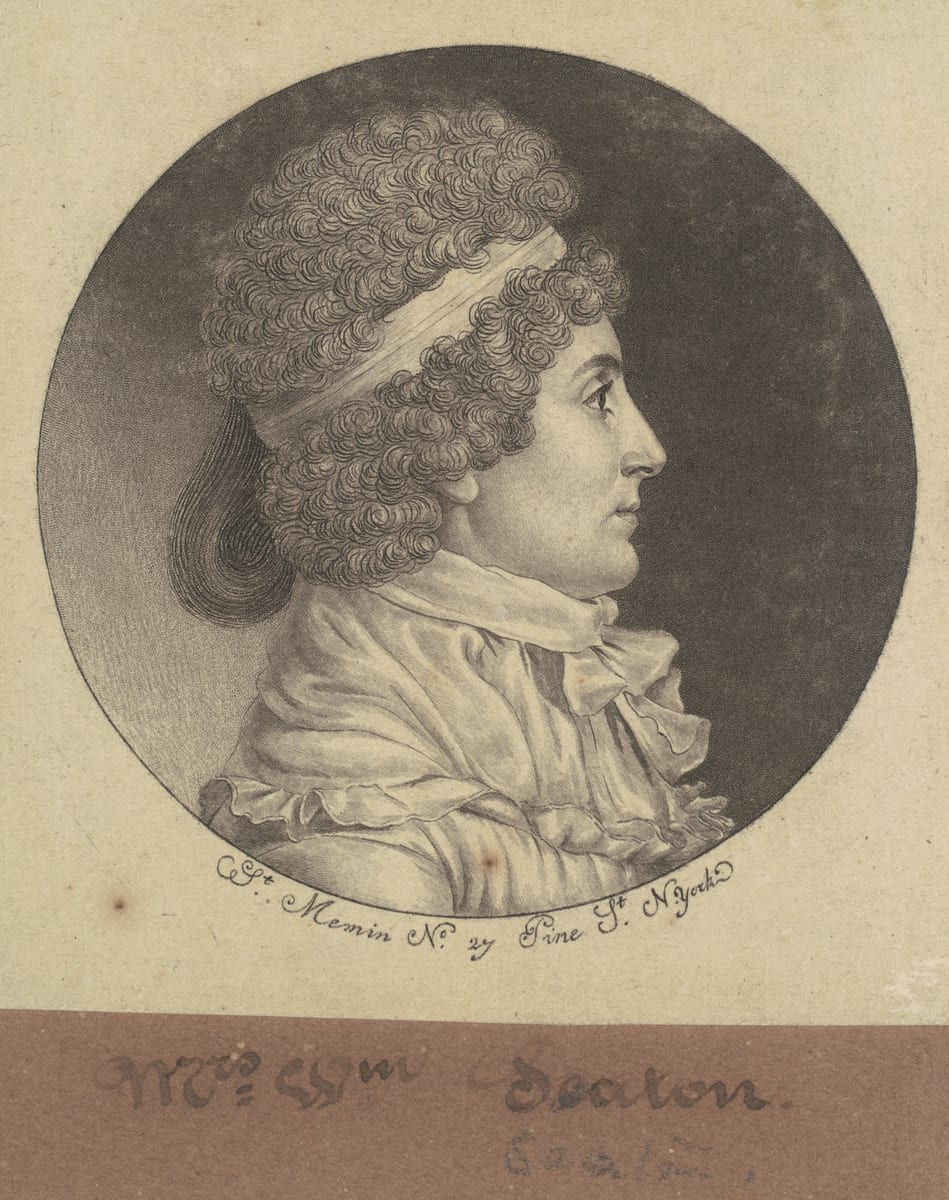
Elizabeth Ann Bayley Seton, Charles Balthazar Julien Fevret de Saint-Memin (1770-1852 AD), 1797 AD Charles Balthazar Julien Fevret de Saint-Memin (1770-1852 AD), National Gallery of Art, Washington (Corcoran Collection, accession 2015.19.1584.6.12) On January 25, 1794 AD she married the merchant William Magee Seton at Trinity Church, not yet twenty. Five children were born to them in a few years. When her father-in-law died she became at once the mother of six more.
From 1798 AD the commercial crisis stopped the prosperity of her husband's house. In 1801 AD her father found fever aboard an Irish emigrant ship at the Staten Island quarantine. He went home to his bed that afternoon and died seven days after.
-
1803 AD
Twenty-six days in the lazaretto
The voyage taken for her husband's health ended behind the stone walls of a quarantine station.
Her husband's health broke down, and the brig Shepherdess sailed for Italy on October 2, 1803 AD. She went with him, and with their eldest daughter Anna Maria, then in her ninth year. The ship reached the mole of Livorno on November 18 and was refused landing.
Theirs was the first ship to bring the news that yellow fever had broken out in New York. The next day they were shut inside the quarantine station, in a cold and bare room. William Magee Seton died at a quarter past seven on the morning of December 27, 1803 AD.
“At a quarter past seven, on Tuesday morning, December twenty-seventh, his soul was released, and mine from a struggle worse than death.”
St. Elizabeth Ann Seton to Rebecca Seton, letter recounting William Seton's death, December 27, 1803 AD -
1804–1805 AD
A widow's search
The Filicchi households at Livorno, and the cost of what she decided in New York.
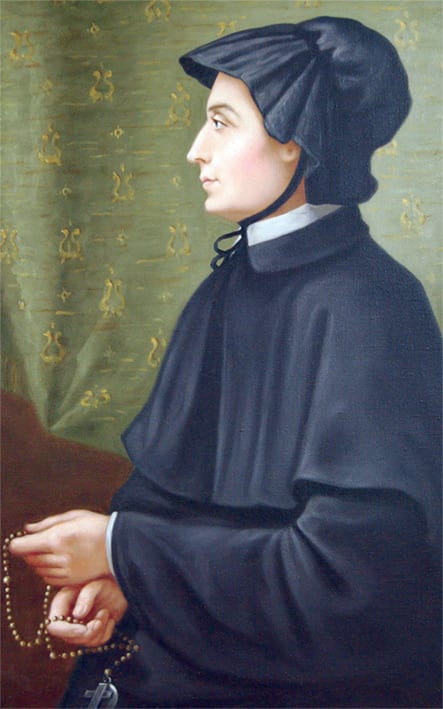
Portrait of Elizabeth Ann Seton, Amabilia Filicchi, after the Ceroni engraving of c. 1868 AD, itself after Saint-Memin's engraving of 1797 AD, painted in Livorno; the reproduction sent to the Daughters of Charity by Patrizio Filicchi in 1888 AD Amabilia Filicchi, after the Ceroni engraving of c. 1868 AD, itself after Saint-Memin's engraving of 1797 AD, Daughters of Charity / National Shrine of St. Elizabeth Ann Seton, Emmitsburg (the original painting was destroyed in the Second World War; a reproduction is exhibited in the shrine museum) At Livorno the Filicchi brothers kept her and her daughter and put Catholic books into her hands. On February 2, 1804 AD they brought her to Mass at Our Lady of Montenero above the town. In that church a young Englishman spoke scornfully of the Real Presence at the Elevation.
Home in New York, her relatives made their support conditional on her staying an Episcopalian, and then deserted her. She made her profession of faith at St. Peter's in Barclay Street on March 14, 1805 AD. She made her first Communion there eleven days later, on the feast of the Annunciation.
“At last, Amabilia, at last, God is mine and I am His. Now let all earthly things go as they will. I have received Him.”
St. Elizabeth Ann Seton to Amabilia Filicchi, letter describing her first communion, March 25, 1805 AD -
1808–1809 AD
Baltimore, and the valley of St. Joseph
A school for girls, vows at thirty-four, and a farmhouse fifty miles from Baltimore.
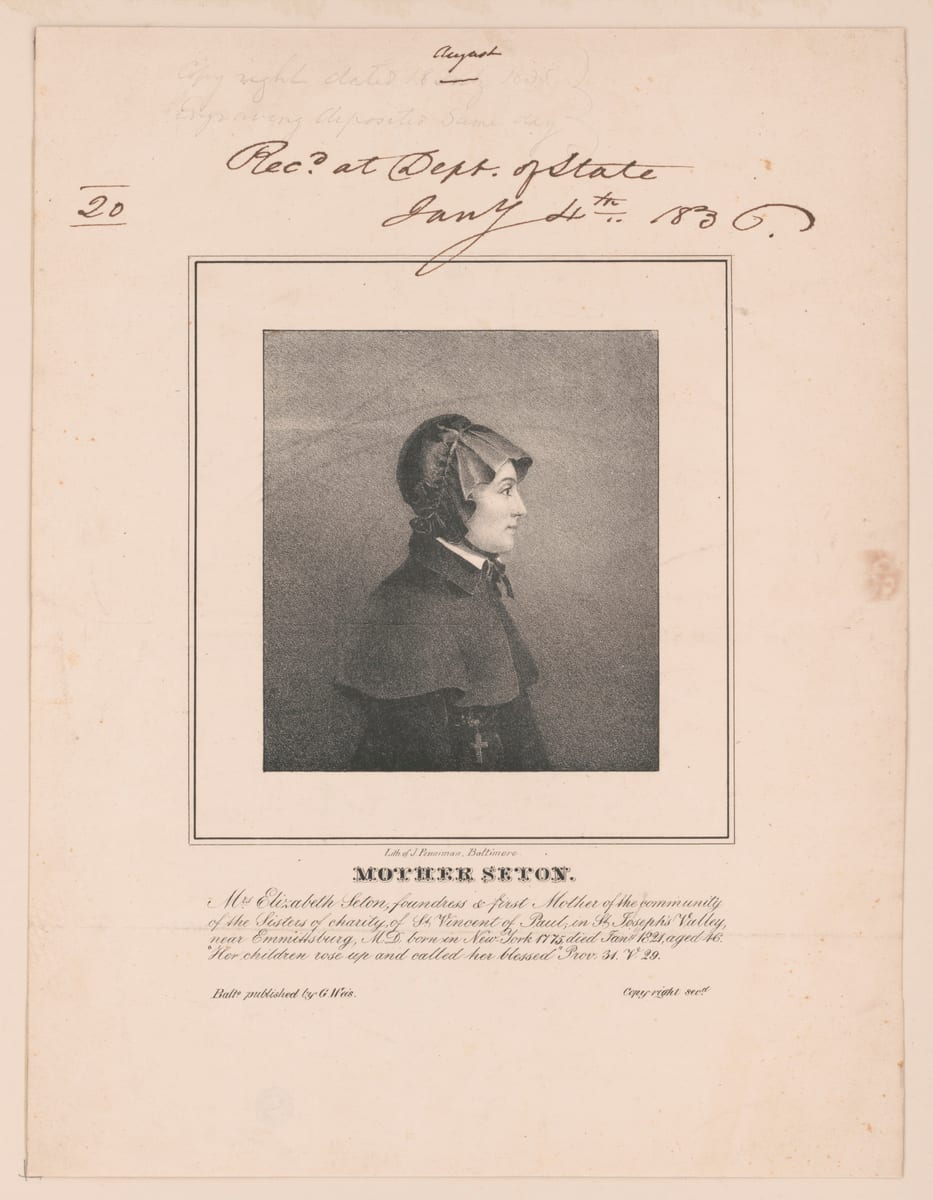
Mother Seton, J. Penniman (associated name on the Library of Congress shelflist), nineteenth century; no date on the shelflist card J. Penniman (associated name on the Library of Congress shelflist), Library of Congress, Prints and Photographs Division, Popular Graphic Arts collection (LCCN 2003677120, digital id pga.11129, call number PGA - Penniman, J. - Mother Seton) Father William Valentine Dubourg offered her a small school for the education of girls at Baltimore. She left New York with her children and landed there on June 16, 1808 AD, the feast of Corpus Christi. She pronounced her vows on March 25, 1809 AD, and from that time was called Mother Seton.
A benefactor, Samuel Cooper, gave a plot of land at Emmitsburg, fifty miles from Baltimore. The sisters went down into the valley of St. Joseph on July 31, 1809 AD. Six months later Mother Seton opened the school in a new wooden building painted white.
“Dearest Saviour, if you would give me the care of poor little children, no matter how poor!”
St. Elizabeth Ann Seton to God, praying after Holy Communion, 1808 AD -
1809–1816 AD
The wood at St. Joseph's
Four graves under the oak, and a rule confirmed at Baltimore between them.
Her sister-in-law Harriet Seton died before Christmas 1809 AD and was buried under an oak in the wood. Cecilia Seton, who at fifteen had left her family to follow her into the Church, died on April 29, 1810 AD. Her eldest daughter Anna Maria made her vows on her deathbed and died on March 12, 1812 AD, at sixteen.
Twenty sisters were told they need not accept the Rule of St. Vincent de Paul, and all but one embraced it. Archbishop John Carroll confirmed the rule on January 17, 1812 AD, and the sisters then elected her superior. Her youngest daughter Rebecca died in her arms on November 2, 1816 AD, after nine weeks nursed night and day.
“Dearest Harriet and my angel Cecil sleep in the wood close beside me. The children, and many of our good sisters, to whom they were much attached, have planted their graves with wild-flowers, and the little enclosure which contains them is the dearest spot to me on earth.”
St. Elizabeth Ann Seton to a Protestant friend, letter, 1810 AD -
1818–1821 AD
The last illness
Consumption held her four months in one room, and the sisters were called at midday.
From an attack of illness in 1818 AD she never entirely recovered. Archbishop Ambrose Marechal visited the valley that September and set down in his diary that she was in consumption. An abscess on the lungs confined her to her room for four months from the autumn of 1820 AD.
Father Simon Gabriel Bruté gave her Viaticum on December 30, 1820 AD. At midday on January 2, 1821 AD the sisters were called to her bedside for Extreme Unction. She died towards two in the morning on January 4, 1821 AD, in her forty-seventh year.
“Dear ones, pray for me when I am gone, for I shall want it. I thank God for having made me a child of His church: when you come to this hour you will know what it is to be a child of the church.”
St. Elizabeth Ann Seton to the Sisters present, on her deathbed, after extreme unction, January 2, 1821 AD -
1880–1975 AD
The cause, and the canonization
From a Baltimore archbishop's petition to the basilica of St. Peter.
Archbishop James Gibbons of Baltimore urged in 1880 AD that steps be taken toward her canonization. The results of the Baltimore inquiries were placed in the postulator's hands at Rome on June 7, 1911 AD.
Pope John XXIII beatified her in St. Peter's Basilica on March 17, 1963 AD. Pope Paul VI canonized her in the same basilica on September 14, 1975 AD. The Pope set her deathbed words of January 2, 1821 AD before her sisters as a heavenly testament.
“Elizabeth Ann Bayley Seton is a Saint! She is the first daughter of the United States of America to be glorified with this incomparable attribute!”
Pope Paul VI, canonization homily, 14 September 1975, September 14, 1975 AD


Pray with the Church
A familiar prayer of Saint Elizabeth Ann Seton
One of the prayers St. Elizabeth Ann Seton repeated most often, near the end of her life, and printed in the published memoir, letters and journal.
May the most just, the most high, and the most amiable will of Godbe in all things fulfilled, praised, and exalted above all, forever.
All 7 reports on Saint Elizabeth Ann Seton

About this picture
AI-generated image, in the manner of a nineteenth-century reportage drawing in pen, ink and sepia wash. No person appears in it.
Archbishop of Baltimore is buried in his aunt St. Elizabeth Ann Seton's vault

About this picture
AI-generated image, in the manner of early nineteenth-century American stipple and line engraving, from the paper's reference portrait based on Elizabeth Ann Bayley Seton (Charles Balthazar Julien Fevret de Saint-Memin, 1797, National Gallery of Art, Washington) View source artwork.
St. Elizabeth Ann Seton leaves a one-year-old baby and sails for Italy

About this picture
AI-generated image, in the manner of an early nineteenth-century American stipple and line engraving, from the paper's reference portrait based on Portrait of Elizabeth Ann Seton (Amabilia Filicchi, after the Ceroni engraving of c. 1868 after Saint-Memin's engraving of 1797, Daughters of Charity / National Shrine of St. Elizabeth Ann Seton, Emmitsburg) View source artwork.
St. Elizabeth Ann Seton likens her soul to a bird in a net

About this picture
AI-generated image, in the manner of early nineteenth-century American stipple and line engraving, from the paper's reference portrait based on Portrait of Elizabeth Ann Seton (Amabilia Filicchi, after the Ceroni engraving of c. 1868 after Saint-Memin's engraving of 1797; Daughters of Charity / National Shrine of St. Elizabeth Ann Seton, Emmitsburg) View source artwork.
St. Elizabeth Ann Seton, in her pew, prays toward the Catholic church

Pope Paul VI declares Saint Elizabeth Ann Seton a saint

About this picture
AI-generated image, in the manner of early nineteenth-century American stipple and line engraving, from the paper's reference portrait based on Mother Seton (J. Penniman, nineteenth century, Library of Congress, Prints and Photographs Division) View source artwork.
The Archbishop decides whether St. Elizabeth Ann Seton may lead her sisters

About this picture
AI-generated image, in the manner of early nineteenth-century American stipple and line engraving, from the paper's reference portrait based on Mother Seton (J. Penniman, nineteenth century, Library of Congress, Prints and Photographs Division) View source artwork.