
Saints Carmelite of Lisieux and Doctor of the Church · 1873–1897 AD
Saint Thérèse of Lisieux
Feast 1 October · Born 1873 AD, 42 Rue Saint-Blaise, Alençon, Orne, France · Died 1897 AD, the infirmary, Carmel of Lisieux, Calvados, France
A Carmelite of twenty-four in a small Norman monastery, whom the Church now numbers among the Doctors of the universal Church — her life in eight chapters, from the lace house at Alençon to Saint Peter's Square.
Begin the life
In brief
Saint Thérèse of Lisieux, also called Therese of Lisieux, was born at Alençon in Normandy on January 2, 1873 AD, the ninth child of a watchmaker and a maker of point-lace. She entered the Carmel of Lisieux at fifteen, on April 9, 1888 AD, and lived there for nine years. She died of tuberculosis in the monastery infirmary on September 30, 1897 AD, at twenty-four. Pope Pius XI canonized her in Saint Peter's Basilica on May 17, 1925 AD, twenty-eight years later. On October 19, 1997 AD Pope John Paul II proclaimed her a Doctor of the Universal Church, the thirty-third and the youngest. The Church keeps her memorial on October 1, the day after her death.
-
1873–1877 AD
The house on the Rue Saint-Blaise
She was born into a working household at Alençon and lost her mother before she was five.
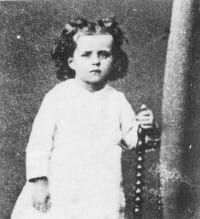
Thérèse at three and a half years old (Carmel of Lisieux photograph n° 1), Unidentified photographer of Alençon, first half of July 1876 AD Unidentified photographer of Alençon, Wikimedia Commons, from the Archives of the Carmel of Lisieux Saint Louis Martin had given up his jeweller's business in 1871 AD and retired to a house at 42 Rue Saint-Blaise in Alençon, where his ninth child was born on January 2, 1873 AD. Saint Zélie Martin had set up a Point d'Alençon lace workshop in the same street about 1853 AD, and the work kept her on her feet from four in the morning until eleven at night. The child was baptized two days later in the church of Notre-Dame, her eldest sister Marie standing as godmother. Within weeks she was failing, and she was sent out to a foster-mother in the country before being brought back to Alençon some months later.
Four of the nine Martin children had already died young. In late 1876 AD a doctor told St. Zélie Martin that the tumour in her breast was serious and advised against an operation. She left Alençon for Lourdes on June 18, 1877 AD with her three eldest daughters, went into the baths, and came home with her condition unchanged. She received Extreme Unction at home on August 26, 1877 AD, with the whole family gathered round the bed. She died at half past midnight on August 28, 1877 AD, her husband and her brother in the room.
St. Thérèse was four and a half years old. She had knelt in the room for the anointing, and remembered afterwards the place where she knelt and the sound of her father sobbing. The day after the death her father carried her to the body and told her to kiss her mother for the last time. The funeral was sung at nine o'clock the following morning in the parish church, and by the custom of the time the five daughters did not attend. That day, when the family nurse spoke to the two youngest, Céline chose Marie for her mother and St. Thérèse chose Pauline. From then on the lively, demonstrative child became timid, shy and extremely sensitive, and a look was enough to make her cry.
“And Pauline will be my Mother.”
St. Thérèse of Lisieux, August 1877 AD -
1877–1886 AD
Les Buissonnets
At Lisieux she lost a second mother to the Carmel, nearly died of a strange illness, and came to the sacraments.
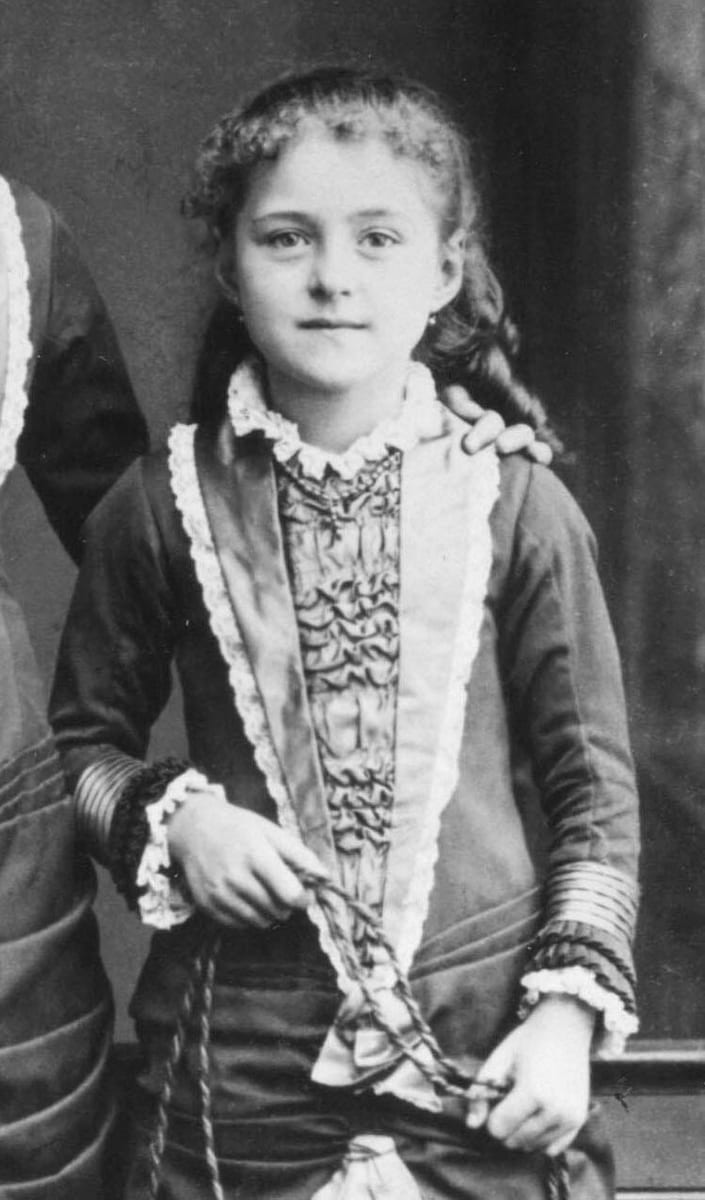
Thérèse at eight years old, Workshop of Mme Besnier, photographer in Lisieux, 1881 AD Workshop of Mme Besnier, photographer in Lisieux, Wikimedia Commons; credited to archives.carmeldelisieux.fr In November 1877 AD St. Louis Martin moved his five daughters to Lisieux, to a house called Les Buissonnets, so as to be near his brother-in-law Isidore Guérin, a chemist and the girls' deputy guardian. Pauline gave her her reading lessons, and on the afternoon walks she took every day with her father he showed her the grating of the Carmel of Lisieux. From 1881 AD to 1886 AD she was a half-boarder at the Benedictine Abbey school of Notre-Dame du Pré, where she learned easily but never adapted to life with her classmates. She finished her lessons privately with Madame Papinau until February 1888 AD.
Pauline Martin entered the Carmel of Lisieux on October 2, 1882 AD and became Sister Agnes of Jesus. Before the entry St. Thérèse, then nine, had contrived to be alone with the prioress and told her that she too wanted to be a Carmelite, and was told to wait until she was sixteen. At the close of that year the headaches began, and the family traced them to the loss of Pauline. At Easter 1883 AD, while her father was in Paris and she was in the Guérins' care, the headache turned to shivering, delirium and terror, and the nails in the wall appeared to her as long fingers blackened with fire.
Her father sent money to Paris for a novena of Masses at the shrine of Our Lady of Victories. On Pentecost Sunday, May 13, 1883 AD, while Marie, Léonie and Céline knelt praying before the statue of the Virgin beside her bed, the statue seemed to her to come to life, and she was healed. Pope John Paul II described the healing as an extraordinary grace obtained through the intercession of Our Lady of Victories. Marie asked leave to tell the Carmel, and the nuns' questions afterwards persuaded the child that she had told an untruth, a pain that lasted four years. She made her First Communion on May 8, 1884 AD, the day Pauline made profession at the Carmel, and was confirmed at the Abbey on June 14, 1884 AD by Bishop Flavien Hugonin. Marie Martin entered the Carmel on October 15, 1886 AD, and the sister who had carried her through two years of scruples was behind the grating too.
“Pauline is lost to me.”
St. Thérèse of Lisieux, October 2, 1882 AD -
1886–1888 AD
The fight to enter
A change on Christmas night, a sinner prayed for, and a long round of asking her father, her uncle, a superior, a bishop and a pope.
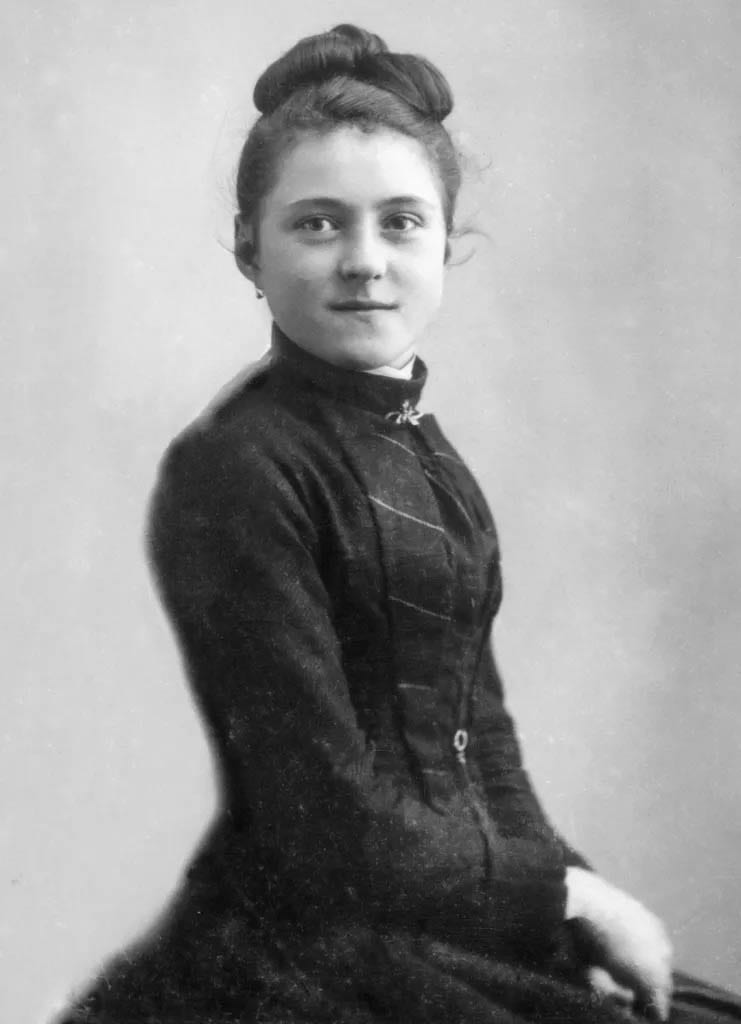
Thérèse at fifteen (Carmel of Lisieux photograph n° 4), Workshop of Mme Besnier, photographer in Lisieux, April 1888 AD Workshop of Mme Besnier, photographer in Lisieux, Wikimedia Commons, from the Archives of the Carmel of Lisieux Coming home from Midnight Mass on Christmas night 1886 AD, she overheard her father on the stairs, vexed at the shoes still waiting for her in the chimney-corner as they had waited when she was small. She choked back her tears, ran down to the dining-room and pulled out the presents, and she called the night her complete conversion. Pope John Paul II said that by that experience she overcame the emotional weakness caused by the loss of her mother. In July 1887 AD, at the end of Mass in the cathedral of Saint-Pierre, a picture of the crucified Christ half slipped from her missal and showed one pierced and bleeding hand. The Carmel of Lisieux archives call that moment the revelation of her mission, to save souls by prayer and sacrifice.
The next month she took up the case of Henri Pranzini, sentenced to death for three murders and refusing all help from religion, and asked God for one sign of his repentance. Her father never let his daughters read the papers, but the day after the execution she opened La Croix. Pranzini had mounted the scaffold without confession and then, as the executioners dragged him to the block, had turned, seized the priest's crucifix and kissed the wounds three times. Pope Benedict XVI called the episode her first and fundamental experience of spiritual motherhood.
On Pentecost Sunday, May 29, 1887 AD, after Vespers, she sat down beside her father in the garden at Les Buissonnets and told him she wanted to enter Carmel, and he wept and consented. He picked a small white flower from the low stone wall and gave it to her, pulled up by the roots without breaking them. Her uncle Isidore Guérin held that entering so severe an order at fifteen was against all common sense, and gave way on October 22, 1887 AD. Canon Delatroëtte, superior of the Carmel, refused to admit her before she was twenty-one, adding that he was only the bishop's delegate. On October 31, 1887 AD she put up her long hair to look older and pleaded her case at Bayeux before Bishop Hugonin, who deferred his answer and promised she would hear while she was in Italy. At the papal audience of November 20, 1887 AD the Vicar-General forbade anyone in a loud voice to address the Holy Father, and she knelt and asked Pope Leo XIII to let her enter at fifteen.
“Holy Father, in honour of your jubilee, will you allow me to enter the Carmel when I am fifteen?”
St. Thérèse of Lisieux, November 20, 1887 AD -
1888–1894 AD
Behind the grating
Five years of linen rooms and staircases began with her father's collapse and ended with his death.
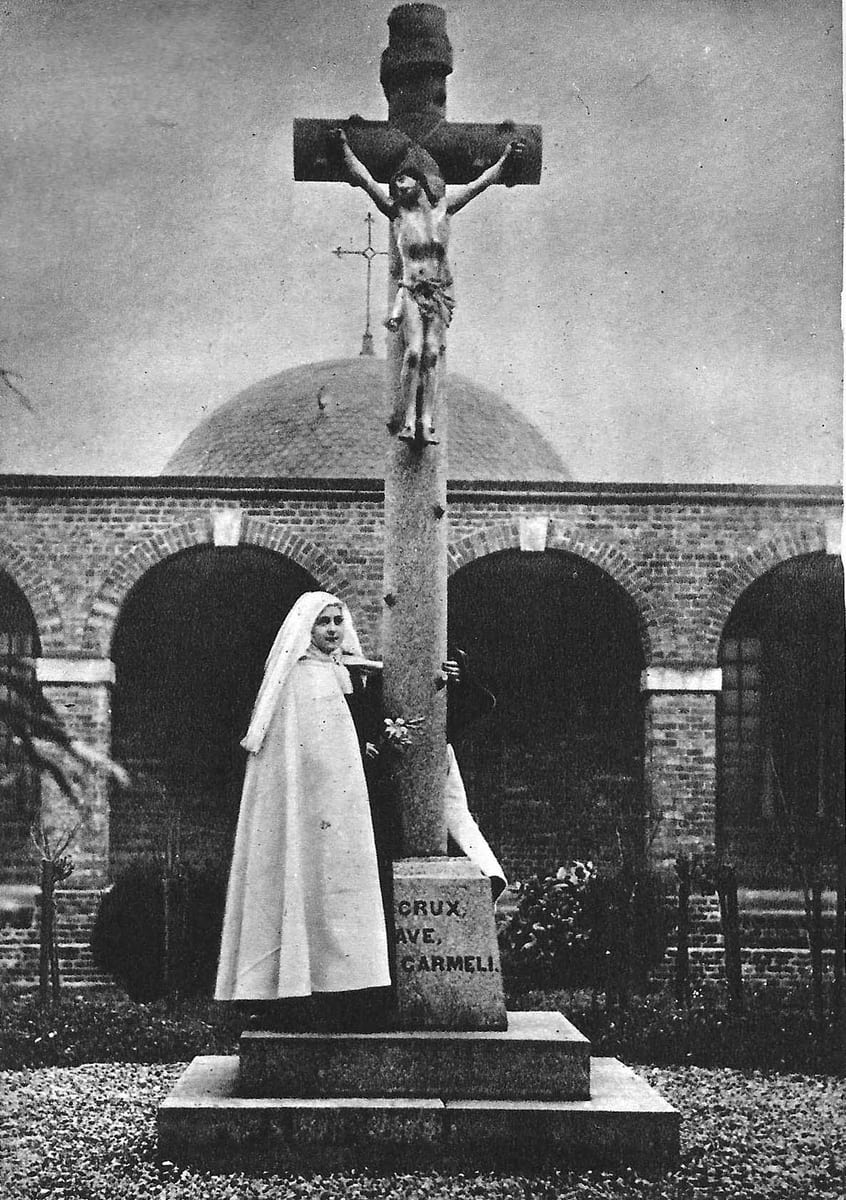
Thérèse a novice at the calvary of the courtyard (Carmel of Lisieux photograph n° 5 / n° 6), Father Gombault of the Minor Seminary; halftone plate from Histoire d'une âme, Office central de Lisieux / Imprimerie Saint-Paul, Bar-le-Duc, 1937 AD edition, 1940 AD printing, January 1889 AD, a few days after the clothing of January 10 Father Gombault of the Minor Seminary; halftone plate from Histoire d'une âme, Office central de Lisieux / Imprimerie Saint-Paul, Bar-le-Duc, 1937 AD edition, 1940 AD printing, Wikimedia Commons The bishop's authorisation had been in the prioress's hands since December 28, 1887 AD, and the doors opened only after Lent, on April 9, 1888 AD. At the cloister door her father knelt with her and blessed her through his tears. As a postulant she worked in the linen room with the sub-prioress and was given the sweeping of the staircase and the dormitory. Mother Marie de Gonzague rebuked her before the whole community for a cobweb left in the cloister, and remarked in her hearing that the child did absolutely nothing. Two months after her entry Father Pichon heard her general confession and declared that before God she had never committed a mortal sin. She received the Carmelite habit on January 10, 1889 AD, and snow covered the quadrangle in spite of the mild weather, as she had secretly wished.
One month later, on February 12, 1889 AD, a degenerative brain disease brought on a serious attack and St. Louis Martin was taken to the Bon Sauveur asylum at Caen, where he remained three years. His youngest daughter plunged into silence and prayer and contemplated the Holy Face at length, and her name in religion was formed in those years: Sister Thérèse of the Child Jesus and of the Holy Face. Her profession was put off eight months by the ecclesiastical superior, and on the eve of it she was seized by the conviction that she had no vocation and was deceiving her superiors. She pronounced her vows on September 8, 1890 AD, at seventeen and a half, carrying on her heart a paper on which she had written her own petitions. She received the black veil on September 24, in a ceremony her father was too ill to attend and at which Bishop Hugonin was unable to preside.
At the community retreat of October 1891 AD the Franciscan Alexis Prou understood her at once, after years in which she had been unable to open her heart in spiritual direction. Influenza swept the community towards the close of that year, and she, who had it only slightly, was one of three sisters still on their feet while the others died around them. She was made assistant sacristan in 1891 AD, and in 1893 AD, when Pauline was elected prioress, she was asked to help with the novices. Her father, completely paralysed for his last two years and cared for in Isidore Guérin's house, was able to visit the Carmel once in the whole course of his illness. St. Louis Martin died on July 29, 1894 AD, and Céline entered the Carmel on September 14 with a camera. Forty-one of the forty-seven authenticated photographs of St. Thérèse are Céline's, and the exposure of about nine seconds is why the faces in them are so fixed.
“I have come to save souls, and especially to pray for Priests.”
St. Thérèse of Lisieux, 1890 AD -
1894–1896 AD
The lift, and the copybook
In two years she found her little way, was ordered to write her life, offered herself to Merciful Love and was given two missionary brothers.
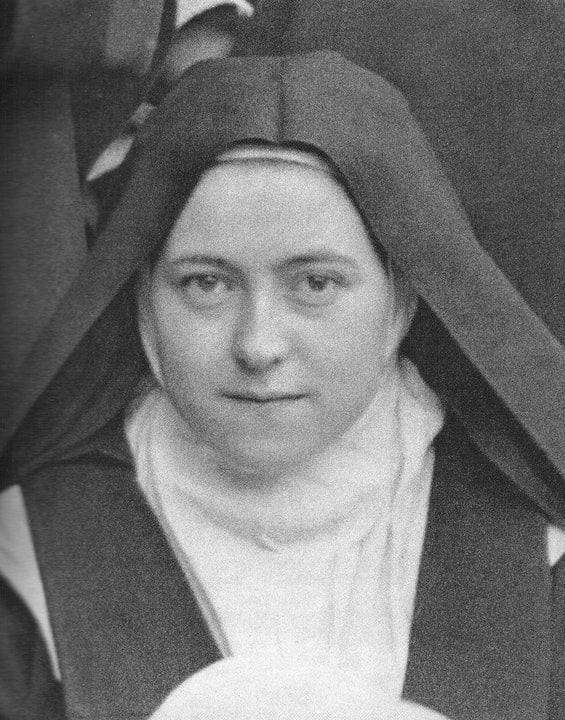
Detail of Thérèse in the Easter Monday photographs taken in the courtyard of the monastery (from Carmel of Lisieux photograph n° 18 / n° 19 / n° 20), Céline Martin (Sister Geneviève of the Holy Face, 1869–1959 AD), April 15, 1895 AD, Easter Monday Céline Martin (Sister Geneviève of the Holy Face, 1869–1959 AD), Wikimedia Commons; source file from the Archives of the Carmel of Lisieux At the end of 1894 AD she found what she called her little way. She had measured herself against the saints, found the distance impassable, and concluded that God would not inspire desires he could not realise. She took her image from the lifts then going into rich houses, and found in Scripture the words that told her the arms of Jesus were the lift. To reach them, she concluded, she need not grow but remain little and become still less.
In December 1894 AD, during recreation in the warming room, Mother Agnes of Jesus ordered her to write down her childhood memories, at the suggestion of Sister Marie of the Sacred Heart. She wrote through 1895 AD in the scraps of time the Rule left her, and handed the copybook now called Manuscript A to her prioress on January 21, 1896 AD. On Trinity Sunday, June 9, 1895 AD, she offered herself as a victim of holocaust to God's Merciful Love. A few days later, beginning the Way of the Cross in choir, she was wounded by a dart of fire so ardent that she thought she should die, and said afterwards that one second more and her soul must have been set free.
Her cousin Marie Guérin entered the Carmel on August 15, 1895 AD as Sister Marie of the Eucharist. In October 1895 AD Mother Agnes of Jesus gave her a first spiritual brother, the seminarian Maurice Bellière, who had written asking for a sister to pray for his salvation and that of his future flock. On May 30, 1896 AD Mother Marie de Gonzague gave her a second, Father Adolphe Roulland of the Paris Foreign Missions, who was preparing to leave for China. Pope John Paul II said her intense personal commitment supporting the two missionaries, in Africa and in China, is well known. She was by then acting novice mistress without the title, and she shared the Offering to Merciful Love with her sisters at once.
“We live in an age of inventions; nowadays the rich need not trouble to climb the stairs, they have lifts instead. Well, I mean to try and find a lift by which I may be raised unto God, for I am too tiny to climb the steep stairway of perfection.”
St. Thérèse of Lisieux, June 1897 AD -
1896 AD
Blood and darkness
Tuberculosis announced itself on a handkerchief, and within days the certainty of heaven went out.
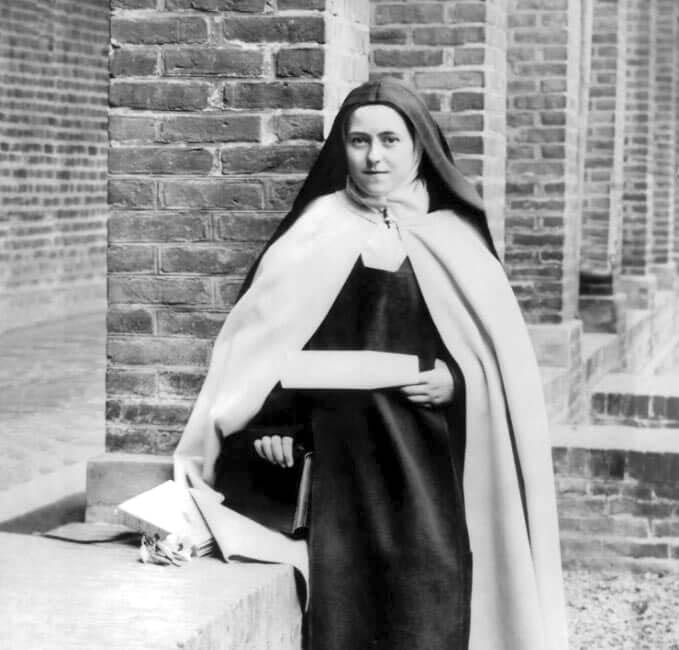
Thérèse standing in the courtyard with the parchment and La Mission du Su-tchuen au XVIIIe siècle (Carmel of Lisieux photograph n° 29), Céline Martin (Sister Geneviève of the Holy Face, 1869–1959 AD), after July 3, 1896 AD Céline Martin (Sister Geneviève of the Holy Face, 1869–1959 AD), Wikimedia Commons; source page at the Archives of the Carmel of Lisieux In the night between Holy Thursday and Good Friday, April 3, 1896 AD, she had scarcely laid her head on the pillow when she felt a hot stream rise to her lips. She put out the lamp, waited until morning, and at five o'clock found the handkerchief soaked with blood. She was convinced that on the anniversary of his death her Bridegroom had let her hear his first call. She said nothing that would excuse her, obtained permission to keep the full Good Friday fast and penances, and was seen that afternoon cleaning windows with a livid face. A second haemorrhage came the following night.
Within days God let her understand that there really are souls bereft of faith and hope, and allowed her own soul to be invaded by the deepest darkness. The thought of heaven, which had consoled her from her earliest childhood, became a subject of conflict and torture. She offered to sit at the table of unbelievers and eat the bread of sorrow for as long as God wished, and called them her brothers. She said she made more acts of faith in that one year than in all the rest of her life. Pope Benedict XVI said she was aware of living the trial for the salvation of the atheists of the modern world. The trial did not lift before her death.
On September 7, 1896 AD she began the last private retreat of her life, and at the request of Sister Marie of the Sacred Heart she wrote in it the short manuscript now called Manuscript B. Searching for her place in the Church, she reasoned that the Church has a heart, that the heart burns with love, and that love alone gives life to its members. Pope John Paul II quoted the passage at length in the homily proclaiming her a Doctor of the Church, citing it by its place in the manuscript. That Christmas, ten years to the night after the grace of 1886 AD, she left a spinning top in a novice's cell with a letter written in the name of the Child Jesus.
“Then, beside myself with joy, I cried out: O Jesus, my Love, at last I have found my vocation. My vocation is love! Yes, I have found my place in the bosom of the Church, and this place, O my God, Thou hast Thyself given to me: in the heart of the Church, my Mother, I will be LOVE! . . . Thus I shall be all things: thus will my dream be realised. . . .”
St. Thérèse of Lisieux, September 1896 AD -
1897 AD
The infirmary
Nine months from her twenty-fourth birthday to a death that took more than two hours.
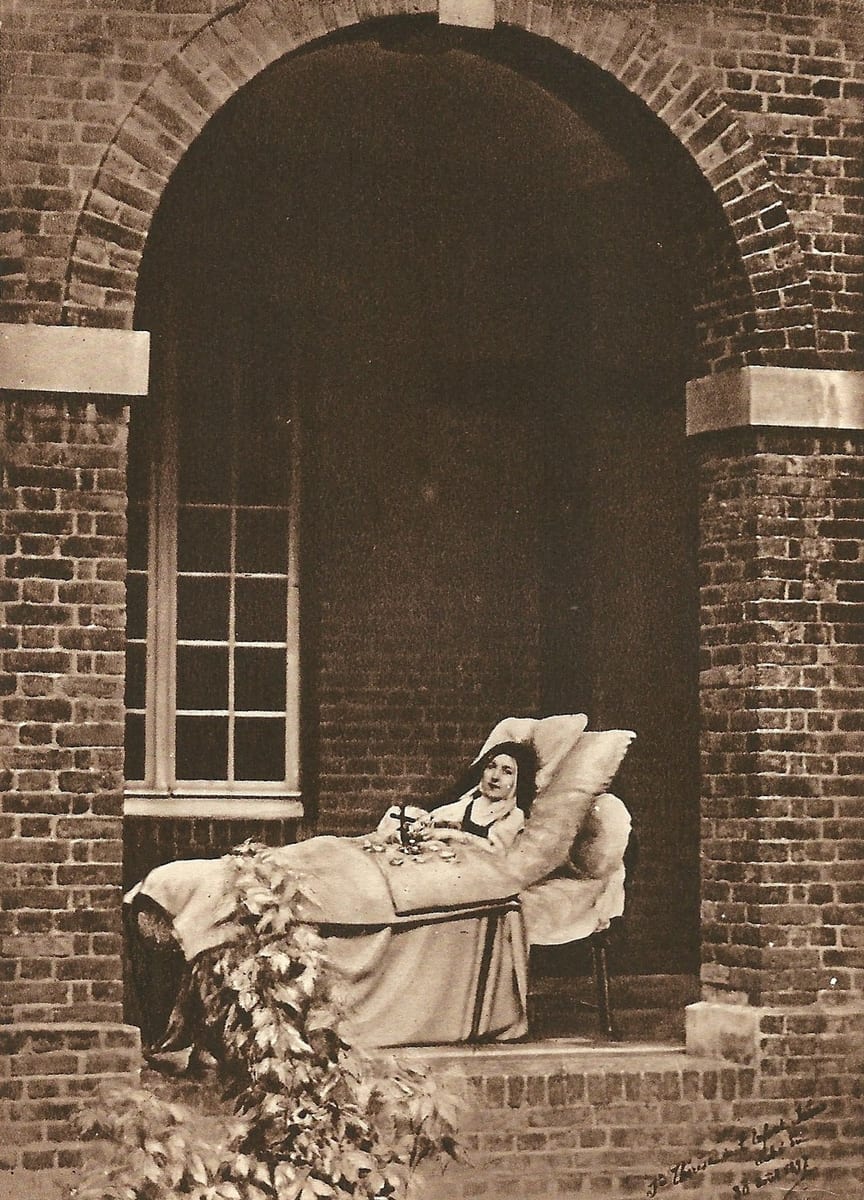
Thérèse sick under the cloister, stripping the petals of roses over her crucifix (Carmel of Lisieux photograph n° 45); halftone plate from Histoire d'une âme, Céline Martin (Sister Geneviève of the Holy Face, 1869–1959 AD); plate, Office central de Lisieux / Imprimerie Saint-Paul, Bar-le-Duc, 1937 AD edition, 1940 AD printing, August 30, 1897 AD Céline Martin (Sister Geneviève of the Holy Face, 1869–1959 AD); plate, Office central de Lisieux / Imprimerie Saint-Paul, Bar-le-Duc, 1937 AD edition, 1940 AD printing, Wikimedia Commons Through the winter her health deteriorated and she suffered a great deal, and the darkness did not lift. In April 1897 AD Mother Agnes of Jesus and Sister Geneviève began writing down what she said, and the dated entries run from May 1 to the day of her death. The historian Claude Langlois has questioned whether those last words are truly those of St. Thérèse, since no recorder sat at her bedside. In June and the first days of July, at the prioress's order, she wrote the last part of her autobiography, and ended it with the word love, as she had ended the others.
On June 7, 1897 AD Céline photographed her on her feet for the last time, holding the images of the Child Jesus and the Holy Face taken from her breviary. She was carried down to the infirmary on July 8 and did not leave it again. Canon Maupas anointed her and gave her Viaticum on July 30, the community having already sent down her straw mattress because they thought her death imminent. She received Holy Communion for the last time on August 19, nearly fainting as the Miserere was chanted, and continual sickness made it impossible for her to receive again. She wrote her last letter, the two hundred and sixty-sixth of those that survive, to Father Bellière on August 25. On August 30 the sisters laid her on a folding bed and rolled her along the cloister as far as the choir door, and Céline made there the last photograph of her alive.
On the morning of September 30, 1897 AD she could hardly breathe, and she joined her hands and looked at the statue of the Blessed Virgin facing her bed. Though she had not been able to raise herself for weeks she sat up in bed, to the surprise of the sisters. The agony began towards five in the evening; the community assembled in the infirmary and she greeted every sister with a smile. For more than two hours the death rattle tore her chest, her hands purple and her feet icy, while Céline laid a small piece of ice on her lips. She died at about twenty minutes past seven, after an ecstasy that lasted the space of a Credo, in the arms of Mother Marie de Gonzague. A multitude of little birds had sung in the tree by the open infirmary window throughout the agony, and the dark, rainy day cleared towards seven until the stars came out.
“Oh! . . . I love Him! . . . My God! . . . I . . . love . . . Thee!”
St. Thérèse of Lisieux, September 30, 1897 AD -
1897–2023 AD
Afterwards
A book sent out as a circular to other Carmels became a worldwide reputation, and the Church answered it within thirty years.
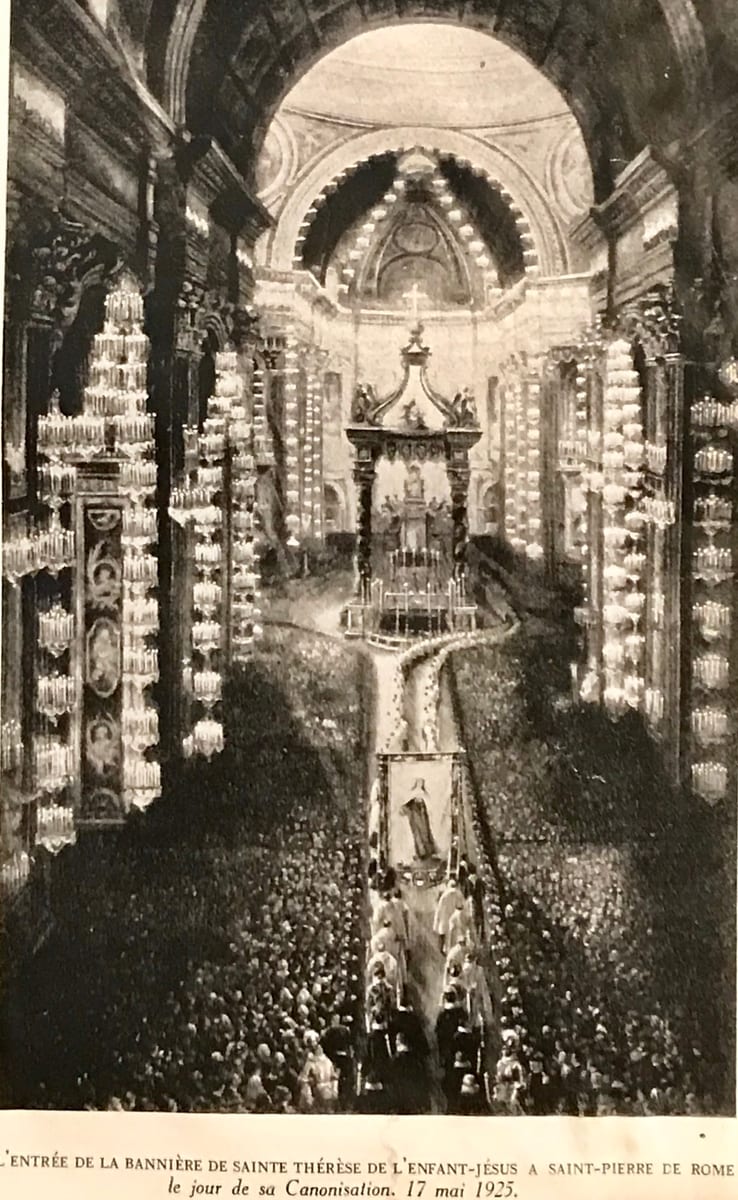
The banner of Saint Thérèse carried into the basilica of St Peter on the day of her canonisation, Unidentified, May 17, 1925 AD Unidentified, Wikimedia Commons; source file credited to thereseoflisieux.org On the Saturday and Sunday after her death a large crowd passed before the grating of the nuns' chapel, and hundreds of medals and rosaries were brought to touch her. She was buried on October 4, 1897 AD in the Carmelite plot of the Lisieux town cemetery, a palm branch laid in her hands. Histoire d'une âme was published at Lisieux in 1898 AD, the three manuscripts edited by Mother Agnes of Jesus, printed as one continuous book and sent out as a circular to other Carmels. It has since been translated, with her other writings, into about fifty languages.
The Episcopal Process opened at Bayeux on August 3, 1910 AD and closed at its hundred and ninth sitting on December 12, 1911 AD, having taken the depositions of forty-five witnesses over 108 sittings. Her remains were exhumed on September 6, 1910 AD from a depth of over eleven feet, and the palm laid on her thirteen years earlier was found fresh and green. Pope Pius X signed the decree introducing her cause on June 10, 1914 AD, the ten years that ordinarily separate the episcopal and apostolic inquiries having been suppressed in her favour. Pope Benedict XV declared her heroic virtues on August 14, 1921 AD and gave an address for the occasion on the way of spiritual childhood. Pope Pius XI beatified her on April 29, 1923 AD and canonized her before an immense crowd in Saint Peter's Basilica on May 17, 1925 AD.
On December 14, 1927 AD, answering the petition of many missionary bishops, Pope Pius XI proclaimed the enclosed Carmelite patron of the missions alongside St. Francis Xavier. Pope Pius XII declared her secondary patroness of France, beside St. Joan of Arc, on May 3, 1944 AD. Her relics left Lisieux for the first time in 1945 AD, and since 1994 AD they have visited nearly seventy countries. Pope John Paul II proclaimed her a Doctor of the Universal Church in Saint Peter's Square on World Mission Sunday, October 19, 1997 AD, having announced his intention at World Youth Day in Paris that August. Her parents were beatified together on October 19, 2008 AD and canonized by Pope Francis on October 18, 2015 AD during the Synod on the Family. Pope Francis signed an Apostolic Exhortation on her at the Basilica of Saint John Lateran on October 15, 2023 AD, for the 150th anniversary of her birth and the centenary of her beatification.
“I feel that my mission is about to begin; my mission of making souls love the good God as I love Him, to teach my little way to souls. If my desires receive fulfillment, I shall spend my heaven on earth even until the end of time. Yes, I will spend my heaven doing good upon earth.”
St. Thérèse of Lisieux, July 17, 1897 AD


Pray with the Church
Prayer to the Holy Face
Written by St. Thérèse and printed among her prayers in the 1912 AD English edition of Story of a Soul, edited by T. N. Taylor.
O Adorable Face of Jesus, sole beauty which ravisheth my heart,vouchsafe to impress on my soul Thy Divine Likeness, so that it may notbe possible for Thee to look at Thy Spouse without beholding Thyself. Omy Beloved, for love of Thee I am content not to see here on earth thesweetness of Thy Glance, nor to feel the ineffable Kiss of Thy SacredLips, but I beg of Thee to inflame me with Thy Love, so that it mayconsume me quickly, and that soon Teresa of the Holy Face may beholdThy glorious Countenance in Heaven.
All 11 reports on Saint Thérèse of Lisieux

Prioress tells St. Thérèse, nine, to wait until sixteen to enter convent

Dying St. Thérèse tells her prioress: "I do not wish to suffer less"

Saint Thérèse receives the black veil at seventeen, and cannot stop crying

Saint Thérèse's sister Céline enters the Carmel weeks after their father's death

St. Thérèse, seventeen, makes her vows with a prayer against her heart

Church inquiry opens Saint Thérèse of Lisieux's grave; only bones remain

The sister who nursed St. Thérèse waits to give evidence on oath

'My vocation is love': St. Thérèse writes her answer at Lisieux

Céline photographs St. Thérèse under the infirmary cloister at Lisieux

St. Zélie Martin is buried at Alençon without her five daughters
