
Saints Saints of France · 1412–1431 AD
Saint Joan of Arc
Feast 30 May · Born 1412 AD, Domremy, duchy of Bar, France · Died 1431 AD, Rouen, Normandy, France
A farmer's daughter from the Meuse who rode to the Dauphin at seventeen, relieved Orleans, saw a king crowned at Reims, and answered a tribunal at Rouen alone.
Begin the life
In brief
Saint Joan of Arc, called in her own century La Pucelle, the Maid, was a farmer's daughter from Domremy. She relieved Orleans in May of 1429 AD and stood beside Charles VII at his crowning in Reims that July. Taken in war a year later, she was burned at Rouen on May 30, 1431 AD, at nineteen.
-
1412–1425 AD
Domremy
A village on the Meuse, and a voice at noon in her father's garden.
Saint Joan of Arc was born at Domremy on the Meuse on January 6, 1412 AD. Her father, Jacques d'Arc, was a small farmer, and her mother was Isabelle. She never learned to read or write.
At about thirteen she heard a voice from God towards noon in summer, in her father's garden. It taught her to be good, to go to church often, and told her she must come into France. She answered with a vow to keep her body and her mind whole for God.
“I saw them with my bodily eyes as well as I see you; and when they left me, I wept; and I fain would have had them take me with them too.”
St. Joan of Arc, February 27, 1431 AD -
1428–1429 AD
Vaucouleurs
Twice sent home by the captain, she stayed in the town until he gave her an escort.
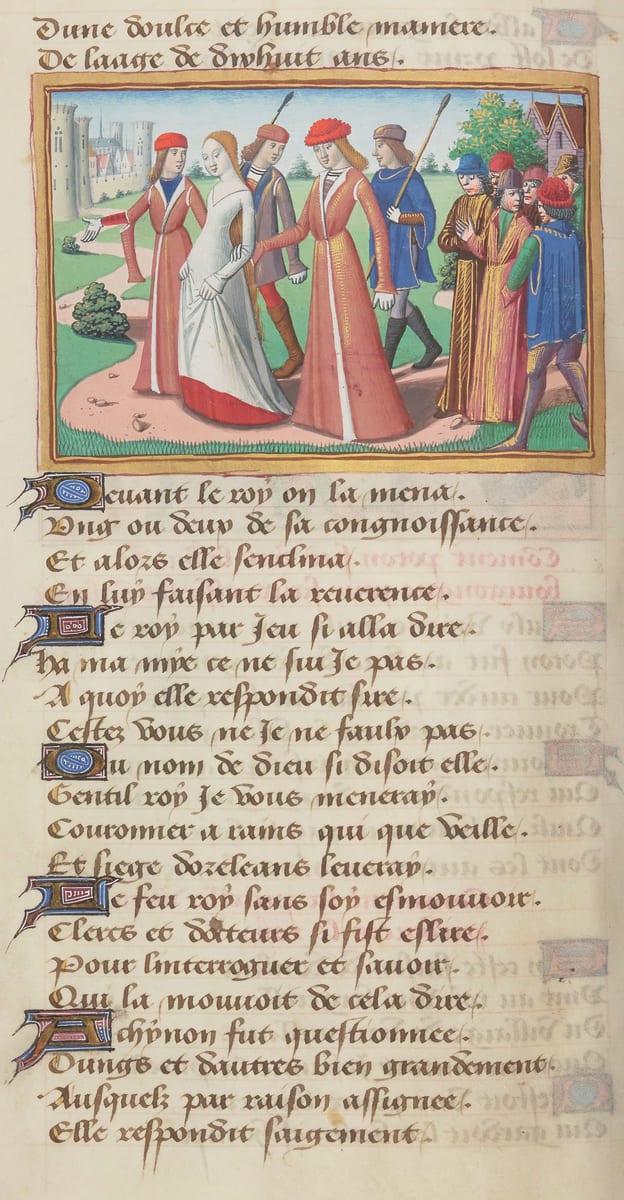
Jeanne d'Arc conduite a Chinon — Les Vigiles de Charles VII, fol. 55v, Anonymous illuminator; manuscript of Martial d'Auvergne, c. 1484 AD Anonymous illuminator; manuscript of Martial d'Auvergne, Bibliotheque nationale de France, Departement des Manuscrits, Francais 5054 AD, fol. 55v In May of 1428 AD her kinsman Durand Laxart took her to the captain Robert de Baudricourt. Baudricourt told Laxart many times to take her back to her father and box her ears. She returned in January of 1429 AD and lodged with Henri Le Royer in a poor worn red dress.
On February 12, 1429 AD a French force was beaten at Rouvray, as she had announced beforehand. The townspeople then had a man's dress and a full equipment made for her, and bought a horse. She rode out for Chinon on February 23, 1429 AD, eleven days on the road, mostly by night.
“No one in the world, neither kings, nor dukes, nor the daughter of the King of Scotland, nor any others, can recover the kingdom of France; there is no succour to be expected save from me; but, nevertheless, I would rather spin with my poor mother, for this is not my proper estate: it is, however, necessary that I should go, and do this, because my Lord wills that I should do it.”
St. Joan of Arc, January 1429 AD -
1429 AD
Chinon and Poitiers
She named the Dauphin in a crowded room, then sat three weeks with the theologians.
St. Joan reached Chinon towards noon on March 6, 1429 AD and lodged at an inn. Brought into the king's room, she picked Charles out among many others. Charles VII said afterwards that she had told him secrets which could be known by God alone.
Bishops and doctors at Poitiers examined her for three weeks before the king would employ her. The Poitiers examiners concluded that they had found nothing in her contrary to the Catholic faith. There she dictated the ultimatum of March 22, 1429 AD ordering the English out of France.
“I well believe that you have been sent to question me. I know neither A nor B.”
St. Joan of Arc, March 1429 AD -
1429 AD
Orleans
A wind that turned, an arrow above the breast, and a siege lifted in nine days.
An English army had besieged Orleans since October 12, 1428 AD. She came up the Loire on April 29, 1429 AD, when the contrary wind turned and the boats moved. She entered the town carrying a white banner with the image of Our Lord holding a lily.
She told her chaplain one evening that blood would flow from her body above the breast. The next day, May 7, 1429 AD, an arrow entered between her neck and her shoulder at the Tourelles. The English marched away on Sunday, May 8, 1429 AD, and she forbade any pursuit.
“I would rather die than do a thing which I know to be a sin; I know well that I must die one day, but I know not when, nor in what manner, nor on what day; if my wound may be healed without sin, I shall be glad enough to be cured.”
St. Joan of Arc, May 7, 1429 AD -
1429 AD
Reims
The march through enemy country to the anointing she had promised at Chinon.
The English army was broken at Patay on June 18, 1429 AD. She had told the captains to have good spurs, because the English would have to be pursued. The royal army left Gien for Reims on June 29, 1429 AD, deep inside enemy country.
Troyes submitted within three days of her promise to bring the king in by favour or force. Charles VII was consecrated and crowned in the cathedral at Reims on July 17, 1429 AD. St. Joan stood beside him through it, holding her standard.
“It had been present in the perils; that was reason enough for it to be honored.”
St. Joan of Arc, March 17, 1431 AD -
1429–1430 AD
The year after the crown
A wound at Paris, an army sent home, and a drawbridge raised behind her at Compiegne.
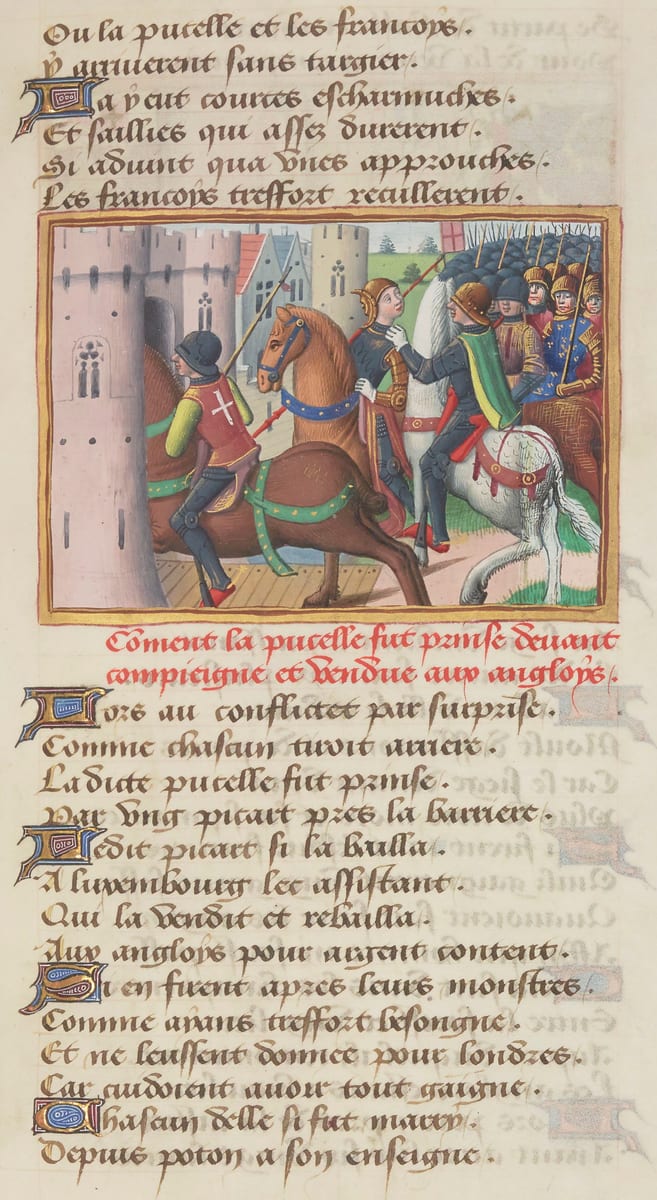
Prise de Jeanne d'Arc a Compiegne (1430 AD) — Les Vigiles de Charles VII, fol. 70r, Anonymous illuminator; manuscript of Martial d'Auvergne, c. 1484 AD Anonymous illuminator; manuscript of Martial d'Auvergne, Bibliotheque nationale de France, Departement des Manuscrits, Francais 5054 AD, fol. 70r A crossbow bolt went through her thigh at the wall of Paris on September 8, 1429 AD. Charles VII disbanded the army at Gien on September 21, 1429 AD. In Easter week at Melun her voices told her she would be captured before Saint John's Day.
She came into Compiegne secretly at sunrise on May 23, 1430 AD and made a sortie that evening. She stayed with the rearguard, and an archer dragged her from her horse against the river. In November John of Luxembourg sold her to the English for ten thousand livres.
“Where it shall please God; for I am not certain of either the time or the place, any more than you are yourself. Would it might please God, my Creator, that I might retire now, abandon arms and return to serve my father and mother and to take care of their sheep with my sister and my brothers, who would be so happy to see me again!”
St. Joan of Arc, August 1429 AD -
1431 AD
Rouen
Four months of questions in an English prison, and the Old Market on a Wednesday morning.
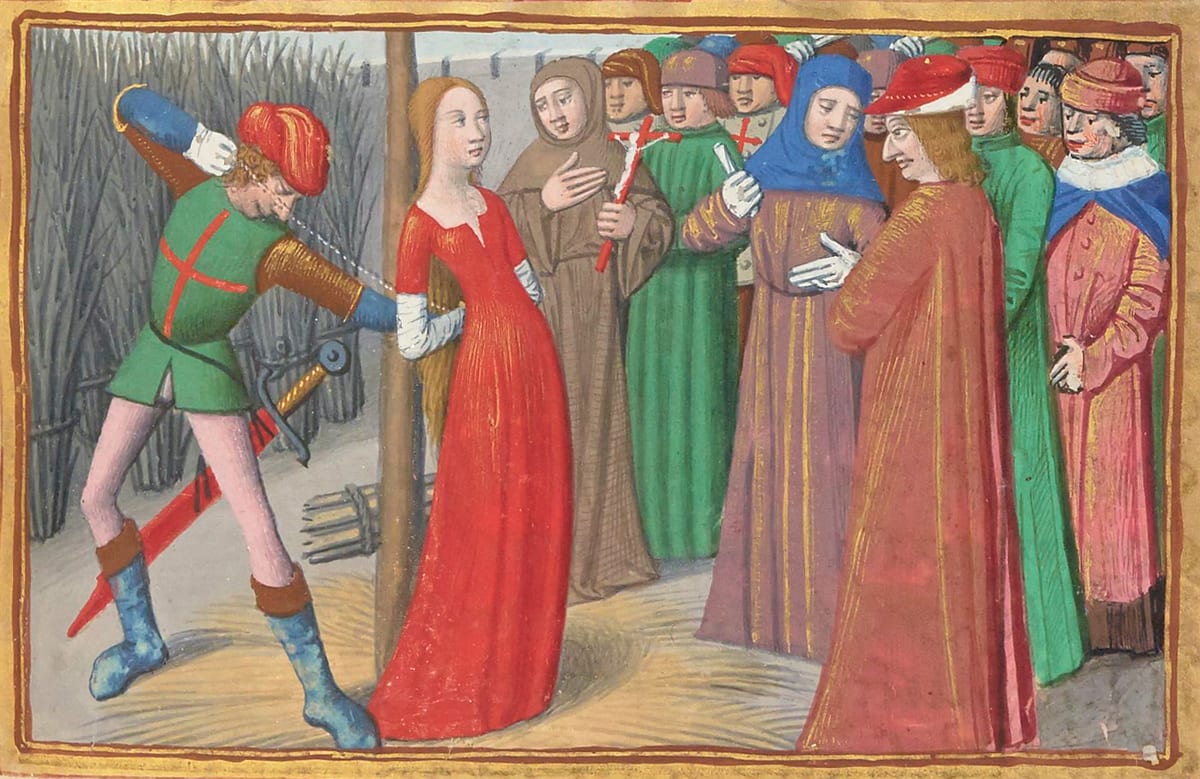
Jeanne d'Arc au bucher, May 30, 1431 AD — Les Vigiles de Charles VII, fol. 71r, Anonymous illuminator; manuscript of Martial d'Auvergne, c. 1484 AD Anonymous illuminator; manuscript of Martial d'Auvergne, Bibliotheque nationale de France, Departement des Manuscrits, Francais 5054 AD, fol. 71r The trial opened at Rouen on January 9, 1431 AD before Pierre Cauchon, Bishop of Beauvais. She was held in a secular prison under English guards and allowed no advocate. Told on March 17, 1431 AD to submit to the Church Militant, she said Our Lord and the Church were all one.
She asked on May 24, 1431 AD that her case go to the Pope at Rome, and was refused. Four days later she said her recantation had been made only for fear of the fire. She was burned in the Old Market on May 30, 1431 AD, calling aloud on the Name of Jesus.
“If I am not, may God put me there; and if I am, may God so keep me. I should be the saddest creature in the world if I knew I were not in His grace.”
St. Joan of Arc, February 24, 1431 AD -
1455–1922 AD
What followed
Her mother went to Notre-Dame for a verdict, and the Church gave one twenty-five years on.
Her mother, Isabelle, knelt before the commissioners in Notre-Dame at Paris on November 7, 1455 AD. About a hundred and twenty witnesses from every period of her life were then heard on oath. The Inquisitor-General Jean Brehal called her death a martyrdom in his Recollectio of June 1456 AD.
On July 7, 1456 AD the court at Rouen declared the trial and sentence null, void and of no consequence. Pope Benedict XV canonized her at Saint Peter's Basilica on May 16, 1920 AD. France has venerated St. Joan of Arc as its patroness since 1922 AD.


Pray with the Church
Her prayer before her judges
A prayer Saint Joan of Arc made at her trial at Rouen, quoted by Pope Benedict XVI in his General Audience of January 26, 2011 AD.
Sweetest God, in honour of your holy Passion, I ask you, if you love me, to show me how I must answer these men of the Church
All 4 reports on Saint Joan of Arc

St. Joan tells her judges she saw St. Michael with her own eyes

About this picture
AI-generated image, in the manner of a 15th-century French manuscript illumination, from the paper's reference portrait based on Jeanne d'Arc a la porte Saint-Honore lors du siege de Paris (1429) — Les Vigiles de Charles VII, fol. 66v (Anonymous illuminator; manuscript of Martial d'Auvergne, c. 1484, Bibliotheque nationale de France, Departement des Manuscrits, Francais 5054, fol. 66v) View source artwork.

Charles VII disbands his army at Gien and sends the captains home

St. Joan lays down her armour at Saint-Denis and is marched south

About this picture
AI-generated image, in the manner of French manuscript illumination, from the paper's reference portrait based on Jeanne d'Arc a la porte Saint-Honore lors du siege de Paris (1429) — Les Vigiles de Charles VII, fol. 66v (Anonymous illuminator; manuscript of Martial d'Auvergne, c. 1484, Bibliotheque nationale de France, Departement des Manuscrits, Francais 5054, fol. 66v) View source artwork.