
Saints Jesuit missionary, Apostle of the Indies · 1506–1552 AD
Saint Francis Xavier
Feast 3 December · Born 1506 AD, Castle of Xavier, near Sangüesa, Navarre, Spain · Died 1552 AD, Shangchuan Island (Sancian), Guangdong, China
A young nobleman in Paris who resisted St. Ignatius of Loyola became his companion, carried the faith from India to Japan in ten years, and died on an island off China waiting for a passage to the mainland.
Begin the life
In brief
Saint Francis Xavier, also called Francisco Javier, was the youngest son of a noble house in the kingdom of Navarre. He became one of the first companions of St. Ignatius of Loyola, who sent him to the Indies in 1540 AD. For ten years he worked in India, Malacca, the Moluccas and Japan, and he died on an island off the coast of China in 1552 AD.
-
1506–1525 AD
The youngest son of a noble house in Navarre
Born in a castle in Navarre, he chose study over arms.
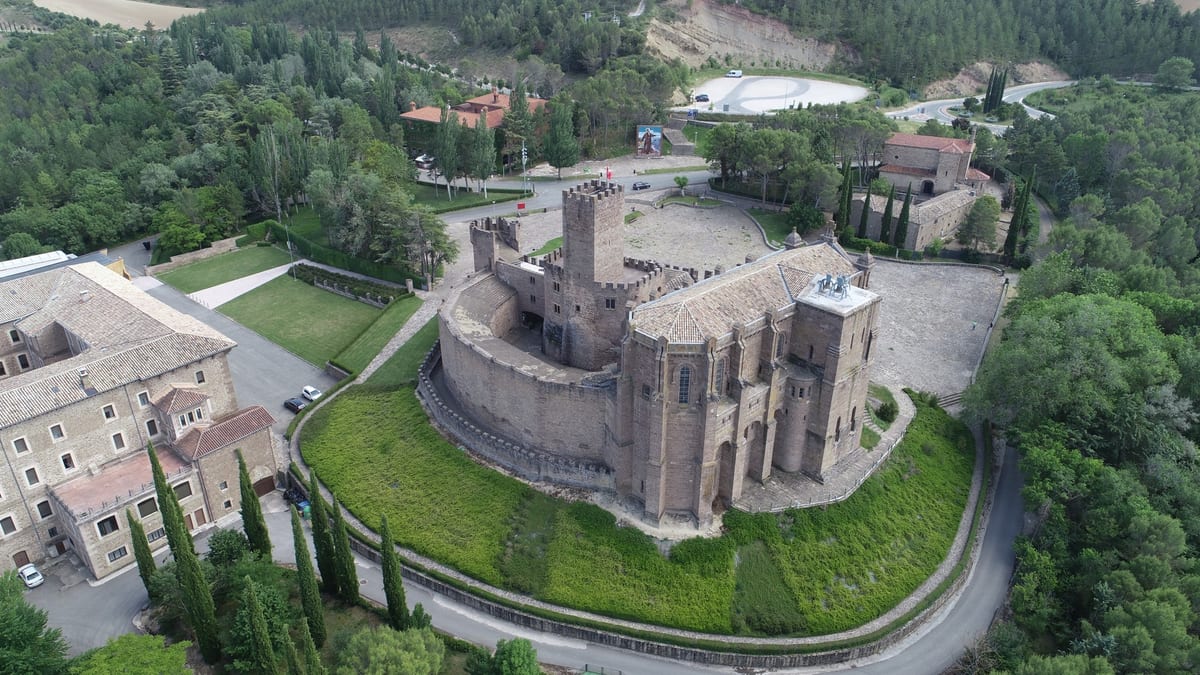
Castillo de Javier, aerial view, Francis Vaquero / Turismo de Navarra, June 14, 2019 AD Francis Vaquero / Turismo de Navarra, Wikimedia Commons St. Francis Xavier was born on April 7, 1506 AD, in his mother's family castle near Sangüesa, in the kingdom of Navarre. His father, Juan de Jasso, was president of the royal council of Navarre. His mother, María de Azpilcueta, was the sole heiress of the house of Azpilcueta and of the castle where he was born. He took his surname from the castle through her family, so that the name would not die out.
He was the youngest son of a large family, and he surprised his relatives by preferring study to war. In his boyhood, men posted by the Castilian governors guarded the house for three months. After his father died, he lived on at the castle with his mother, who supported him as her son.
-
1525–1535 AD
Won over in Paris
At Montmartre he joined St. Ignatius of Loyola and five other companions in a vow to give themselves wholly to God.
In 1525 AD St. Francis Xavier went to the University of Paris and entered the Collège de Sainte-Barbe. He shared lodgings and studies with St. Peter Faber, a Savoyard, and the two became close friends. St. Ignatius of Loyola, an older student already planning a new religious order, later came to lodge at the same college.
St. Peter Faber agreed to the plan without objection, but St. Francis Xavier resisted. On August 15, 1534 AD, he and six companions, St. Ignatius among them, vowed at Montmartre to go to Jerusalem or else to put themselves at the Pope's service. Afterwards he answered his brother Juan, who had complained about him, writing that St. Ignatius had helped him with money and kept him from bad company.
-
1536–1542 AD
Sent in another man's place
Ordained at Venice, he was sent to the Indies when the man first chosen fell ill.
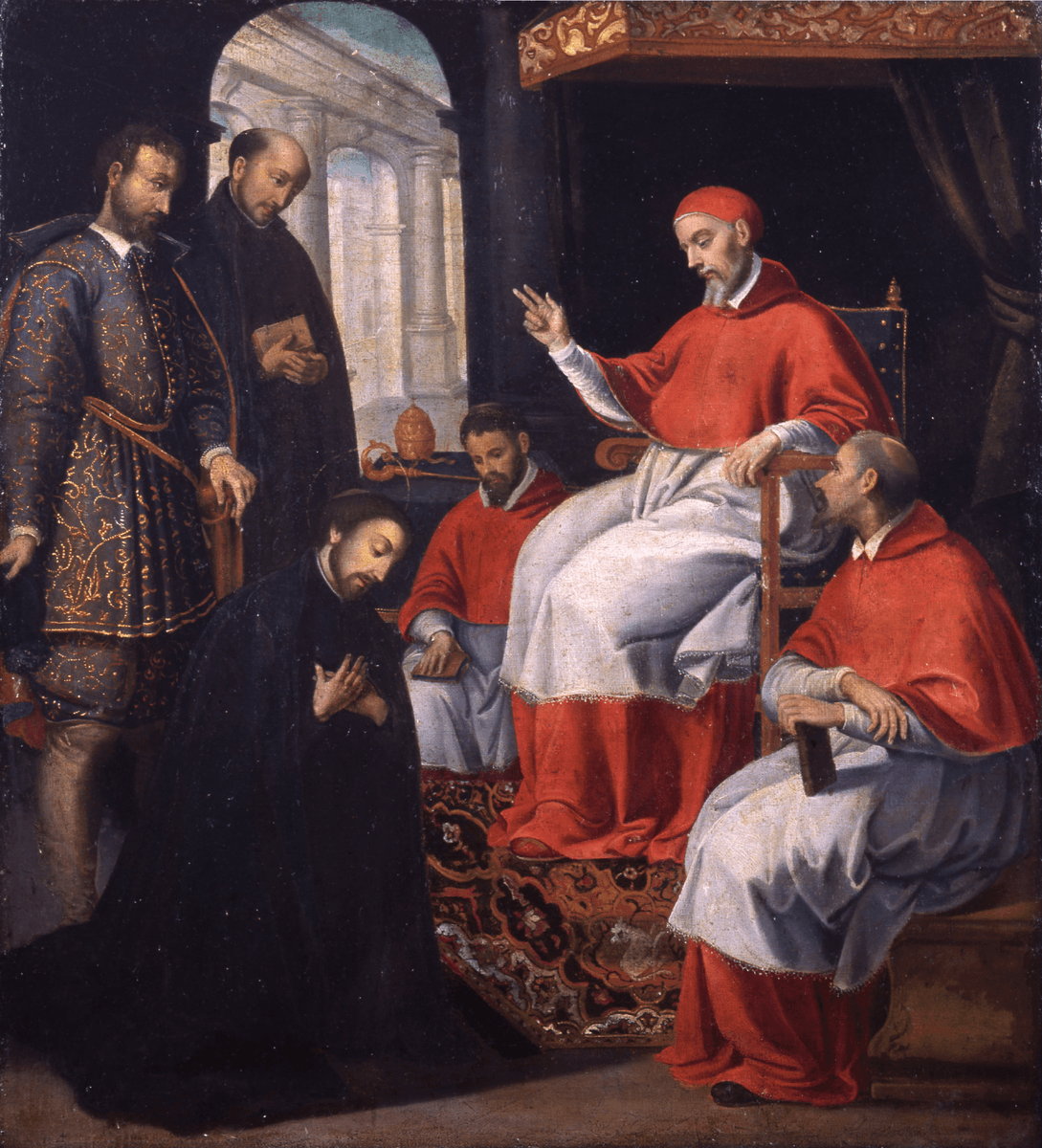
Pope Paul III receives St. Francis Xavier (O Papa Paulo III recebe São Francisco Xavier), André Reinoso, c. 1619 AD André Reinoso, Museu de São Roque, Lisbon (sacristy cycle of the Igreja de São Roque) In November 1536 AD the companions walked from Paris to Venice, begging their food on the way. St. Francis Xavier was ordained priest at Venice on June 24, 1537 AD. In 1540 AD King John III of Portugal asked for men to send to the Indies.
When Nicolás de Bobadilla, one of the men chosen, fell ill, St. Ignatius sent St. Francis Xavier instead. He sailed from Lisbon on April 7, 1541 AD, his thirty-fifth birthday. He landed at Goa on May 6, 1542 AD, thirteen months after leaving Lisbon.
“Cessamos rogando á Xpo. nuestro Señor nos dé gratia de vernos y junctarnos en la otra vida corporalmente, (we pray to our Lord God that in a better life He will vouchsafe to bring us together again)”
St. Francis Xavier to St. Ignatius of Loyola and Jean Codure in Rome, March 18, 1541 AD -
1542–1545 AD
Among the pearl fishers
From a hospital in Goa he went south to the Christian fishing villages of the coast.
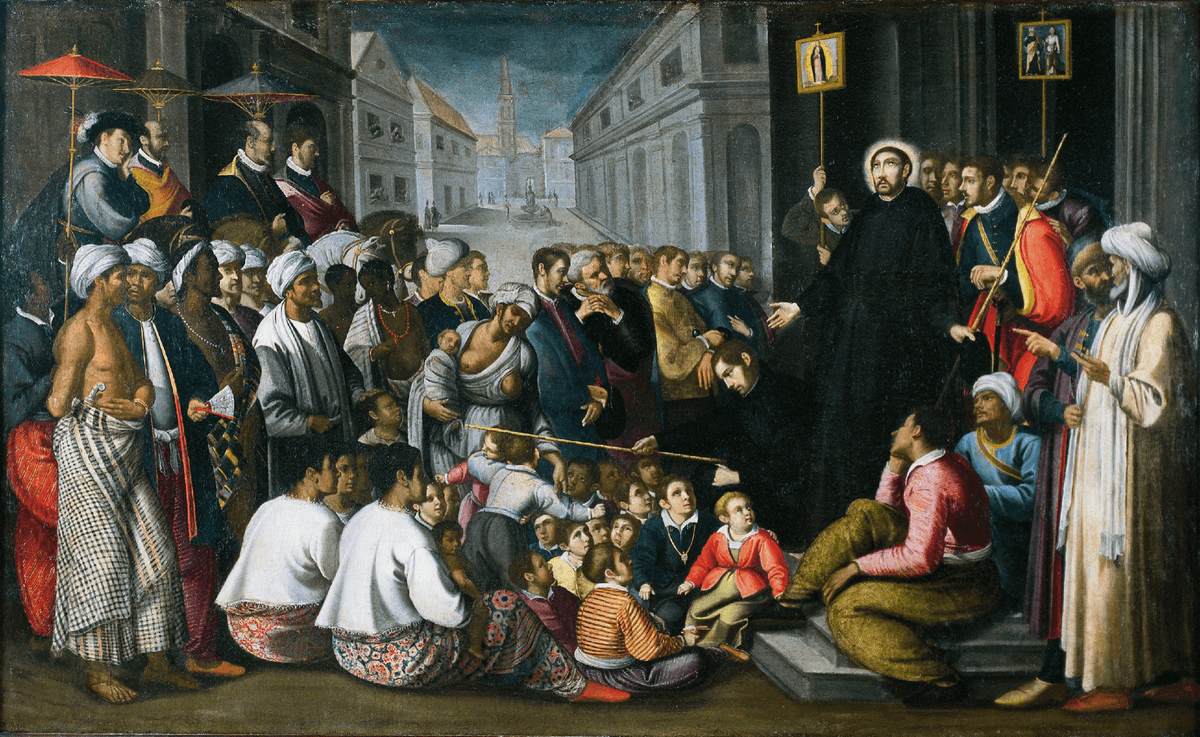
Saint Francis Xavier preaching in Goa (São Francisco Xavier pregando em Goa), André Reinoso, c. 1619 AD (Commons and Google Arts & Culture give 1610 AD; the cycle was completed in 1619 AD) André Reinoso, Museu de São Roque, Lisbon At Goa, St. Francis Xavier lived in the hospital and heard the confessions of the sick and the prisoners. In October 1542 AD he sailed south to the pearl fisheries to work among the Paravas, taking two young clerics as interpreters. In June 1544 AD, Christians fleeing raiders were hiding on the rocks off Cape Comorin, dying of hunger and thirst.
On June 20 he set out from Manapad by night with twenty boats to reach them. Strong winds kept him from reaching the Cape. Late in 1544 AD, on the Travancore coast, he baptized the fishing villages, more than ten thousand people.
“Rogo-vos muito que com essa gente vos hajais como se ha hum bom pai com maos filhos (I implore you over and over again to deal with that poor degraded people as good fathers do with bad children.)”
St. Francis Xavier to Francisco Mansilhas on the Fishery Coast, letter of instruction, 1544 AD -
1545–1548 AD
The islands beyond Malacca
He sailed to the Moluccas, and back at Malacca met the Japanese man who turned his thoughts to Japan.
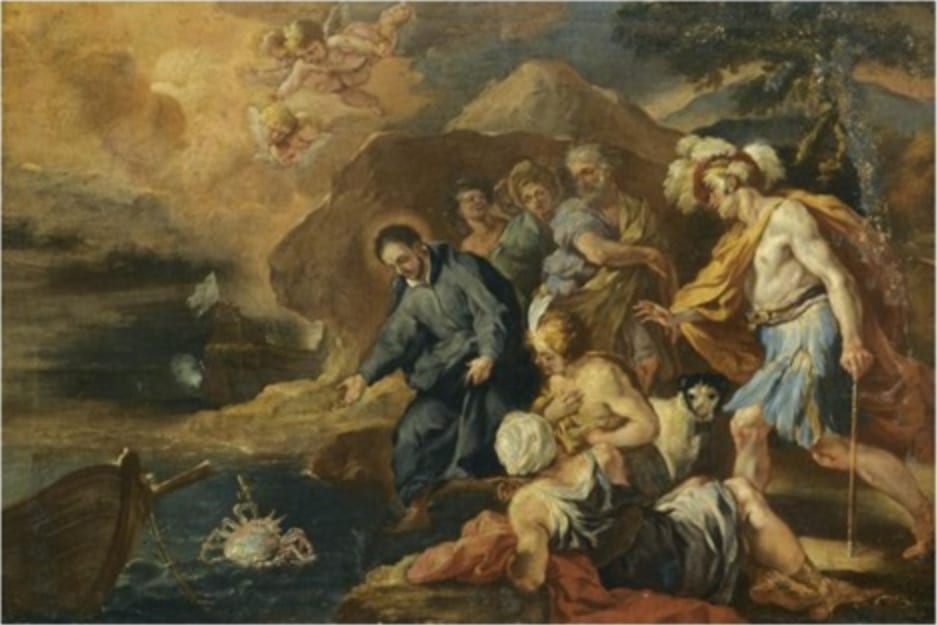
The Miracle of Saint Francis Xavier and the Crab, Francesco Solimena (painter), late 17th century Francesco Solimena (painter), Not stated on Commons On January 1, 1546 AD, St. Francis Xavier sailed from Malacca for the Moluccas. At Amboina he found seven Christian villages and baptized the children who had not been baptized. When the Portuguese at Ternate refused him a boat to the Isles of the Moor, he said he would swim there if he had to.
According to longstanding Catholic Tradition, a crab carried back to shore a crucifix he had lost overboard in a storm. In July 1547 AD, back at Malacca, he met a Japanese man named Anjirō. He wrote to Rome that he sensed he or another Jesuit would go to Japan within two years.
“cuenta os doy para que sepáis quán abundosas islas son estas de consolaciones spirituales (I have written all this to you, my dearest brothers, that you may know how much these islands overflow with heavenly joys.)”
St. Francis Xavier to the Fathers and Brothers in Rome, on the Isles of the Moor -
1549–1551 AD
Two years in Japan
He landed at Kagoshima, walked to a ruined capital, and left the first Christian communities in Japan.
On August 15, 1549 AD, St. Francis Xavier landed at Kagoshima, the home of Anjirō, now baptized Paul of the Holy Faith. Paul's relatives took the newcomers in and became Christians. On September 29, St. Michael's Day, the lord of the land received St. Francis Xavier. The lord told him to take good care of the books of the Christian law.
In December 1550 AD he set out on foot in winter for Meaco, the capital. He found the city wrecked by war and fire, and could make no headway there. Through 1551 AD he preached in other cities and founded the first Christian communities, with Yamaguchi at their centre.
“Adesso siamo fra loro come statue, perché parlano et praticanno de noi (At present we are like so many dumb statues in the midst of the people. They talk about us and discuss us)”
St. Francis Xavier to the Jesuit brothers, letter from Kagoshima, on not yet knowing Japanese, November 5, 1549 AD -
1552 AD
Within sight of China
When the captain of Malacca stopped the embassy to China, St. Francis Xavier went on without it to an island off the coast and died there waiting for a passage to the mainland.
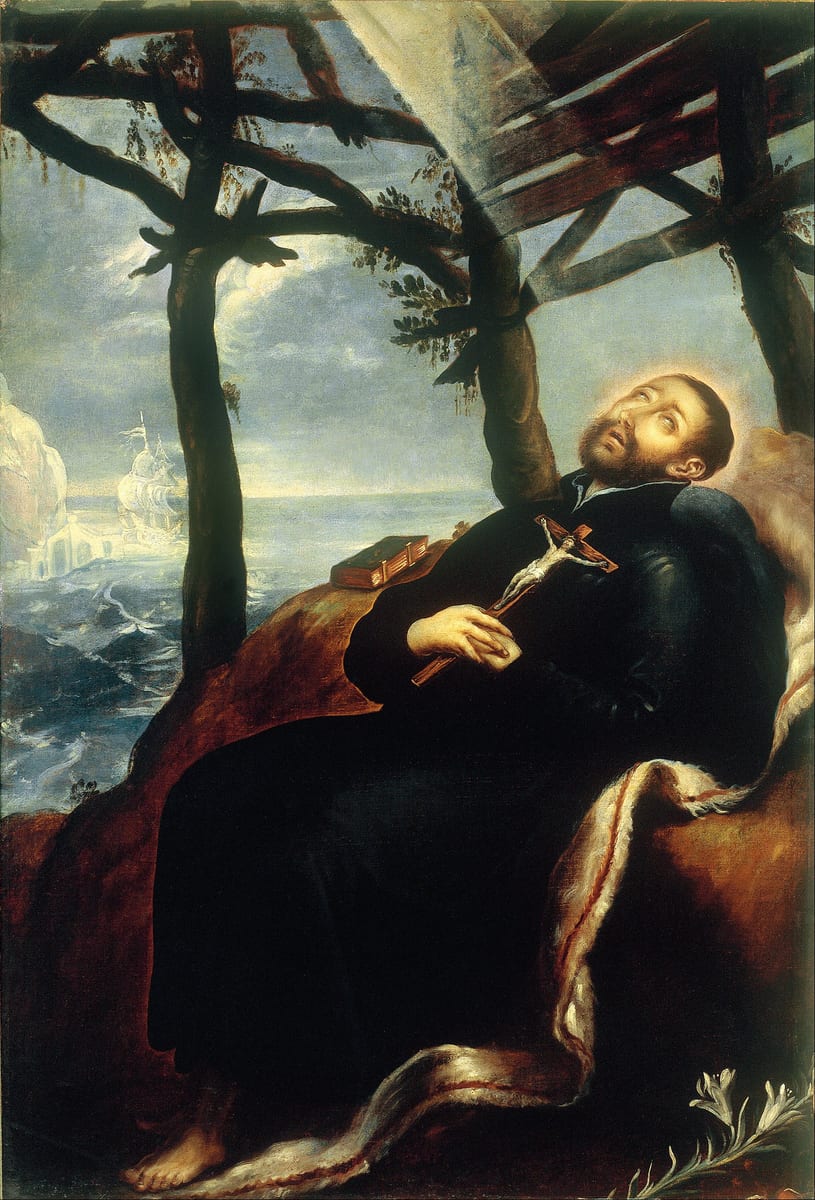
The Death of Saint Francis Xavier (La muerte de San Francisco Xavier), Unknown painter, 17th century (c. 1650 AD) Unknown painter, Museo Nacional de Arte (MUNAL), Mexico City In April 1552 AD St. Francis Xavier left Goa with his companions, bound for China; the viceroy had named Diogo Pereira ambassador to the Chinese court. At Malacca the captain, Dom Álvaro de Ataíde, stopped the embassy. Only then, for the first time since he had left Portugal, did St. Francis Xavier make known that Pope Paul III had named him papal nuncio to the Indies.
Even so, the captain would not let the embassy sail. St. Francis Xavier went on without it and reached Sancian, an island off the Chinese coast, in late August. There he waited each day for a Chinese merchant who had agreed to take him into Canton. He fell ill with fever and died in a poor hut on the island in December 1552 AD, with Antonio, his Chinese companion, beside him.
“estamos determinados de entrar en el reyno de la China (we have resolved and are positively determined to enter China)”
St. Francis Xavier to Francisco Pérez, letter from Sancian, October 22, 1552 AD -
1553–1747 AD
Carried back to Goa
His body was found whole on Sancian and carried to Goa, and Pope Gregory XV canonized him in 1622 AD.
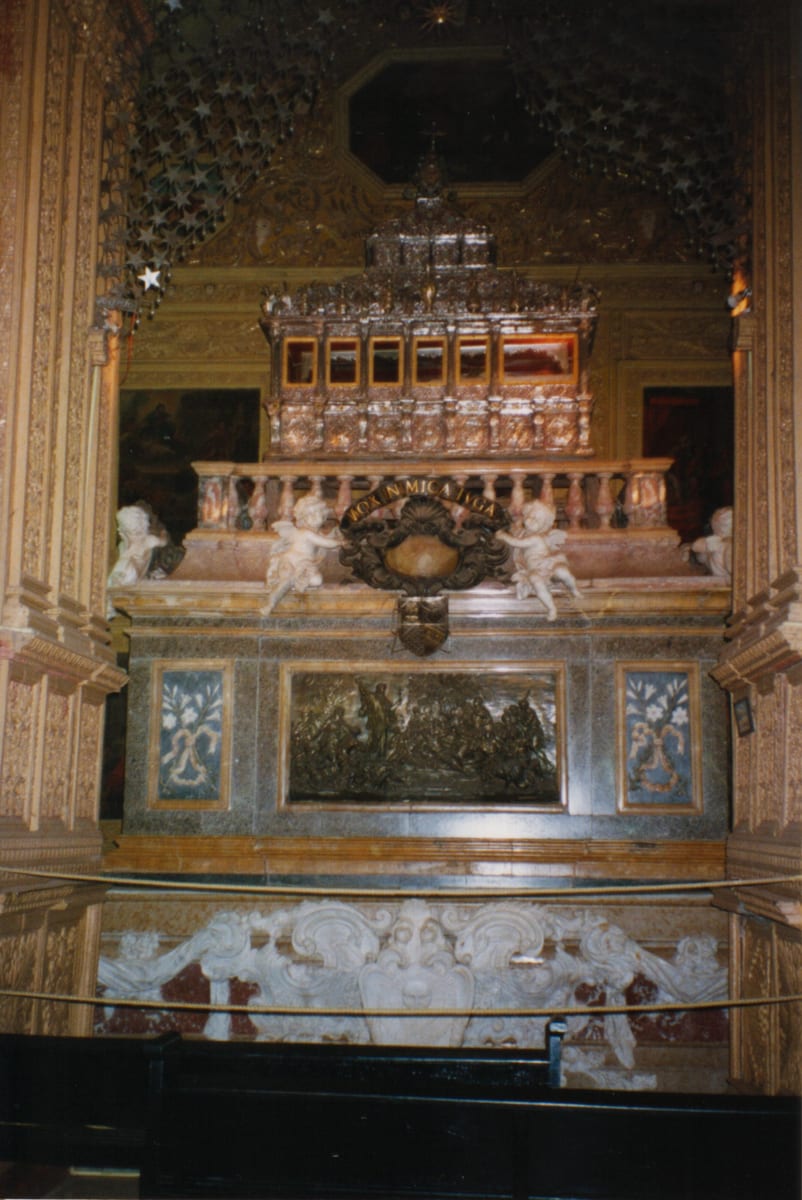
Casket of Saint Francis Xavier, Gaius Cornelius, 1995 AD Gaius Cornelius, Basilica of Bom Jesus, Old Goa On February 17, 1553 AD, before the Portuguese ship left Sancian, his coffin was opened. The body was found whole and fresh. In 1554 AD it reached Goa and was placed in the church of the College of St. Paul.
Pope Gregory XV canonized St. Francis Xavier at Rome on March 12, 1622 AD, together with St. Ignatius of Loyola. The Church keeps his feast on December 3. In 1747 AD Pope Benedict XIV named him patron and protector of the East Indies.


_-_Andr%C3%A9_Reinoso.png)
_-_Andr%C3%A9_Reinoso_(Museu_de_S%C3%A3o_Roque).png)


Pray with the Church
Prayer for the Conversion of Unbelievers
A prayer printed among the writings of St. Francis Xavier in the Monumenta Xaveriana, given here in the English of Henry James Coleridge, The Life and Letters of St. Francis Xavier (1872 AD).
O Eternal God, Creator of all things, remember that the souls of infidels have been created by Thee out of nothing, and formed after Thine image and likeness.Behold, Lord, to the dishonour of Thy name, hell is peopled with them.Remember that Jesus Thy Son suffered for their salvation the most cruel death : permit not, I beseech Thee, O Lord, that Thy Son be any longer held in contempt by these infidels ; but, appeased by the prayers of Thy chosen Saints, of the Church, the most holy Spouse of Thy Son, remember Thy mercy ; forget their idolatry and infidelity, and grant that they may at length acknowledge our Lord Jesus Christ, Whom Thou hast sent, in Whom is our salvation, our life, our resurrection, by Whom we have been saved and set at liberty, and to Whom be all glory for ever and ever. Amen.
All 3 reports on Saint Francis Xavier

About this picture
AI-generated image, in the manner of mid-sixteenth-century Roman oil portraiture, from the paper's reference portrait based on Portrait of Ignatius of Loyola (Jacopino del Conte, 1556 AD, Curia Generalizia of the Society of Jesus, Rome) View source artwork.

St. Ignatius gives his old roommate, now in Japan, charge of India

About this picture
AI-generated image, in the manner of a sixteenth-century travel-album drawing in brown ink and grey wash.
St. Francis Xavier sails to pearl fishers baptised but never taught

About this picture
AI-generated image, in the manner of the Portuguese painters of c. 1620, from the paper's reference portrait based on Saint Francis Xavier preaching in Goa (André Reinoso, c. 1619, Museu de São Roque, Lisbon) View source artwork.