Saints Archangel — Feast of September 29
Saint Michael the Archangel
Feast 29 September
Scripture names him four times, and his shrines stand on a mountain cave in Apulia and a rock in the Norman sea.
Begin the life
In brief
Saint Michael the Archangel, also called St. Michael, is named four times in Scripture: twice in the Book of Daniel, and once each in the Letter of St. Jude and the Apocalypse of St. John. St. Gregory the Great gives the meaning of the name as Who is like God. The Church keeps his feast on September 29, together with St. Gabriel and St. Raphael.
-
Undated, in the Apocalypse of St. John
War in heaven
The Apocalypse shows him and his angels fighting the dragon, and Tradition holds that he drove Lucifer out.
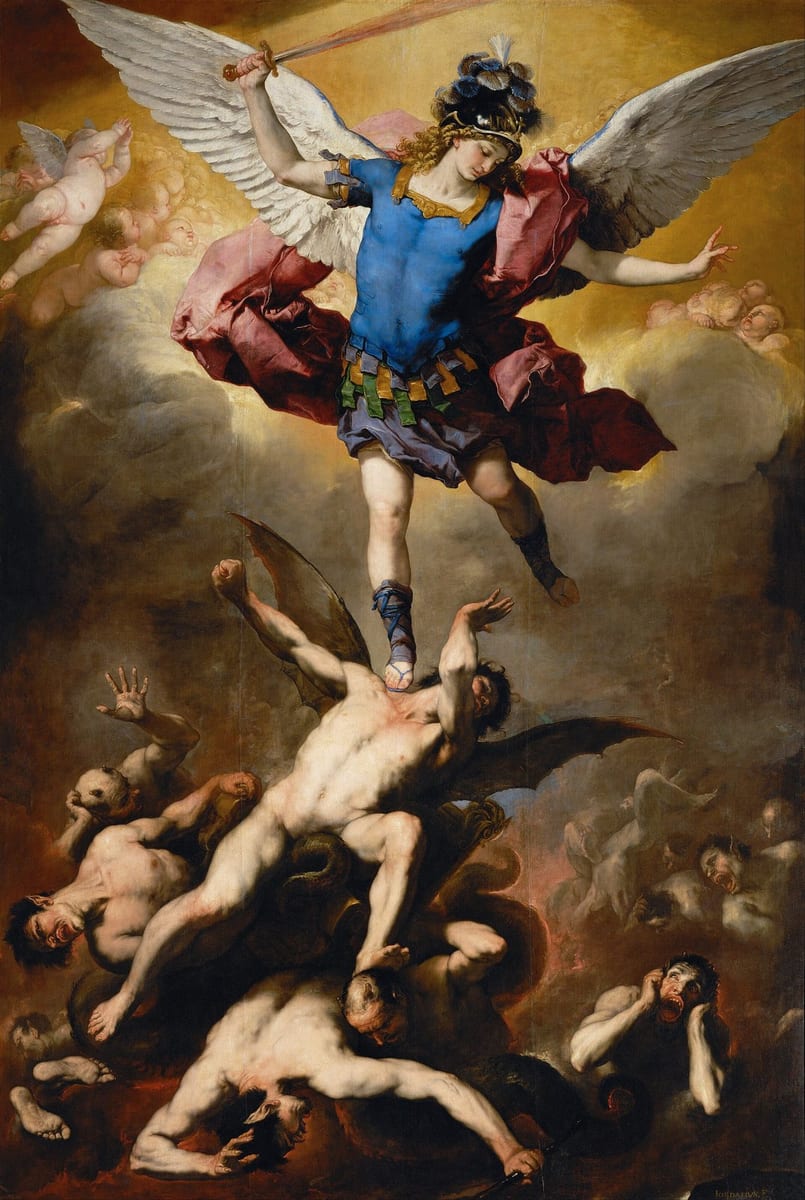
The Fall of the Rebel Angels, Luca Giordano, c. 1660-1666 AD Luca Giordano, Kunsthistorisches Museum, Vienna War arose in heaven, St. Michael and his angels fighting against the dragon. The dragon and his angels were defeated, and no place was left for them in heaven. A loud voice then proclaimed that the accuser of the brethren, who accused them day and night before God, had been thrown down.
According to longstanding Catholic Tradition, carried in the Office of the feast and in the Golden Legend, St. Michael was the prince of the faithful angels who stood against Lucifer in his revolt. He bore the banner of the heavenly host, drove Lucifer and his followers out of heaven, and shut them in dark air until the day of doom. The Eastern books name him Chief Commander over all nine ranks of the heavenly powers.
“And there was a great battle in heaven, Michael and his angels fought with the dragon.”
St. John of Dukla, the vision of the war in heaven in the Apocalypse -
Undated, in the Book of Daniel
The prince who stands for a people
Daniel's visitor names him twice: as the helper who came in a twenty-one-day contest, and as the prince of Daniel's people.
In the third year of Cyrus king of Persia, Daniel saw a man clothed in linen on the bank of the Tigris. The visitor said that the prince of the kingdom of Persia had withstood him twenty-one days, until St. Michael, one of the chief princes, came to help him. He added that nobody contended at his side against those adversaries except St. Michael, whom he called Daniel's prince.
Daniel's last vision opens with St. Michael, named the great prince who has charge of Daniel's people. There follows a time of trouble such as there has never been, and the deliverance of everyone whose name is written in the book.
“At that time shall arise Michael, the great prince who has charge of your people. And there shall be a time of trouble, such as never has been since there was a nation till that time; but at that time your people shall be delivered, every one whose name shall be found written in the book.”
The man clothed in linen to Daniel, in the vision revealed -
Undated, in the Letter of St. Jude
The dispute over the body of Moses
Contending with the devil, he passed no judgment of his own but left it to the Lord.
The Letter of St. Jude records St. Michael contending with the devil about the body of Moses. He passed no judgment of his own on the devil, and answered him in one sentence.
Butler writes that the body was ordered to be buried in secret, so that it should not become an occasion of idolatry, and that the devil tried to stop the burial. In his reading St. Michael checked the devil not by commanding him in his own name, but by putting God's command to him.
“The Lord rebuke you.”
St. Michael the Archangel to The devil, in the dispute with the devil over the body of Moses -
Undated, at Chonae in Phrygia
The water at Chonae
Tradition tells of a mute girl who speaks at a spring, a custodian who keeps the church sixty years, and two rivers turned against it that are swallowed by a rock.
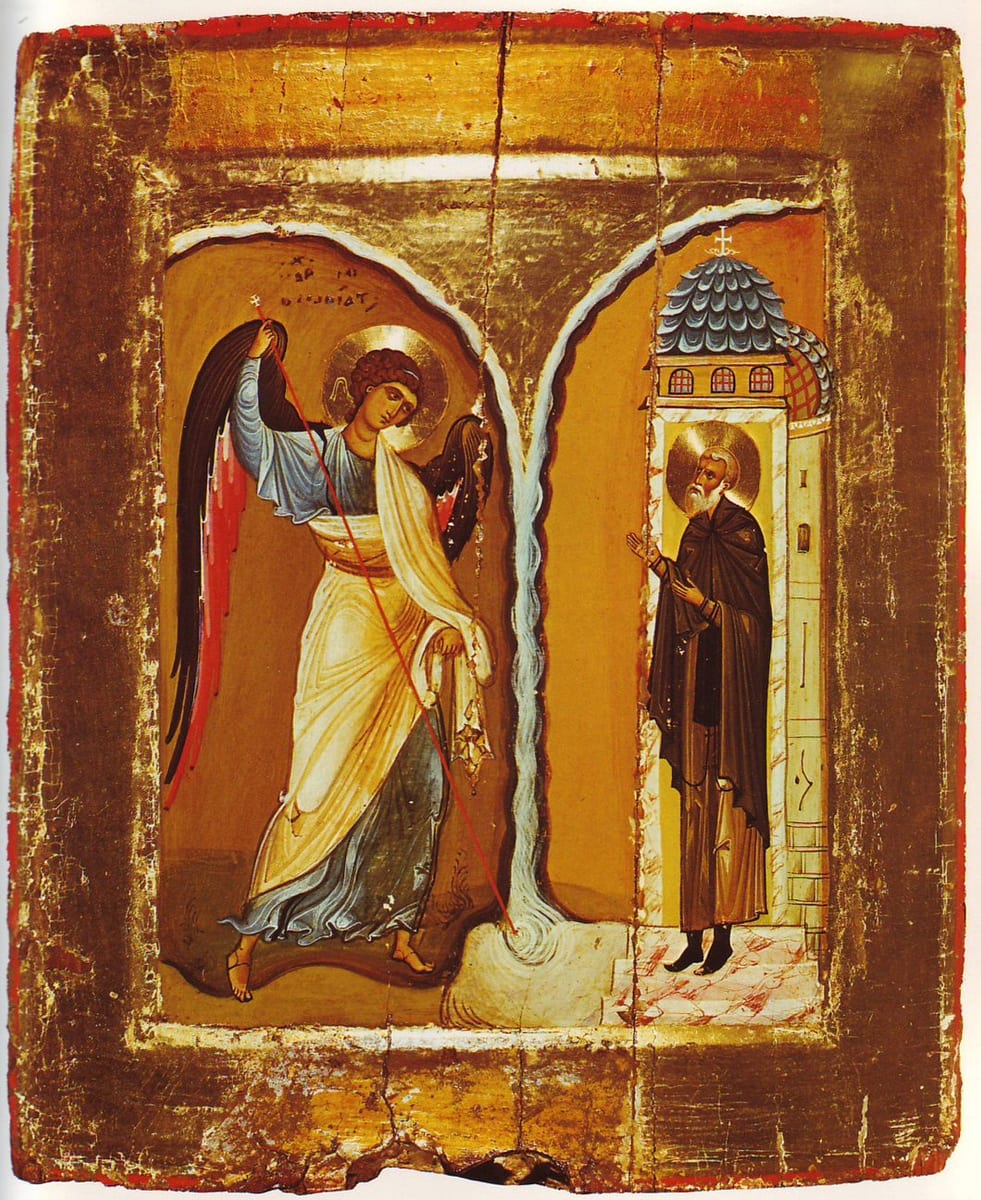
The Miracle of the Archangel Michael at Chonae, unknown, 12th century unknown, Monastery of St. Catherine, Mount Sinai According to longstanding Catholic Tradition, healing water rose from an opening in the earth at Chairetopa, near Colossae in Phrygia. A pagan man of Laodicea whose daughter had been unable to speak since birth poured the water into her mouth, and she was healed. The family was baptised, and the father built a church over the spring.
A man named Archippus kept that church for sixty years and brought many of his neighbours to the faith. The pagans of the district dammed two rivers and loosed them at the church, meaning to destroy it and to kill him. St. Michael halted the two rivers, struck the rock before the church so that it opened, and sent the flood into the chasm; the place has been called Chonae, which means plunging, ever since.
-
490–493 AD
The cave on Monte Gargano
Tradition tells of a lost bull, an arrow that turned back, and a cave the Archangel claimed as already his.
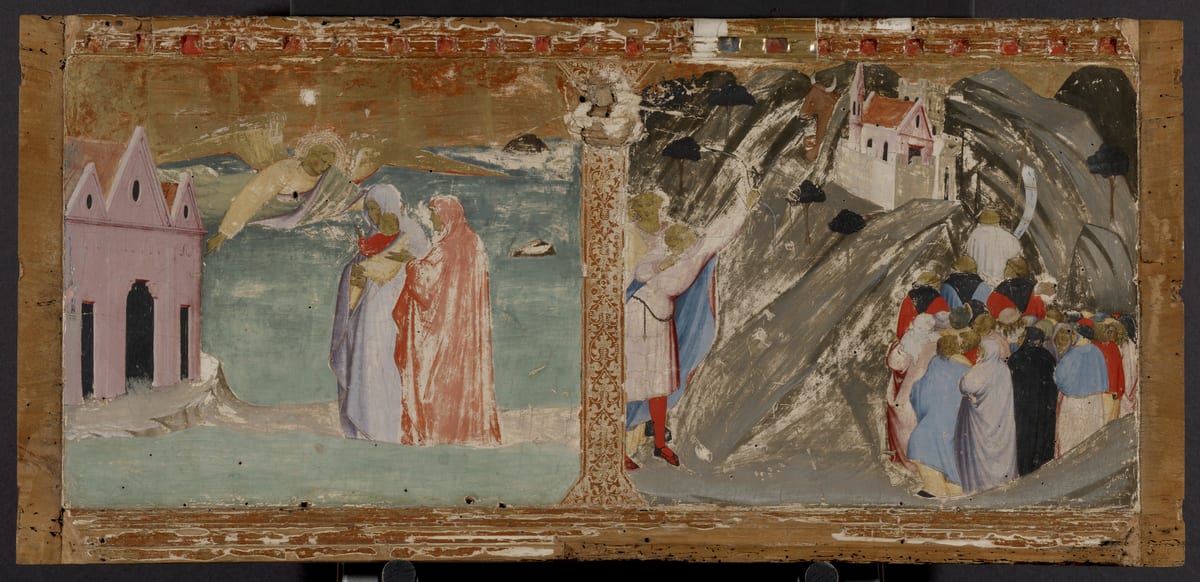
Saint Michael Archangel Makes the Sea Withdraw, and Saint Michael Archangel and the Bull of Monte Gargano, Fra Angelico, 1413 AD Fra Angelico, Yale University Art Gallery, New Haven According to longstanding Catholic Tradition, kept by the shrine on the mountain, a wealthy lord of Siponto went looking for a bull lost from his herds in 490 AD and found it at the mouth of a cave on the summit. He shot an arrow at the animal, and the arrow turned back and wounded his own foot. He took the account to the bishop of Siponto, who ordered three days of prayer and penance, and when the three days were done St. Michael appeared to the bishop, named himself, and said the man had been struck by his will.
Butler records that the Archangel told the bishop in a vision to build a church in his honour on the mountain, and the cave was found to be shaped like a church and used for the divine service. On the last night of an appointed fast he told the bishop that the cave needed no dedication, because the one who had founded it had dedicated it. Pope Gelasius I gave his assent to the dedication of the grotto in 493 AD and granted the indulgence known as the Angelic Pardon, and that dedication gave occasion to the feast of St. Michael in the West.
“This festival is kept in memory of the day, when under his invo- cation, was consecrated a church, unpretending in its exterior, but endowed with virtue celestial.”
The Roman Martyrology, the entry for the commemoration of the blessed archangel Michael on Mount Gargano -
May 8, 663 AD
The victory at Siponto
The Lombards drove off the Greeks who had come to plunder the mountain sanctuary, and gave the day to the Archangel.
On May 8, 663 AD the Lombards of Sipontum, now Manfredonia, defeated the Greek Neapolitans, who had come to plunder the sanctuary on Mount Garganus. They gave the victory to St. Michael's intercession, and the church of Sipontum kept a feast on May 8 in his honour that afterwards spread over the whole Latin Church.
According to longstanding Catholic Tradition, the people of Siponto asked their enemies for a three-day truce so that they might fast and beg the Archangel's protection. On the night before the fighting he appeared to the bishop, promised to be present, and told him to engage the enemy at the fourth hour of the day. The Golden Legend has the mountain begin to tremble, a dark cloud cover it, and six hundred of the enemy die of fiery arrows from the air.
-
708–710 AD
The rock in the sea
A bishop of Avranches built a church on a barren rock between Normandy and Brittany, and the anniversary of its dedication gave the Archangel a feast of his own in the West.
In 708 AD Saint Aubert, bishop of Avranches, built a church in honour of St. Michael on a barren rock that stands out of the sea between Normandy and Brittany. According to longstanding Catholic Tradition, carried in the Norman account of the foundation, the Archangel had commanded the building and appeared to the bishop in a dream three times before he moved. When the bishop doubted how large to make the place, the Golden Legend says St. Michael appeared again and told him the size.
Envoys from the rock reached Monte Gargano and were given two relics: a piece of the red cloak the Archangel had laid on the altar there, and a piece of the marble on which he had stood. They came back on the very day the building was finished, and St. Aubert went out to meet them. The first church on the rock was dedicated on October 16, 710 AD, and its anniversary gave the Archangel a feast of his own in the West.
-
The nineteenth century to 2013 AD
The Popes and the prayer
Pope Leo XIII gave the Church a prayer to him; Pope Francis made him patron of the Vatican City State.
At the end of the nineteenth century Pope Leo XIII introduced a special prayer to St. Michael throughout the whole Church. Pope Pius XII proclaimed him patron of radiologists on January 15, 1941 AD. Pope St. John Paul II went to the grotto on Monte Sant'Angelo on May 24, 1987 AD, and said he had come to ask the Archangel to protect and defend the Church.
In his Regina Coeli address of April 24, 1994 AD, Pope St. John Paul II recalled the prayer of Pope Leo XIII and urged the faithful to take it up. On July 5, 2013 AD Pope Francis inaugurated a monument to St. Michael in the Vatican Gardens and named him Patron of Vatican City State. He then consecrated the Vatican City State to the Archangel, asking him to defend those present from the Evil One and to cast him out.
“Michael — which means: "Who is like God?" — is the champion of the primacy of God, of his transcendence and power. Michael fights to reestablish divine justice; he defends the People of God from their enemies and above all from the arch-enemy par excellence, the devil. And St Michael triumphs because in him it is God who acts.”
Pope Francis to those gathered at the inauguration, July 5, 2013 AD


Pray with the Church
Collect of the feast of Saints Michael, Gabriel and Raphael
The Roman Missal, third edition, appointed for September 29 and said over the whole Latin Church on the feast of the Archangels.
O God, who dispose in marvelous order ministries both angelic and human,graciously grant that our life on earth may be defendedby those who watch over us as they minister perpetually to you in heaven.Through our Lord Jesus Christ, your Son,who lives and reigns with you in the unity of the Holy Spirit,God, for ever and ever.
All 2 reports on Saint Michael the Archangel

St. Michael and his angels throw the dragon out of heaven
