
Saints Rome, 540–604 AD
Saint Gregory the Great
Feast 3 September · Born 540 AD, Rome, Italy · Died 604 AD, Rome, Italy
The prefect of Rome who gave his fortune away to monasteries, took the papacy in a plague, and sent monks to Britain.
Begin the life
In brief
Saint Gregory the Great, also called Pope Saint Gregory I, was born at Rome about 540 AD. He was prefect of the city, then a monk, then Bishop of Rome for thirteen years. St. Bede wrote that because he converted the English nation, they must call him their apostle.
-
540–549 AD
A boy in a besieged Rome
Born to a senatorial house on the Caelian, in a city the Gothic war was breaking.
St. Gregory was born at Rome into an ancient senatorial family that had long been Christian. The family house stood on the Caelian Hill, on the street called Clivus Scauri. Three of his aunts kept consecrated virginity together in that house.
On December 17, 546 AD four Isaurian soldiers betrayed Rome to the besieging Goths. Dudden judges the boy old enough to feel and remember the horrors of that siege. Dudden places his return to the city in 549 AD, among the relics of a decaying Rome.
-
554–573 AD
Chief magistrate of the city
Schooled in rhetoric and law, he governed Rome before he was thirty-three.
At fourteen St. Gregory began his public education in grammar, rhetoric and dialectic. St. Gregory of Tours recorded that in those arts he was thought second to none in Rome. He went on to the civil law and to the canons of the Church.
Before he was thirty-three the Emperor Justin II made him Prefect of the City. The civil administration inside the walls rested in his hands, and he bought and distributed grain with the pope and worked with the Magister Militum to defend the city. As chief judge he wore the trabea, a silk robe embroidered and set with precious stones.
-
574–578 AD
He gave the house away
The inheritance became seven monasteries, and the fasting broke his health for good.
His father died, and the Caelian palace and most of the family wealth came to St. Gregory. He left every civil office and made the house into the monastery of Saint Andrew. Six more monasteries were built out of the Sicilian estates, and the rest went to the poor.
His fasts were so severe that they injured his health for the rest of his life. Saint Silvia, his mother, sent him raw vegetables and fruit on a silver dish from her retreat. Dudden records that St. Gregory always counted those three years the happiest of his life.
“I have learnt that certain properties and several farms do not rightfully belong to us, and that you know it, but, on account of the vehement entreaties of certain persons, or through timidity, you are afraid to restore them to their proper owners.”
St. Gregory the Great to Peter (in Sicily), rebuking failure to restore wrongfully held property -
579–585 AD
The pope's envoy at Constantinople
Ordained deacon against his will, he was sent east to ask for soldiers.
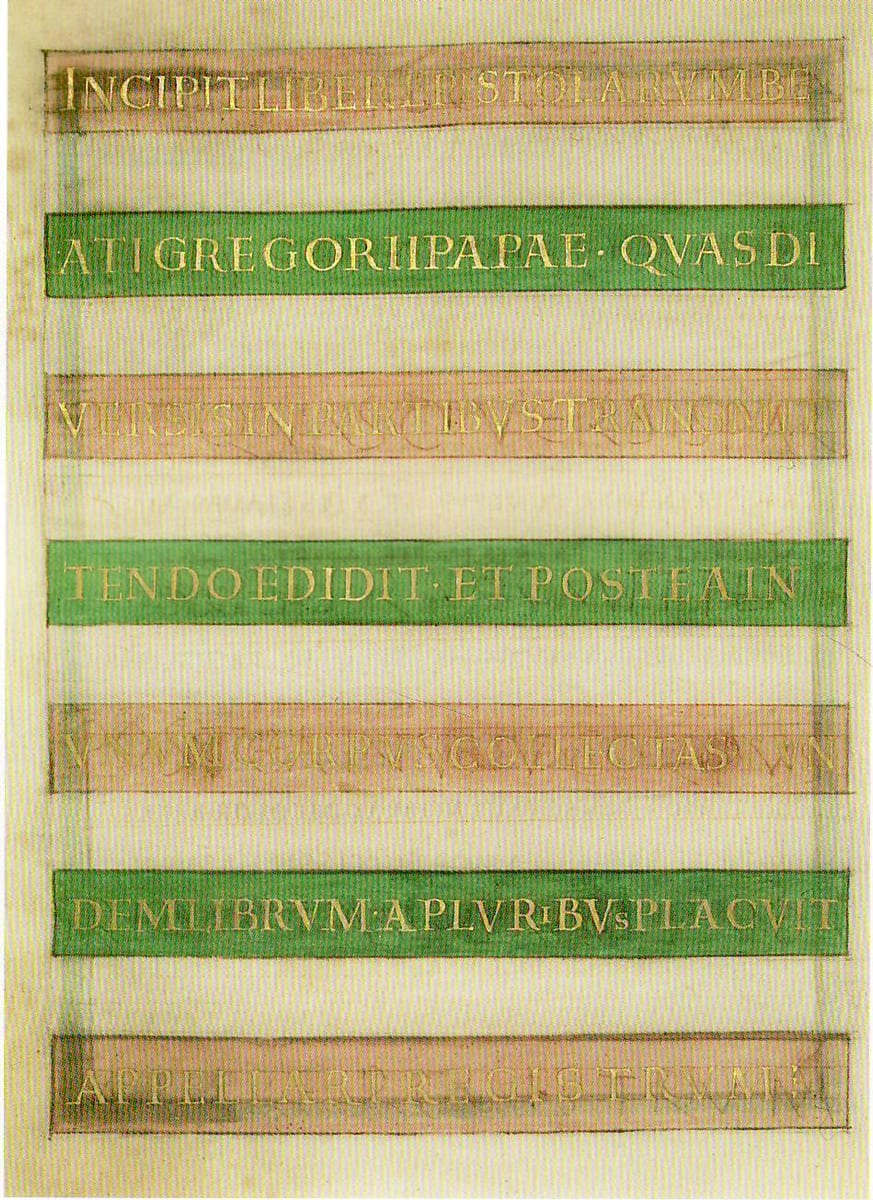
St. Gregory the Great writing, Registrum Gregorii, Stadtbibliothek Trier, Hs. 171/1626a, fol. 1v, Master of the Registrum Gregorii (the Gregormeister), anonymous painter of Trier, c. 983-985 AD Master of the Registrum Gregorii (the Gregormeister), anonymous painter of Trier, Stadtbibliothek Trier, Germany The pope ordained St. Gregory one of the seven deacons of Rome, against his will. Early in 579 AD he left for Constantinople as apocrisiarius, the papal envoy at the imperial court. His commission was to obtain troops against the Lombards.
He stood godfather to the eldest son of the Emperor Maurice. At Constantinople he composed his Morals on the Book of Job for the monks who had followed him. He came home to the Caelian about 585 AD without soldiers.
-
589–590 AD
Flood, plague, and an election
The Tiber, then the pestilence that killed a pope and made him one.
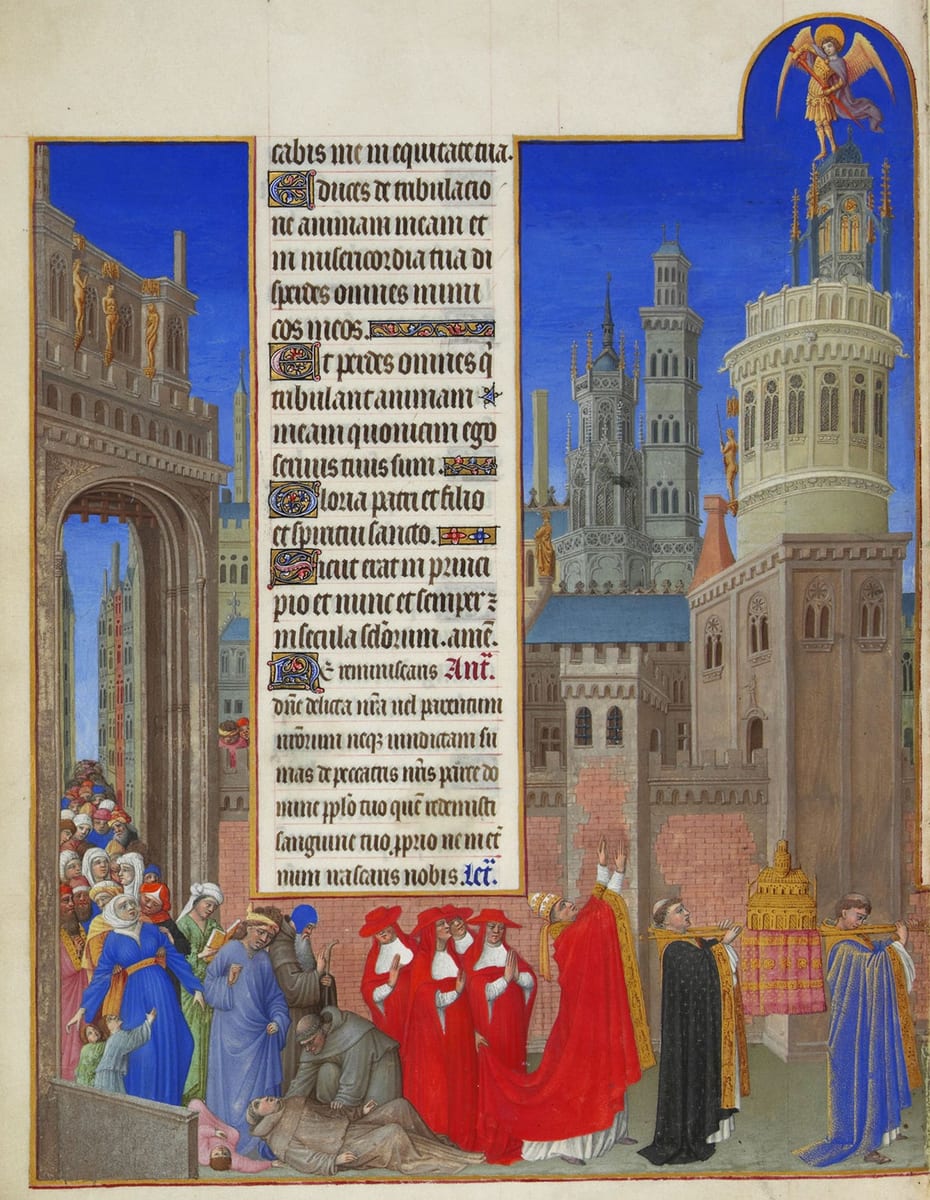
The Procession of St. Gregory - Tres Riches Heures du Duc de Berry, fol. 71v, The Limbourg brothers (Herman, Paul and Jean de Limbourg), 1411-1416 AD The Limbourg brothers (Herman, Paul and Jean de Limbourg), Musee Conde, Chateau de Chantilly, France In November 589 AD the Tiber overwhelmed Rome and destroyed the granaries of the Church. The plague followed, and in January it killed Pope Pelagius II. St. Gregory climbed the ambo of St John Lateran and preached to the dying city.
A seventh-century Roman tradition holds that seven trains of penitents crossed Rome, marchers falling dead of the plague as they went. The whole people elected the deacon St. Gregory, and he was consecrated Bishop of Rome on September 3, 590 AD.
“Lo, our most serene Lord the Emperor has ordered an ape to be made a lion. And, indeed, in virtue of his order it can be called a lion, but a lion it cannot be made. Wherefore his Piety must needs himself take the blame of all my faults and short-comings, having committed a ministry of power to a weak agent.”
St. Gregory the Great to Narses, reflecting on his elevation to the episcopate/papacy, 590 AD -
591–599 AD
Buying peace at the walls
Lombard armies at the gates, an angry emperor, and a peace the Church paid for.
In the summer of 592 AD Ariulf of Spoleto sent a threatening letter and came before the walls. St. Gregory concluded a truce with the duke that July, and the Church bore the cost. King Agilulf marched on Rome in June 593 AD, and no relief came from Ravenna.
In June 595 AD a letter from the Emperor Maurice reached him, accusing him of treachery and folly. The negotiations ended in a truce in 598 AD, and the articles of peace were signed the next year.
“Let no one blame me if henceforth I cease my speaking, since, as you all see, our tribulations have increased; we are surrounded on all sides by swords; on all sides we are afraid for imminent danger of death. Some return to us with their hands cut off; others are reported to us as taken captive or slain. I am now forced to withhold my tongue from exposition, for my soul is weary of life.”
St. Gregory the Great to his congregation, closing his homilies on Ezekiel during the siege of Rome, 593 AD -
586–604 AD
Monks sent to the English
A market-place tradition, and the mission that carried the faith to Britain.
According to the tradition St. Bede handed on from his ancestors, St. Gregory saw youths from Britain offered for sale at Rome. Tradition holds that he then asked the pope to send preachers to the English and offered himself for the work.
In 596 AD he sent Saint Augustine and a company of monks to preach to the English. He wrote to the monks on the road when their nerve failed. St. Augustine ordained two bishops in Britain in 604 AD.
“Since it had been better not to have begun what is good than to return back from it when begun, you must, most beloved sons, fulfil the good work which with the help of the Lord you have begun. Let, then, neither the toil of the journey nor the tongues of evil-speaking men deter you; but with all instancy and all fervour go on with what under God's guidance you have commenced, knowing that great toil is followed by the glory of an eternal reward.”
St. Gregory the Great to the brethren going to England, 596 AD -
599–604 AD
The last letters
Gout held him in bed while he dictated the business of the Church.
In 599 AD St. Gregory wrote that for eleven months he had rarely been able to leave his bed. The letters, homilies and negotiations of those years were dictated from a sickbed.
On January 25, 604 AD he gave lands to the church of St Paul to furnish it with lights. Shortly before the end he sent Queen Theodelinda wood of the true cross for her baptized son. He died at Rome on March 12, 604 AD, and was buried that day in the portico of St Peter's.
“For eleven months, I have rarely been able to leave my bed. I am so tormented with gout and painful anxieties that life itself is to me most grievous suffering. Every day I sink through pain. Every day I look for the relief of death.”
St. Gregory the Great, describing his suffering from gout, 599, 599 AD


Pray with the Church
Words Saint Gregory added to the Canon of the Mass
The words St. Gregory added to the Canon of the Mass.
diesque nostros in tua pace disponas,atque ab aeterna damnatione nos eripi,et in electorum tuorum jubeas grege numerari
All 6 reports on Saint Gregory the Great

Pope St. Gregory refuses to let frightened monks abandon the journey to England

About this picture
AI-generated image, in the manner of manuscript illumination, staged after The Procession of St. Gregory, Tres Riches Heures du Duc de Berry, fol. 71v (the Limbourg brothers, 1411-1416 AD, Musee Conde, Chantilly) View source artwork.
Bedridden St. Gregory works for Lombard peace through Queen Theodelinda

About this picture
AI-generated image, in the manner of Italian buon fresco on lime plaster, from the paper's reference portrait based on Come Romano monaco da lo abito eremitico a Benedetto (Life of St Benedict, Scene 4: The Monk Romanus Dresses Benedict) (Il Sodoma (Giovanni Antonio Bazzi), 1505-1508 AD, Great cloister, Abbazia di Monte Oliveto Maggiore, Asciano, Siena) View source artwork.

Shepherds mistake the hermit St. Benedict in his cave for a beast

About this picture
AI-generated image, in the manner of manuscript illumination, from the paper's reference portrait based on The Procession of St. Gregory, Très Riches Heures du Duc de Berry, fol. 71v (the Limbourg brothers, 1411-1416 AD, Musée Condé, Chantilly) View source artwork.
St. Gregory the Great buys Rome a truce the emperor's governor forbade

Lombard king agrees an eighteen-month truce, days after storming Mantua

About this picture
AI-generated image, in the manner of a Latin manuscript illumination, from the paper's reference portrait based on St. Gregory the Great dictating the chant to the deacon Peter, Antiphonary of Hartker, St. Gallen, Stiftsbibliothek, Cod. Sang. 390, p. 13 (Hartker, monk of St. Gall, c. 990-1000 AD, Stiftsbibliothek St. Gallen, Switzerland) View source artwork.
.jpg)