Saints Founder of the Society of Jesus
Saint Ignatius of Loyola
Feast 31 July · Born 1491 AD, The castle of Loyola above Azpeitia, Guipuzcoa, Spain · Died 1556 AD, The professed house beside Santa Maria della Strada, Rome, Papal States
From the castle of Loyola to a professed house in Rome: a soldier, a beggar, a prisoner, a schoolboy at thirty-three, and the first general of the Society of Jesus.
Begin the life
In brief
Saint Ignatius of Loyola was a Basque soldier whose legs a cannon ball broke at Pamplona in 1521 AD. He founded the Society of Jesus, wrote the Spiritual Exercises, and governed the order from Rome until 1556 AD. Pope Gregory XV canonized him on March 12, 1622 AD, and the Church keeps his feast on July 31.
-
1491–1520 AD
The youngest son of the house of Loyola
Basque nobility, a place at court, and a young man who wanted a name.
Saint Ignatius of Loyola was born at the castle of Loyola above Azpeitia in 1491 AD. He was baptized with the name Inigo and took the name Ignatius later, at Rome. About 1506 AD he went to Arevalo, into the household of the crown's chief treasurer.
St. Ignatius took great care of his hair and dress, and wanted to win glory. In 1517 AD he entered the service of the Duke of Najera, who taught him the military art himself. At the storming of Najera in 1520 AD he refused any share of the plunder.
-
1521 AD
The wall came down, and the reading began
A cannon ball at Pamplona, a leg broken twice over, and two books he had not asked for.
The French crossed into Navarre, and St. Ignatius went into the citadel of Pamplona of his own accord. On May 20, 1521 AD a cannon ball tore open one leg and broke the other. The citadel surrendered as he fell.
At Loyola the surgeons broke and reset the leg, and he gave no sign of pain but clenched fists. He asked for romances of chivalry, and the house had none. They brought him a Life of Christ and a book of the saints instead.
“What if I should do what St. Francis did? What if I should act like St. Dominic?”
St. Ignatius of Loyola, 1521 AD -
1522 AD
He hung up his sword and went down to Manresa
A night's watch before Our Lady's altar, a year of begging, and the first pages of a book.
At the end of February 1522 AD he rode out of his father's house for Montserrat. On the eve of the Annunciation he gave his costly clothes to a beggar. He hung his sword and dagger at Our Lady's altar and watched there all night.
He came down to Manresa at daybreak, begged his bread and stayed the better part of a year. Sitting on the bank of the river Cardoner, the eyes of his soul were opened. At Manresa he began the notes that grew into the Spiritual Exercises.
“Man is created to praise, reverence, and serve God our Lord, and by this means to save his soul.”
St. Ignatius of Loyola -
1523 AD
Six weeks in the Holy Land
He sailed with a fever, entered the city at midday, and was ordered home within the month.
He sailed from Venice for Cyprus on July 24, 1523 AD, after several days of fever. The doctor had told him that morning that he could go if he wished the ship to be his tomb. He entered Jerusalem at midday on September 4, 1523 AD.
He asked to stay and visit the holy places often. The Franciscan Provincial ordered him to leave with the pilgrims the next day. He sailed from Jaffa on October 3, 1523 AD, after about six weeks in Palestine.
-
1524–1533 AD
Grammar school at thirty-three
Eleven years of study, forty-two days in one prison and a chain in the next.
He decided to study so as to be better fitted to save souls. At thirty-three he went back to grammar school at Barcelona, taught free by a master there. He gave eleven years to study, more than a third of his remaining life.
At Alcala de Henares he spent forty-two days in prison, the first seventeen without being told the charge. At Salamanca he was chained to a pillar beside his companion. He walked into Paris on February 2, 1528 AD and sat down in a class with children.
“I shall give the reply made to-day to a woman who bewailed my lot. For the love of Jesus Christ, I gladly would wear all the handcuffs and chains that could be found in Salamanca. And if you consider this an evil, you show that as yet you are not desirous of suffering imprisonment for the love of Our Lord.”
St. Ignatius of Loyola, 1527 AD -
1534–1540 AD
Seven men at Montmartre, and a charter at Rome
The vow outside Paris, the sea closed by war, and the bull that made a new order.
At Montmartre on August 15, 1534 AD, seven men vowed poverty, chastity and a journey to Jerusalem. St. Ignatius was ordained priest at Venice on June 24, 1537 AD. That July the Turkish war closed the sea, and the voyage was given up.
For three months in 1539 AD the companions met in the evenings and agreed unanimously to live under obedience. Pope Paul III approved their Formula by word of mouth at Tivoli on September 3, 1539 AD. The bull Regimini militantis Ecclesiae approved the Society of Jesus on September 27, 1540 AD.
“Whoever wishes to serve as a soldier of God beneath the banner of the cross in our Society, which we desire to be designated by the name of Jesus, and to serve the Lord alone and his vicar on earth.”
St. Ignatius of Loyola, September 27, 1540 AD -
1541–1552 AD
The general who governed by letter
Elected by every vote but his own, he ran an order from one house in Rome.
On April 8, 1541 AD every vote but his own elected him Superior General. He refused the office and accepted it eleven days later. He governed from Rome by letter, sending two hundred and fifty in a few days of December 1542 AD.
Pope Paul III approved and praised the Spiritual Exercises on July 31, 1548 AD. He made India a province of the Society in 1549 AD, under Saint Francis Xavier. The Roman College opened on February 22, 1551 AD, and taught Latin and Greek the next day.
-
1553–1556 AD
The story he told at last, and the morning he died
Two years of dictation, months without Mass, and a quiet death at sunrise.
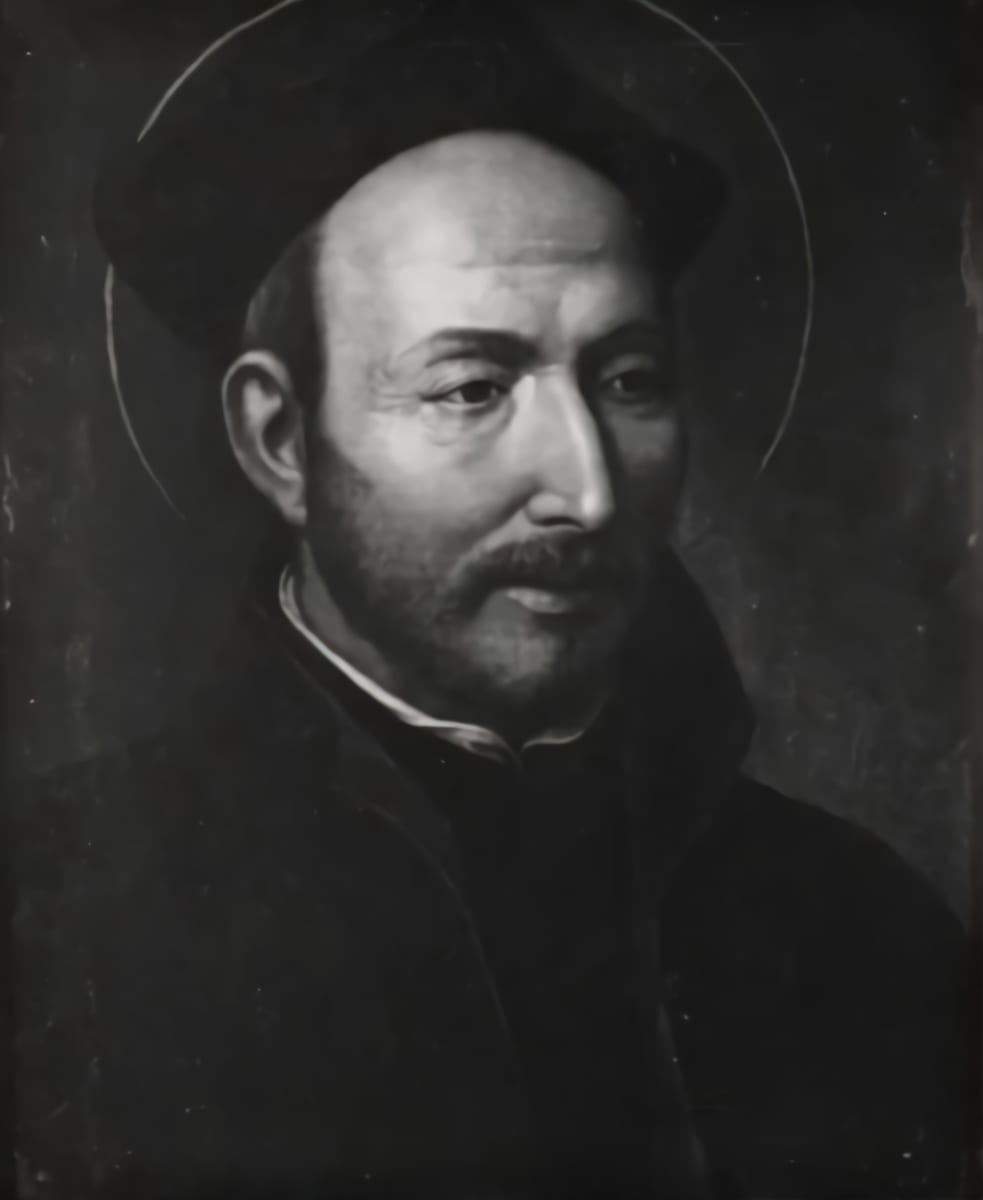
Portrait of Ignatius of Loyola, Jacopino del Conte (1510/1515-1598 AD), 1556 AD, painted on the day of his death, July 31 Jacopino del Conte (1510/1515-1598 AD), Curia Generalizia of the Society of Jesus, Rome; catalogued by the Fondazione Federico Zeri, Bologna In August 1553 AD he began dictating the story of his life to Luis Goncalves da Camara. He finished it on October 22, 1555 AD, the day before da Camara left for Portugal. By February 1556 AD he had for several months been unable to celebrate Mass.
On July 30, 1556 AD he sent Polanco to Saint Peter's to beg the Pope's blessing. He died at sunrise on Friday, July 31, 1556 AD, with two priests beside him. Polanco wrote that he named no successor and passed in the common way of this world.
“How is that? Do you think you are going to live that long?”
St. Ignatius of Loyola, 1553 AD


Pray with the Church
Take, Lord, and Receive
The offering Saint Ignatius of Loyola wrote into the Contemplation to Attain Love, at the close of the Spiritual Exercises, in the translation of Elder Mullan, S.J., from the Spanish autograph.
Take, Lord, and receive all my liberty, my memory, my intellect, and all my will--all that I have and possess.Thou gavest it to me: to Thee, Lord, I return it!All is Thine, dispose of it according to all Thy will.Give me Thy love and grace, for this is enough for me.
All 11 reports on Saint Ignatius of Loyola

About this picture
AI-generated image, in the manner of mid-sixteenth-century Roman oil portraiture, from the paper's reference portrait based on Portrait of Ignatius of Loyola (Jacopino del Conte, 1556 AD, Curia Generalizia of the Society of Jesus, Rome) View source artwork.
St. Ignatius gives his old roommate, now in Japan, charge of India

About this picture
AI-generated image, in the manner of mid-sixteenth-century Roman and Spanish oil portraiture, from the paper's reference portrait based on Portrait of Ignatius of Loyola (Jacopino del Conte, 1556 AD, Curia Generalizia of the Society of Jesus, Rome) View source artwork.
Paris rector kneels to St. Ignatius instead of flogging him

About this picture
AI-generated image, in the manner of mid-sixteenth-century Spanish and Roman oil painting, from the paper's reference portrait based on Portrait of Ignatius of Loyola (Jacopino del Conte, 1556 AD, Curia Generalizia of the Society of Jesus, Rome) View source artwork.
Storm wrecks the ship that refused St. Ignatius a free passage

About this picture
AI-generated image, in the manner of mid-sixteenth-century Roman oil portraiture, from the paper's reference portrait based on Portrait of Ignatius of Loyola (Jacopino del Conte, 1556 AD, Curia Generalizia of the Society of Jesus, Rome) View source artwork.
Pope Paul III approves St. Ignatius's order, but caps it at sixty men

About this picture
AI-generated image, in the manner of mid-sixteenth-century Spanish oil painting, from the paper's reference portrait based on Portrait of Ignatius of Loyola (Jacopino del Conte, 1556 AD, Curia Generalizia of the Society of Jesus, Rome) View source artwork.
Ordered out of Jerusalem, St. Ignatius climbs the Mount of Olives twice more

About this picture
AI-generated image, in the manner of mid-sixteenth-century Roman oil portraiture, from the paper's reference portrait based on Portrait of Ignatius of Loyola (Jacopino del Conte, 1556 AD, Curia Generalizia of the Society of Jesus, Rome) View source artwork.
St. Ignatius sends more than a hundred men out of Rome

About this picture
AI-generated image, in the manner of mid-sixteenth-century Roman and Spanish oil painting, from the paper's reference portrait based on Portrait of Ignatius of Loyola (Jacopino del Conte (1510/1515-1598), 1556 AD, painted on the day of his death, 31 July, Curia Generalizia of the Society of Jesus, Rome; catalogued by the Fondazione Federico Zeri, Bologna) View source artwork.
St. Ignatius and three priests shout in four squares of Vicenza

St. Ignatius walks barefoot to nurse the man who took his money

About this picture
AI-generated image, in the manner of sixteenth-century Netherlandish and Spanish oil painting on panel, from the paper's reference portrait based on Portrait of Ignatius of Loyola (Jacopino del Conte (1510/1515-1598), 1556 AD, painted on the day of his death, 31 July, Curia Generalizia of the Society of Jesus, Rome; catalogued by the Fondazione Federico Zeri, Bologna) View source artwork.
Saint Ignatius walked 45 miles barefoot — and nearly didn't go

About this picture
AI-generated image, in the manner of mid-sixteenth-century Spanish and Roman oil painting, from the paper's reference portrait based on Portrait of Ignatius of Loyola (Jacopino del Conte (1510/1515-1598), 1556 AD, painted on the day of his death, Curia Generalizia of the Society of Jesus, Rome; catalogued by the Fondazione Federico Zeri, Bologna) View source artwork.
St. Ignatius enters Jerusalem at midday after a year begging across Europe
