
Saints Wife, mother and foundress · 1384–1440 AD
Saint Frances of Rome
Feast 9 March · Born 1384 AD, Parione district, Rome, Italy · Died 1440 AD, Ponziani palace, Trastevere, Rome, Italy
A Roman noblewoman fed and nursed her city through famine, plague and war during forty years of marriage, gathered a community of women beside the Capitol, entered it as a widow and died as its superior.
Begin the life
In brief
Saint Frances of Rome, also called Francesca Romana, asked as a girl to serve God in a monastery and was married at twelve instead, because her father had promised her to a Roman nobleman. She lived with her husband for forty years in the Trastevere district of Rome and bore three children. She founded a community of women, the Oblates of Tor de' Specchi, but could not join it until her husband died.
-
1384–1398 AD
Married at twelve, against her wish
Married at twelve, St. Frances fell so ill that she could not move without help, and rose healed one night in July 1398 AD.
St. Frances was born in Rome in 1384 AD, the daughter of the nobleman Paolo Bussa and Jacobella de' Roffredeschi. As a girl she asked to serve God in a monastery. Her father refused, because he had already promised her to Lorenzo Ponziani, a young nobleman of Trastevere.
She was married at twelve, moved to the Ponziani palace in Trastevere, and soon fell so ill that she could not move without help. One night in July 1398 AD St. Alexius, a saint of Rome, appeared to her in a vision and asked whether she wished to be healed. She answered that she wanted only what pleased the Lord, and at once got up from the bed healed.
-
Early 1400s AD
The keys taken, the granary filled
In a famine St. Frances gave away the family grain until her father-in-law took the keys of the stores.
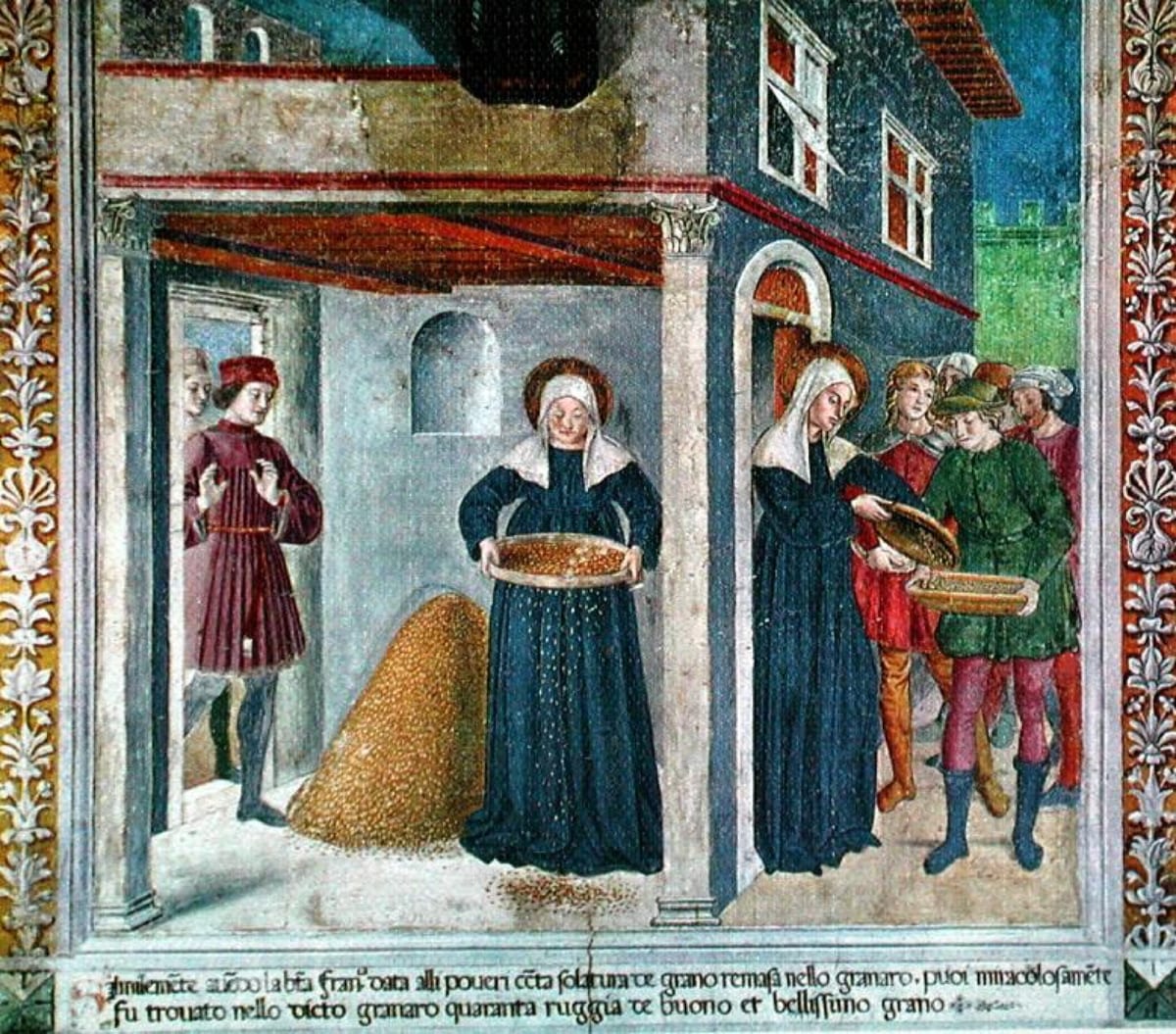
St. Frances of Rome and the miracle of the grain: fresco of the old oratory, Tor de' Specchi, Antoniazzo Romano or his circle, 1468 AD Antoniazzo Romano or his circle, Monastero delle Oblate di Santa Francesca Romana, Tor de' Specchi, Rome (old oratory) After her mother-in-law died, the running of the large Ponziani house passed to St. Frances. She had run it for about a year when famine and disease struck Rome, and she fed the hungry from the family's grain. Her father-in-law feared that his own family would go hungry, so he took the keys of the stores from her and sold off the grain and wine.
She begged alms through the city with her sister-in-law and gave the poor the little grain still left in the granary. A few days later the granary was found full of good wheat, about forty measures. Her husband, Lorenzo, was awed by what had happened in his house, and from then on he let her decide for herself how she lived and how she spent her days.
-
1408–1409 AD
The king's governor demands her son
A king's army left the husband of St. Frances for dead, and the king's governor demanded her son as a hostage.
King Ladislaus of Naples seized Rome in 1408 AD, and the Ponziani stood with the Pope against him. Lorenzo commanded a body of the Pope's soldiers; in the fighting he was wounded in several places, and for a time everyone believed he was dead. St. Frances washed and bound his wounds with her own hands.
The Count of Troia, who governed Rome for the king, then turned on the families loyal to the Pope, the Ponziani first among them. He arrested Lorenzo's brother and ordered that the couple's eldest son, Battista, be handed over as a hostage for Lorenzo; if the boy was not given up, the brother would be beheaded. According to longstanding Catholic Tradition, she gave the boy up at the Capitol on her confessor's order, while people in the streets called her mad, and the Count sent him back as she prayed in the church of Aracoeli.
-
1411–1414 AD
Two children dead, the palace sacked
St. Frances lost two of her three children, and war sent her husband into exile.
Plague struck Rome in 1411 AD and seized her second son, Evangelista, who was nine years old. He received the last sacraments, asked his mother for her blessing, folded his own hands and died. Her daughter, Agnese, died in 1413 AD, and of her three children only Battista was left.
When the king's army took Rome a second time, Lorenzo was banished with his brother, soldiers sacked the palace, and this time Battista was left a prisoner. St. Frances turned some ground-floor rooms of the wrecked palace into a small hospital for the sick. Three witnesses later swore that she stayed cheerful through these trials and thanked God for whatever happened.
“God hath given, and God hath taken away. I rejoice in these losses, because they are God's will. Whatever he sends, I shall continually bless and praise his name for.”
St. Frances of Rome, when her husband was banished, the estate confiscated and her son held hostage, 1413 AD -
1414–1430 AD
An offering made with nine companions
St. Frances and nine other Roman women gave themselves to God's service and went on living at home.
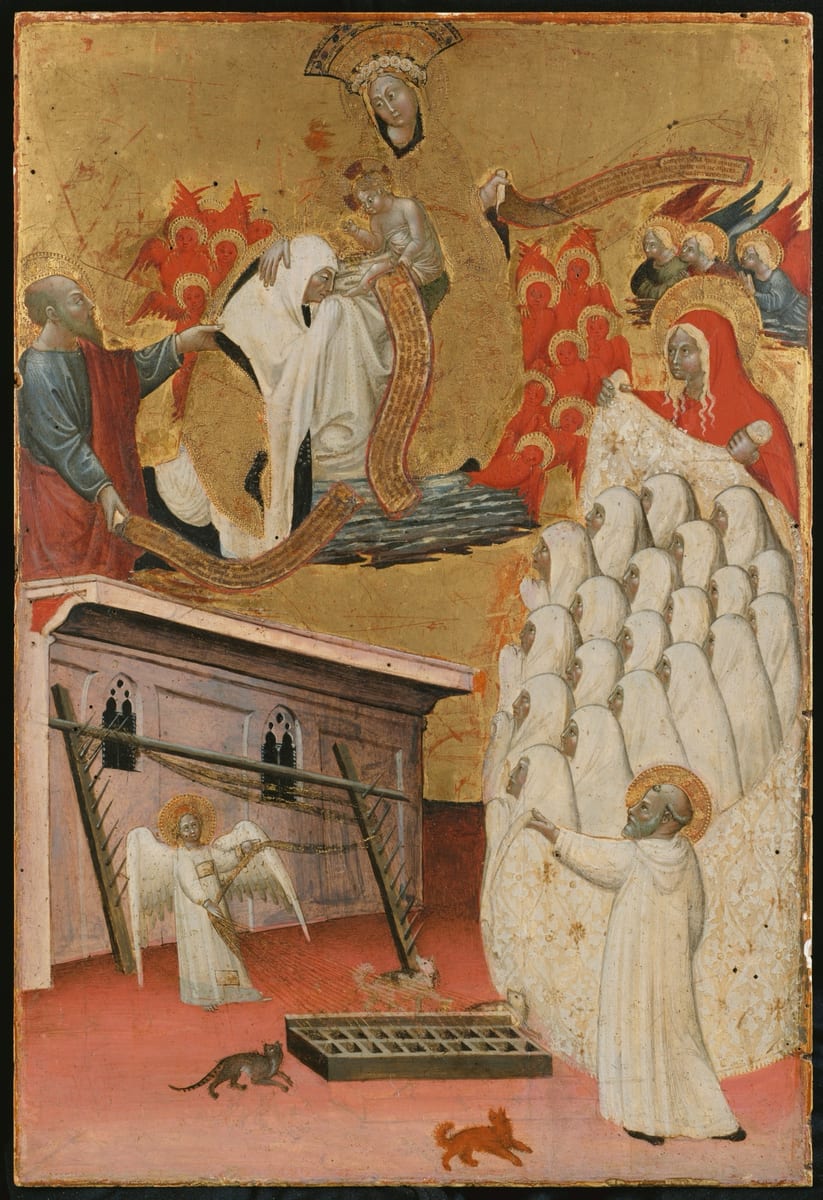
St. Frances of Rome Clothed by the Virgin, Antonio da Viterbo the Elder (attributed), c. 1445 AD Antonio da Viterbo the Elder (attributed), The Metropolitan Museum of Art, New York, Robert Lehman Collection (1975.1.100) Lorenzo and Battista came home after the king died in August 1414 AD, and about 1425 AD Lorenzo agreed that the couple would live chastely, provided she stayed in his house and kept running it. That year she proposed to the Roman matrons who met at the church of Santa Maria Nova that they offer themselves together to the Virgin Mother, and on August 15, the feast of the Assumption, she and nine companions did so. By this offering, called an oblation, the women gave themselves to God in service of the afflicted; it did not make them nuns, and the Oblates, as they were called, went on living in their own homes.
From 1430 AD her confessor, Don Giovanni Mattiotti, wrote down in detail what she told him of her visions and ecstasies. She told him that evil spirits came to her as lions, dogs and serpents and dragged her through the house. She also told her confessors of an angel who stayed at her side day and night in human form.
“His stature is that of a child of about nine years old; his aspect full of sweetness and majesty; his eyes generally turned towards heaven: words cannot describe the divine purity of that gaze. His brow is always serene; his glances kindle in the soul the flame of ardent devotion. When I look upon him, I understand the glory of the angelic nature, and the degraded condition of our own. He wears a long shining robe, and over it a tunic, either as white as the lilies of the field, or of the colour of a red rose, or of the hue of the sky when it is most deeply blue. When he walks by my side, his feet are never soiled by the mud of the streets or the dust of the road.”
St. Frances of Rome to her confessor Don Antonello, 1412 AD -
1433–1436 AD
The house she could not join
The Oblates took a house in 1433 AD. St. Frances entered it in 1436 AD, straight from her husband's funeral.
In 1433 AD the unmarried and widowed Oblates moved into a small house at Tor de' Specchi, at the foot of the Capitol, and that July Pope Eugenius IV recognised the community. St. Frances could not get Lorenzo's permission to live with them; whenever she came to the house or left it, she kissed the hand of the Oblate in charge and asked her blessing. Lorenzo died early in 1436 AD, after a long illness through which she nursed him.
She had lived with him forty years. Straight after his funeral she went to Tor de' Specchi and asked the Oblates to take her in out of charity. The Oblate in charge resigned and the sisters with one voice chose St. Frances as superior; she refused, and gave way only when her confessor, whom she had always obeyed, ordered her to accept.
-
March 1440 AD
Seven days in her son's house
St. Frances went to her sick son, was seized by fever and told her confessor when she would die.
Early in March 1440 AD St. Frances went to the Ponziani palace, where her son Battista lay sick with fever. A violent fever seized her there, and by evening her confessor, Don Giovanni Mattiotti, judged her too weak for the journey back to Tor de' Specchi and told her to stay the night. Battista was still living twelve years later.
Within days she told her confessor that Christ had appeared to her in the night and that she would die on the seventh day of her illness. She asked for the last sacraments and received them, and as the news spread through Rome, more clergy and lay people came to see her than could be held back. On the evening of Wednesday, March 9, 1440 AD, the seventh day of her illness, she spoke a last time to the Oblates, raised her eyes to heaven and died in the palace, still praying aloud.
“Laudetur Deus, Mercurij vel Iouis dies terminum vitæ meæ adferet. (God be praised, my pilgrimage will end from Wednesday to Thursday next.)”
St. Frances of Rome to her confessor, in her last illness, when he told her she seemed better, March 1440 AD -
1440–1925 AD
Three days at her coffin
Crowds delayed the burial of St. Frances in 1440 AD; Pope Paul V canonised her in 1608 AD.
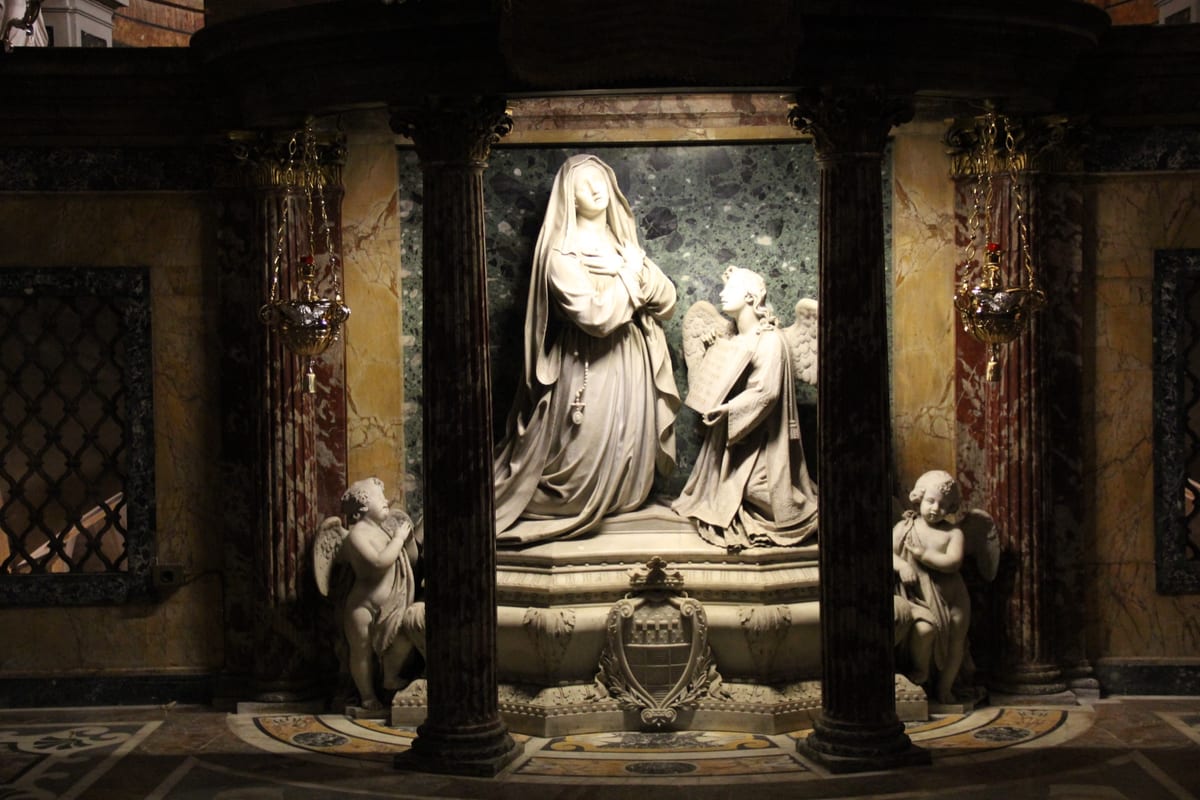
St. Frances of Rome and her angel: marble group in the confessio of the basilica of Santa Francesca Romana (Santa Maria Nova), Rome, confessio finished 1649 AD Basilica of Santa Francesca Romana (Santa Maria Nova), Roman Forum, Rome Her body was carried in procession from Trastevere to Santa Maria Nova, the church where she had made her offering in 1425 AD, and for three days people came to venerate it. The people's outcry forced the Olivetan monks who served the church to put off her burial until March 12, when she was buried before the high altar. The Auditors of the Rota, the judges who later examined her case for canonisation, reported that the crowd had gathered with no one urging or arranging it.
Pope Paul V canonised her in St. Peter's Basilica on May 29, 1608 AD. Pope Pius XI proclaimed her patroness of motorists in 1925 AD, and a homily published by the Dicastery for the Causes of Saints gives his reason: the angel she saw constantly at her side.


.jpg)
Pray with the Church
A prayer dear to St. Frances of Rome
Pope Leo XIV, in his message of August 15, 2025 AD to the Oblate Sisters of Tor de' Specchi, wrote that St. Frances was fond of this prayer, and gave it in Latin and in English.
Tenuisti manum dexteram meam:in voluntate tua deduxisti me:et cum gloria assumpsisti me.
[You held my right hand in yours, you led me into your will and welcomed me into glory]
English as given in the Holy See's translation of Pope Leo XIV's message
All 1 report on Saint Frances of Rome
