
Saints Penitent of the Third Order of St. Francis · 1247–1297 AD
Saint Margaret of Cortona
Feast 22 February · Born 1247 AD, Laviano, near Castiglione del Lago, Italy · Died 1297 AD, Cortona, Italy
Turned out by her father after the nobleman she lived with was killed, a farmer's daughter walked to Cortona with her small son, waited three years for a penitent's habit, nursed the sick poor and died in a cell beside a church she had rebuilt.
Begin the life
In brief
Saint Margaret of Cortona was a farmer's daughter who lived nine years with a nobleman and bore him a son. He was killed, her father turned her away, and she went to Cortona, where she lived as a Franciscan penitent and founded a hospital for the sick poor. She died at Cortona in 1297 AD; Pope Benedict XIII canonized her on May 16, 1728 AD, and the Roman Martyrology records her on February 22.
-
1247 AD–c. 1264 AD
A farmer's daughter at Laviano
Born to poor farmers, St. Margaret lost her mother at about seven and left home at about sixteen.
St. Margaret was born in 1247 AD to poor farmers at Laviano, a hamlet about ten miles from Cortona. Her mother taught her a prayer for the salvation of everyone God wished her to pray for.
When she was about seven her mother died, and two years later her father married again. There was little affection between the girl and her stepmother. At about sixteen she left her father's house to live with a young nobleman of Montepulciano, who had a villa near Laviano.
“Rogo te, Domine, pro salute omnium, pro quibus me vis orare. (Lord, I entreat Thee to save those for whom it is Thy will that I pray.)”
St. Margaret of Cortona to Christ, the prayer her mother taught her as a child, said again in her cell -
c. 1264–1273 AD
Nine years at Montepulciano
St. Margaret bore the nobleman a son and asked him often to marry her; he never did.
St. Margaret lived with the nobleman for nine years and bore him a son. She asked him often to marry her; he promised each time and never did. Pope John Paul II gave the reason: she was a peasant's daughter and he a nobleman.
She went about Montepulciano in fine clothes, with pearls and gold in her hair. She was tender toward the poor and often gave them what they needed. When her companions teased her about her dress, she answered that they would one day call her a saint and come as pilgrims to her tomb.
“Adhuc tempus adueniet, in quo me nominabitis Sanctam, cum sancta fuero: & visitabitis me cum baculo peregrino, scarcellis pendentibus ab humeris vestris. (A time will come when you shall call me holy, because I shall have become so; and you shall visit me staff in hand, with a pilgrim's wallet on your shoulders.)”
St. Margaret of Cortona to her companions at Montepulciano, at Montepulciano, answering their teasing -
c. 1273 AD
The nobleman is killed
The nobleman St. Margaret lived with was killed, and she gave back his gifts and left Montepulciano on foot with their son.
After nine years the nobleman was killed while away from home. According to longstanding Catholic Tradition, his dog came home alone, pulled at St. Margaret's dress and led her to some oaks, where it dug up part of his buried body. The sight of the decaying body filled her with fear of God's judgment, and she blamed herself for the way he had lived.
She went back to Montepulciano and changed her fine clothes for a plain black dress. She gave his relatives back the jewels and property he had given her, and sold a few ornaments for the poor she had been helping. Then she left the town on foot, leading her small son by the hand.
-
c. 1273 AD
Turned away at her father's door
St. Margaret's father turned her out, and two women of Cortona took her and her boy in.
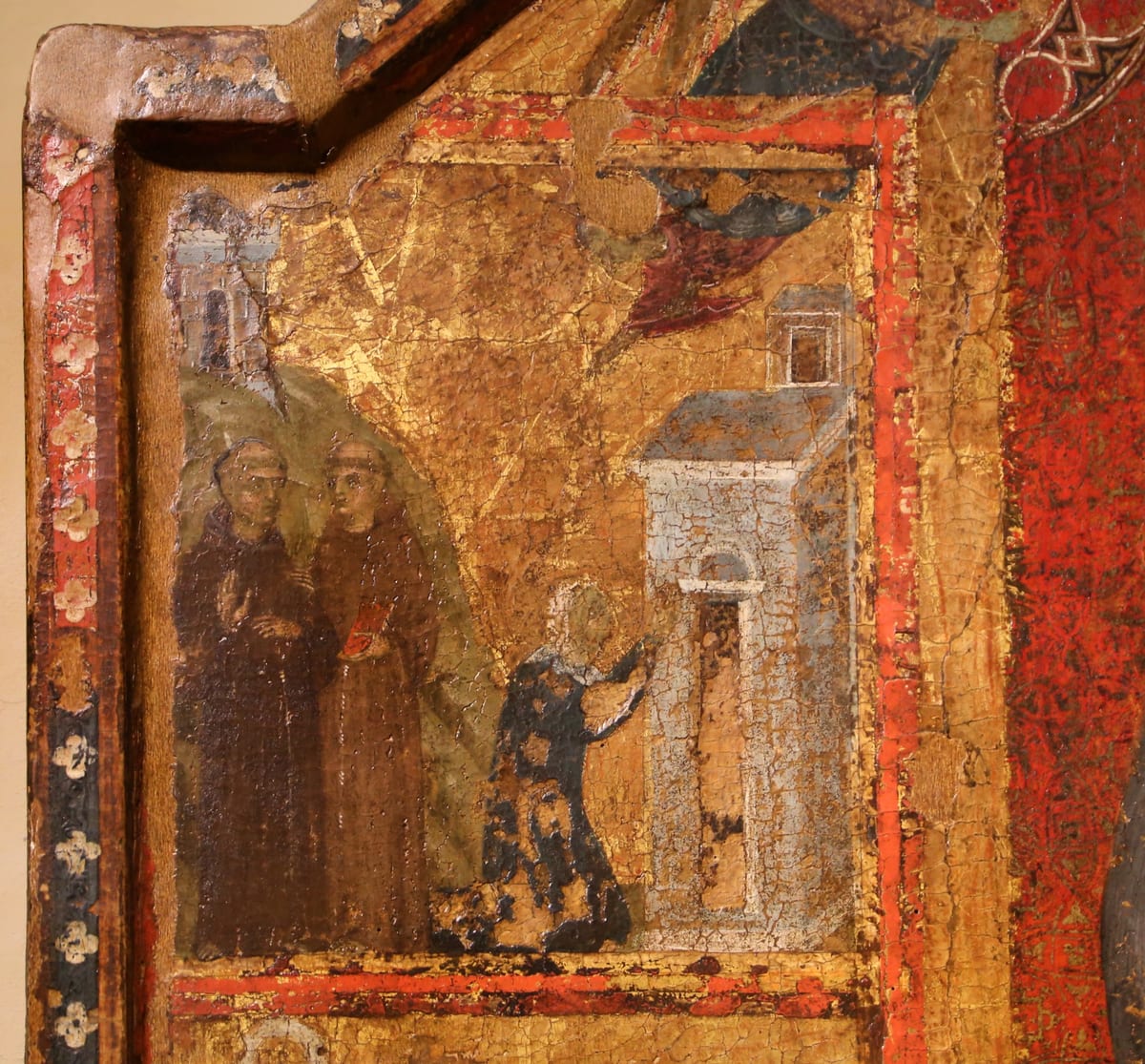
St. Margaret of Cortona and stories of her life: first scene, Christ directs St. Margaret to the Franciscans, Aretine or Sienese painter, 1298–1299 AD Aretine or Sienese painter, Museo Diocesano, Cortona (from the monastery of Santa Chiara); photograph by Sailko St. Margaret went back to her father's house at Laviano, threw herself at his feet and begged his pardon. Her father, urged on by her stepmother, turned her out. She sat down with her son under a fig tree in a garden nearby and wept.
There a voice within her told her to go to Cortona and ask the Franciscan friars to guide her. She set out at once on foot with the boy, who was seven or eight, and entered Cortona by the gate called Porta Berarda. Two noblewomen, Marinaria and Raneria, met her there and took mother and son into their house.
-
c. 1273–1276 AD
Three years of waiting
The friars made St. Margaret wait three years for a penitent's habit while she worked and did public penance.
The two women brought St. Margaret to the Franciscan friars, and she asked them for the habit of the Third Order of St. Francis, whose members lived as penitents under the friars' direction. The friars doubted she would keep to it, thought her too attractive and too young, and made her wait three years. She supported herself and her son by nursing the women of Cortona through childbirth.
In time the boy went to school at Arezzo, and later he became a friar. One Sunday she walked into Mass at Laviano with a rope round her neck and asked the people's pardon for the scandal of her past life. She meant to disfigure her face, believing her beauty had harmed other souls; her confessor, the friar Fra Giunta Bevegnati, forbade it.
-
c. 1276–1277 AD
The penitent's habit
The friars received St. Margaret as a penitent, and she prayed before the crucifix in their church.
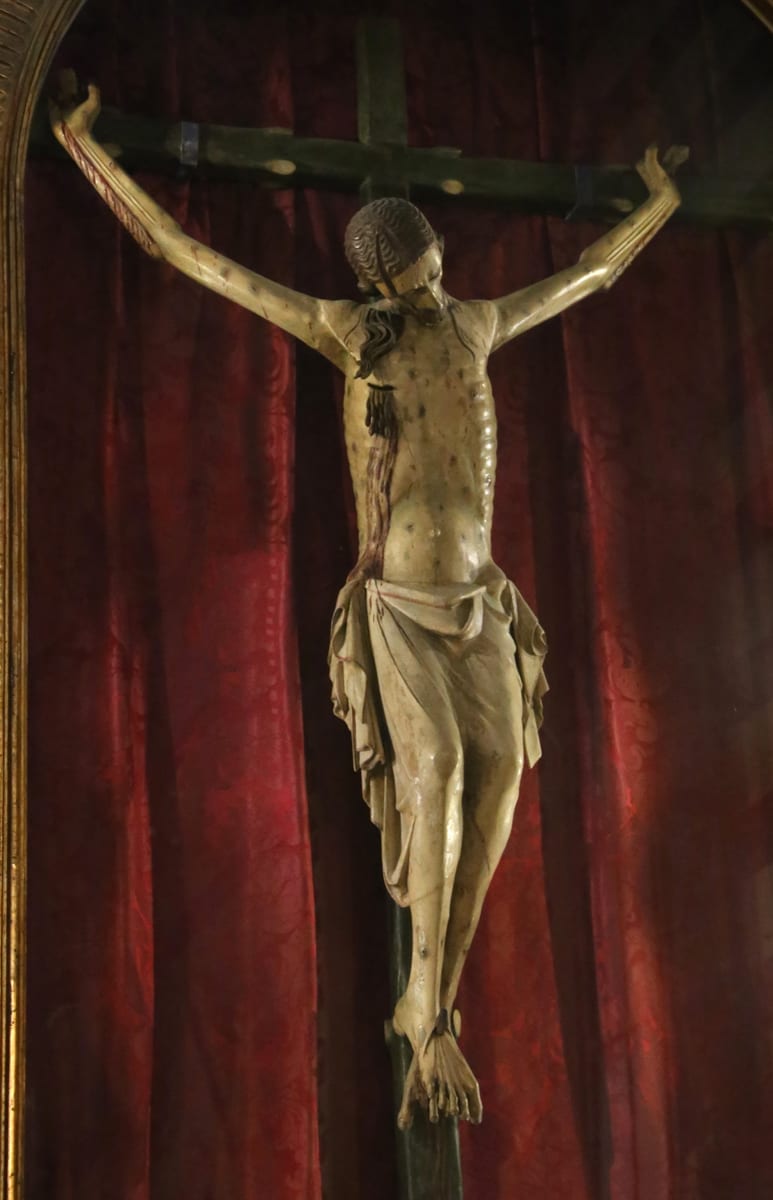
The crucifix before which St. Margaret prayed, thirteenth century AD Basilica of Santa Margherita, Cortona (formerly in the church of San Francesco of the Friars Minor); photograph by Sailko After three years the friars received her into the Third Order and gave her its habit. St. Margaret told Fra Giunta that she had asked Christ to call her his daughter and was told she must first confess her whole life again. St. Margaret's confession to Fra Giunta took eight days; she told him that at Communion on the eighth, the feast of St. John the Evangelist, she heard Christ call her his daughter.
St. Margaret told her confessor that she was praying before the crucifix in the friars' church when she heard Christ ask what she wished. She answered that she wanted nothing but him.
“Non quæro, nec volo aliud, nisi vos, Domine mi Iesu. (I seek nothing, I wish for nothing but you, my Lord Jesus Christ.)”
St. Margaret of Cortona to Christ, before the crucifix in the friars' church at Cortona, 1277 AD -
1277–1286 AD
Peace for Cortona, a hospital for its poor
Cortona made peace with the bishop it was fighting, and St. Margaret opened a hospital for the sick poor.
In 1277 AD Cortona was at war with the Bishop of Arezzo, who pressed claims on the city. St. Margaret told Fra Giunta that on May 5 Christ commanded her to send the bishop word to make peace; she held back, and sent the message only after a second summons. Two months later, on July 17, the bishop gave up his claims, lifted the Church penalties he had laid on Cortona and made peace.
When she had no food for the poor she found them shirts, knives, belts, jugs, cups, firewood and bed coverings. In 1286 AD the hospital she founded for the sick poor of Cortona opened as the Hospital of Our Lady of Mercy, with the city council's backing.
“Pater mi, nihil de rebus ad victum vel indumentum mihi transmissis retinere volo. Nam desidero esurire, vt satiem pauperes; exuere me, vt induam eos. (My father, I wish to retain for myself nothing that is sent to me, whether food or clothing. I desire to go hungry that I may feed the poor, and to go ill-clad that I may clothe them.)”
St. Margaret of Cortona to Fra Giunta Bevegnati, after an ecstasy -
1288–1297 AD
The cell below the citadel
St. Margaret spent her last years in a cell beside a church she had rebuilt, and died there.
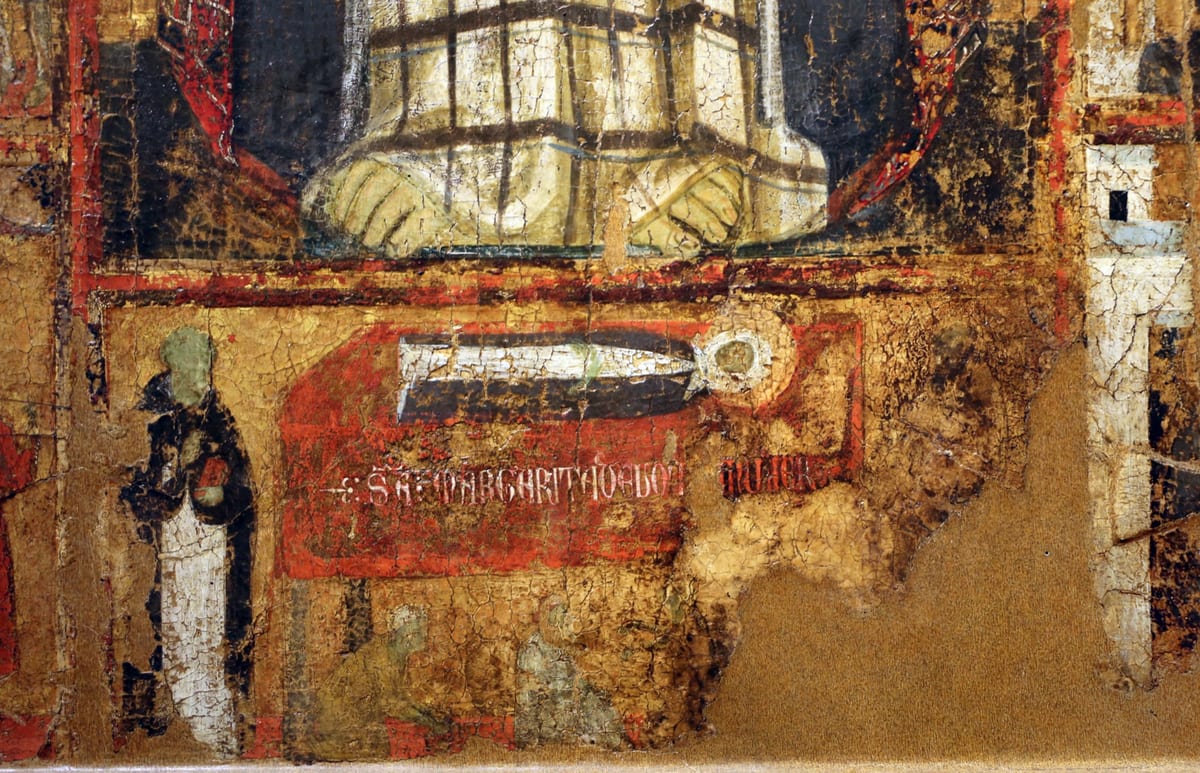
St. Margaret of Cortona and stories of her life: her death, Aretine or Sienese painter, 1298–1299 AD Aretine or Sienese painter, Museo Diocesano, Cortona; photograph by Sailko In 1288 AD St. Margaret left the hospital for a cell below Cortona's citadel, away from the noise and the crowds. That year the friars of the region, at their governing meeting in Siena, limited Fra Giunta to one visit to her every eight days, because some of them suspected she was deluded. In 1290 AD she had the ruined church of St. Basil beside the cell rebuilt, and it reopened for worship; the same year Fra Giunta was moved to Siena.
He came back late in 1296 AD; she had told him he would be with her when she died. From February 5, 1297 AD she could eat nothing, and she died with joy in her cell just before daybreak on February 22. The town's General Council went up at once to St. Basil's, where her body was dressed in purple and buried in a new tomb.


Pray with the Church
A prayer of St. Margaret of Cortona
St. Margaret's answer to Christ at Christmas, when she was bidden to ask what she wished, as her confessor Fra Giunta Bevegnati recorded it; English translation by F. M'Donogh Mahony, 1883 AD.
My Lord Jesus Christ, grant me never to offend Thee.
All 1 report on Saint Margaret of Cortona
