
Saints Saints of the Americas
Saint Juan Diego Cuauhtlatoatzin
Feast 9 December · Born 1474 AD, Cuauhtitlan, Valley of Anahuac, then in the kingdom of Texcoco (Mexico State, Mexico) · Died 1548 AD, The hermitage beside the shrine at Tepeyac, New Spain (Mexico City, Mexico)
A Chichimeca commoner was walking to Mass past a hill outside Mexico City, and three days later came down that same hill carrying flowers in his cloak.
Begin the life
In brief
Saint Juan Diego Cuauhtlatoatzin was born in 1474 AD, at Cuauhtitlan by the Holy See's account, and was baptized at fifty. In December 1531 AD the Blessed Virgin Mary appeared to him on the hill of Tepeyac and sent him to the bishop of Mexico. From 1532 AD until his death in 1548 AD he lived as a hermit beside the shrine that rose there.
-
1474–1524 AD
A boy named for an eagle
Born in the Valley of Anahuac, at Cuauhtitlan, Tulpetlac or San Juanico, a commoner of the Chichimeca; Cuauhtitlan then lay within the kingdom of Texcoco.
The Holy See places the birth of Saint Juan Diego Cuauhtlatoatzin at Cuauhtitlan in 1474 AD. He belonged to the Chichimeca people, and his town then lay within the kingdom of Texcoco. The Holy See renders the Nahuatl name of St. Juan Diego Cuauhtlatoatzin as the talking eagle.
He was a macehualli, a commoner, with a house and lands of his own. He was forty-seven when the city of Mexico fell to the Spanish in 1521 AD. Franciscan missionaries reached his region in 1524 AD, and their preaching moved him deeply.
-
1525–1529 AD
Baptized at fifty, widowed at fifty-five
He and his wife Maria Lucia entered the Church together; she died two years before Tepeyac.
He was baptized at fifty by the Franciscan Fr Peter of Ghent and took the name Juan Diego. His wife Maria Lucia was baptized with him, and the two were married in the Christian rite. He lived at Cuauhtitlan, but in the things of God he belonged to the parish of Tlatelolco.
After hearing Fray Toribio de Motolinia preach on chastity, the couple lived in continence. They had no children. Maria Lucia died about 1529 AD, and St. Juan Diego was two years a widower before Tepeyac.
-
December 9, 1531 AD
The voice on the hill
On the road to Mass he heard singing on Tepeyac and was called up by name.
Before dawn on Saturday, December 9, 1531 AD, St. Juan Diego set out for morning Mass. As he neared Tepeyac at sunrise he heard singing on the hilltop, like the songs of many rare birds. The singing stopped and a voice called him by name from the top.
He climbed the hill happy rather than afraid. At the summit the Blessed Virgin Mary named herself the mother of the true God. She asked for a sacred house on the plain below and sent him to the bishop of Mexico.
“My Lady, Beloved Lady, I am going now to make your venerable word a reality. I, your poor commoner, am leaving you for a while.”
St. Juan Diego Cuauhtlatoatzin, December 9, 1531 AD -
December 9–10, 1531 AD
Twice at the bishop's door
Bishop Zumarraga heard him out, disbelieved him, demanded a sign, and had him followed.
Bishop Juan de Zumarraga heard the whole message as if he did not believe it to be true. That evening St. Juan Diego begged the Virgin to send a nobleman in his place. She answered that he himself must go, and ordered him back the next day.
On the Sunday the bishop questioned him closely and then demanded a sign. Zumarraga had him followed, and the servants lost him at the wooden bridge near Tepeyac. They told the bishop he was lying, and agreed to seize him if he came back.
“Because I am really (just) a man from the country, I am like a mere [porter's] rope, a back-frame, a tail, a wing, a man of no importance: I myself need to be led, carried on someone's back.”
St. Juan Diego Cuauhtlatoatzin, December 9, 1531 AD -
December 11–12, 1531 AD
The road round the hill
His uncle was dying, so he took the far side of Tepeyac to avoid being stopped.
His uncle Juan Bernardino fell gravely ill, and St. Juan Diego missed the day appointed for the sign. Shortly after midnight the old man begged him to fetch a priest to hear his confession. Before dawn he crossed to the eastern side of Tepeyac so that the Virgin would not stop him.
She came down the hill, blocked his road and asked where he was going. She told him his uncle would not die of the sickness and was already well. Juan Bernardino recovered at that moment, as the household found out afterwards.
“Am I not here, I, who am your mother? Are you not under my shadow and protection? Am I not the source of your joy? Are you not in the hollow of my mantle, in the crossing of my arms? Do you need something more?”
The Blessed Virgin Mary, December 12, 1531 AD -
December 12, 1531 AD
The flowers and the cloak
He carried December flowers to the bishop's house and opened his tilma.
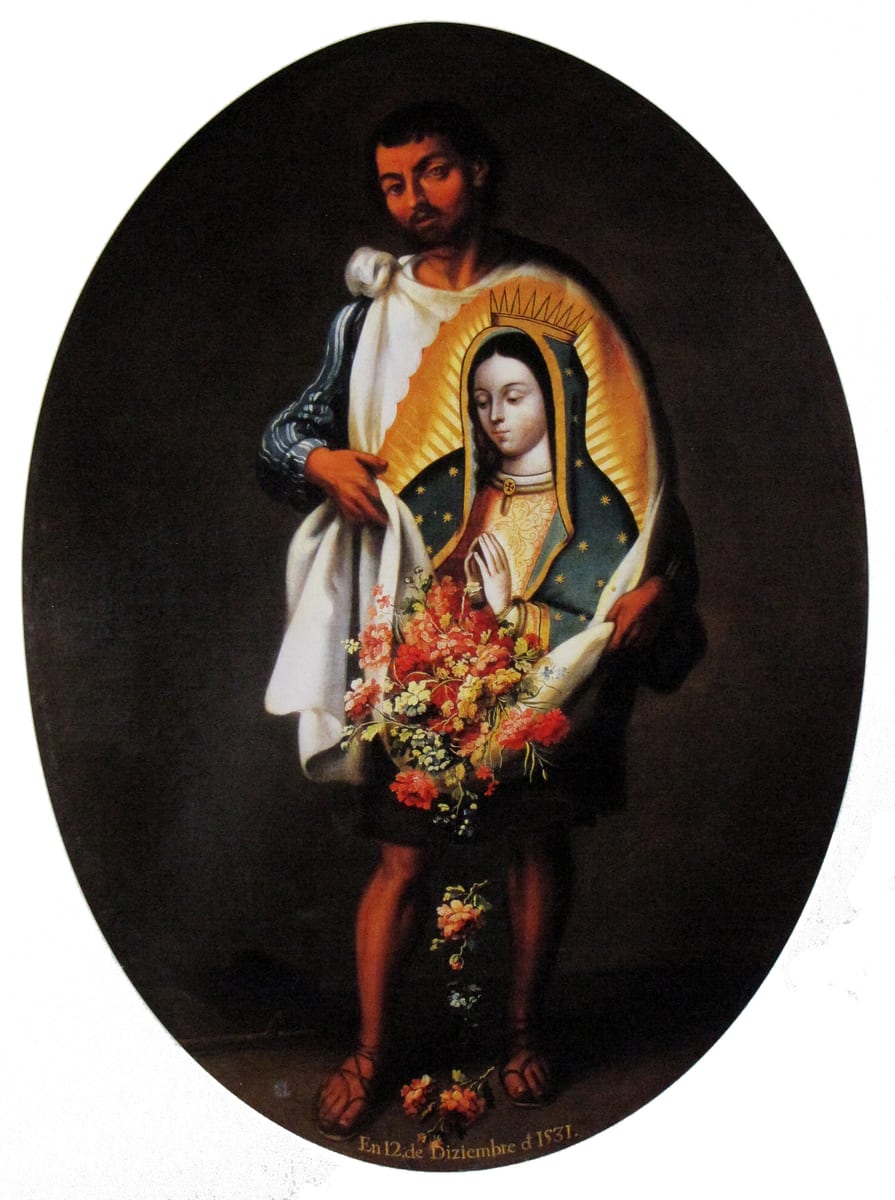
San Juan Diego con el ayate — catalogued as Milagro de la Virgen de Guadalupe en la tilma de Juan Diego, Anonymous, New Spain, 1737 AD Anonymous, New Spain, Arca — Arte Colonial Americano, Universidad de los Andes, Bogota She sent him to the hilltop, where flowers of every kind were blooming out of their season. The frost was harsh, and nothing grows up there but rocks, thorns and mesquite. He gathered the flowers into his tilma, and she arranged them there with her own hands.
At the bishop's residence the servants tried three times to take the flowers and could not. Admitted at last, St. Juan Diego opened the cloak and the flowers fell to the floor. The image of the Virgin stood on the cloth, and Bishop Zumarraga knelt and wept.
“It should now be clear that my message is true. Here they are; please receive them.”
St. Juan Diego Cuauhtlatoatzin, December 12, 1531 AD -
1532–1548 AD
Sweeping the shrine for his remaining years
He gave away his land and lived in a hut beside the chapel until his death.
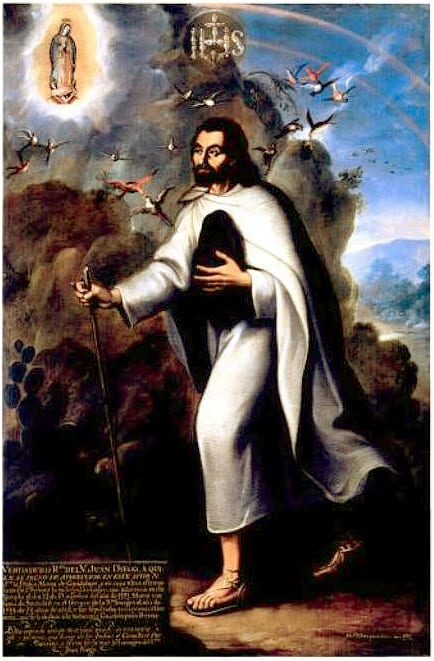
Verdadero retrato del venerable Juan Diego (True Portrait of the Venerable Juan Diego), Miguel Cabrera (1695-1768 AD), 1752 AD Miguel Cabrera (1695-1768 AD), Museo de la Basilica de Guadalupe, Mexico City A shrine of adobe stood at the foot of Tepeyac by 1532 AD, and pilgrims began to come. St. Juan Diego left his house and lands to Juan Bernardino and moved into a hut beside the chapel. He swept the church daily, fasted, did penance and received communion often.
Guadalupan tradition, recorded by Francisco de Florencia, holds that his neighbours called him the Pilgrim and the Solitary. Plague took Juan Bernardino on May 15, 1544 AD, and he was buried in the church at Tepeyac. St. Juan Diego died in 1548 AD, about seventy-four years old, and was buried in the same chapel.
“With the Bishop's permission, Juan Diego lived the rest of his life as a hermit in a small hut near the chapel where the miraculous image was placed for veneration. Here he cared for the church and the first pilgrims who came to pray to the Mother of Jesus.”
The Holy See, July 31, 2002 AD -
1556–2002 AD
St. Juan Diego canonized
The devotion at Tepeyac was fought over within a generation, and the Church raised him to the altars four centuries later.
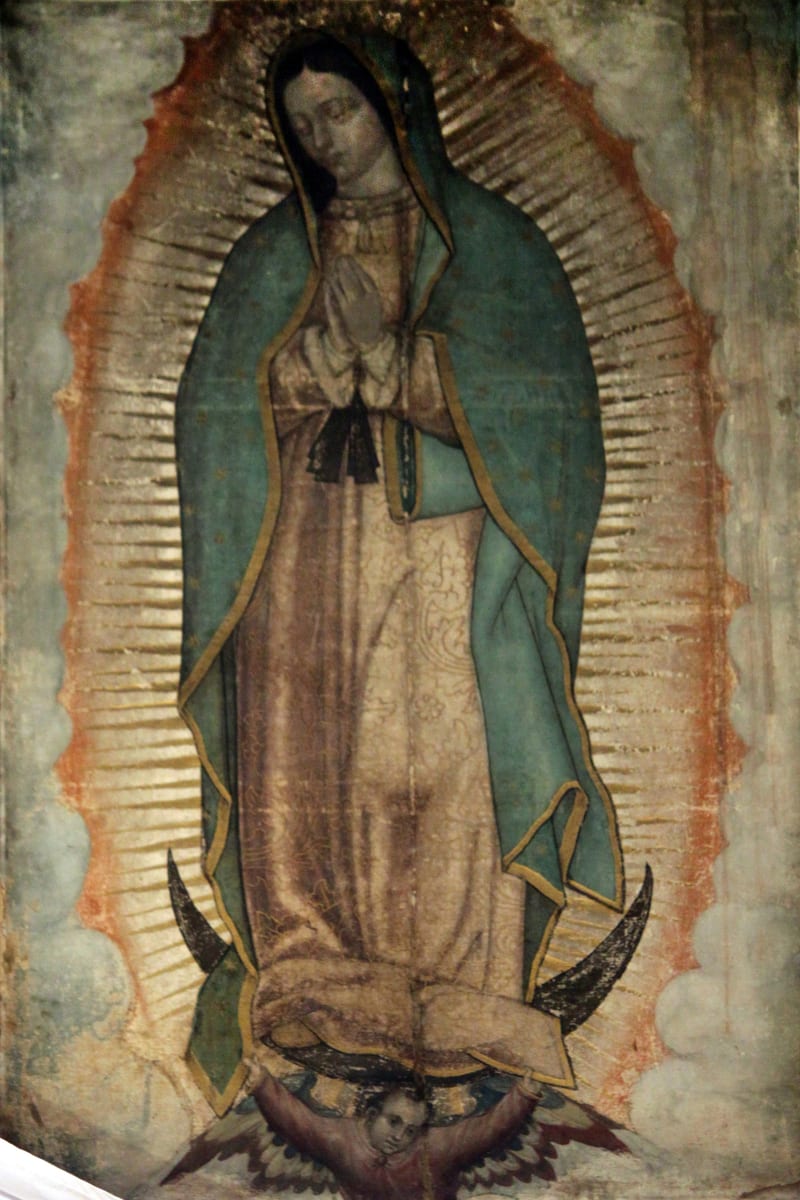
Nuestra Senora de Guadalupe — the image on the ayate of Juan Diego, The image the Church holds to be of supernatural origin; photograph by Anagoria, 1531 AD; photographed December 23, 2013 AD The image the Church holds to be of supernatural origin; photograph by Anagoria, Basilica de Nuestra Senora de Guadalupe, Mexico City About 1556 AD the Nahua scholar Antonio Valeriano wrote the Nahuatl account that preserves St. Juan Diego's words. Archbishop Alonso de Montufar preached in support of the devotion at Tepeyac on September 6, 1556 AD. Two days later the Franciscan provincial Francisco de Bustamante preached against it before the viceroy.
Pope John Paul II beatified him at the Basilica of Guadalupe on May 6, 1990 AD. The same Pope canonized him there on July 31, 2002 AD, calling him the first indigenous saint of the American continent. The Church keeps his memorial on December 9, the day the Virgin first called his name.
“Beloved Juan Diego, "the talking eagle"! Show us the way that leads to the "Dark Virgin" of Tepeyac, that she may receive us in the depths of her heart, for she is the loving, compassionate Mother who guides us to the true God.”
Pope John Paul II, July 31, 2002 AD


Pray with the Church
Collect for the Optional Memorial of Saint Juan Diego Cuauhtlatoatzin
The Collect of the Mass for his optional memorial, December 9, in the Roman Missal (ICEL translation)
O God, who by means of Saint Juan Diego showed the love of the most holy Virgin Mary for your people,grant, through his intercession, that, by following the counsels our Mother gave at Guadalupe,we may be ever constant in fulfilling your will.Through our Lord Jesus Christ, your Son, who lives and reigns with you in the unity of the Holy Spirit, God, for ever and ever.
All 3 reports on Saint Juan Diego Cuauhtlatoatzin

About this picture
AI-generated image, in the manner of New Spanish colonial baroque oil painting, from the paper's reference portrait based on The Virgin of Guadalupe with the Four Apparitions (Nicolas Enriquez, 1773, The Metropolitan Museum of Art, New York) View source artwork.
Archbishop halts the sworn enquiry he ordered into the sermon against Tepeyac

About this picture
AI-generated image, in the manner of New Spanish colonial baroque oil painting, from the paper's reference portrait based on The Virgin of Guadalupe with the Four Apparitions (Nicolas Enriquez, 1773, The Metropolitan Museum of Art, New York, accession 2014.173) View source artwork.
Nine witnesses swear to what a friar preached against the Tepeyac chapel

About this picture
AI-generated image, in the manner of New Spanish colonial baroque oil painting, from the paper's reference portrait based on Cuarta aparición de la Virgen de Guadalupe (Juan Dualte, 18th century, Museo de la Colegiata de San Luis, Villagarcía de Campos) View source artwork.
