
Saints Virgin and martyr of Rome · Feast January 21
Saint Agnes of Rome
Feast 21 January · Died Rome, Italy
A Roman girl went gladly to the sword for Christ, and her grave beside the Via Nomentana became a basilica, a feast kept by the whole Church, and the place where lambs are blessed each year for the archbishops' pallium.
Begin the life
In brief
Saint Agnes of Rome was a girl put to death for Christ at Rome and buried beside the Via Nomentana outside the city. St. Ambrose gave her age as twelve, and St. Augustine as thirteen. St. Ambrose wrote that she was ready to stretch out her hands to Christ at the pagan altars, and that she offered herself to the soldier's sword.
-
330s–414 AD
A grave beside the Via Nomentana
By 354 AD the Church of Rome kept her feast at her grave, where the emperor Constantine raised a basilica, and St. Jerome held her up as an example to the virgin Demetrias.
St. Agnes was laid in a tomb of her own beside the Via Nomentana, at the third mile from Rome. A catacomb bearing her name grew up around it. By 354 AD the Church of Rome kept her feast there on January 21.
At the request of his daughter Constantina, the emperor Constantine built a basilica and a baptistery at her grave, and the basilica was standing by 367 AD. Constantina was buried beside the basilica in 354 AD, in a mausoleum she had built, now called Santa Costanza.
Writing from Bethlehem in 414 AD to the virgin Demetrias, St. Jerome told her to take courage from St. Agnes.
“Omnium géntium lítteris atque linguis, præcípue in Ecclésiis, Agnétis vita laudáta est; quæ et ætátem vicit et tyránnum, et títulum castitátis martýrio consecrávit. (Agnes is praised in the writings and by the tongues of all nations, especially in the churches. She overcame the weakness of her age, conquered the cruelty of the tyrant, and consecrated her chastity by martyrdom.)”
St. Jerome to Demetrias, 414 AD -
January 21, 377 AD
St. Ambrose tells Milan how she died
On her feast the Bishop of Milan preached on a girl of twelve who went to the sword gladly.
St. Ambrose, Bishop of Milan, preached on St. Agnes on her feast day in 377 AD. It was the first of a series of sermons, later collected as his book On Virgins, and he began it with the story of her death. She was twelve, St. Ambrose said, and no iron band was small enough to close around her slender limbs.
In his telling she went to the place of execution more gladly than a bride goes to her wedding, and everyone there wept except her. The executioner trembled and went pale, as if he were the one condemned, while she showed no fear. She stood, prayed and bent her neck to the sword.
“Qui me sibi prior elégit, accípiet: quid, percússor, moráris? Péreat corpus, quod amári potest óculis, quibus nolo. (He who chose me first for Himself shall receive me. Why are you delaying, executioner? Let this body perish which can be loved by eyes which I would not.)”
St. Agnes of Rome to the executioner, at the place of execution, as St. Ambrose tells it in On Virgins -
366–384 AD
A Pope's verses at her tomb
Pope St. Damasus had carved in marble what her parents had told of the girl, the fire and her hair.
Pope St. Damasus, Bishop of Rome from 366 AD to 384 AD, had verses cut in marble for her tomb. The verses set down what St. Agnes's parents had told of her long before. According to longstanding Catholic Tradition, she left her nurse's lap when a trumpet announced the persecution, and stood up to the tyrant by her own choice.
As her parents told it, when the tyrant wanted to burn her she overcame a great fear and covered her body with her loosened hair, so that no one would see the temple of the Lord. The marble still stands at the foot of the stairs to her tomb.
“o ueneranda mihi, sanctum decus, alma, pudoris, ut Damasi precibus faueas precor, inclyta martyr. (O you whom I revere, holy glory of modesty, kindly one: I pray you, glorious martyr, to favour the prayers of Damasus.)”
Pope St. Damasus to St. Agnes of Rome, closing lines of his epigram at her tomb -
c. 396–400 AD
A sermon at Hippo and a poet's hymn
St. Augustine explained her name to his people, and the poet Prudentius set her death in verse.
St. Augustine preached on her at Hippo Regius, in Africa, around 396 AD. It was the feast of the martyrs Sts. Fructuosus, Augurius and Eulogius, and St. Augustine noted that it was also the day of her martyrdom. He told his people she was what her name meant: lamb in Latin, chaste in Greek.
The poet Prudentius wrote a hymn to her around 400 AD in his book Crowns of Martyrdom. In Prudentius's telling, which Catholic Tradition keeps, the judge put her on show at a street corner, and the only man who stared at her was struck blind. Prudentius has her bow her head to the sword and die at a single stroke.
“Agnes puella tredecim annorum, vicit diabolum. (Agnes, a girl of thirteen years, conquered the devil.)”
St. Augustine to the congregation at Hippo, Sermon 273, preached on her feast -
5th century AD
The prefect's son, the angel and the fire
A fifth-century life told of the suitor she refused, the light that covered her in a brothel, and the sword.
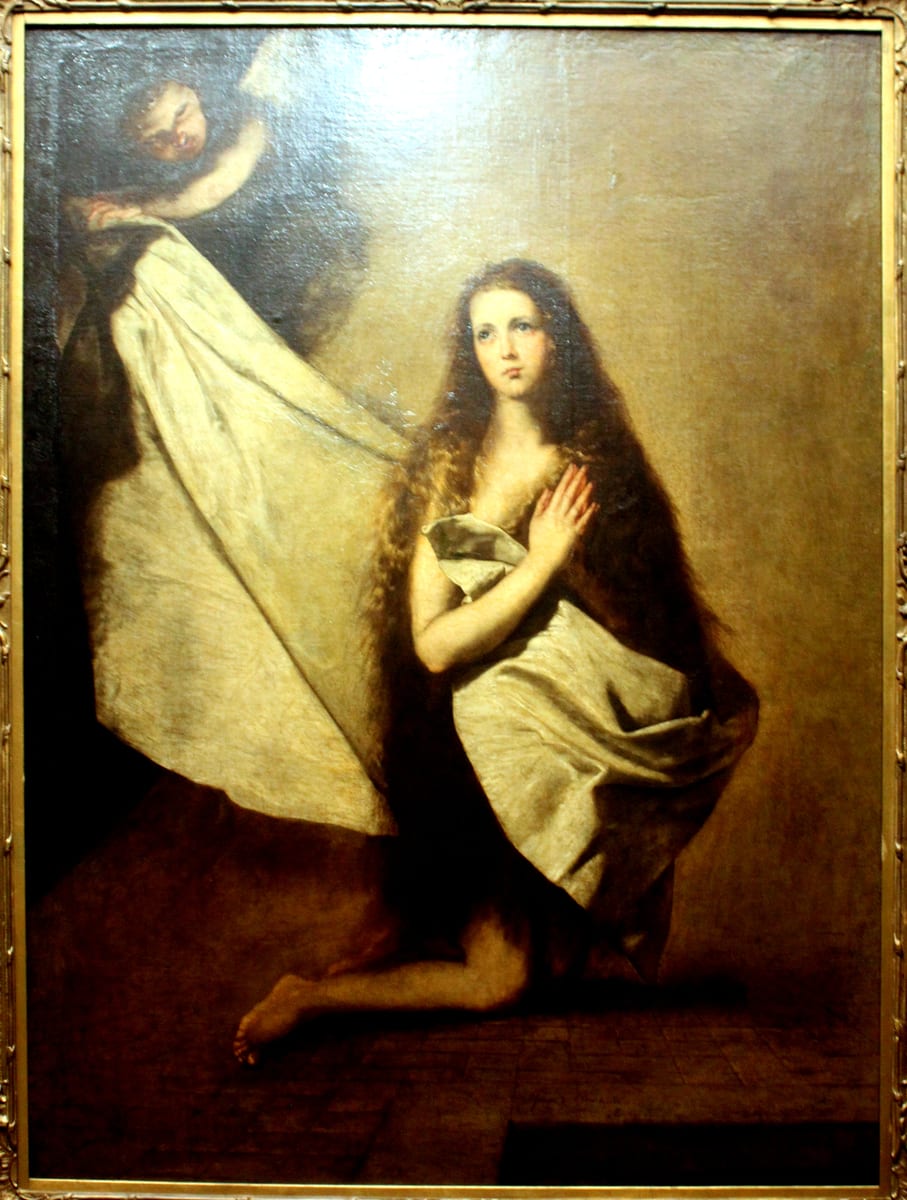
Saint Agnes in Prison, Jusepe de Ribera, 1641 AD Jusepe de Ribera, Gemäldegalerie Alte Meister, Dresden; photograph Dguendel, CC BY 4.0 In the fifth century a Latin life of St. Agnes, the Passion, was written and put under St. Ambrose's name. Catholic Tradition, as the Passion tells it, holds that the son of the city prefect fell in love with her when she was thirteen, as she walked home from school. She turned down his jewels and told him she was already promised to another lover.
The young man's father, the prefect Symphronius, learned that she was a Christian, and when she refused to sacrifice to the goddess Vesta he sent her to a brothel. There an angel surrounded her with so much light that no one could look at her. The older Roman Martyrology recorded the end: she was thrown into a fire, her prayers put it out, and she was struck with the sword.
-
625–638 AD
Pope Honorius I rebuilds her church
Pope Honorius I rebuilt her church from the ground up and set her image in the apse.
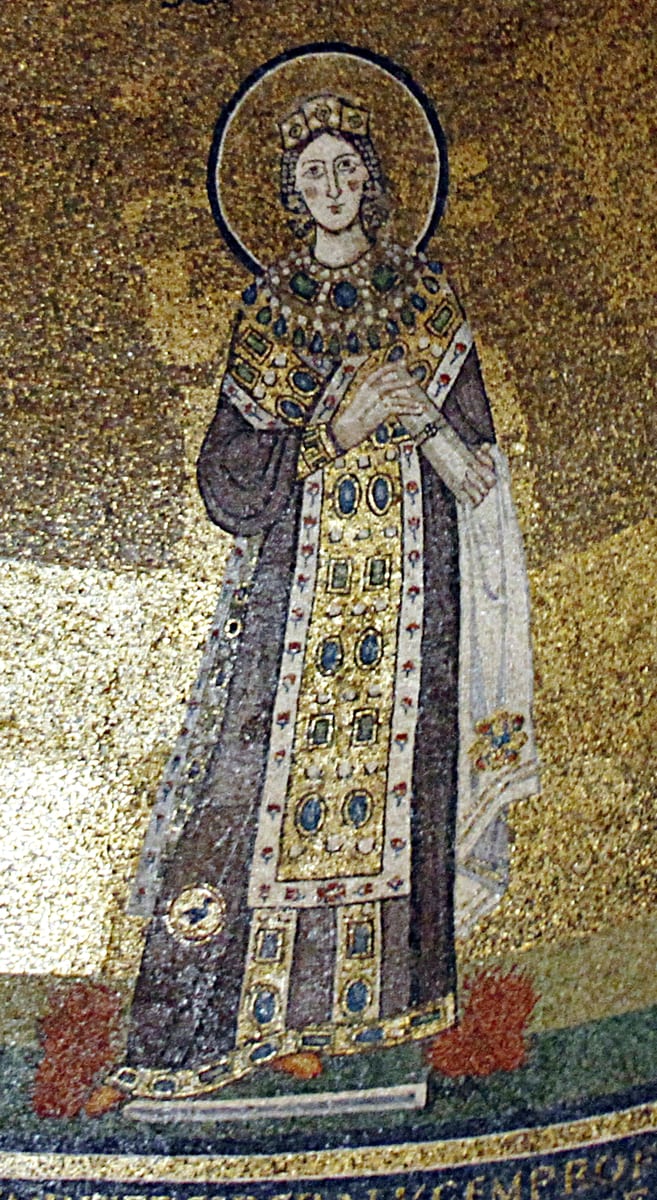
St. Agnes, apse mosaic of Pope Honorius I, 625–638 AD Basilica of Sant'Agnese fuori le mura, Via Nomentana, Rome; photograph José Luiz Bernardes Ribeiro, CC BY-SA 4.0 Pope Honorius I, who reigned from 625 AD to 638 AD, built a new church over her tomb from the ground up. He covered her tomb with 252 pounds of silver and set a gilded bronze canopy over it. In the apse he placed a mosaic of St. Agnes dressed as a Byzantine empress.
“Inclita uota suis adquirunt praemia laudis, dum perfecta micant mente fide meritis. uirginis hoc Agnae clauduntur membra sepulchro, quae incorrupta tamen uita sepulta tenet. hoc opus argento construxit Honorius amplo martyris et sanctae uirginis ob meritum... uirginis aula micat uariis decorata metallis, sed plus numque nitet meritis fulgentior amplis. (Glorious vows win for their own the rewards of praise, while they shine with a perfect mind, with faith and with merits. In this tomb lie the limbs of the virgin Agnes, which life keeps uncorrupt though buried. Honorius built this work with abundant silver for the merit of the martyr and holy virgin. The virgin's hall shines, adorned with many metals, but it shines still more, brighter with her great merits.)”
The verses of Pope Honorius I's rebuilt basilica -
January 21, every year
The lambs, the Canon and her feast
On her feast two lambs are blessed in her basilica, and their wool is woven into the band the Pope gives new archbishops.
Each year on her feast, two lambs are blessed in her basilica on the Via Nomentana. Their wool is woven into the pallium, a narrow band of white wool with six black silk crosses. The Pope gives it to new metropolitan archbishops on June 29 as a sign of honour and authority.
Her name is said at Mass in the Roman Canon, among the martyrs it names. The Roman Martyrology of 2004 AD says that while still a girl she gave Rome the supreme testimony of faith.
“esso viene intessuto con la lana di agnelli, che vengono benedetti nella festa di sant’Agnese. Ci ricorda così il Pastore diventato Egli stesso Agnello, per amore nostro. (it is woven from the wool of lambs blessed on the feast of Saint Agnes. Thus it reminds us of the Shepherd who himself became a lamb, out of love for us.)”
Pope Benedict XVI to the new metropolitan archbishops and the faithful, June 29, 2011 AD


Pray with the Church
Collect of the Mass of St. Agnes
The opening prayer of the Mass of St. Agnes, Virgin and Martyr, on January 21, in the Roman Missal of 1962 AD
Omnípotens sempitérne Deus, qui infírma mundi éligis, ut fórtia quæque confúndas: concéde propítius; ut, qui beátæ Agnétis Vírginis et Mártyris tuæ sollémnia cólimus, ejus apud te patrocínia sentiámus. (Almighty, eternal God, You Who choose the weak things of the world to confound the strong, mercifully grant that we who are celebrating the feast of blessed Agnes, Your Virgin and Martyr, may reap the benefit of her patronal intercession with You.)