
Saints Bishop of Milan · from 374 AD
Saint Ambrose of Milan
Feast 7 December · Born 340 AD, Trier (Augusta Treverorum), Gaul · Died April 4, 397 AD, Milan, Italy
A Roman governor acclaimed bishop of Milan before he was even baptised, Saint Ambrose of Milan refused his churches to an empress, brought an emperor to public penance after a massacre and died at dawn on Holy Saturday, 397 AD.
Begin the life
In brief
Saint Ambrose of Milan, Sant'Ambrogio to the city he served, was a Roman governor whom the people of Milan made their bishop in 374 AD. His Church was divided by the Arian heresy, and in 385 AD and 386 AD the Empress Justina, mother of the young Emperor Valentinian II, took the Arians' side against him.
-
About 340 AD to the 360s AD
A prefect's son in Gaul and Rome
St. Ambrose is born into the household of the Roman governor of the Gauls and grows up in Rome.
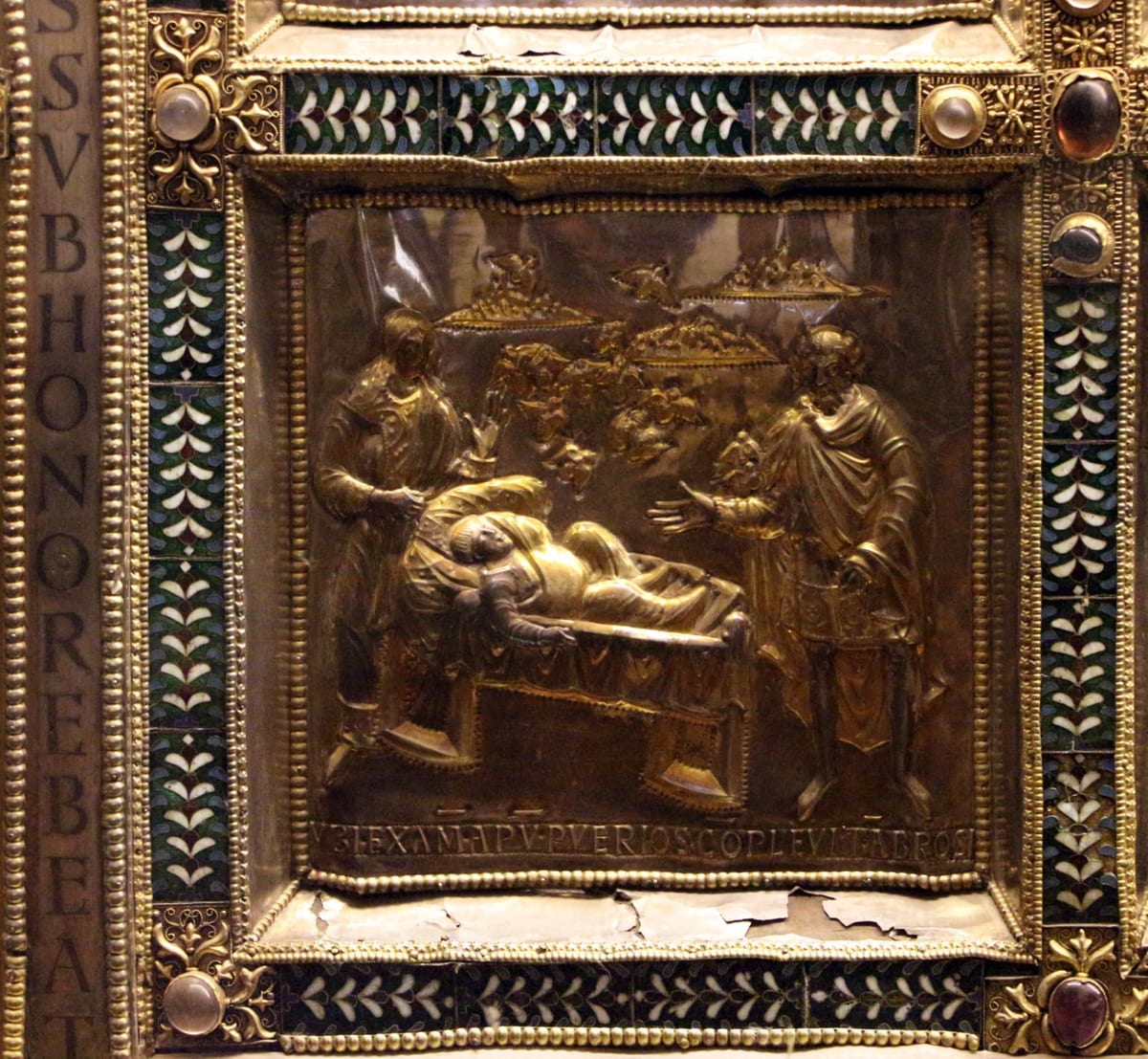
Golden altar of Sant'Ambrogio, Milan: the miracle of the bees, Volvinius (Vuolvinius), goldsmith, c. 824-859 AD Volvinius (Vuolvinius), goldsmith, Basilica di Sant'Ambrogio, Milan; photograph Sailko / Wikimedia Commons, CC BY 3.0 St. Ambrose was born about 340 AD, most probably at Trier, where his father, Aurelius Ambrosius, governed the Gauls as praetorian prefect. St. Ambrose was the youngest of three children in a Christian family, after St. Marcellina and St. Satyrus, and his parents did not have him baptised as a baby. According to longstanding Catholic Tradition, a swarm of bees settled on the sleeping baby's face in the courtyard and flew off, leaving him unharmed.
His father died about 354 AD, and his mother took the children to Rome. At Christmas, in St. Peter's, Pope Liberius gave St. Marcellina the veil of a consecrated virgin. At home the boy saw his mother and sister kiss the hands of the clergy, so he held out his own and told them he would be a bishop, and St. Marcellina brushed him off.
-
About 368–374 AD
Governor at Milan
Trained as a lawyer, St. Ambrose is sent to govern northern Italy from Milan, a city whose Church is divided.
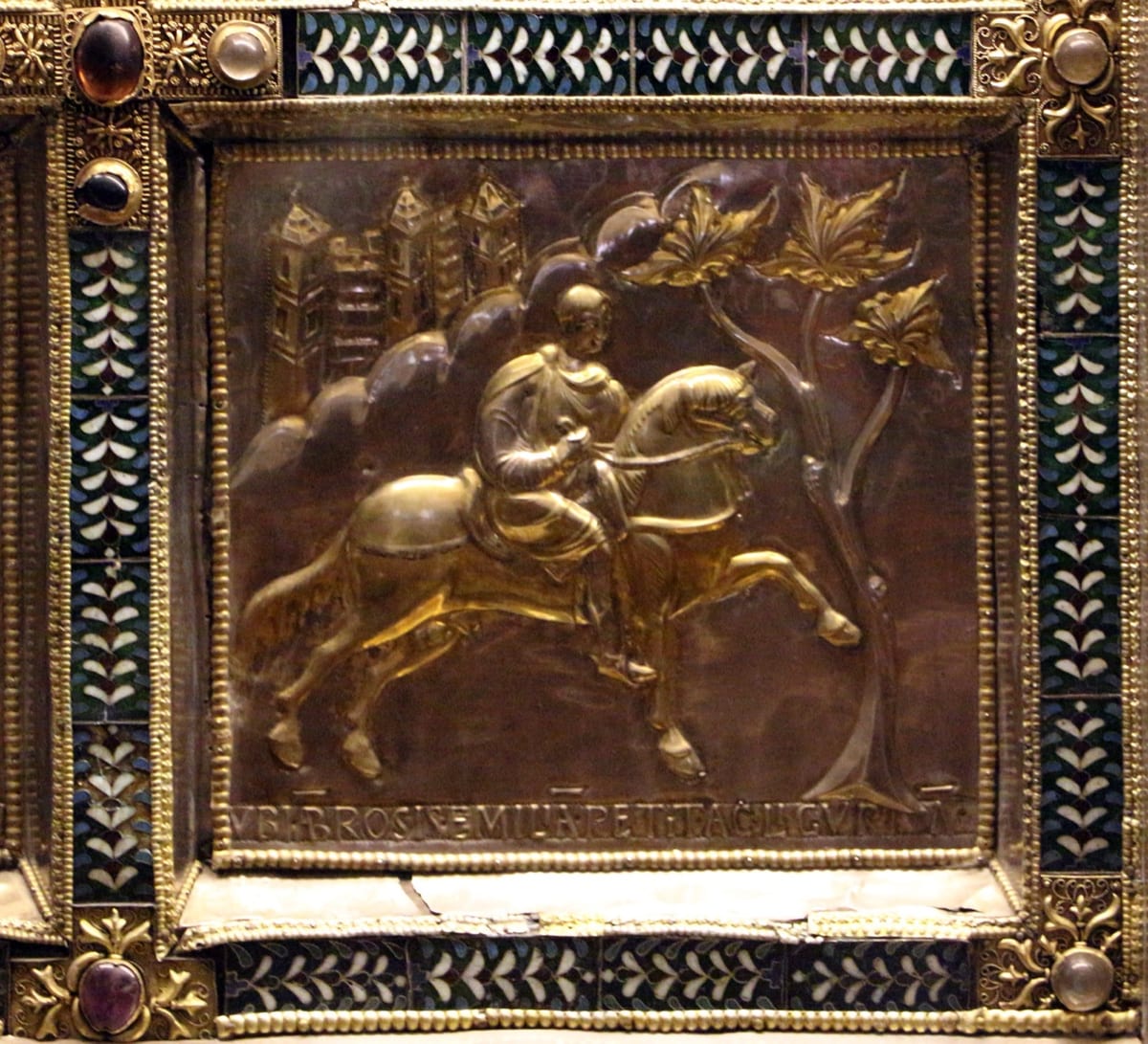
Golden altar of Sant'Ambrogio, Milan: St. Ambrose sets out for Liguria, Volvinius (Vuolvinius), goldsmith, c. 824-859 AD Volvinius (Vuolvinius), goldsmith, Basilica di Sant'Ambrogio, Milan; photograph Sailko / Wikimedia Commons, CC BY 3.0 Trained in Rome in rhetoric and law, St. Ambrose made his name pleading in the courts, and the praetorian prefect Probus took him into his council. About 370 AD Probus had him made governor of Aemilia and Liguria in northern Italy, with his seat at Milan. As he sent him off, Probus told him to govern not as a judge but as a bishop, words the Roman Breviary calls, as it were, prophetic.
St. Ambrose governed so fairly and kindly that the people came to look on him as a father more than a judge. Milan's Church was split over the divinity of Christ, which the Nicene faith confessed and the Arians disputed. In 355 AD its Catholic bishop, St. Dionysius, had been banished for holding to the Nicene faith, and the Arian Auxentius was forced into his place.
“Vade, age non ut iudex, sed ut episcopus. (Go, act not as judge but as bishop.)”
The prefect Probus to St. Ambrose, sending him to govern Liguria and Aemilia -
374 AD
Acclaimed bishop before his baptism
St. Ambrose, then the governor, went to keep the peace at a disputed election and was chosen bishop, then baptised and consecrated eight days apart.
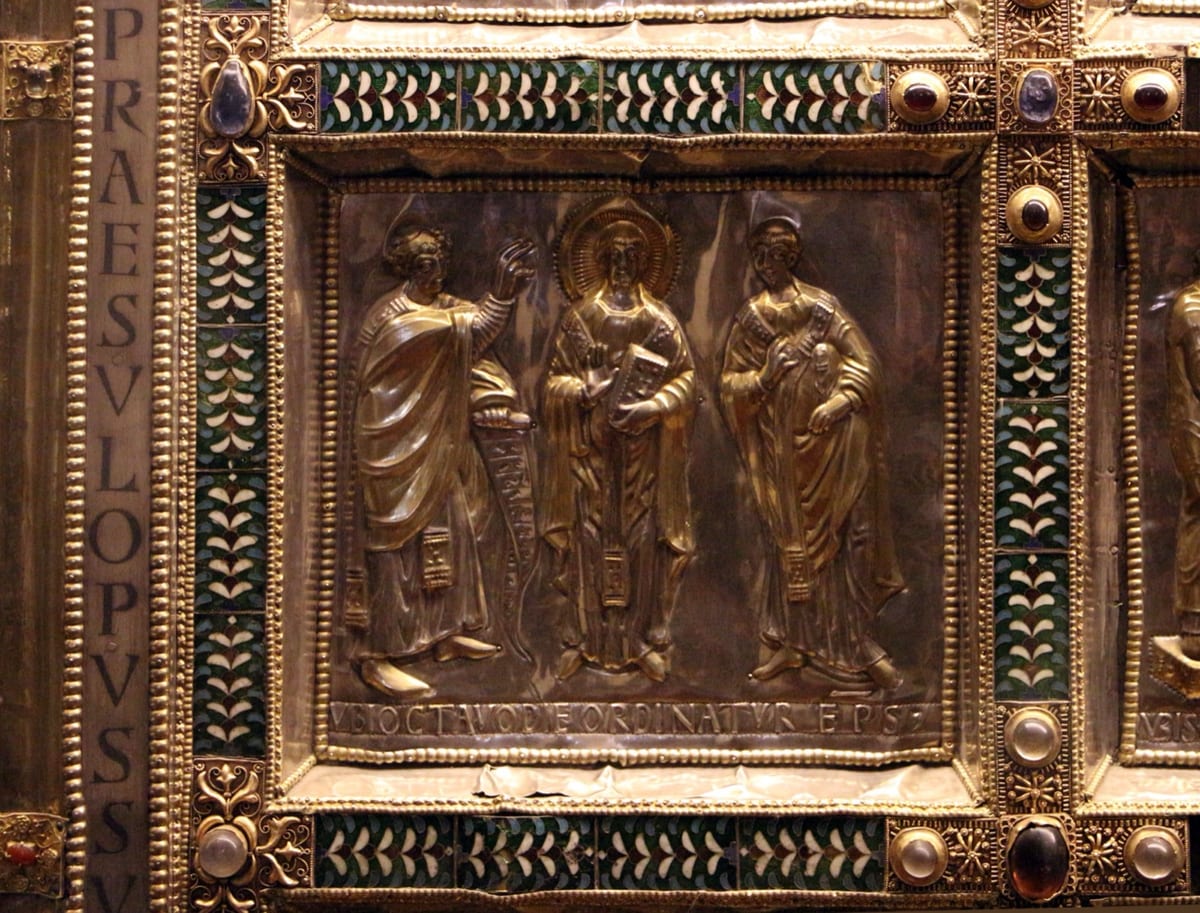
Golden altar of Sant'Ambrogio, Milan: episcopal ordination, Volvinius (Vuolvinius), goldsmith, c. 824-859 AD Volvinius (Vuolvinius), goldsmith, Basilica di Sant'Ambrogio, Milan; photograph Sailko / Wikimedia Commons, CC BY 3.0 When Auxentius died in 374 AD, the choice of his successor split Milan into rival parties. St. Ambrose went as governor to the basilica where clergy and people had gathered, and urged them to keep the peace. The whole assembly called for him as their bishop, though he was still a catechumen, a Christian under instruction who had not been baptised.
Catholic Tradition holds that a small child raised the cry first, and that St. Ambrose then tried several ways to escape the office, among them flight. He gave way once the Emperor Valentinian I confirmed the people's choice, and he accepted it as the will of God. He was baptised on November 30, 374 AD, and consecrated Bishop of Milan eight days later, on December 7.
“Plus debuisse me fateor, et plus dimissum mihi qui de forensium strepitu jurgiorum, et a publicae terrore administrationis ad sacerdotium vocatus sum; et ideo vereor ne ingratus inveniar, si minus diligam, cui plus dimissum est. (I confess that I owe more, and that more has been forgiven me who have been called to the priesthood from the tumult and strife of the law courts and the dread of public administration; and therefore I fear that I may be found ungrateful, if I, to whom more has been forgiven, love less.)”
St. Ambrose of Milan, prayer in On Repentance, on his call from the law courts -
374–378 AD
The new bishop gives away his wealth
St. Ambrose gives up his property, writes on the faith for an emperor and ransoms captives with the Church's plate.
His first act as bishop was to give his silver and gold to the poor and to the Church. He handed his estates to his brother, St. Satyrus, to manage, keeping back only an income for his sister for the rest of her life.
Before marching east against the Goths, the young Emperor Gratian asked St. Ambrose for a book proving that Christ is God, and St. Ambrose answered with On the Faith. After the Goths defeated the Emperor Valens at Adrianople, they carried off a great many captives to sell as slaves. Many of them were Christians, and in 378 AD St. Ambrose sold the Church's plate to buy their freedom.
“Itaque factum est ut prius docere inciperem, quam discere. Discendum igitur mihi simul et docendum est; quoniam non vacavit ante discere. (So it happened that I began to teach before I began to learn. Therefore I must learn and teach at the same time, since I had no leisure to learn before.)”
St. Ambrose of Milan, on the Duties of the Clergy, Book I, 391 AD -
385–386 AD
The basilicas of Milan
The imperial court demands a church for the Arians, and St. Ambrose and his people will not hand it over.
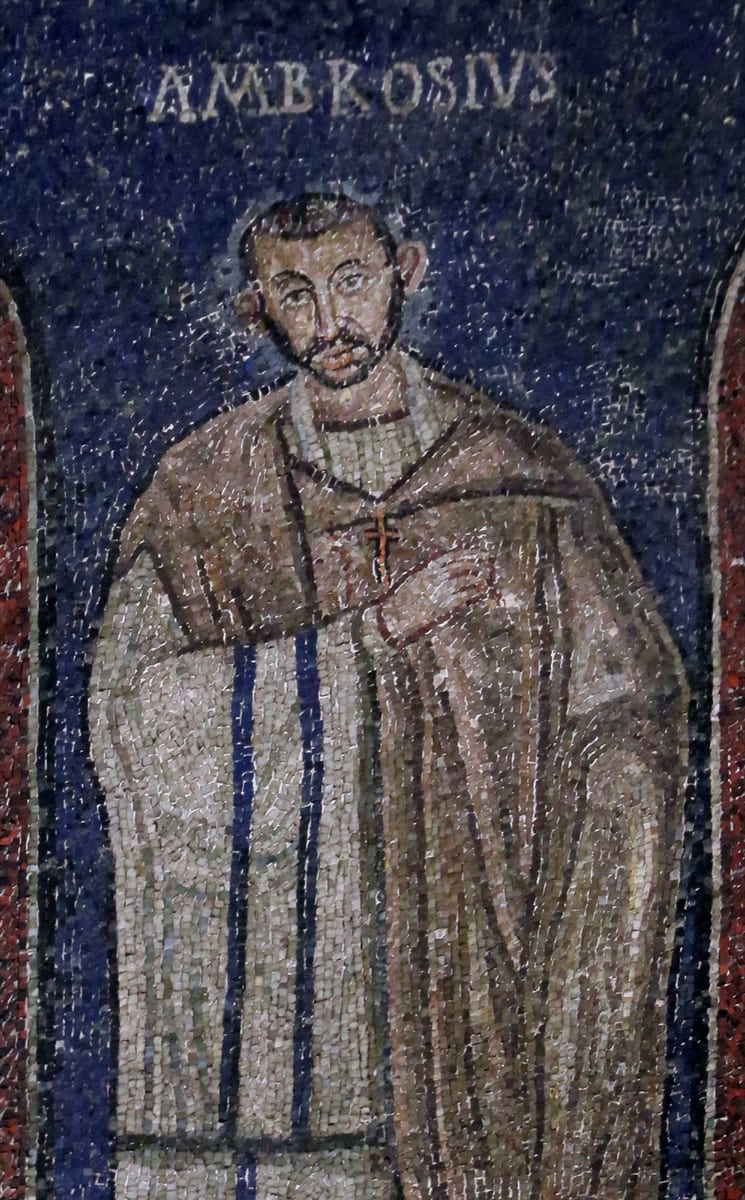
Mosaic of St. Ambrose, chapel of San Vittore in Ciel d'Oro (detail), Unknown Milanese mosaicist, 5th century AD Unknown Milanese mosaicist, Sacello di San Vittore in Ciel d'Oro, Basilica di Sant'Ambrogio, Milan; photograph Sailko / Wikimedia Commons, CC BY 3.0 As Easter 385 AD approached, the Empress Justina, mother of the young Emperor Valentinian II, demanded a church in Milan for the Arians, and St. Ambrose refused. Before dawn one day in Holy Week he found the basilica surrounded by soldiers, and he told his people to keep out of communion with them. The soldiers who had occupied the basilica began coming to his congregation, and on Maundy Thursday the court withdrew them and gave way.
In Lent 386 AD the court sent soldiers to take a church again, and St. Ambrose and his people stayed inside it, singing psalms and hymns, until the soldiers withdrew. That year St. Ambrose found the bodies of the martyrs Sts. Gervasius and Protasius at Milan. As their relics were carried through the city, a blind man regained his sight.
“quae dei deo, quae Caesaris Caesari. ad imperatorem palatia pertinent, ad sacerdotem ecclesiae. (The things which are God's to God, those which are Cæsar's to Cæsar. The palaces belong to the Emperor, the churches to the Bishop.)”
St. Ambrose of Milan, reply on the demand for the basilica, 385 AD -
384–387 AD
Baptising St. Augustine
A teacher of rhetoric sent from Rome comes to hear St. Ambrose preach, and is later baptised by him.
St. Augustine came to Milan from Rome in the autumn of 384 AD as the city's public teacher of rhetoric. St. Ambrose received him kindly, and St. Augustine went to hear him preach.
At Easter 387 AD St. Ambrose baptised St. Augustine at Milan. In 387 AD St. Ambrose wrote On the Mysteries for the newly baptised, explaining the rites of baptism and confirmation.
“veniebant in animum meum simul cum verbis quae diligebam res etiam quas neglegebam (There came to me with the words which I loved, the truths themselves which I disregarded.)”
St. Augustine of Hippo, Confessions V, of hearing Ambrose preach, 384 AD -
390 AD
An emperor called to penance
After a massacre ordered by the Emperor Theodosius, St. Ambrose tells him he must repent before he can come to Mass.
Early in 390 AD a crowd in Thessalonica killed the Gothic commander of the garrison, who had jailed a popular charioteer. To avenge him, the Emperor Theodosius ordered reprisals, and soldiers killed at least seven thousand people summoned to the circus. Without regard for the danger to himself, St. Ambrose wrote to the emperor that he could not let Theodosius be present at Mass until the emperor had openly repented.
Theodosius did penance: he wept for his sin publicly in church, begging forgiveness with groans and tears. The penance lasted eight months. Then the emperor was readmitted to communion.
“Homo es, et tibi venit tentatio, vince eam. Peccatum non tollitur nisi lacrymis et poenitentia. ... ego, inquam, causam in te contumaciae nullam habeo, sed habeo timoris: offerre non audeo sacrificium, si volueris assistere. An quod in unius innocentis sanguine non licet, in multorum licet? Non puto. ... Postremo scribo manu mea, quod solus legas. (You are man and temptation has come to you, conquer it. Sin is not taken away except by tears and penitence,... I have no reason for obstinacy toward you but I have cause for fear. I do not dare to offer the Sacrifice if you intend to be present. Is that which is unlawful because of the blood of one innocent man, lawful in the blood of many? I think not.... I write by my own hand something for you alone to read.)”
St. Ambrose of Milan, letter after Thessalonica, 390 AD -
February–April 397 AD
Dawn on Holy Saturday
St. Ambrose falls ill, prays on Good Friday with his arms outstretched and dies after receiving the Eucharist.
In February 397 AD St. Ambrose fell ill after consecrating a bishop at Pavia. Count Stilicho said that losing such a man threatened Italy with ruin, and he persuaded the nobles of Milan to ask St. Ambrose to pray for a longer life. On Good Friday, April 3, St. Ambrose lay on his bed praying, his arms stretched out in the form of a cross.
As Catholic Tradition tells it, a voice woke the Bishop of Vercelli, who was sleeping upstairs, to tell him St. Ambrose was dying. The Bishop of Vercelli hurried down with the Body of the Lord, and St. Ambrose died as soon as he had received it, at dawn on Holy Saturday, April 4, 397 AD. On Easter morning he was buried in the basilica in Milan that now bears his name.
“Non ita inter uos uixi ut pudeat me uiuere nec timeo mori, quia Dominum bonum habemus. (I have not so lived among you that I am ashamed to live nor do I fear to die, because we have a good Lord!)”
St. Ambrose of Milan to the nobles sent by Count Stilicho, asked on his deathbed to pray for longer life, 397 AD


Pray with the Church
A prayer of St. Ambrose for the office he was given
St. Ambrose's own prayer in On Repentance, Book II, 73.
Preserve, O Lord, Thy work, guard the gift which Thou hast given even to him who shrank from it.For I knew that I was not worthy to be called a bishop, because I had devoted myself to this world, but by Thy grace I am what I am.
All 1 report on Saint Ambrose of Milan

About this picture
AI-generated image, in the manner of a late-antique Milanese wall mosaic, from the paper's reference portrait based on Mosaic of St. Ambrose, chapel of San Vittore in Ciel d'Oro (detail) (unknown Milanese mosaicist, 5th century AD, Sacello di San Vittore in Ciel d'Oro, Basilica di Sant'Ambrogio, Milan; photograph Sailko / Wikimedia Commons, CC BY 3.0) View source artwork.