
Saints Bishop of Rome · 366–384 AD
Saint Damasus I
Feast 11 December · Born 304 AD, Rome, Italy (probably) · Died December 11, 384 AD, Rome, Italy
A Roman deacon who became Bishop of Rome after a disputed election that cost many lives marked the martyrs' graves in verse, set St. Jerome to revise the Latin Bible, and was buried beside his mother and sister.
Begin the life
In brief
Pope Saint Damasus I, also called Pope Damasus, was Bishop of Rome from 366 AD until his death in 384 AD. He became Pope after a disputed election, and the fighting between the two sides left many people dead in Rome. As Pope he searched the cemeteries for the martyrs' graves, marked them in verse, and set St. Jerome to revise the Latin Bible.
-
c. 304–355 AD
A boy in the clergy of St. Lawrence's
As Catholic Tradition tells it, a boy serving a Roman church heard how two martyrs died from the man who had beheaded them.
The future Pope St. Damasus was born about 304 AD and grew up at Rome serving the church of St. Lawrence. His father, Antonius, served the same church as reader, deacon and priest in turn. His mother, Laurentia, spent sixty years as a widow in the service of God, and his sister, Irene, consecrated to God, died before she was twenty.
According to longstanding Catholic Tradition, when he was a small boy serving as a reader, the man who had beheaded the martyrs Sts. Marcellinus and Peter told him how they died. By 355 AD he was a deacon of the Roman Church under Pope Liberius.
“Marcelline tuos pariter Petre nosse triumphos percussor retulit Damaso mihi, cum puer essem. (Marcellinus, and you, Peter, I came to know your triumphs together: the executioner himself told them to me, Damasus, when I was a boy.)”
St. Damasus I, his epitaph for the martyrs Marcellinus and Peter -
September–October 366 AD
A disputed election and a day of killing
Two deacons claimed to be Bishop of Rome, and the fighting between their supporters left many dead.
Pope Liberius died at Rome on September 24, 366 AD. That October, St. Damasus, then a deacon of the Roman Church, was elected Bishop of Rome by a large majority. Some partisans of Pope Liberius chose the deacon Ursinus, in a quarrel over who would be bishop, not over doctrine.
The prefect of Rome sent Ursinus and some of his party into exile, but Ursinus's supporters freed seven of his priests and took them to the Liberian basilica. On October 26, 366 AD, the two factions fought at that church, and the historian Ammianus Marcellinus, who lived at the time, recorded that 137 bodies were found there in a single day. The prefect could not stop the fighting and withdrew from the city, and Pope St. Damasus came out on top, carried forward by the party that favoured him.
“Damasus et Vrsinus supra humanum modum ad rapiendam episcopalem sedem ardentes (Damasus and Ursinus, burning beyond all human measure to seize the bishop's see)”
Ammianus Marcellinus, his history of Rome, Res gestae XXVII.3, 366 AD -
366–368 AD
The rival exiled, the clergy brought home
The prefect of Rome sided with Pope St. Damasus, the emperor exiled his rival, Ursinus, to Gaul, and clergy who had followed Ursinus came back.
Pope St. Damasus was installed without a council, with the prefect of Rome on his side. Emperor Valentinian I later let the exiles return, and Ursinus came back to Rome on September 15, 367 AD. After new disturbances the emperor sent Ursinus into exile again that November and confined him at Cologne in Gaul.
The Pope vowed to honour certain martyrs, asking their prayers for the clergy who had stayed with Ursinus. When those clergy came back to his side, they paid out of their own money, in gratitude, to decorate the martyrs' tomb on the Via Salaria Nova. The Pope set an inscription there saying he had kept his vow for the clergy's return.
“Sanctorum, quicumque legis, uenerare sepulchrum. nomina nec numerum potuit retinere uetustas. ornauit Damasus tumulum, cognoscite, rector, pro reditu cleri Christo praestante triumphans martyribus sanctis reddit sua uota sacerdos. (Whoever you are who read this, honour the tomb of the saints; time could not keep their names or their number. Damasus, their ruler, adorned the tomb, know it: rejoicing that by Christ's help the clergy had returned, the priest pays his vows to the holy martyrs.)”
St. Damasus I, his votive inscription for unnamed martyrs, fulfilling a vow for the return of the clergy -
366–384 AD
Verses for the martyrs' graves
Pope St. Damasus searched the cemeteries for the martyrs' graves and marked them with his poems cut in marble.
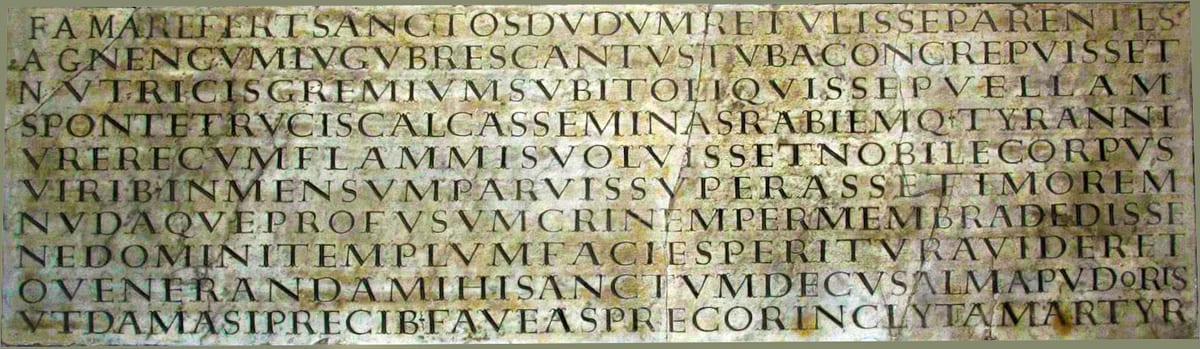
Epigram of Pope St. Damasus on St. Agnes, cut by Furius Dionysius Filocalus (facsimile), Pope St. Damasus (verse); Furius Dionysius Filocalus (lettering); photograph by Broutille, late 4th century AD (original); photograph 2020 AD Pope St. Damasus (verse); Furius Dionysius Filocalus (lettering); photograph by Broutille, Original slab: Basilica of Sant'Agnese fuori le Mura, Rome; the photograph is described by its uploader as a facsimile of it Pope St. Damasus searched the cemeteries for the martyrs' graves, found many of them and honoured them in verse. His friend Furius Dionysius Filocalus carved the poems into marble in a style of lettering made especially for them. On the Vatican hill the Pope drained the springs that ran over the graves beside St. Peter's tomb, so that water would not damage the bodies buried there.
One of his poems tells how St. Tarsicius, carrying the Eucharist, chose to be beaten to death rather than give it up. His marble poem for St. Agnes survives in her church on the Via Nomentana.
“non tulit hoc Damasus, communi lege sepultos post requiem tristes iterum persoluere poenas. (Damasus could not bear that those buried by the common law should, after their rest, pay sad penalties a second time.)”
St. Damasus I, his inscription on draining the waters that flooded the graves by St. Peter's -
c. 370–380 AD
Holding to the faith against the Arian teaching
Pope St. Damasus condemned the Arian bishop of Milan, and in 380 AD three emperors ordered all their peoples to hold the faith he followed.
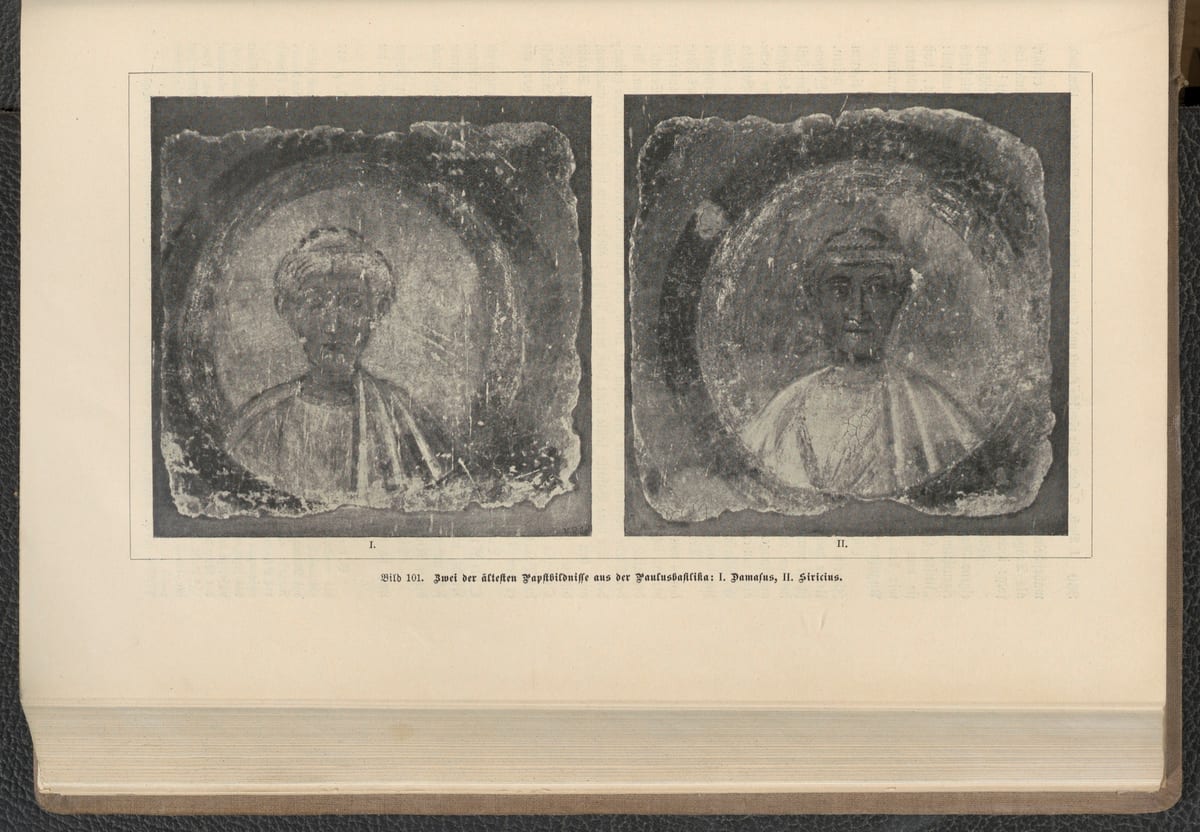
Two of the oldest papal portraits from St. Paul's Outside the Walls: I. Damasus, II. Siricius (Grisar, Geschichte Roms und der Päpste im Mittelalter, vol. 1, Bild 101 AD), Anonymous Roman painter of the papal medallion series (photograph reproduced by Hartmann Grisar), 5th century AD (painting); 1898 AD (publication) Anonymous Roman painter of the papal medallion series (photograph reproduced by Hartmann Grisar), Monastery of St. Paul's Outside the Walls, Rome (fragments surviving the fire of 1823 AD); reproduced from Grisar, Freiburg im Breisgau: Herder, 1898 AD, via Polona (National Library of Poland) The Arians, followers of Arius, taught that the Son and the Holy Spirit were creatures. At a synod in Rome, Pope St. Damasus and ninety bishops of Italy and Gaul condemned Auxentius, the Arian bishop of Milan.
The Roman Martyrology remembers Pope St. Damasus for restoring Peter, bishop of Alexandria, to the see from which he had been driven. On February 27, 380 AD, three emperors ordered all their peoples to hold the faith followed by the Pope and by that same Peter of Alexandria. Those who held it were to be called catholic Christians, and all others were to be treated as heretics.
-
378–380 AD
Accused and cleared
A charge brought against Pope St. Damasus in 378 AD ended with the emperor and a synod of bishops clearing him.
Ursinus's party, later allied with the Arians at Milan, never stopped working against Pope St. Damasus. In 378 AD a charge was brought against him. A Roman council later wrote to the emperors that Ursinus's faction had put the accuser up to it, in order to have the Pope put to death.
Emperor Gratian cleared him, and so did a Roman synod of forty-four bishops. A ruling from the emperors called the charges shameful slanders against a man proved to be holy. The Pope went on pilgrimage to the shrine of St. Felix at Nola to give thanks for escaping dangers and persecutions.
“Corpore mente animo pariterque et nomine Felix, sanctorum in numero Christi sociate triumphis, qui ad te sollicite uenientibus omnia praestas nec quemquam pateris tristem repedare uiantem: te duce seruatus mortis quod uincula rupi hostibus extinctis, fuerant qui falsa locuti, uersibus his Damasus supplex tibi uota rependo. (Felix, happy in body, mind and soul, and happy in name as well, joined among the saints to the triumphs of Christ, you who give everything to those who come to you in earnest and let no traveller go home sad: because under your guidance I was saved and broke the bonds of death, when the enemies who had spoken falsely were destroyed, I, Damasus, in supplication, pay you my vows in these verses.)”
St. Damasus I to St. Felix of Nola, his votive inscription at St. Felix's shrine at Nola -
376–384 AD
St. Jerome and the Latin Bible
St. Jerome wrote to Pope St. Damasus from the desert, later became his secretary and, at the Pope's command, revised the Latin New Testament.
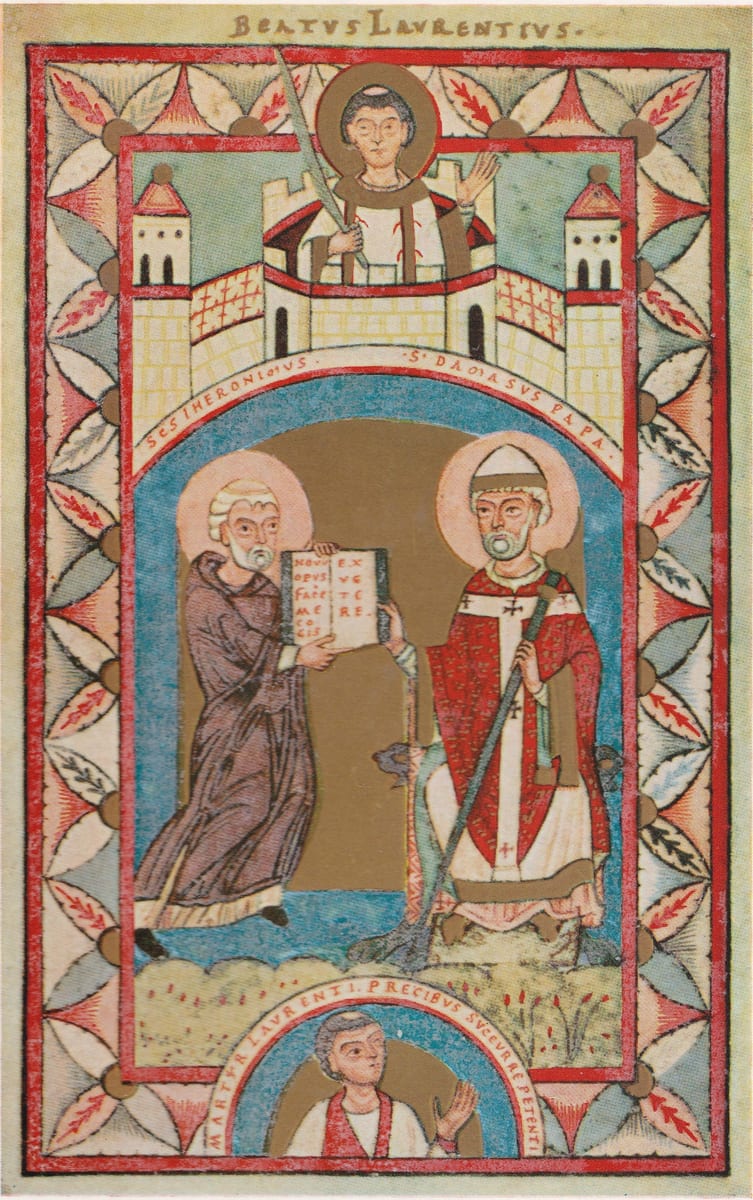
St. Jerome presents the Gospels to Pope St. Damasus, with St. Lawrence above (frontispiece of a gospel book from Lund), Anonymous illuminator, c. 1150 AD Anonymous illuminator, Uppsala University Library (Cod. Ups. C 83, given on Commons as 'Cod. Ups. 83'); reproduced from Kulturhistoriskt lexikon för nordisk medeltid, vol. 10, 1965 AD In 376 AD or 377 AD St. Jerome wrote to Pope St. Damasus from the Syrian desert. The church at Antioch was split among St. Meletius, Vitalis and St. Paulinus, who each claimed to be in communion with Rome, and St. Jerome asked the Pope which of them to take communion with. The Pope and the Western bishops held communion with St. Paulinus, because they doubted the orthodoxy of St. Meletius.
In 382 AD St. Jerome came to Rome, and the Pope made him his secretary and counsellor. St. Jerome wrote the Pope's answers to questions sent by the councils of East and West, and at the Pope's command he revised the Latin New Testament to agree with the Greek. The Pope wrote to St. Jerome as his dearest son.
“Fateor quippe tibi, eos quos mihi jam pridem Lactantii dederas libros, ideo non libenter lego, quia et plurimæ epistolæ hujus usque ad mille spatia versuum tenduntur, et raro de nostro dogmate disputant (I confess to you that I do not read willingly those books of Lactantius you gave me some time ago, because most of his letters run on for up to a thousand lines and seldom discuss our doctrine.)”
St. Damasus I to St. Jerome, his letter putting scriptural questions to him -
December 384 AD
An epitaph of his own
Pope St. Damasus wrote his own epitaph, died almost eighty, and was laid beside his mother and sister on the Via Ardeatina.
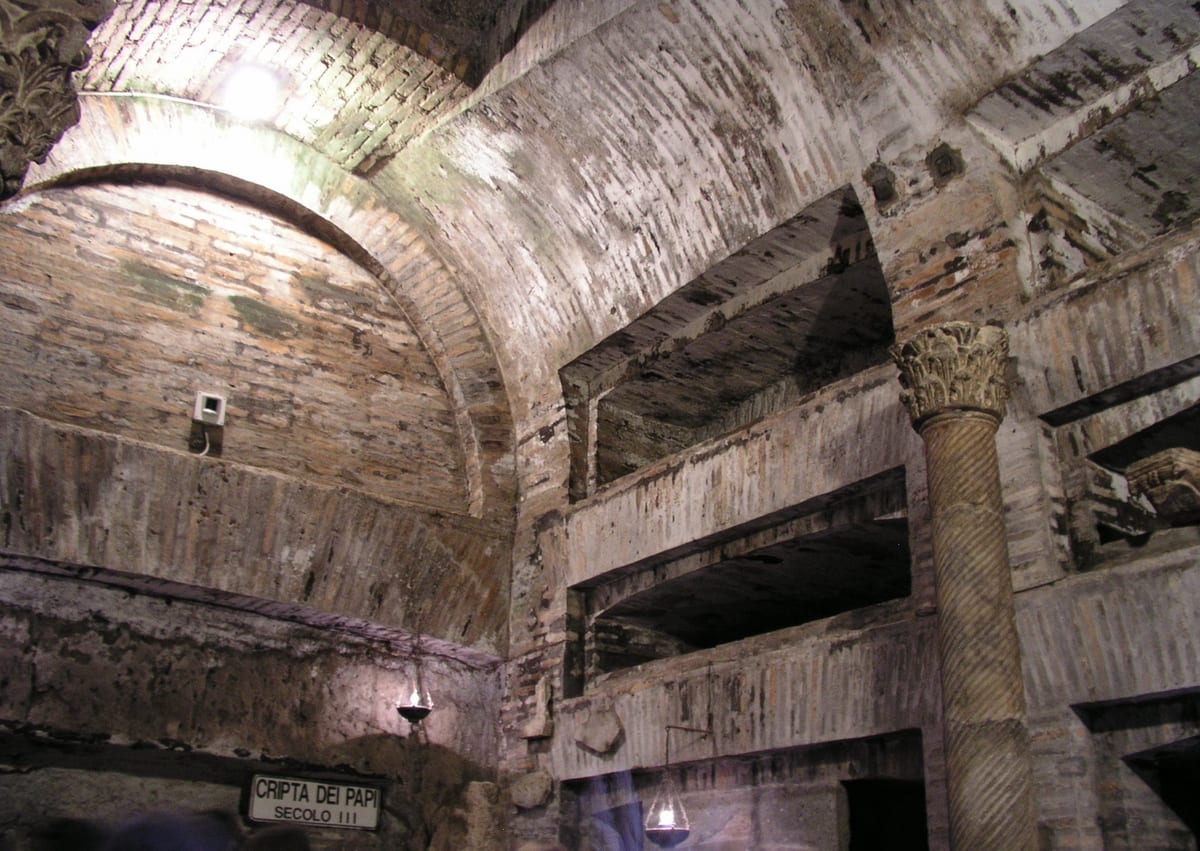
The Crypt of the Popes in the Catacombs of St. Callixtus, Rome, Photograph by Dnalor 01, photograph 2007 AD Photograph by Dnalor 01, Catacombs of St. Callixtus, Via Appia, Rome; photograph by Dnalor 01, CC BY-SA 3.0 Pope St. Damasus had wanted to be buried among the martyrs, but in verse he wrote that he feared to disturb their holy ashes. He built a small basilica on the Via Ardeatina and composed his own epitaph for his tomb there.
Catholic Tradition holds that when fever seized him in December 384 AD he received the Body and Blood of the Lord and died praying, eyes and hands raised to heaven. He was almost eighty years old. On December 11 he was buried in his own basilica on the Via Ardeatina, beside his mother, Laurentia, and his sister, Irene.
“Qui gradiens pelagi fluctus compressit amaros, vivere qui praestat morientia semina terrae, solvere qui potuit letalia vincula mortis, post tenebras fratrem post tertia lumina solis, ad superos iterum Marthae donare sorori, post cineres Damasum faciet quia surgere credo. (He who walked on the sea and calmed its bitter waves, who gives life to the dying seeds of the earth, who could loose the deadly bonds of death and, after the darkness and the third day's light, give the brother back to the living, to his sister Martha: he, I believe, will make Damasus rise again from his ashes.)”
St. Damasus I, the epitaph he wrote for his own tomb


Pray with the Church
For the feast of Pope St. Damasus
The prayer of the Roman Breviary for December 11, the feast of St. Damasus, Pope and Confessor, in the English translation of John, Marquess of Bute (1908 AD).
HEAR our prayers, O Lord, andat the petition of Thy blessedBishop and Confessor Damasus, merci-fully grant us pardon and peace.Through our Lord Jesus Christ ThySon, Who liveth and reigneth withThee, in the unity of the Holy Ghost,one God, world without end. Amen.
All 1 report on Saint Damasus I

About this picture
AI-generated image, in the manner of a late-antique Roman fresco, from the paper's reference portrait based on Two of the oldest papal portraits from St. Paul's Outside the Walls: I. Damasus, II. Siricius (Anonymous Roman painter of the papal medallion series, 5th century AD, Monastery of St. Paul's Outside the Walls, Rome) View source artwork.