
Saints Order of Preachers · 1350–1419 AD
Saint Vincent Ferrer
Feast 5 April · Born 1350 AD, Valencia, Crown of Aragon (Spain) · Died 1419 AD, Vannes, Brittany, France
From a Valencia font to a house at Vannes: the Dominican who taught theology, judged the crown of Aragon, and spent his last twenty years on the road.
Begin the life
In brief
Saint Vincent Ferrer was born at Valencia on January 23, 1350 AD and died at Vannes in Brittany on April 5, 1419 AD. He was a Dominican priest who preached across Spain, France, Italy and Switzerland for the last twenty years of his life. He judged the vacant succession of Aragon at Caspe, and served the Avignon claimant Benedict XIII for years before reading the act that broke Aragon from him.
-
1350–1367 AD
The name settled at the font
A Valencia household, a disputed baptismal name, and a boy who gave his portion away in four days.
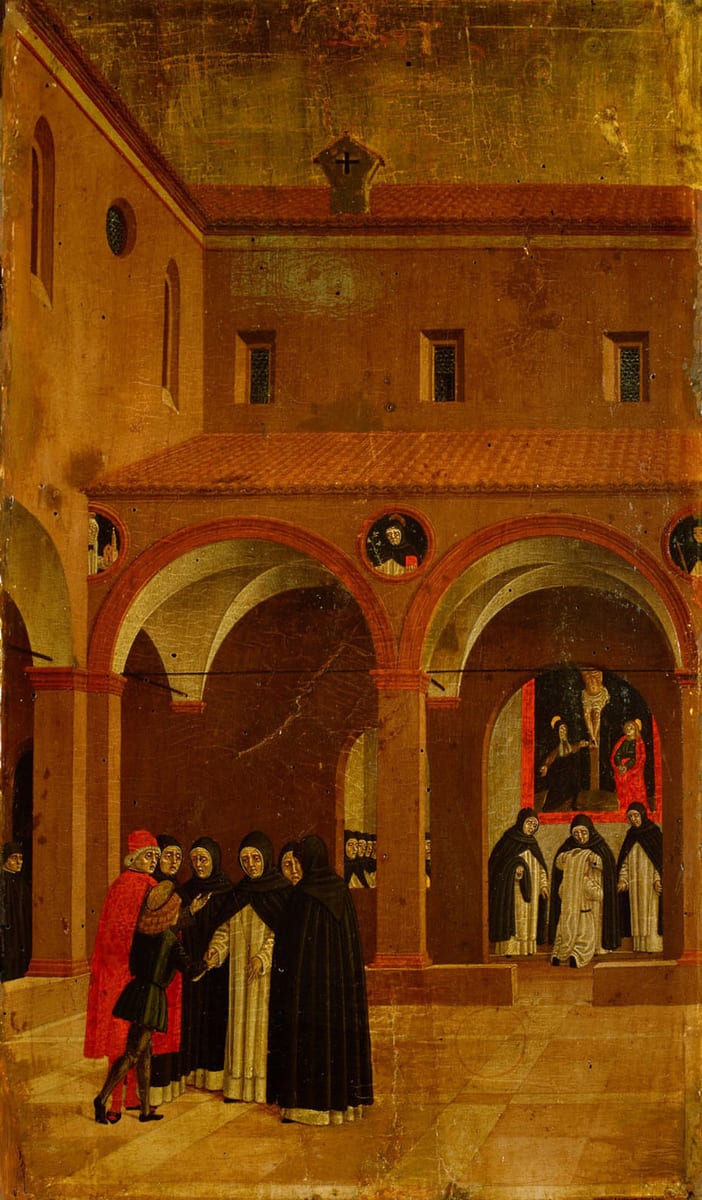
Szene aus dem Leben des Hl. Vinzenz Ferrer: Der Vater fuehrt den Knaben Vinzenz zu den Dominikanern, von denen er drei Tage spaeter eingekleidet wird (GG 6702 AD), Agnolo degli Erri (Italian, 1440-1482 AD), c. 1470-1490 AD Agnolo degli Erri (Italian, 1440-1482 AD), Kunsthistorisches Museum, Vienna (painted for San Domenico, Modena) Saint Vincent Ferrer was born at Valencia on January 23, 1350 AD, to William Ferrer and Constantia Miguel, who had married in the city ten years before. Butler's Lives records that his parents gave away in alms whatever they saved each year from the household's necessary expenses. The 1855 AD life by Bayle holds that the priest at the font, wearied by a long dispute over the name, settled it himself.
He entered the clerical state at seven, began philosophy at twelve and theology at fourteen. At seventeen his father offered him a religious, an ecclesiastical or a secular life, and he asked at once for the Order of Saint Dominic. His parents made over a third of their goods to him, and he gave the whole of it to the poor within four days.
“My father, you have anticipated my wishes, and I thank our Lord for having inspired you with the thought to propose that which is the most agreeable to me. I have no longing after the riches and pleasures and honours of this life; my love, thoughts, and resolutions are centred in God. I am, therefore, determined to follow His divine call to the Dominican family; and now I desire nothing more except my mother's consent and your joint blessing.”
St. Vincent Ferrer to his father William Ferrer, deciding to enter religious life, 1367 AD -
1368–1391 AD
The friar in the schools
Profession at Valencia, a decade of teaching from Lérida to Paris, and the cathedral chair at home.
He made his profession at Valencia in February 1368 AD, into the hands of the prior, Father Matthew Benincasa. His superiors sent him to Lérida in 1370 AD to teach philosophy, and to Barcelona two years later to study Scripture. According to longstanding Catholic tradition he told a famine procession in a Barcelona square that relief would come that day, and two wheat ships entered the port by evening.
The provincial chapter assigned him to Toulouse in 1376 AD and he passed on to Paris, where he taught the young friars and preached to the city. He was ordained priest about 1378 AD, and from 1385 AD held the cathedral chair of theology at Valencia for five years. In February 1389 AD at Valencia he handed down his sentence as arbiter between the secular clergy and the mendicant orders.
“Have courage and be glad, my brethren, for this very night two vessels will arrive in this port laden with wheat, which will supply you with abundant provisions.”
St. Vincent Ferrer to the people of Barcelona, prophecy of relief ships during a famine, 1375 AD -
1395–1399 AD
Avignon, and a sickbed
Master of the Sacred Palace to Benedict XIII, cited before the Inquisition, and sent out to preach after an illness at the papal court.
Benedict XIII, whom he had served as Cardinal Pedro de Luna, called him to Avignon and made him Master of the Sacred Palace, confessor and Apostolic Penitentiary. He refused the bishoprics and the cardinal's hat pressed on him, and withdrew from the court to a convent of his Order. He was cited before the Inquisition for preaching that Judas had done penance, and Benedict XIII called the case to his own tribunal and burned the papers.
On October 3, 1396 AD a crisis in his illness convinced those around his bed that he was dying. According to longstanding Catholic tradition, Our Lord appeared to him with Saint Dominic and Saint Francis, cured him and sent him out to preach penance. Writing to Benedict XIII in 1412 AD, he set down the same revelation in the third person, as made to a religious of the Order of Preachers who was healed and told to preach.
“It behoves me to execute the order which I have received from God, for God has commanded me to preach the judgment to all nations.”
St. Vincent Ferrer to those offering him the Bishopric of Lerida and a Cardinal's hat -
1400–1411 AD
The roads
Provence, Lombardy, Geneva and Castile, a company of penitents at his back, and a warning letter from Paris.
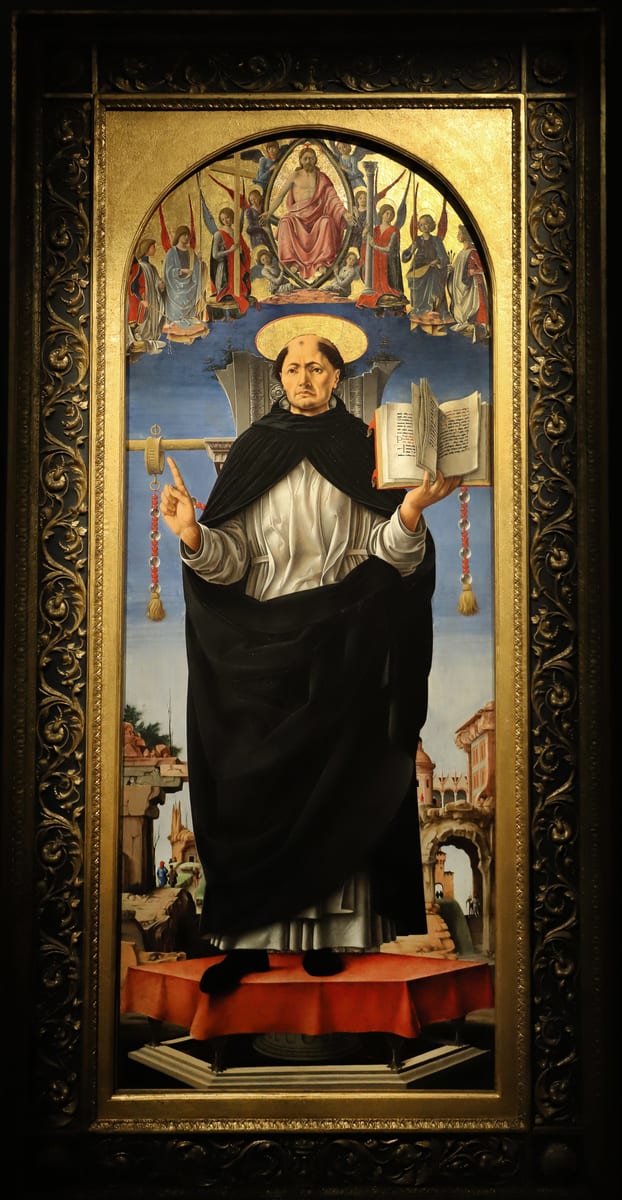
Saint Vincent Ferrer, central panel of the Griffoni Polyptych from San Petronio, Bologna (NG597), Francesco del Cossa (c. 1435/6 - c. 1477/8 AD); photograph by Sailko for Wikimedia CH, painted c. 1472-1475 AD; photograph 2020 AD Francesco del Cossa (c. 1435/6 - c. 1477/8 AD); photograph by Sailko for Wikimedia CH, The National Gallery, London (NG597) He entered Aix in October 1400 AD, preached at Marseille through that December, and crossed the Alps into Lombardy in June 1402 AD. He wrote to his master general from Geneva in 1403 AD and preached the Lent of 1404 AD at Lausanne. He ate no meat, and drank water reddened with a few drops of wine.
A company of a hundred to two hundred penitents travelled with him and scourged themselves as they entered a town. Jean Gerson, with a word added by Pierre d'Ailly, wrote begging his dear master to take care and not compromise himself. The councillors of Orihuela wrote in March 1411 AD to thank God for his visit, counting a hundred and twenty-three reconciliations.
“Arise, ye dead, and come to the judgment.”
St. Vincent Ferrer, repeated theme in his sermons on the final judgment -
1410–1412 AD
Nine judges at Caspe
A crown left vacant, a tribunal in a walled castle on the Ebro, and a verdict published from the pulpit.
King Martin of Aragon died in May 1410 AD and left the crown without an heir. In February 1412 AD the Cortes of Aragon, Catalonia and Valencia agreed to leave the succession to nine judges meeting at the castle of Caspe on the Ebro. St. Vincent Ferrer was one of the nine, and voted first although he stood eighth on the list.
On June 24, 1412 AD the judges declared Ferdinand of Castile elected king of Aragon. Five days later he preached before the judges and the assembled people and published the decision from the pulpit. The chronicler Zurita wrote that among the nine he shone like the sun by reason of his sanctity.
“After enduring the most furious storms, we now see the winds calmed at last. Our ship, battered by the tempest, having lost its pilot and its rudder, comes happily into its desired harbour.”
St. Vincent Ferrer -
1415–1416 AD
Perpignan, and the Epiphany act
Sent by a dying king to press Benedict XIII, he read on the Epiphany the act that withdrew Aragon from the obedience he had defended.
King Ferdinand fell dangerously ill in May 1415 AD and asked him to go in his place to Perpignan. He arrived in August and set himself to make Benedict XIII resign the papacy. The Emperor Sigismund came in September and left with his whole retinue in early November, the talks having failed.
He then fell so ill in his cell at the convent of the Preachers that his life was despaired of. On the Epiphany, January 6, 1416 AD, he sang Mass, preached to some ten thousand people, and read the act withdrawing Aragon from the obedience of Benedict XIII. In the same sermon St. Vincent Ferrer declared that Benedict XIII was the legitimate pope, but would not resign to give the Church peace.
“But for you this union could never have been accomplished.”
Jean Gerson to St. Vincent Ferrer, letter after the withdrawal of obedience from Benedict XIII ended the Schism, 1416 AD -
1417–1419 AD
Brittany
Two years of preaching in Brittany and Normandy, a failed voyage home, and death at Vannes in Passion Week.
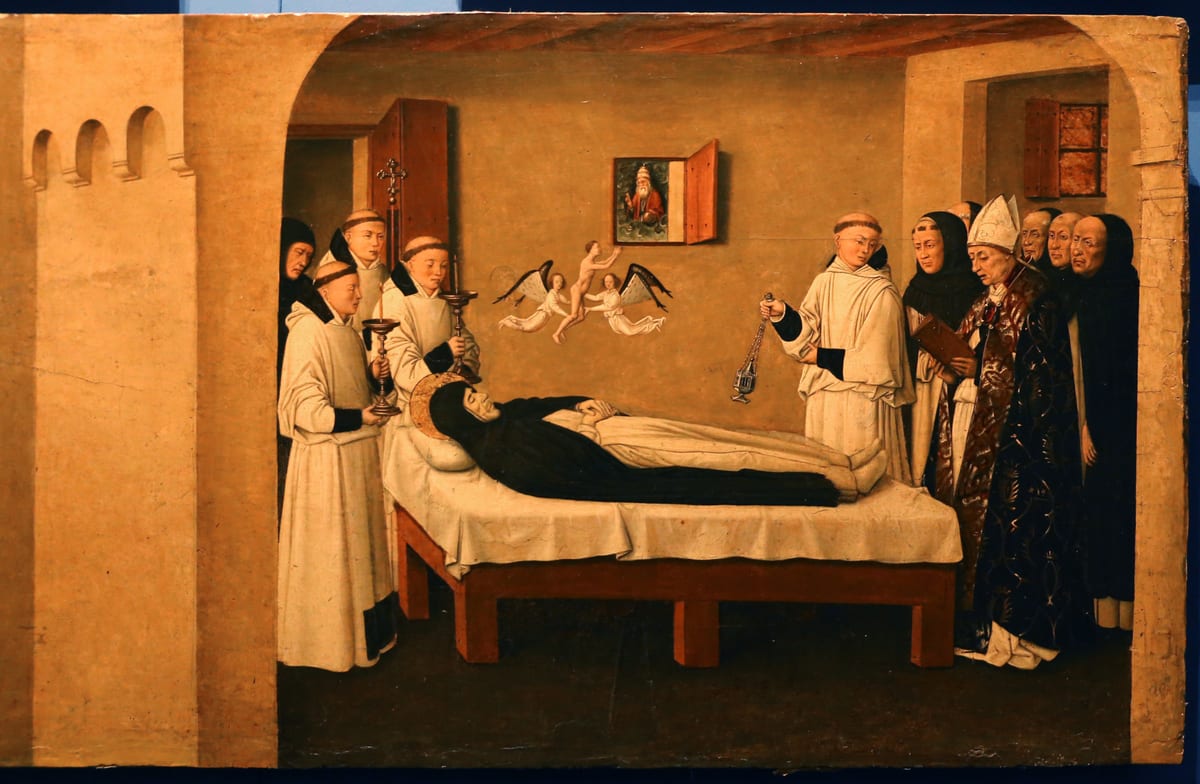
San Vincenzo Ferrer e storie della sua vita, predella: the death of the saint, Niccolo Antonio Colantonio (active Naples c. 1440-1470 AD); photograph by Sailko, painted c. 1456-1458 AD; photograph 2019 AD Niccolo Antonio Colantonio (active Naples c. 1440-1470 AD); photograph by Sailko, Museo e Real Bosco di Capodimonte, Naples (from San Pietro Martire, Naples) He crossed into Brittany in March 1417 AD and preached at Vannes from the fourth Sunday of Lent until Easter Tuesday. The devotional tradition of both saints' Lives holds that at Besançon that June he conferred with Saint Colette of Corbie on the schism and the affairs of France. According to longstanding Catholic tradition, St. Colette told him afterwards that God would call him within two years, and that he would die in France.
Henry V of England invited him to preach in Normandy, and he went to Caen where the king held his court. He came back to Vannes spent and weary at the beginning of 1419 AD, and illness turned back an attempt to carry him home to Spain by sea. He died in the house the Duchess of Brittany had found him, on the Wednesday of Passion Week, April 5, 1419 AD, at the hour of vespers.
“In manus tuas, Domine, commendo spiritum meum; into Thy hands, 0 Lord, I commend my spirit”
St. Vincent Ferrer, his last words before death -
1419–1836 AD
The shrine at Vannes
Buried two days later in the choir of the cathedral of Vannes, canonized thirty-six years later, and kept by Brittany against every Spanish request.
The Bishop of Vannes buried him in the choir of his cathedral on April 7, 1419 AD. Pope Nicholas V opened the inquiry into his life and miracles on October 18, 1451 AD, and it closed in April 1454 AD. Pope Calixtus III canonized him at the Dominican church of Santa Maria sopra Minerva in Rome on June 29, 1455 AD.
The same pope fixed his feast on April 5, the anniversary of his death. Valencia asked for the body more than once, and two popes ruled that the relics were to stay at Vannes. Naples decreed him patron of the city in 1836 AD, after the cholera ceased.


_01.jpg)
,_predella_04_morte_del_santo_1.jpg)
Pray with the Church
Collect for the Memorial of Saint Vincent Ferrer
The Church's own prayer for his memorial on April 5, from the Roman Missal, as printed with the Office of Readings for the day.
O God, who raised up the Priest Saint Vincent Ferrerto minister by the preaching of the Gospel,grant, we pray,that, when the Judge comes,whom Saint Vincent proclaimed on earth,we may be among those blessedto behold him reigning in heaven.Who lives and reigns with you in the unity of the Holy Spirit,God, for ever and ever.
All 7 reports on Saint Vincent Ferrer

About this picture
AI-generated image, in the manner of a fifteenth-century panel painting in egg tempera and early oil, from the paper's reference portrait based on Szene aus dem Leben des Hl. Vinzenz Ferrer: Durch Aufregungen infolge des Schismas erkrankt der Heilige; er wird am Krankenbett vom hl. Dominikus besucht und von Christus geheilt (GG 6695) (Agnolo degli Erri, c. 1470-1490 AD, Kunsthistorisches Museum, Vienna) View source artwork.

Christ's touch cures the dying St. Vincent Ferrer and sends him preaching

About this picture
AI-generated image, in the manner of a fifteenth-century panel painting in egg tempera and early oil on gessoed poplar, from the paper's reference portrait based on Szene aus dem Leben des Hl. Vinzenz Ferrer: Der Heilige legt in Avignon in Gegenwart des Papstes und der Kardinaele das Wort aus (GG 6692) (Agnolo degli Erri, c. 1470-1490 AD, Kunsthistorisches Museum, Vienna) View source artwork.

Avignon cardinals elect the patron St. Vincent Ferrer would not follow

About this picture
AI-generated image, in the manner of a fifteenth-century panel painting in egg tempera and early oil on gessoed poplar, from the paper's reference portrait based on a scene from the life of St. Vincent Ferrer (Agnolo degli Erri, c. 1470-1490 AD, Kunsthistorisches Museum, Vienna) View source artwork.
St. Vincent Ferrer brings the emperor to Perpignan after a month's argument

Aragon's heirless king remarries, and Saint Vincent Ferrer sings the Mass

About this picture
AI-generated image, in the manner of a fifteenth-century panel painting in egg tempera and early oil on gessoed poplar, from the paper's reference portrait based on Szene aus dem Leben des Hl. Vinzenz Ferrer: Die Mutter des Heiligen fragt den Bischof von Valencia nach den Wunderzeichen vor der Geburt ihres Kindes (GG 6700) (Agnolo degli Erri, c. 1470-1490 AD, Kunsthistorisches Museum, Vienna) View source artwork.

St. Vincent Ferrer, aged seven, is enrolled among the clergy of Valencia

About this picture
AI-generated image, in the manner of a fifteenth-century panel painting in egg tempera and early oil on gessoed poplar, from the paper's reference portrait based on Saint Vincent Ferrer, central panel of the Griffoni Polyptych from San Petronio, Bologna (Francesco del Cossa, painted c. 1472–1475 AD, The National Gallery, London, NG597) View source artwork.
Aragon proclaims Ferdinand its king, ten weeks after nine judges chose him

About this picture
AI-generated image, in the manner of a fifteenth-century panel painting in egg tempera and early oil on gessoed poplar, from the paper's reference portrait based on Szene aus dem Leben des Hl. Vinzenz Ferrer (GG 6695) (Agnolo degli Erri, c. 1470-1490 AD, Kunsthistorisches Museum, Vienna) View source artwork.