
Saints Virgin and Abbess · Feast February 10
Saint Scholastica
Feast 10 February · Born 480 AD, Nursia (Norcia), Umbria, Italy · Died 543 AD, Her monastery at Plombariola, near Monte Cassino, Lazio, Italy
She governed a house of nuns five miles from her brother's abbey, and met him once a year outside his gate.
Begin the life
In brief
Saint Scholastica, also called Scholastica of Nursia, was the sister of Saint Benedict. She founded and governed a monastery of women a few miles from his abbey at Monte Cassino, and she died there about 543 AD.
-
About 480 AD
A child dedicated from her infancy
Born in the Umbrian mountains, and given to God before she could choose it.
St. Benedict was born about 480 AD at Nursia, in the inland mountains of Umbria. St. Scholastica was his sister. According to longstanding Catholic tradition, which St. Bede accepts, the two were twins, born on the same day.
St. Scholastica was dedicated to God from her infancy. A later Life printed with the Acta Sanctorum places her birth in the city of Norcia, of a kind father and a pious mother.
-
About 500–529 AD
Her brother goes south
Rome, a cave above the Anio, and at last the mountain at Cassino.
St. Benedict's well-to-do parents sent him to Rome to study rhetoric. He then lived three years completely alone in a cave at Subiaco. In 529 AD he left Subiaco and settled at Monte Cassino.
-
529 AD
Her own house at Plombariola
She settled five miles south of the abbey and took charge of a community of nuns.
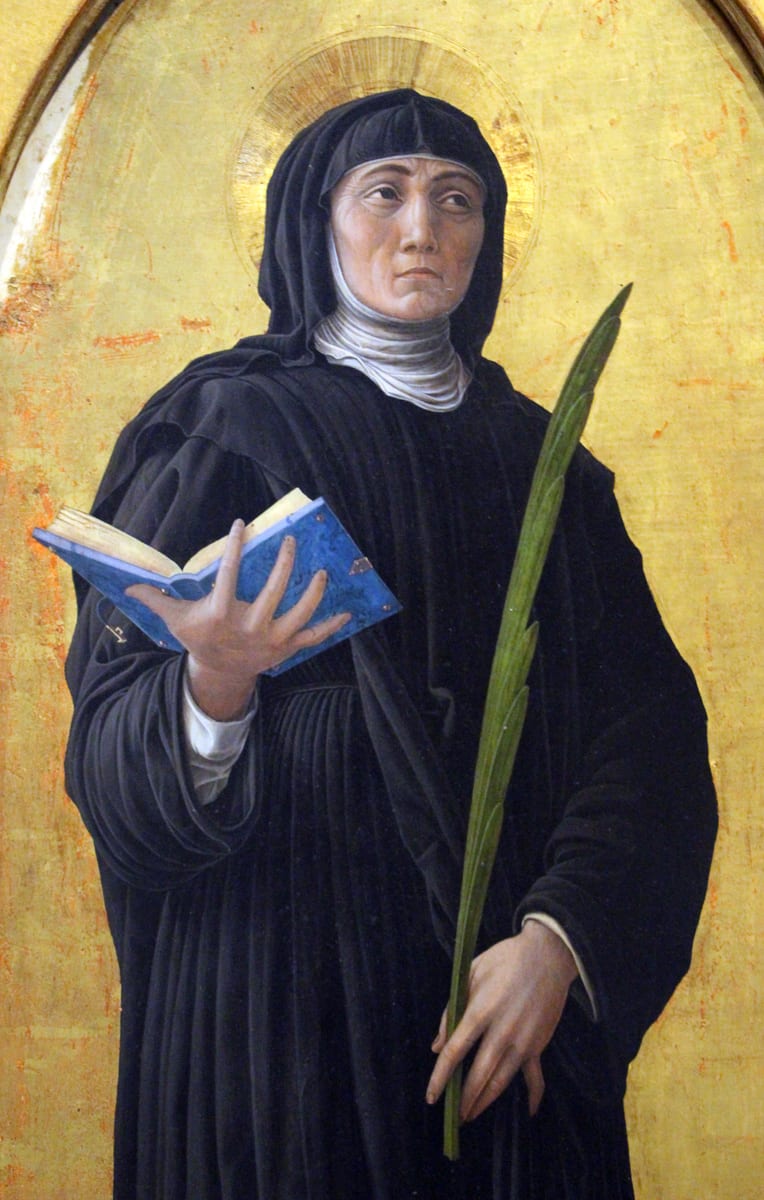
Polittico di San Luca — Santa Scolastica (detail), Andrea Mantegna (1431–1506 AD), 1453–1454 AD Andrea Mantegna (1431–1506 AD), Pinacoteca di Brera, Milan; painted for the Benedictine abbey of Santa Giustina, Padua St. Scholastica followed her brother south and chose her retreat at Plombariola. There she founded and governed a nunnery about five miles south of his monastery.
Pope Saint John Paul II, speaking at Monte Cassino, said that St. Scholastica directed the convent of religious women while her brother evangelized the peoples who were still pagan. The Benedictines call Plumbariola the first Benedictine convent and St. Scholastica its abbess.
-
About 530–542 AD
One journey a year
She taught the women in her charge, and kept a yearly appointment at her brother's gate.
St. Bertharius, abbot of Cassino three hundred years later, wrote that St. Scholastica instructed several of her own sex in virtue. Once a year she came to visit her brother. She could not enter his monastery, so he came out with some of his monks to a house belonging to the abbey, not far from the gate.
In 542 AD St. Benedict received the Gothic king Totila on the mountain, a few miles from her house.
-
543 AD
The last supper outside the gate
A clear February day of prayer and talk, and a request her brother would not grant.
At her last coming the two spent the whole day in the praises of God and spiritual talk. The sky was so clear that no cloud was to be seen.
When it was almost night they dined together. St. Scholastica entreated her brother to stay until morning. St. Benedict would not agree, because he might not spend a night outside his abbey.
“I beg you, do not leave me this night, so that we may speak until morning of the joys of the heavenly life.”
St. Scholastica to Saint Benedict, their last meeting -
543 AD
The storm out of a clear sky
She prayed with her head on the table, and the weather shut her brother in for the night.
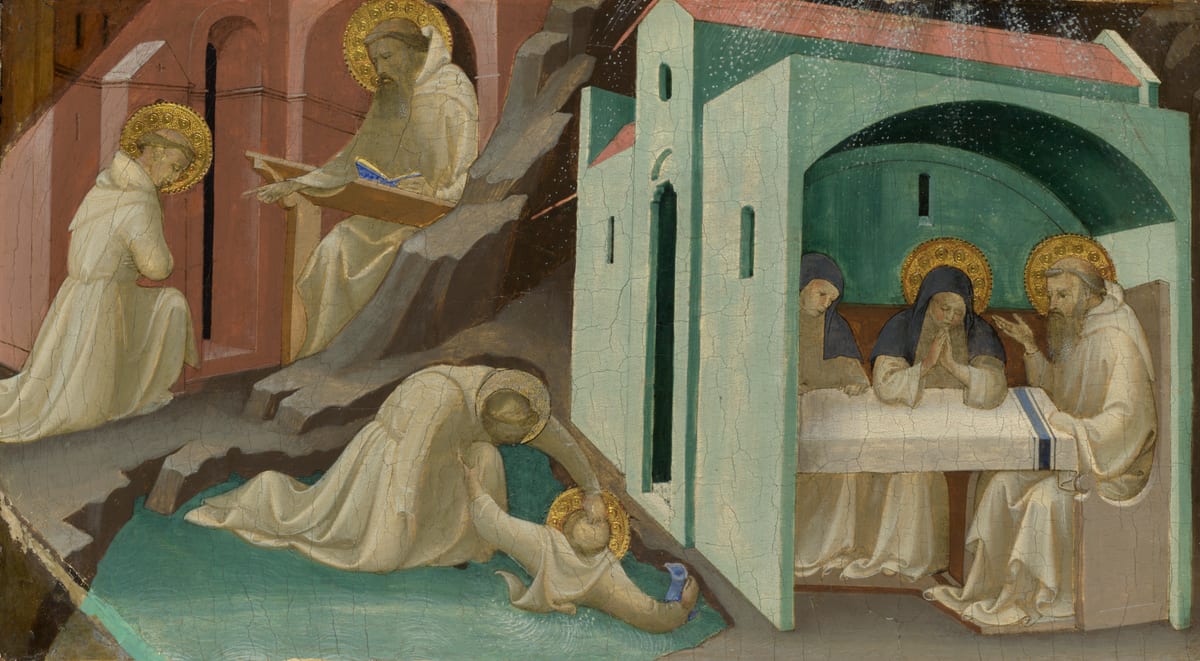
Incidents in the Life of Saint Benedict (predella panel, NG4062), Lorenzo Monaco (c. 1370–1425 AD), 1409 AD Lorenzo Monaco (c. 1370–1425 AD), The National Gallery, London St. Scholastica joined her hands on the table, bowed her head upon them, and prayed to Almighty God in tears. As she lifted her head there fell such lightning, thunder and rain that no one could put a head out of doors. St. Benedict could not return to his abbey, and he complained to his sister.
Pope Saint Gregory the Great called the storm a miracle wrought by a woman's prayers through the power of Almighty God. The same pope judged that her prayers were of greater power than her brother's will because she had the greater love. The two watched all night and comforted one another with heavenly talk.
“See, I asked you, and you would not listen to me; I asked my Lord, and He heard me. Now then, if you can, go out and leave me behind, and return to the monastery.”
St. Scholastica to Saint Benedict, after the storm prevented his departure -
February 10, 543 AD
Three days later, a dove
She died in her solitude, and her brother saw her go.
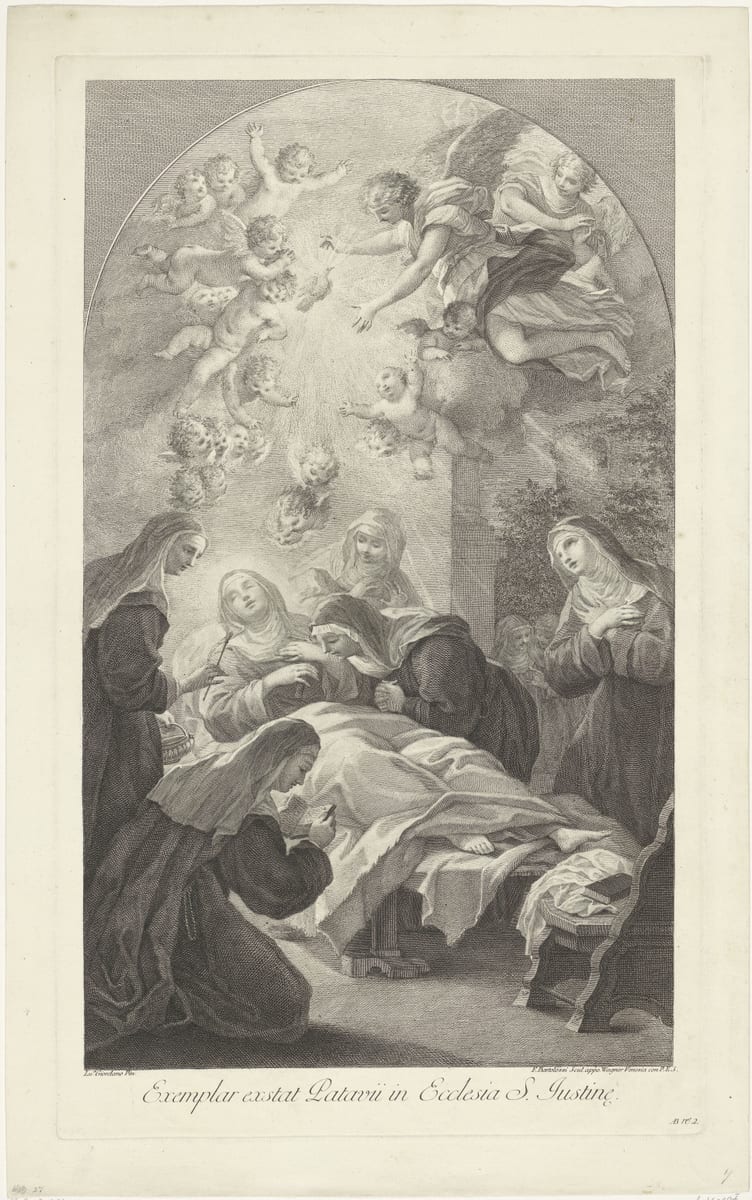
De dood van de heilige Scholastica (The Death of Saint Scholastica), RP-P-OB-5367 AD, Francesco Bartolozzi, engraver, after the painting by Luca Giordano, 1739–1780 AD Francesco Bartolozzi, engraver, after the painting by Luca Giordano, Rijksmuseum, Amsterdam The next day St. Scholastica returned to her monastery and St. Benedict to his abbey. Three days later she died in her solitude. Butler's Lives of the Saints places her death about the year 543 AD.
Standing in his cell and lifting his eyes to heaven, St. Benedict saw her soul ascend in the likeness of a dove. He gave thanks with hymns and told his monks that she had died. He sent them to bring her body to the grave he had provided for himself.
“On Mount Cassino, St. Scholastica, a virgin, whose soul her brother, St. Benedict, the abbot, saw leaving her body in the form of a dove, and ascending to heaven.”
the Roman Martyrology -
593–2026 AD
The houses that carry her name
A pope wrote her story down, and two abbeys still answer to her name.
In 593 AD Pope Saint Gregory the Great wrote the four books of the Dialogues, fifty years after her death in 543 AD. Paul the Deacon, a monk of Monte Cassino, wrote a poem in her honour. Pope Benedict VII consecrated the rebuilt church below the grotto at Subiaco, and from then the abbey was known by her name.
On November 23, 1876 AD she was officially proclaimed patroness of Le Mans. In March 2026 AD Pope Leo XIV received the Benedictine communities of Santa Scolastica of Subiaco and of Santa Scolastica of Bari.
“I entrust you to Mary Most Holy, Mother of Silence, Woman of Listening, to Saint Benedict, to Saint Scholastica, and to the many Benedictine saints, and I bless you from my heart.”
Pope Leo XIV to three Benedictine Monastic Communities, March 30, 2026 AD


Pray with the Church
Prayer for the feast of Saint Scholastica
The Collect the Church prays on her feast, February 10, printed by the Order of Saint Benedict with the text of the Dialogues.
O God, to show us where innocence leads, you made the soul of your virgin Saint Scholastica soar to heaven like a dove in flight.Grant through her merits and her prayers that we may so live in innocence as to attain to joys everlasting.This we ask through our Lord.
All 1 report on Saint Scholastica

About this picture
AI-generated image, in the manner of Italian panel painting in egg tempera, from the paper's reference portrait based on De dood van de heilige Scholastica (The Death of Saint Scholastica), RP-P-OB-5367 (Francesco Bartolozzi, engraver, after the painting by Luca Giordano, 1739–1780, Rijksmuseum, Amsterdam) View source artwork.