
Saints Abbot of Monte Cassino
Saint Benedict of Nursia
Feast 11 July · Born 480 AD, Nursia (Norcia), Umbria, Italy · Died 547 AD, Monte Cassino, Cassino, Lazio, Italy
From the schools of Rome to a cave above the Anio, and from the cave to a mountain in Campania where he wrote his Rule.
Begin the life
In brief
Saint Benedict of Nursia, commonly known as Benedict of Norcia, was born about 480 AD in the Umbrian province of Nursia. He lived three years hidden in a cave above the river Anio, governed monasteries in that valley, and ended his life at Monte Cassino, where he wrote his Rule. Pope Paul VI declared St. Benedict the principal heavenly Patron of all Europe in 1964 AD.
-
c. 480–500 AD
The boy sent down to Rome
A household in the Umbrian hills sends its son to the schools of the capital, and he walks out of them.
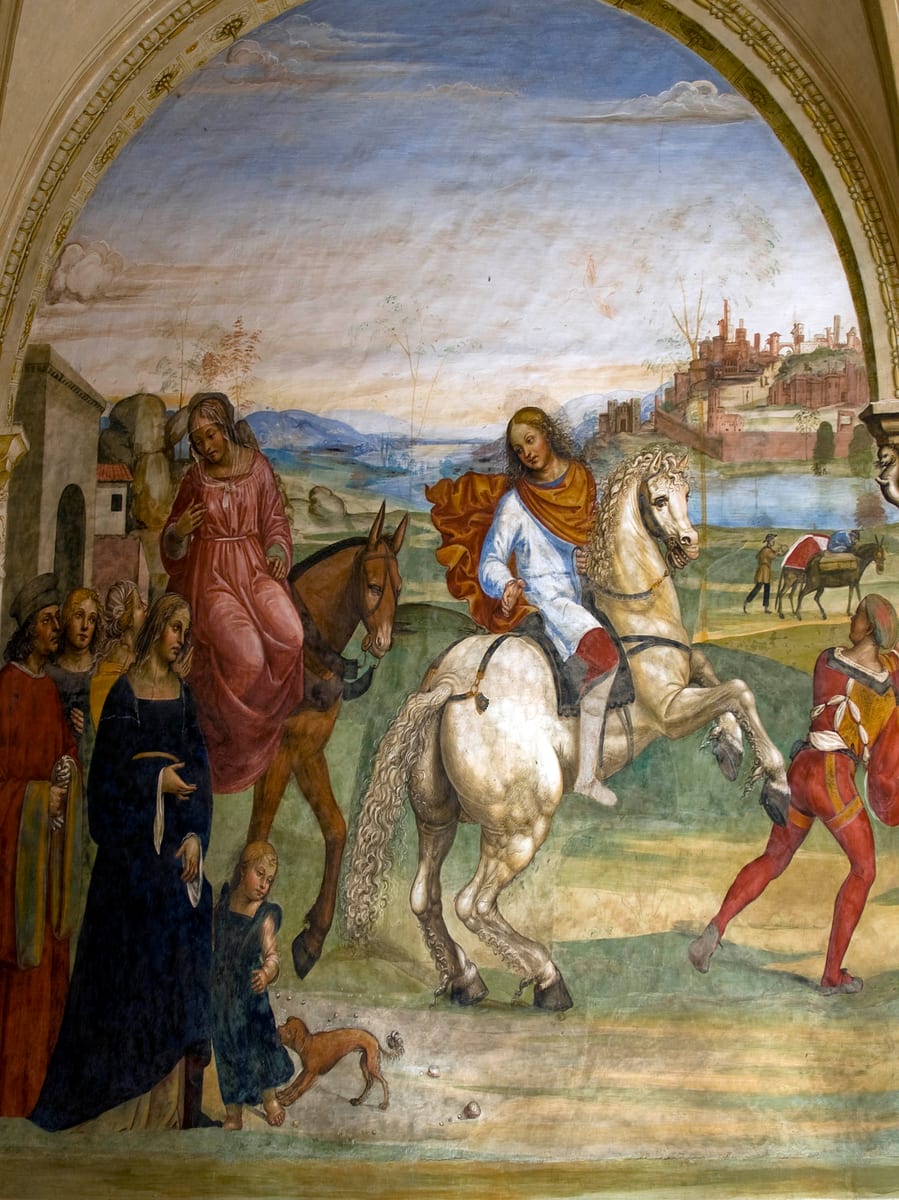
Come Benedetto lascia la casa paterna e recasi a studio a Roma (Life of St Benedict, Scene 1: Benedict Leaves His Parents' House), Il Sodoma (Giovanni Antonio Bazzi), 1505-1508 AD Il Sodoma (Giovanni Antonio Bazzi), Great cloister, Abbazia di Monte Oliveto Maggiore, Asciano, Siena St. Benedict was born about 480 AD in the province of Nursia, high in the Umbrian mountains. His father was named Eutropius and his grandfather Justinian. A tradition which St. Bede accepts makes him the twin of his sister St. Scholastica.
In the first flower of his youth he was sent from Nursia to Rome for the liberal studies, and lived there with his parents. St. Gregory the Great explains that the young student was put off by the dissolute lifestyle of many of his fellow students, and did not wish to make the same mistakes. Before finishing his studies he gave over his book and forsook his father's house and wealth.
“soli Deo placere desiderans”
Pope Saint Gregory the Great, describing Benedict's motive in the Dialogues -
c. 500 AD
Enfide, and a sieve made whole
He leaves the city with his old nurse, and the first miracle drives him further out.
He did not leave Rome to become a hermit, and his old nurse went with him as a servant. The two stopped at a place called Enfide and stayed at the church of St. Peter, in the company of other virtuous men. There the nurse borrowed an earthenware wheat-sifter and broke it.
St. Benedict took away both pieces, fell to his prayers in tears, and rose to find the vessel whole. The townsmen hung it over the church door, where it still hung many years later. The notice this brought him drove him to a desert place called Sublacum, almost forty miles from Rome.
-
c. 500–503 AD
Three years above the Anio
One monk knows where he is, and lowers bread to him on a line.
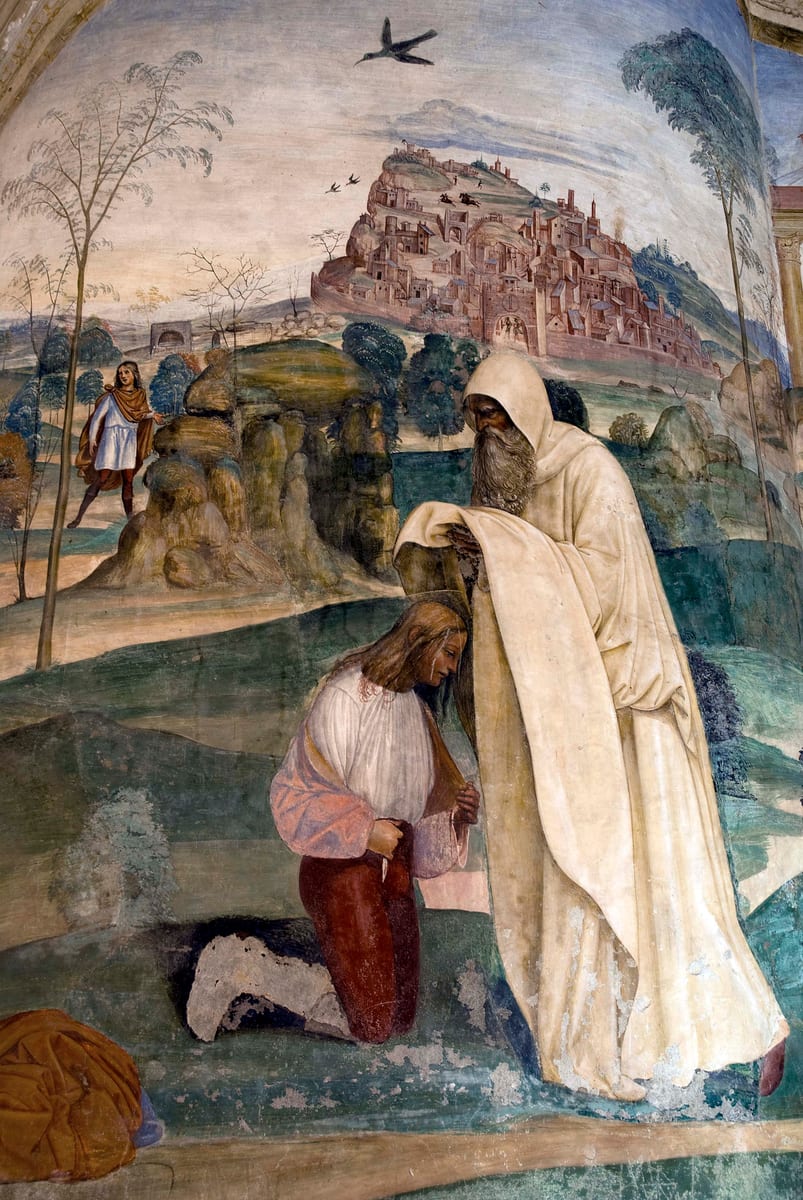
Come Romano monaco da lo abito eremitico a Benedetto (Life of St Benedict, Scene 4: The Monk Romanus Dresses Benedict), Il Sodoma (Giovanni Antonio Bazzi), 1505-1508 AD Il Sodoma (Giovanni Antonio Bazzi), Great cloister, Abbazia di Monte Oliveto Maggiore, Asciano, Siena On the road a monk, Saint Romanus, met him, kept his purpose secret, and gave him the monk's habit. St. Romanus cut bread from his own meals and let it down the cliff on a line, with a bell tied to the cord. St. Benedict lived three years in a narrow cave above the river Anio, unknown to all men but St. Romanus.
Pope Pius XII writes that he strove there for three years to acquire the perfection and holiness of the Gospels. Shepherds came on the cave, saw his apparel made of skins through the bushes, and took him at first for a beast. He threw himself into a thicket of briars and nettles to master a violent temptation of the flesh.
“For God's sake he deliberately chose the hardships of life and the weariness of labour”
Pope Saint Gregory the Great, describing Benedict's chosen poverty -
c. 500s AD
The abbot they tried to poison
A community without an abbot presses him to govern, and he warns them how it will end.
A monastery near the cave lost its abbot, and the whole community came and entreated him to take its government. He told them their manners and his would not agree, and consented only when they pressed him. St Gregory the Great records that some of the monks, chafing under his government, agreed to poison his wine.
At table he made the sign of the cross over the glass, and it broke in pieces though he held it far off. He left the house and went back to the wilderness he loved, and dwelt alone with himself in the sight of his Creator.
“Almighty God have mercy upon you, and forgive you: why have you used me in this manner? Did not I tell you before hand, that our manner of living could never agree together? Go your ways, and seek ye out some other father suitable to your own conditions, for I intend not now to stay any longer amongst you.”
St. Benedict of Nursia to the monks who tried to poison him, after the poisoned wine glass shattered -
c. 520–522 AD
The valley fills with monks
Roman families send their sons up the Anio, and the hermit becomes a builder of houses.
Many began to abandon the world and become his scholars, and Roman nobles commended their children to him. About 520 AD he built the house below his grotto that became the Abbey of St. Scholastica, endowed by the patricians Tertullus and Aequitius. Twelve of the fourteen Benedictine monasteries around Subiaco were built by St. Benedict.
In 522 AD two senators, Equitius and Tertullus, gave him their sons: St. Maurus, then twelve years old, and St. Placidus, still a child. Tradition preserved by Pope Saint Gregory the Great holds that St. Maurus ran over the lake at his command and drew the drowning St. Placidus out by the hair.
“Brother Maurus, run as fast as you can, for Placidus, that went to the lake to fetch water, is fallen in, and is carried a good way off.”
St. Benedict of Nursia to Saint Maurus, Placidus falling into the lake -
529–530s AD
Monte Cassino, and the Rule
He leaves the valley under a priest's persecution and writes the book his monks will live by.
In 529 AD St. Benedict left Subiaco to escape the persecutions of the jealous priest Florentius. A chosen band went with him to Monte Cassino, among them St. Maurus and St. Placid. He reached the mountain on February 27, 529 AD, the first day of Lent, and shut himself in for the forty days.
There he wrote the Rule under which his monks lived. In its last chapter he calls it a minimum Rule written for beginners. It orders that all guests who come be received as Christ, and that the sick be served as Christ himself.
“And so we are going to establish a school for the service of the Lord. In founding it we hope to introduce nothing harsh or burdensome.”
St. Benedict of Nursia to the brethren, Close of the Prologue, announcing the purpose of the Rule -
539–542 AD
Famine, a night at the window, and a king
The Gothic war reaches the mountain, and so does the king who is fighting it.
A famine struck Italy and Campania in 539 AD, and the starving came up to the abbey. The next day the door was opened on some two hundred bushels of flour lying in sacks, and no one learned who had brought them.
Tradition carried by Pope Saint Gregory the Great holds that on the night of October 29, 540 AD he stood at his window and saw the whole world gathered in a single ray of light. Marching through Campania in 542 AD, Totila, King of the Goths, sent word ahead and came to Monte Cassino. Pope Saint Gregory the Great reports that St. Benedict reproved the king and told him how long he had to reign.
“Much wickedness do you daily commit, and many sins have you done: now at length give over your sinful life. Into the city of Rome shall you enter, and over the sea shall you pass: nine years shall you reign, and in the tenth shall you leave this mortal life.”
St. Benedict of Nursia to Totila, King of the Goths, Totila's visit to Monte Cassino, 543 -
543–547 AD
The oratory, and the last day
He asks to be carried to the place of prayer, and dies on his feet.
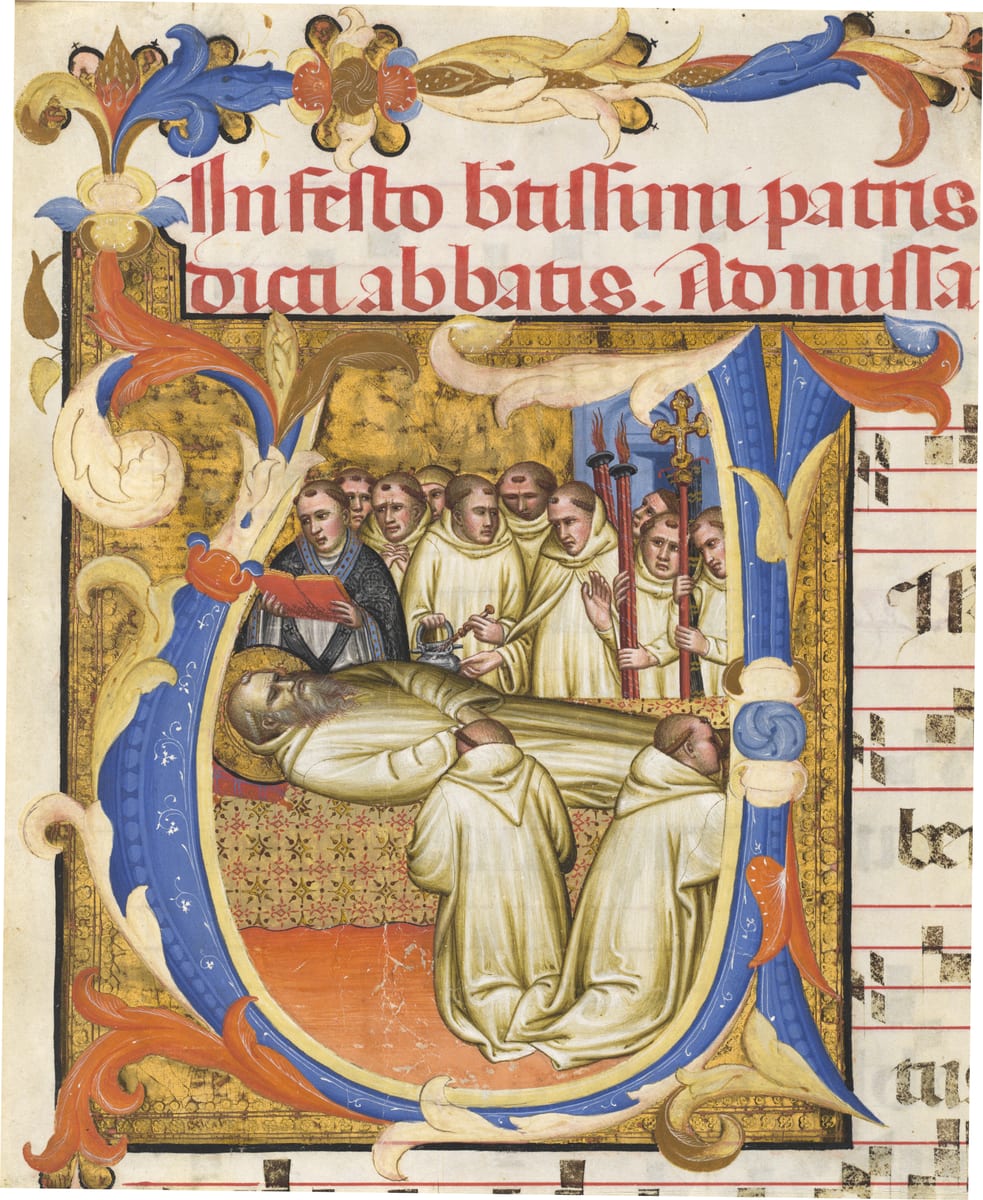
Death of Saint Benedict, Fra Gregorio Mutii da Montalcino, 1390/1395 AD Fra Gregorio Mutii da Montalcino, National Gallery of Art, Washington (open access) His sister St. Scholastica came to him once a year, and he went down to meet her at a property of the monastery near the gate. Abbot Tosti records that at their last meeting the storm her prayer had raised made it impossible for him to return to his monastery, so that he stayed against his will and the two spent the whole night in spiritual conversation.
In his last illness, on the sixth day, he commanded his monks to carry him into the oratory. There he received the Body and Blood of our Saviour Christ. He died standing, his own hands lifted up, his weak body held between the hands of his disciples.
Pope Benedict XVI dates the death to March 21, 547 AD. He was buried at Monte Cassino in one tomb with his sister, St. Scholastica. Pope Paul VI declared him the principal heavenly Patron of all Europe on October 24, 1964 AD, the day he consecrated the rebuilt church of Monte Cassino.
“This is the way, by which the beloved servant of God, Benedict, is ascended up to heaven.”
A man of reverend appearance, in a vision to two monks, vision at Benedict's death


Pray with the Church
The Suscipe of Saint Benedict
The verse Saint Benedict appointed in his Rule, chapter 58, for a monk to sing when he lays his written petition on the altar. English translation by Leonard J. Doyle.
Receive me, O Lord, according to Your word, and I shall live: and let me not be confounded in my hope.
All 3 reports on Saint Benedict of Nursia

About this picture
AI-generated image, in the manner of Italian buon fresco on lime plaster, from the paper's reference portrait based on Come Romano monaco da lo abito eremitico a Benedetto (Life of St Benedict, Scene 4: The Monk Romanus Dresses Benedict) (Il Sodoma (Giovanni Antonio Bazzi), 1505-1508 AD, Great cloister, Abbazia di Monte Oliveto Maggiore, Asciano, Siena) View source artwork.
Shepherds mistake the hermit St. Benedict in his cave for a beast

About this picture
AI-generated image, in the manner of Italian buon fresco on lime plaster, from the paper's reference portrait based on Come Benedetto compie la edificazione di dodici monasteri (Life of St Benedict, Scene 11: Benedict Founds Twelve Monasteries) (Il Sodoma (Giovanni Antonio Bazzi), 1505-1508 AD, Great cloister, Abbazia di Monte Oliveto Maggiore, Asciano, Siena) View source artwork.

Water rises on the rock above Subiaco after St. Benedict prays

About this picture
AI-generated image, in the manner of Italian buon fresco on lime plaster, from the paper's reference portrait based on Come Benedetto compie la edificazione di dodici monasteri (Life of St Benedict, Scene 11: Benedict Founds Twelve Monasteries) (Il Sodoma (Giovanni Antonio Bazzi), 1505-1508 AD, Great cloister, Abbazia di Monte Oliveto Maggiore, Asciano, Siena) View source artwork.