
Saints Bishop of Smyrna and martyr · Feast February 23
Saint Polycarp of Smyrna
Feast 23 February · Born c. 69 AD, Roman province of Asia (birthplace not recorded) · Died c. 155 AD, Stadium of Smyrna (İzmir), Turkey
Taught by apostles and made bishop of Smyrna, Saint Polycarp kept the faith he had from St. John the Apostle into old age and died in the city's stadium for refusing to curse Christ.
Begin the life
In brief
Saint Polycarp of Smyrna was bishop of Smyrna, today's İzmir in Turkey, in the generation after the apostles. He had been a disciple of St. John the Apostle. After eighty-six years of serving Christ, St. Polycarp refused to curse Him and was put to death in the city's stadium.
-
c. 96–150 AD
The man who knew the apostles
A boy in Smyrna remembers the bishop who had talked with St. John the Apostle.
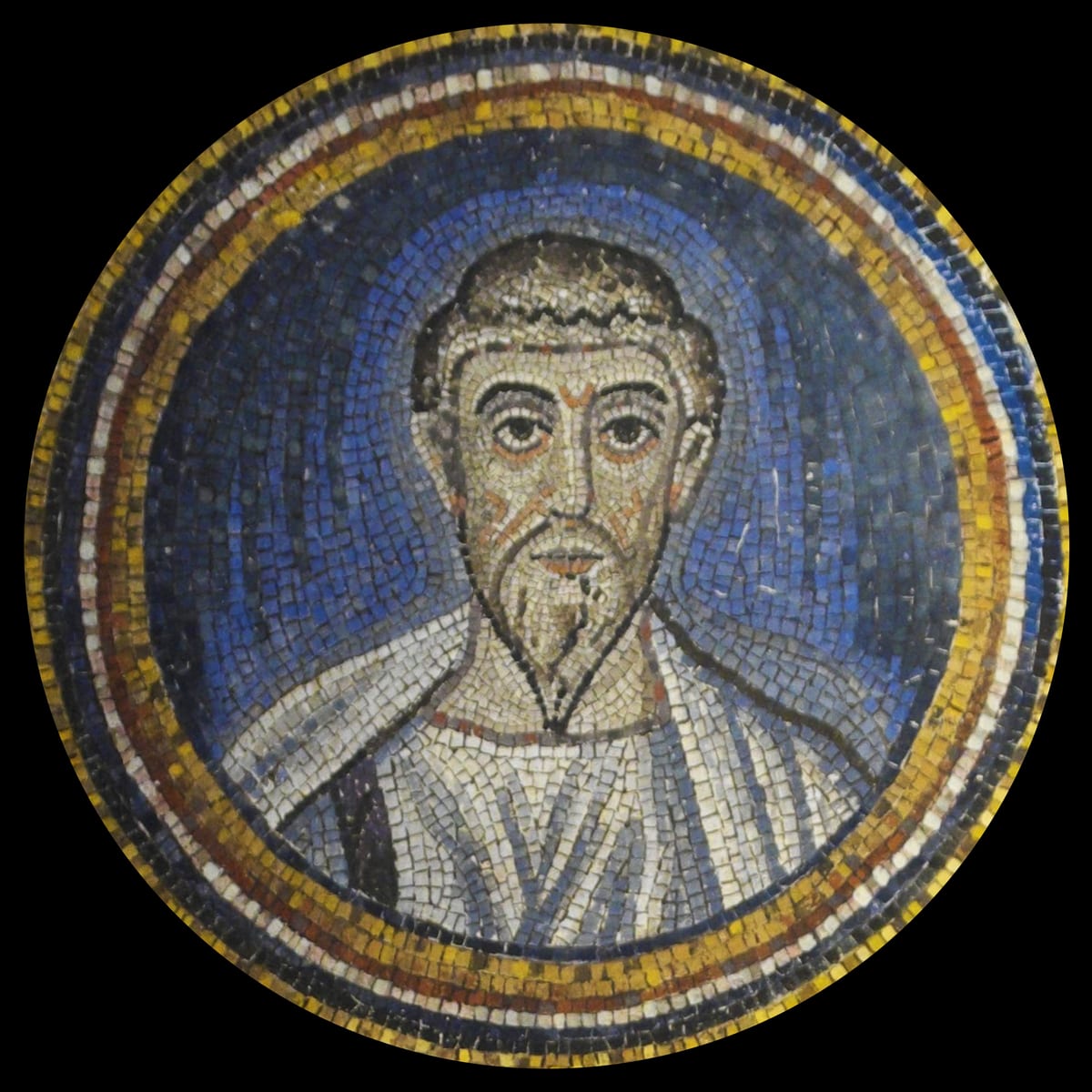
St. Polycarp, mosaic medallion in the Archbishop's Chapel, Ravenna, Ravenna mosaicist, c. 495–520 AD Ravenna mosaicist, Archbishop's Chapel, Museo Arcivescovile, Ravenna; photograph GFreihalter, CC BY-SA 3.0 St. Irenaeus of Lyons attended St. Polycarp's school in Smyrna as a boy. Writing later to a fellow pupil, he could still describe the place where St. Polycarp sat to teach. St. Irenaeus remembered how the bishop came and went, how he lived and how he looked.
St. Polycarp spoke of his time with St. John the Apostle and others who had seen the Lord. He repeated what they had told him of the Lord's miracles and teaching. His hearers passed on his story of St. John running out of a bath-house at Ephesus when he saw the heretic Cerinthus inside.
“οὐ μόνον ὑπὸ ἀποστόλων μαθητευθεὶς καὶ συναναστραφεὶς πολλοῖς τοῖς τὸν κύριον ἑορακόσιν, ἀλλὰ καὶ ὑπὸ ἀποστόλων κατασταθεὶς εἰς τὴν Ἀσίαν ἐν τῇ ἐν Σμύρνῃ ἐκκλησίᾳ ἐπίσκοπος (he was not only taught by the Apostles, and lived in familiar intercourse with many that had seen Christ, but also received his appointment in Asia from the Apostles as Bishop in the Church of Smyrna)”
St. Irenaeus, in Against Heresies, Book III -
c. 107 AD
St. Ignatius of Antioch at Smyrna
A bishop condemned to the beasts stops at Smyrna on his way to Rome, then writes to St. Polycarp.
St. Ignatius of Antioch, condemned to the beasts under the Emperor Trajan, was being taken in chains to Rome. On the way he stopped at Smyrna, where St. Polycarp was bishop. St. Ignatius wrote that the Ephesians, together with St. Polycarp, had comforted him in every way.
From Troas, St. Ignatius wrote to St. Polycarp, thanking God that he had seen the bishop's blameless face. He had heard that his own Church of Antioch, in Syria, was at peace through the prayers of Smyrna, so he asked St. Polycarp to call a council and choose a messenger to go there. He urged St. Polycarp to hold firm against false teachers and to protect the widows of his church.
“Οἱ δοκοῦντες ἀξιόπιστοι εἶναι καὶ ἑτεροδιδασκαλοῦντες μή σε καταπλησσέτωσαν. στῆθι ἑδραῖος ὡς ἄκμων τυπτόμενος. μεγάλου ἐστιν ἀθλητοῦ τὸ δέρεσθαι καὶ νικᾶν. (Let not those that appear to be plausible, but teach strange doctrine, overthrow you. Stand firm as an anvil which is smitten. The task of great athletes is to suffer punishment and yet conquer.)”
St. Ignatius of Antioch to St. Polycarp, in his letter to Polycarp -
c. 107–110 AD
A letter to Philippi
St. Polycarp answers the Church at Philippi and sends on the letters of St. Ignatius of Antioch.
St. Polycarp and the presbyters with him wrote to the Church at Philippi. The Philippians had asked for the letters of St. Ignatius of Antioch, and St. Polycarp sent the ones he had. He wrote before news of St. Ignatius's martyrdom had reached him.
He warned the Philippians against those who denied that Christ came in the flesh. He grieved for Valens, a presbyter of Philippi who had fallen, and drew from his case a warning against greed. The letter is the only writing of St. Polycarp that survives.
“Παρακαλῶ οὖν πάντας ὑμᾶς, πειθαρχεῖν τῷ λόγῳ τῆς δικαιοσύνης καὶ ἀσκεῖν πᾶσαν ὑπομονήν, ἣν καὶ εἴδατε κατ’ ὀφθαλμοὺς οὐ μόνον ἐν τοῖς μακαρίοις Ἰγνατίῳ καὶ Ζωσίμῳ καὶ Ῥούφῳ, ἀλλὰ καὶ ἐν ἄλλοις τοῖς ἐξ ὑμῶν (Now I beseech you all to obey the word of righteousness, and to endure with all the endurance which you also saw before your eyes, not only in the blessed Ignatius, and Zosimus, and Rufus, but also in others among yourselves.)”
St. Polycarp of Smyrna to the Church at Philippi, in his Letter -
c. 150–155 AD
Rome and Pope St. Anicetus
St. Polycarp and the Bishop of Rome disagree over the date of Easter and part in peace.
Late in life, St. Polycarp travelled to Rome, where Pope St. Anicetus led the Church. The churches of Asia kept Easter on the fourteenth day of the Jewish month of Nisan, whatever the day of the week, and Rome on the Sunday after. St. Polycarp held to the day he had always kept with St. John, and Pope St. Anicetus to the custom of the presbyters before him.
Neither changed the other's mind, but Pope St. Anicetus let St. Polycarp celebrate the Eucharist in the church at Rome, and they parted in peace. In Rome, St. Polycarp turned many followers of the heretics Marcion and Valentinus back to the Church. Marcion once met St. Polycarp and asked whether the bishop knew him, and St. Polycarp answered that he knew the first-born of Satan.
“ἐπιγινώσκω ἐπιγινώσκω τὸν πρωτότοκον τοῦ σατανᾶ (Ay, ay, I recognise the first-born of Satan)”
St. Polycarp of Smyrna to Marcion, meeting Marcion face to face, in Rome -
February, c. 155 AD
The farm outside Smyrna
St. Polycarp leaves the city for a farm, sees a vision of fire and is found at night.
In February, after a persecution had sent Christians to the wild beasts in Smyrna's stadium, the crowd shouted against them as atheists and demanded that St. Polycarp be searched out. His people persuaded him to leave for a farm near the city, where he prayed night and day for all people and for the churches everywhere. Three days before his arrest, he saw his pillow burning in a vision and told those with him that he must be burnt alive.
He moved to another farm, but his pursuers tortured two young slaves, and one gave him away. When police and cavalry found him on a Friday evening, he could still have slipped away to another house, but he refused, accepting it as God's will, and had food and drink set before them. He asked them for an hour to pray and then prayed aloud for two hours, and many of the men were sorry they had come for such an old man.
“τὸ θέλημα τοῦ θεοῦ γινέσθω (The will of God be done.)”
St. Polycarp of Smyrna, in the upper room at the farm, when his pursuers found him -
February 23, c. 155 AD
The stadium at Smyrna
Before the Roman governor, St. Polycarp refuses to curse Christ and dies at the pyre.
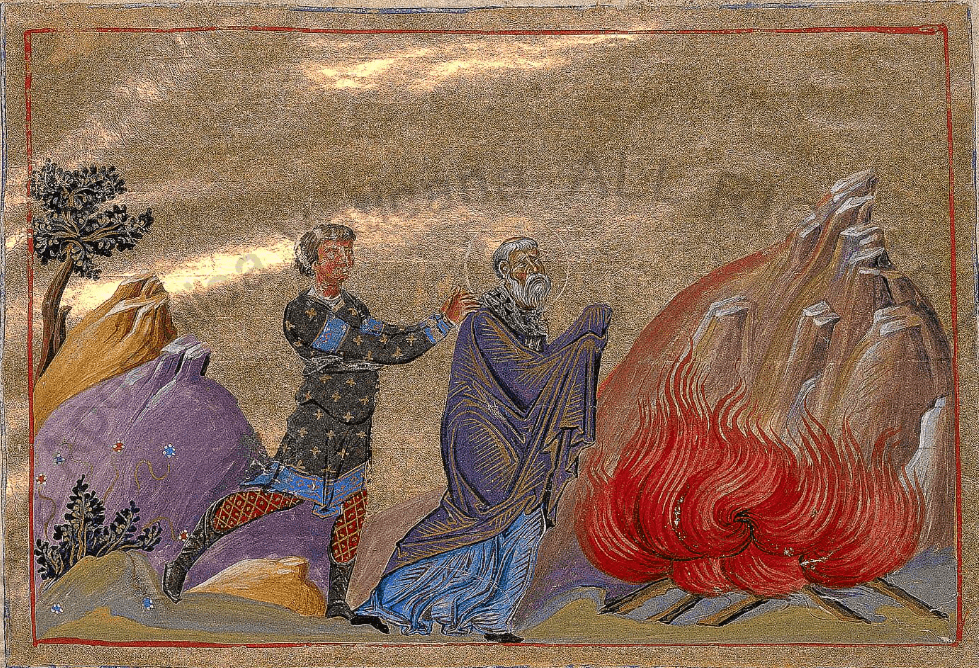
The martyrdom of St. Polycarp, from the Menologion of Basil II, Byzantine illuminators, c. 985 AD Byzantine illuminators, Vatican Apostolic Library Brought into Smyrna on a donkey and led into the stadium on February 23, the second day of the month Xanthicus, St. Polycarp was told by the Roman governor, Statius Quadratus, to swear by the fortune of Caesar, curse Christ and go free. St. Polycarp answered that he had served Christ eighty-six years and been done no wrong, so he could not blaspheme his King. The crowd, calling him the teacher of Asia who taught many not to sacrifice to the gods, shouted for him to be burnt alive.
Bound to the stake, he prayed, and when the fire was lit the flame curved round him like a ship's sail filled by the wind. Because the fire did not consume him, an executioner stabbed him with a dagger, and his blood put out the flames. His body was withheld from the Christians and a centurion burned it, but afterwards they gathered his bones, laid them in a fitting place and planned to meet there on the anniversary of his martyrdom.
“Ὀγδοήκοντα καὶ ἓξ ἔτη δουλεύω αὐτῷ, καὶ οὐδέν με ἠδίκησεν· καὶ πῶς δύναμαι βλασφημῆσαι τὸν βασιλέα μου τὸν σώσαντά με; (Eighty and six years have I served Him, and He never did me any injury: how then can I blaspheme my King and my Saviour?)”
St. Polycarp of Smyrna to the proconsul Statius Quadratus, at his trial in the stadium, when told to curse Christ -
c. 180–2007 AD
His feast on February 23
The Church keeps St. Polycarp's memorial on February 23, the day he died.
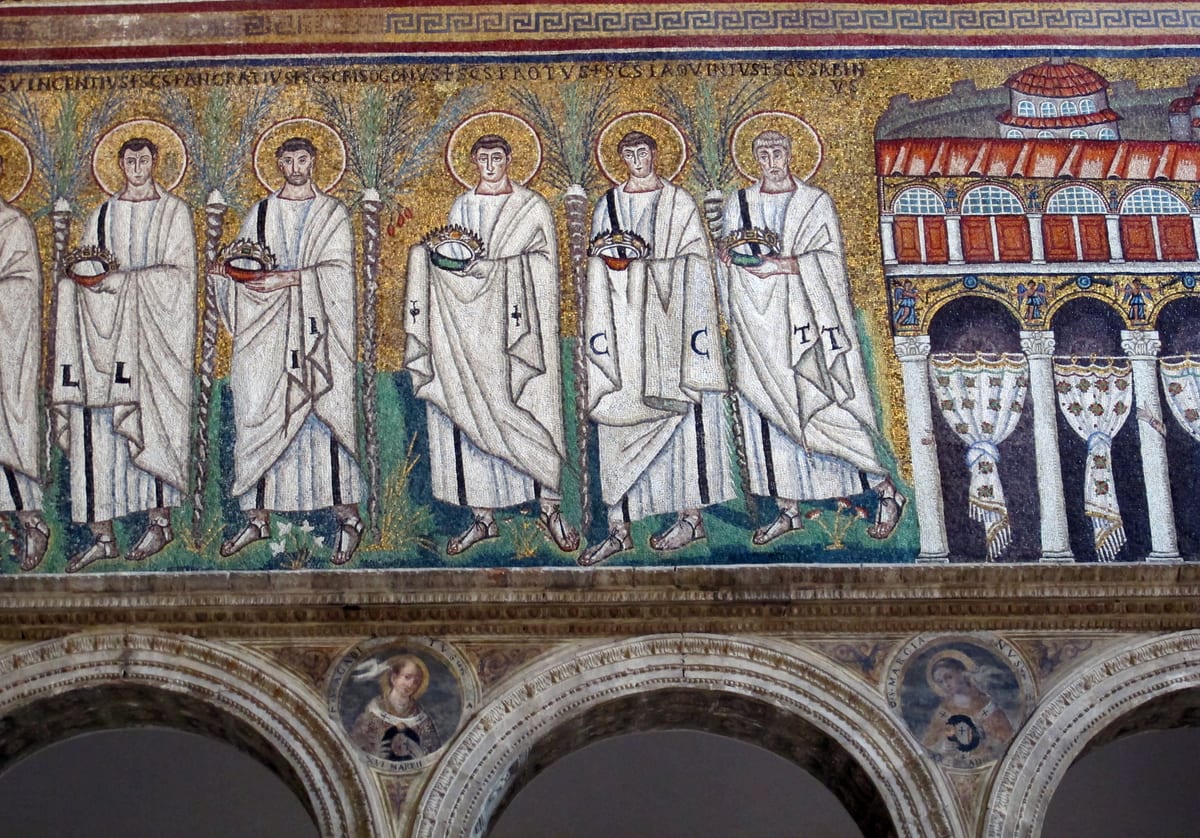
St. Polycarp in the procession of the holy martyrs, Ravenna mosaicist, sixth century Ravenna mosaicist, Basilica of Sant'Apollinare Nuovo, Ravenna; photograph Sailko, CC BY-SA 3.0 The Church keeps the memorial of St. Polycarp, Bishop and Martyr, on February 23, the day he died. When Rome took up his feast in the thirteenth century, it set it on January 26, a date that belonged to another saint of the same name, until the General Roman Calendar of 1969 AD restored it to February 23. The Collect, the prayer of his memorial, thanks God for giving the Bishop St. Polycarp a place among the martyrs.
The Roman Martyrology records him as a disciple of the Apostle St. John. St. Irenaeus called him a more steadfast witness of the truth than the heretics Valentinus and Marcion. On March 28, 2007 AD, Pope Benedict XVI taught that the Gospel St. Irenaeus preached was the one St. Polycarp taught him, which went back to St. John.
“Ibi, quantum fieri potest, cum gaudio et laetitia conveniemus, anniversarium, Deo favente, celebraturi diei quo Polycarpus martyrio caelo natus est. (There, as far as can be done, we shall come together in joy and gladness to celebrate, with God's favour, the anniversary of the day on which Polycarp was born into heaven by martyrdom.)”
The Christians of Smyrna, as quoted in the Roman Calendar of 1969, marking the place where his bones were laid, 155 AD


Pray with the Church
The prayer of St. Polycarp at the pyre
His own prayer, bound at the stake in the stadium of Smyrna, from the Church of Smyrna's letter on his martyrdom, as the Liturgy of the Hours reads it in the Office of Readings on his memorial (ICEL English).
Lord, almighty God, Father of your beloved and blessed Son Jesus Christ, through whom we have come to the knowledge of yourself, God of angels, of powers, of all creation, of all the race of saints who live in your sight,I bless you for judging me worthy of this day, this hour, so that in the company of the martyrs I may share the cup of Christ, your anointed one, and so rise again to eternal life in soul and body, immortal through the power of the Holy Spirit.May I be received among the martyrs in your presence today as a rich and pleasing sacrifice.God of truth, stranger to falsehood, you have prepared this and revealed it to me and now you have fulfilled your promise.I praise you for all things, I bless you, I glorify you through the eternal priest of heaven, Jesus Christ, your beloved Son.Through him be glory to you, together with him and the Holy Spirit, now and for ever. Amen