
Saints Apostle and Evangelist · Feast December 27
Saint John the Apostle
Feast 27 December · Born Galilee · Died Ephesus, Türkiye
A fisherman called from his father's boat on the Sea of Galilee stood by the cross, took the Blessed Virgin Mary into his home, and died at Ephesus in great old age.
Begin the life
In brief
Saint John the Apostle, also called John the Evangelist, was a Galilee fisherman, the son of Zebedee and the younger brother of St. James. Catholic Tradition identifies him as the disciple whom Jesus loved, and the Church names him as the writer of the Fourth Gospel and the Revelation. He died at Ephesus in great old age, and the Church keeps his feast on December 27.
-
Sea of Galilee
Called from his father's boat
Two fishermen brothers leave their father and his hired men in the boat to follow Jesus.
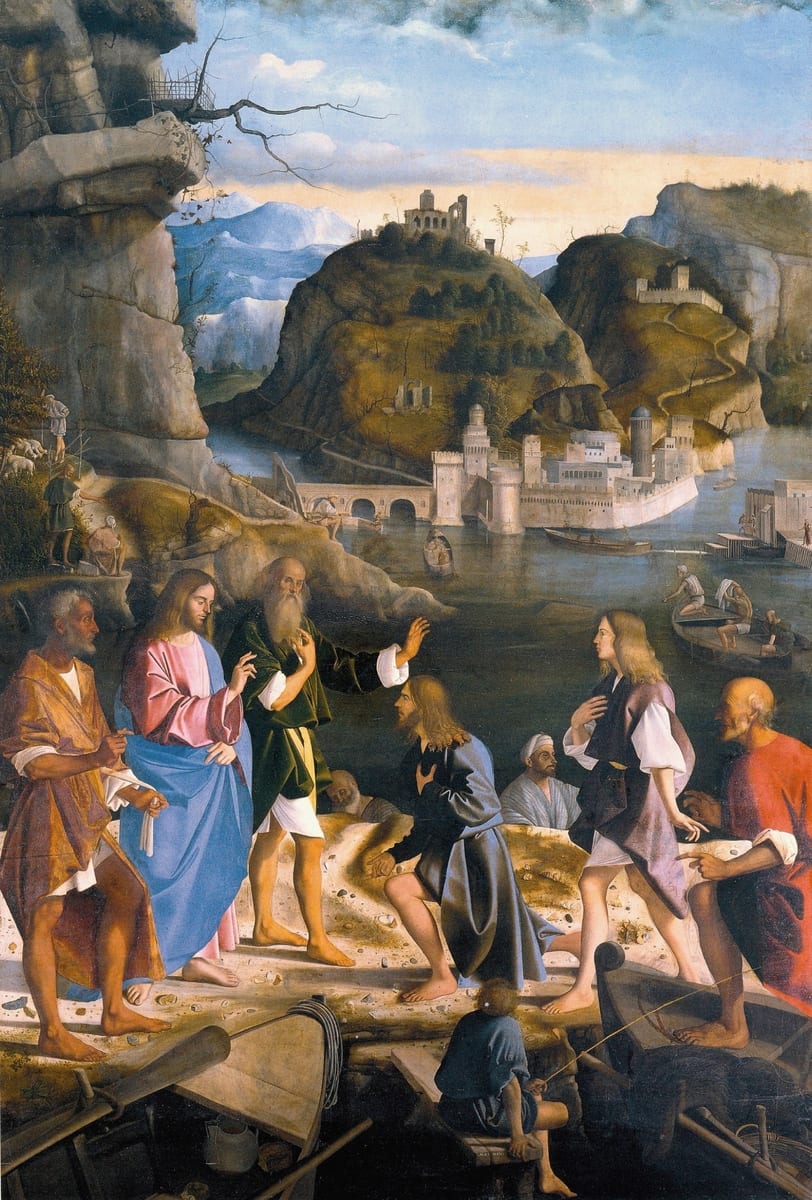
The Calling of the Sons of Zebedee (Vocazione dei figli di Zebedeo), Marco Basaiti, 1510 AD Marco Basaiti, Gallerie dell'Accademia, Venice Jesus was walking by the Sea of Galilee when he called St. Peter and St. Andrew. Farther on he saw St. James and his brother, St. John the Apostle, mending nets in their boat. He called them, and they left their father, Zebedee, in the boat with the hired men and followed him.
The Catholic Encyclopedia judges it entirely probable that the brothers had earlier been disciples of Saint John the Baptist for a time. By its account they went back to their fishing until Christ called them to follow him for good. Butler records that St. John the Apostle was held to be the youngest Apostle, about twenty-five when called.
-
Galilee and the road to Jerusalem
Sons of thunder
Jesus gives St. John the Apostle and his brother, St. James, the name sons of thunder when he appoints the Twelve.
Jesus chose St. James and St. John the Apostle among the Twelve and surnamed them *Boanerges* (*sons of thunder*). St. John the Apostle once stopped a stranger casting out demons in Jesus's name, and Jesus told him not to forbid the man. When a Samaritan village would not receive Jesus, the brothers offered to call down fire on it, and he turned and rebuked them.
On the road up to Jerusalem, the brothers asked for the seats at his right and left in his glory. Jesus asked whether they could drink the cup he would drink, and they answered that they could. Jesus said they would indeed drink his cup, but that the places at his right and left were not his to give.
“Lord, do you want us to bid fire come down from heaven and consume them?”
St. James and St. John the Apostle to Jesus, when a Samaritan village would not receive Jesus -
Galilee and Gethsemane
One of the three
Jesus takes St. Peter, St. James and St. John the Apostle into the house where a dead girl lies.
At the house of Jairus, a synagogue ruler whose daughter had died, Jesus let no one follow him in except St. Peter, St. James and St. John the Apostle. The three saw him raise the girl.
Later he took the same three up a high mountain and was transfigured before them, and Moses and Elijah appeared talking with him. Afterwards they saw no one with them but Jesus. In Gethsemane he took the three apart, began to be greatly distressed, and asked them to stay and keep watch.
-
Jerusalem, the Passion
At the supper and at the cross
The disciple who lay close to Jesus at supper stands by the cross and takes the Blessed Virgin Mary into his home.
At the Passover supper in Jerusalem, one disciple lay close to Jesus, and the Gospel calls him the disciple whom Jesus loved. The Church has always held that disciple to be St. John the Apostle. When Jesus said that one of them would betray him, St. Peter beckoned to St. John the Apostle, who asked Jesus who it was.
At the cross, St. John the Apostle stood near with the Blessed Virgin Mary. From the cross Jesus gave his mother to St. John the Apostle, and gave him to her as her son. From that hour St. John the Apostle took her into his own home.
“Behold, your mother!”
Christ to St. John the Apostle, from the cross -
Jerusalem and the Sea of Tiberias
The empty tomb and the shore
He outruns St. Peter to the empty tomb, and at the lake he recognises the risen Jesus.
On the first day of the week, St. Mary Magdalene ran to tell St. Peter and St. John the Apostle that the Lord had been taken from the tomb. The two ran, and St. John the Apostle reached the tomb first. He looked in at the linen cloths, then went in, and he saw and believed, though they did not yet know the scripture that Jesus must rise.
Later, after a night of empty nets on the Sea of Tiberias, the disciples cast again when a man on the shore told them to, and the net filled. St. John the Apostle recognised the risen Jesus on the shore, and he told St. Peter. Afterwards a saying spread among the disciples that St. John the Apostle would not die, though Jesus had never said so.
“It is the Lord!”
St. John the Apostle to St. Peter, recognising the risen Jesus on the shore when the net filled -
Jerusalem, the first years of the Church
A pillar in Jerusalem
With St. Peter he heals a lame man, faces the council, brings the Holy Spirit to Samaria and is counted a pillar of the Church.
St. Peter and St. John the Apostle were going up to the Temple at the hour of prayer, the ninth hour, when a man lame from birth asked them for alms. St. Peter took him by the right hand and raised him, and his feet and ankles grew strong. The Temple authorities jailed the two overnight for preaching the resurrection, then let them go with a warning.
The apostles later sent the pair to Samaria, where they laid hands on the new believers, who received the Holy Spirit. St. Paul counted St. John the Apostle among the reputed pillars of the Church at Jerusalem. The pillars gave St. Paul and St. Barnabas their right hands as partners in the work, and asked only that the two remember the poor.
“Whether it is right in the sight of God to listen to you rather than to God, you must judge; for we cannot but speak of what we have seen and heard.”
St. Peter and St. John the Apostle to the council, charged not to teach in the name of Jesus -
Patmos and Ephesus, the reign of Domitian and after
Exile on Patmos, home at Ephesus
Banished to an island, he sees the vision recorded in the Book of Revelation; at Ephesus he publishes his Gospel, and Tradition tells how he won back a young man who had become a robber.
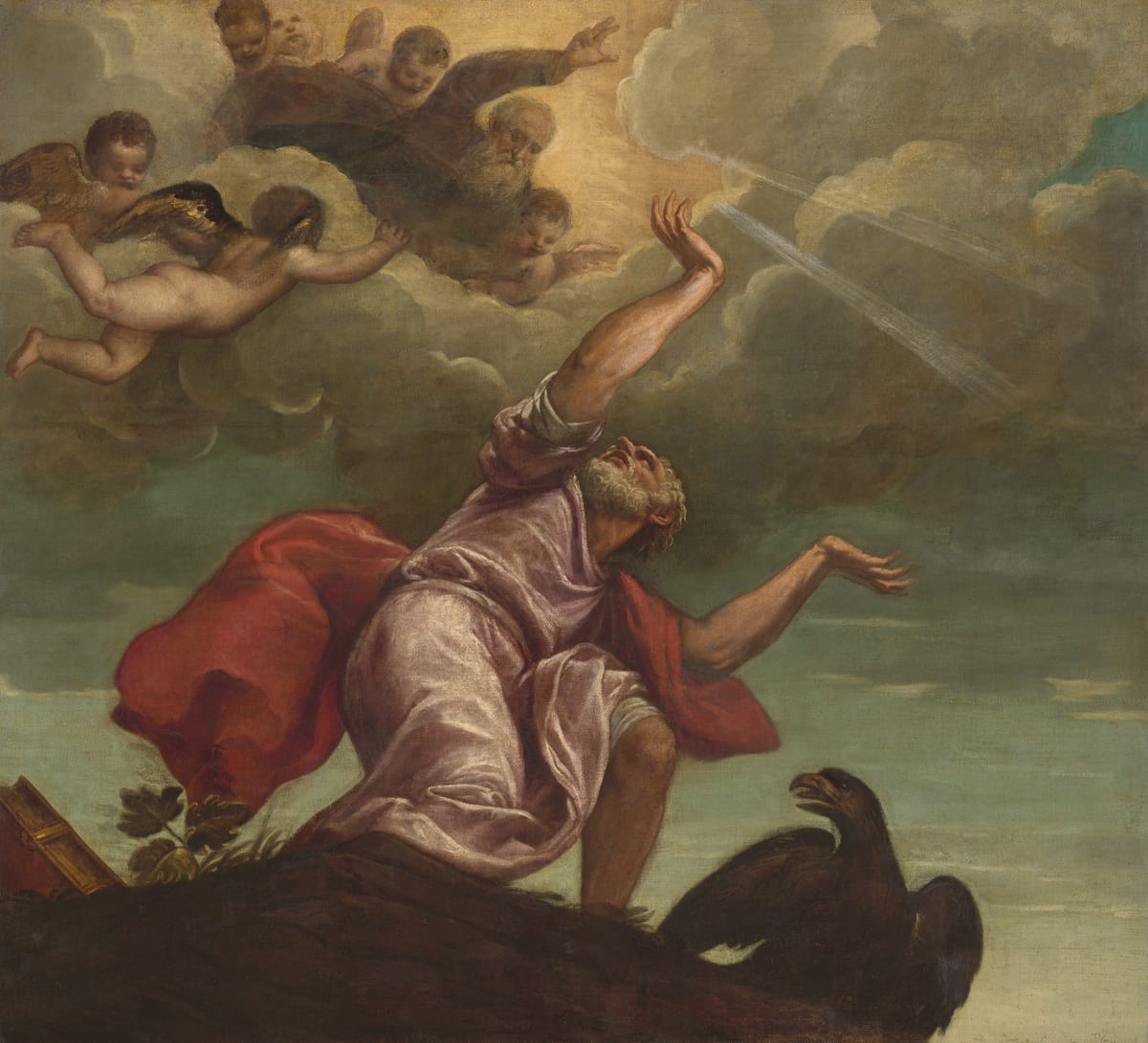
Saint John the Evangelist on Patmos, Titian and workshop, c. 1553–1555 AD Titian and workshop, National Gallery of Art, Washington About 200 AD, Tertullian wrote that at Rome, before his exile, St. John the Apostle had been plunged into boiling oil and came out unhurt. Under the emperor Domitian, St. John the Apostle was exiled to the island of Patmos for the word of God and the testimony of Jesus. There, on the Lord's day, he saw one like a son of man among seven golden lampstands and fell at his feet as though dead. He was told not to fear, and to write what he saw for seven churches of Asia, Ephesus among them.
St. Irenaeus wrote that St. John the Apostle published his Gospel while living at Ephesus. Polycrates, bishop of Ephesus late in the second century AD, wrote that St. John the Apostle had served as a priest and had worn a priest's gold plate on his forehead. Clement of Alexandria tells how St. John the Apostle, by then an old man, rode into the hills after a young convert who had become a robber chief, and brought him back to the Church.
“τί με φεύγεις, τέκνον, τὸν σαυτοῦ πατέρα, τὸν γυμνόν, τὸν γέροντα; ἐλέησόν με, τέκνον, μὴ φοβοῦ· ἔχεις ἔτι ζωῆς ἐλπίδας. ἐγὼ Χριστῷ λόγον δώσω ὑπὲρ σοῦ· ἂν δέῃ, τὸν σὸν θάνατον ἑκὼν ὑπομενῶ, ὡς ὁ κύριος τὸν ὑπὲρ ἡμῶν· ὑπὲρ σοῦ τὴν ψυχὴν ἀντιδώσω τὴν ἐμήν. στῆθι, πίστευσον· Χριστός με ἀπέστειλεν. (Why, my son, do you flee from me, your own father, unarmed, aged? Pity me, my son; fear not; you have still hope of life. I will give account to Christ for you. If need be, I will willingly endure your death as the Lord suffered death for us. For you will I give up my life. Stand, believe; Christ has sent me.)”
St. John the Apostle to the young robber captain, riding after him as he fled -
Ephesus, the reign of Trajan
Carried to the assembly at Ephesus
Tradition holds that St. John the Apostle, carried to the assembly at Ephesus in extreme old age, repeats one commandment.
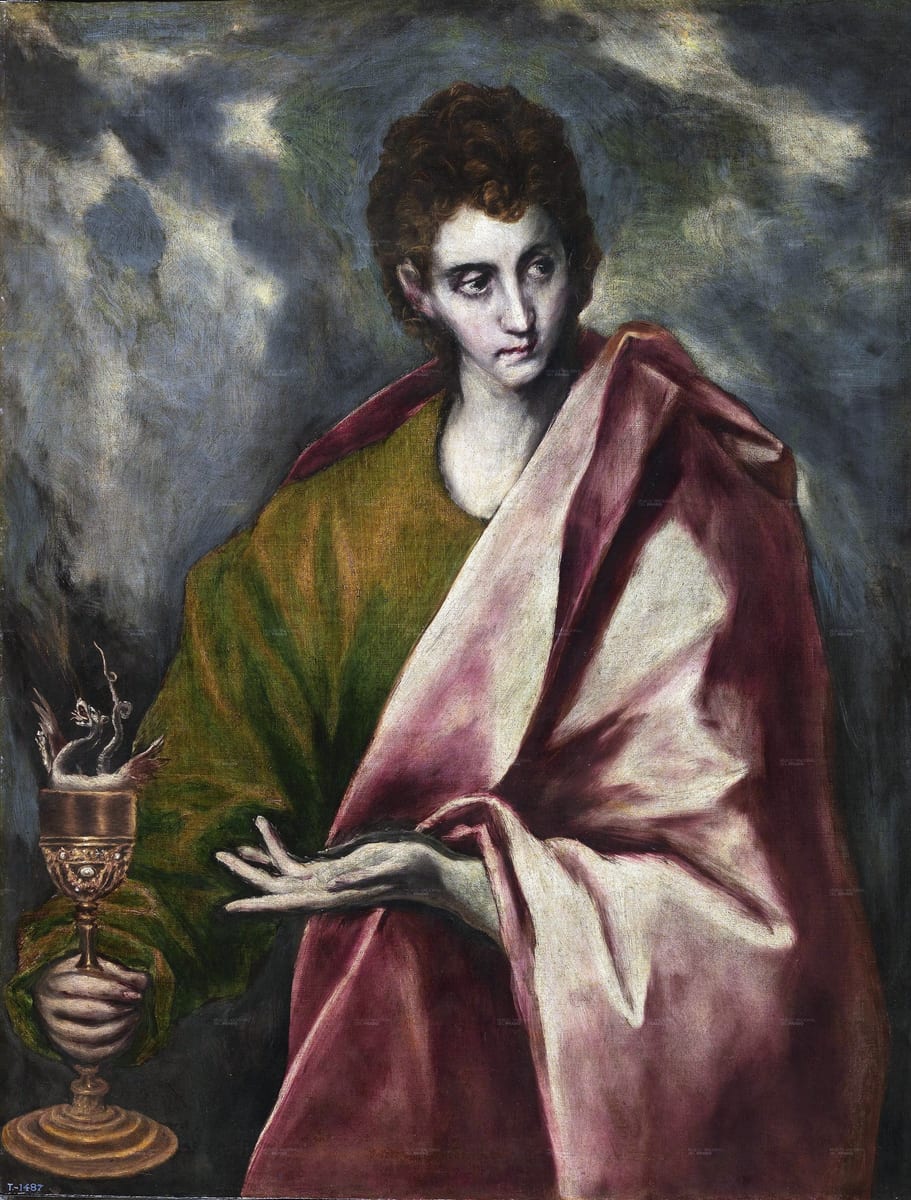
Saint John the Evangelist (San Juan Evangelista), El Greco and workshop, circa 1605 AD El Greco and workshop, Museo Nacional del Prado, Madrid St. Jerome writes that in extreme old age St. John the Apostle had to be carried to the gatherings at Ephesus, and said the same few words each time. When his disciples asked why he always said the same thing, he answered that it was the Lord's commandment, and that if this one thing were done, it would be enough.
St. John the Apostle died at Ephesus in great old age, in the reign of Trajan, and was buried near the city. In the sixth century AD the emperor Justinian replaced the small, ruined church over his tomb with a great basilica. The Church keeps his feast on December 27.
“Filioli, diligite alterutrum. (Little children, love one another)”
St. John the Apostle to the faithful at Ephesus, in extreme old age, carried into the assembly


Pray with the Church
Collect for the Feast of St. John, Apostle and Evangelist
The Roman Missal, Collect of the Mass of December 27
O God, who through the blessed Apostle John have unlocked for us the secrets of your Word, grant, we pray, that we may grasp with proper understanding what he has so marvelously brought to our ears.Through our Lord Jesus Christ, your Son, who lives and reigns with you in the unity of the Holy Spirit, God, for ever and ever.