Saints Doctor of the Church
Saint Irenaeus of Lyons
Feast 28 June · Born 135 AD, Asia Minor, probably Smyrna (modern İzmir), Turkey · Died 202 AD, Lyons (Lugdunum), France
A Greek from Asia Minor took charge of a church in Gaul that had just buried forty-eight of its own, and spent twenty-five years arguing for one faith and for peace.
Begin the life
In brief
Saint Irenaeus of Lyons, also called Irenaeus of Lyon, was born in Asia Minor about 135 AD, within living memory of the Apostles. He served as a priest of the Church of Lyons through the persecution of 177 AD and then governed that church as its bishop. In 2022 AD Pope Francis declared him a Doctor of the Church with the title *Doctor unitatis* (*Doctor of unity*).
-
about 135–155 AD
The boy who heard St. Polycarp
At Smyrna he sat under a bishop who had been taught by the Apostle John, and decades later he could still describe the place where St. Polycarp sat to teach.
Saint Polycarp, Bishop of Smyrna, had been taught by Apostles and appointed to his see by Apostles in Asia. St. Irenaeus attended his school as a boy. Writing to a man named Florinus decades later, he said he could still describe the place where St. Polycarp sat to speak, his manner of life and his face.
He remembered those years better than recent ones, he told Florinus. He had seen Florinus in those days too, in splendour at the royal court, trying to win the old bishop's approval.
“I remember the events of that time more clearly than those of recent years. For what boys learn, growing with their mind, becomes joined with it; so that I am able to describe the very place in which the blessed Polycarp sat as he discoursed, and his goings out and his comings in, and the manner of his life, and his physical appearance, and his discourses to the people, and the accounts which he gave of his intercourse with John and with the others who had seen the Lord.”
St. Irenaeus of Lyons to Florinus, in his letter, On Monarchy -
about 150 AD
Two bishops disagree at Rome and keep the peace
St. Polycarp and the Pope could not settle the day of Easter between them, so they settled everything else.
About 150 AD St. Polycarp travelled to Rome and took up with Pope Anicetus the day on which Easter should be kept. The churches of Asia kept it on the fourteenth day of the moon, on whatever day of the week that fell. Neither bishop persuaded the other.
They communed together anyway, and Pope Anicetus let St. Polycarp offer the Eucharist in the church as a mark of respect. They parted in peace. St. Irenaeus set the scene down forty years later, when the same question had grown dangerous.
-
177 AD
Forty-eight die at Lyons
A priest of the city was sent up the road to Rome with a letter while his people were being killed.
By 177 AD St. Irenaeus was a priest of the Church of Lyons in Gaul, a Greek living among Celts and using their language. That year the pagans of the city turned on the Christians, and forty-eight died under torture, among them Saint Blandina. Saint Pothinus, the bishop, was ninety; he was dragged before the judgment seat and died in prison two days later.
The Christians already in prison asked St. Irenaeus to carry their letter to Pope Eleutherus at Rome. The errand kept him out of the city while the killing went on.
“We pray, father Eleutherus, that you may rejoice in God in all things and always. We have requested our brother and comrade Irenæus to carry this letter to you, and we ask you to hold him in esteem, as zealous for the covenant of Christ.”
The martyrs of Lyons to Pope Eleutherus, in the letter they sent to Rome from prison in 177 AD -
177–180 AD
St. Irenaeus succeeds a martyred bishop
He came back from Rome to a see with a killed predecessor and a magician working the river valley.
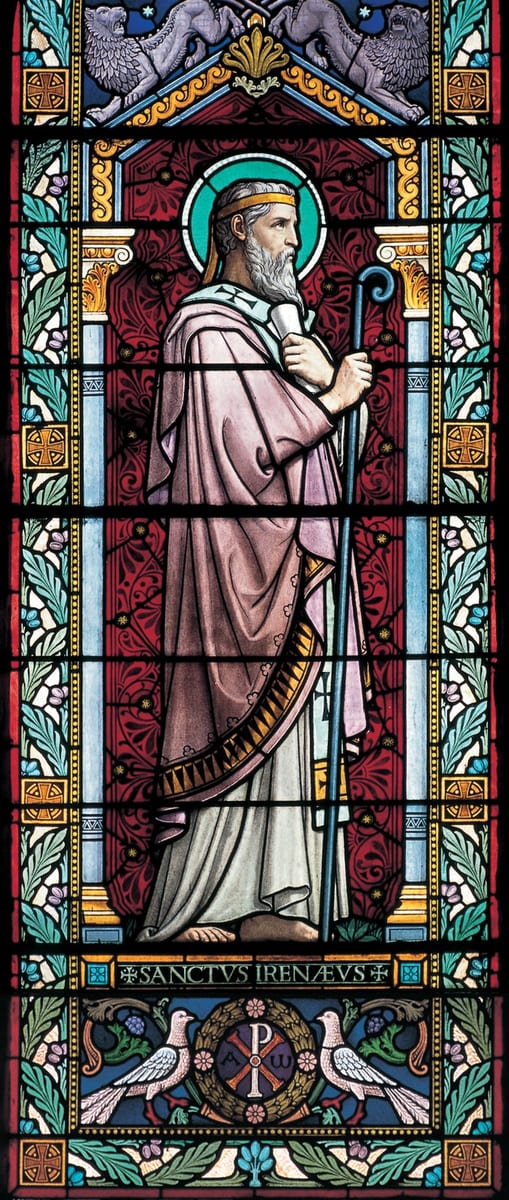
Vitrail de saint Irénée, église Saint-Irénée de Lyon, Lucien Bégule (1848–1935 AD), 1901 AD (window); photographed June 6, 2010 AD Lucien Bégule (1848–1935 AD), Église Saint-Irénée, Lyon (5e), France; photograph Gérald Gambier St. Pothinus was dead, and St. Irenaeus returned from Rome to succeed him as Bishop of Lyons. He held the see until about 202 AD. Lyons was then the only organised church in Gaul.
In his own district of the Rhone the followers of Marcus the magician had deluded many women. One of his deacons took Marcus into his house, and the deacon's wife was seduced. The brethren brought her back with great difficulty, and she spent her whole time afterwards in public confession.
-
about 180 AD
He writes against the teachers of a secret knowledge
He read their books and met them in person first, then answered them with an open list of names.
The teachers he fought held that the God who made the world was not the Father of Jesus Christ. They taught that the faith of the Church was a picture for simple people, and that they themselves had the real knowledge. St. Irenaeus read their commentaries and met some of them in person before he wrote a word against them.
He finished the first three books of his refutation about 180 AD. Against a knowledge handed on in secret he set an open succession: the bishops of Rome in order, from Linus down to Eleutherus, who then held the see. At the close of his book On the Ogdoad he put whoever should copy it on oath to correct the transcript against the original.
“Wherefore it is incumbent to obey the presbyters who are in the Church,—those who, as I have shown, possess the succession from the apostles; those who, together with the succession of the episcopate, have received the certain gift of truth, according to the good pleasure of the Father.”
St. Irenaeus of Lyons, teaching on apostolic succession in Against Heresies -
about 190 AD
Rome cuts off the churches of Asia over Easter
The bishop of a church that kept the Roman day wrote to Rome on behalf of the churches that did not.
About 190 AD Pope Victor wrote to cut the parishes of all Asia out of the common unity of the Church. Those churches kept Easter on the fourteenth day of the moon rather than on a Sunday. His letters declared the brethren there wholly excommunicate, shut out from communion with the rest of the Church.
The bishops of Gaul had already decided for the Sunday, and St. Irenaeus held with them. He wrote to Pope Victor all the same, and reproached him for cutting the Asians off so quickly. He named five bishops of Rome before Pope Victor who had not kept the Asian fast and had stayed at peace with those who did.
“And this variety in its observance has not originated in our time; but long before in that of our ancestors. It is likely that they did not hold to strict accuracy, and thus formed a custom for their posterity according to their own simplicity and peculiar mode. Yet all of these lived none the less in peace, and we also live in peace with one another; and the disagreement in regard to the fast confirms the agreement in the faith.”
St. Irenaeus of Lyons to Pope Victor, in his letter on the Easter question -
about 195 AD
A short book for a friend far away
He could not talk to Marcianus, so he sent him the whole faith in three points.
Parted from his friend Marcianus, St. Irenaeus wrote to him instead. He sent a short handbook of what a Christian must hold, the Demonstration of the Apostolic Preaching. It sets out the faith in three points: the Father who made all things, the Son who was incarnate and died and rose, and the Holy Spirit.
Pope Benedict XVI calls the book the oldest catechism of Christian doctrine. It later disappeared from the Greek and Latin world altogether. An Armenian manuscript of it was found in the Church of the Blessed Virgin at Eriwan in December 1904 AD.
“Knowing, my beloved Marcianus, your desire to walk in godliness, which alone leads man to life eternal, I rejoice with you and make my prayer that you may preserve your faith entire and so be pleasing to God who made you.”
St. Irenaeus of Lyons to Marcianus, opening the Demonstration of the Apostolic Preaching -
202–2022 AD
His ministry ends at Lyons
He was buried in the city he had governed for twenty-five years, and the Church gave him a title for what he did about Easter.
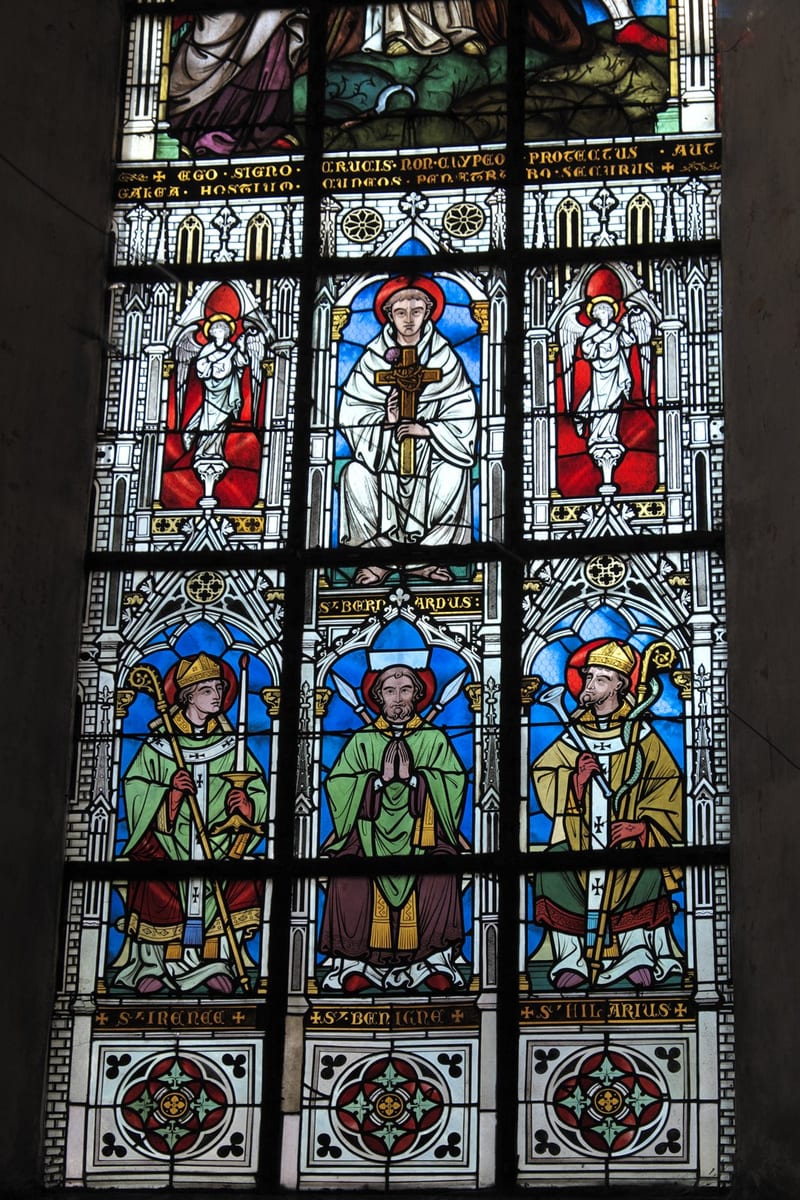
Vitrail: saint Bernard de Clairvaux, saint Irénée de Lyon, saint Bénigne de Dijon, saint Hilaire de Poitiers, Unknown glazier; photograph GFreihalter, Window undated on the file page (nineteenth-century glazing of the church); photographed April 20, 2018 AD Unknown glazier; photograph GFreihalter, Église Saint-Martin, Seurre, Côte-d'Or, France The ministry of St. Irenaeus at Lyons ended in about 202 AD. The Church keeps June 28 as the day of his burial there. According to longstanding Catholic Tradition he is venerated as a martyr.
His body lies in the crypt at Lyons that St. Patiens built at the end of the fifth century. On January 21, 2022 AD Pope Francis declared him a Doctor of the Church with the title *Doctor unitatis* (*Doctor of unity*). The decree of Pope Francis notes that he came from the East and exercised his episcopal ministry in the West.
“May the teaching of this great Master increasingly encourage the journey of all the Lord's disciples towards full communion.”
Pope Francis, in the decree conferring the title of Doctor of the Church


Pray with the Church
The Prayer of St. Irenaeus for Every Reader of His Book
St. Irenaeus broke off the argument in the third book of his refutation, about 180 AD, and prayed for everyone who would read it.
Wherefore I do also call upon thee, Lord God of Abraham, and God of Isaac, and God of Jacob and Israel, who art the Father of our Lord Jesus Christ, the God who, through the abundance of Thy mercy, hast had a favour towards us, that we should know Thee, who hast made heaven and earth, who rulest over all, who art the only and the true God, above whom there is none other God;grant, by our Lord Jesus Christ, the governing power of the Holy Spirit;give to every reader of this book to know Thee, that Thou art God alone, to be strengthened in Thee, and to avoid every heretical, and godless, and impious doctrine.
All 1 report on Saint Irenaeus of Lyons

About this picture
AI-generated image, in the manner of stained glass after Lucien Bégule's windows at Saint-Irénée, Lyons, from the paper's reference portrait based on San Ireneo, vitral (Lucien Bégule, 1901, Église Saint-Irénée, Lyon) View source artwork.
.jpg)