
Saints Bishop of Antioch and martyr · died c. 107 AD
Saint Ignatius of Antioch
Feast 17 October · Died 107 AD, Rome, Italy
A bishop of Antioch in the generation after the Apostles, he was condemned under the Emperor Trajan, wrote seven letters to the churches on the road to Rome, and died there by the wild beasts about 107 AD.
Begin the life
In brief
Saint Ignatius of Antioch was bishop of Antioch in Syria in the generation after the Apostles. Condemned to the wild beasts under the Emperor Trajan, he was taken in chains to Rome and wrote seven letters on the way, six to churches and one to St. Polycarp. In one of them St. Ignatius begged the Christians of Rome to do nothing to save him from the beasts.
-
c. 70–107 AD
Bishop of a great city
St. Ignatius leads the church of Antioch, one of the three great cities of the Roman Empire.
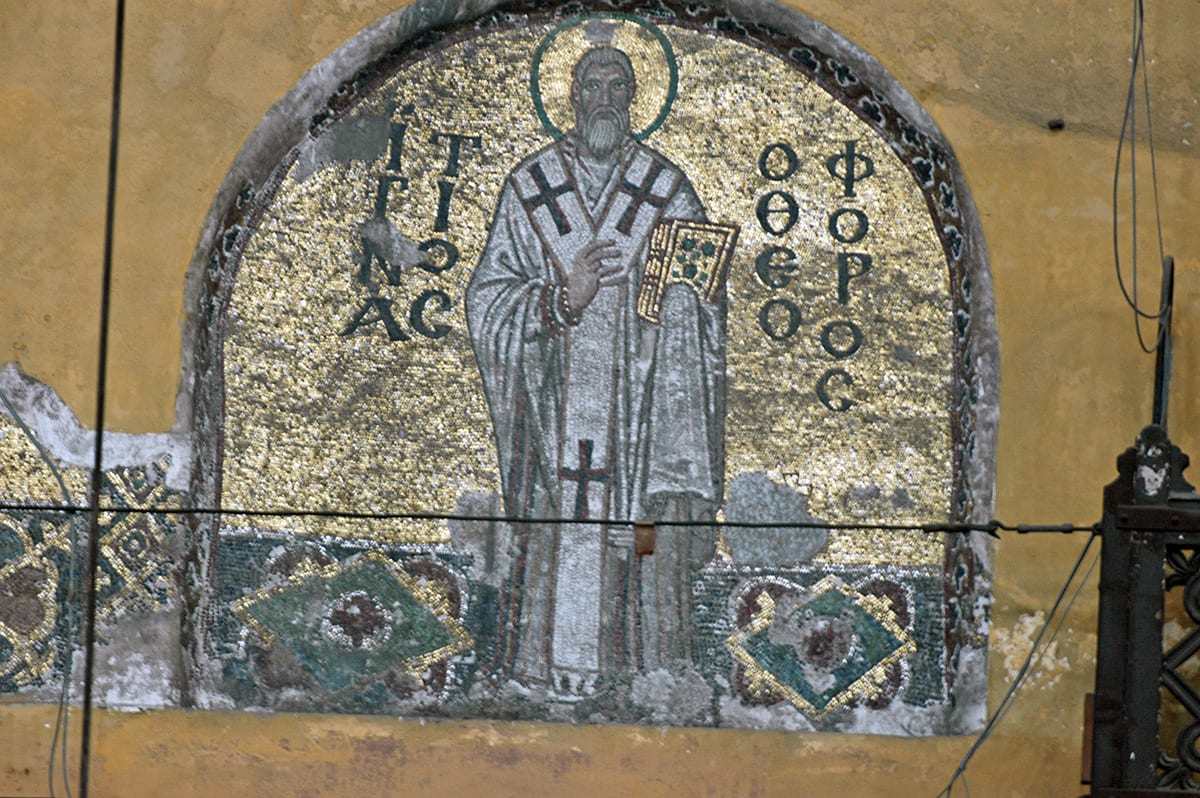
St. Ignatius Theophoros, mosaic in the north tympanum of Hagia Sophia, Istanbul, Byzantine mosaicists, 9th century Byzantine mosaicists, Hagia Sophia, Istanbul — north tympanum Antioch, where St. Ignatius was bishop, ranked with Rome and Alexandria as one of the three great cities of the Roman Empire. The city lies today in Turkey, at Antakya. He followed St. Evodius, whom St. Peter had consecrated as the city's first bishop.
Pope Benedict XVI dates his years as bishop from 70 AD to 107 AD. Saint John Chrysostom, preaching at Antioch, said St. Ignatius led the church there nobly and with great care. According to longstanding Catholic Tradition, St. Ignatius had been a disciple of Saint John the Apostle.
-
c. 107 AD
Before the emperor
Under the Emperor Trajan, St. Ignatius is condemned to the wild beasts and sent in chains to Rome.
Under the Emperor Trajan, a Christian who was accused could be put to death, though Christians were not to be hunted down. Catholic Tradition, in the Acts of his martyrdom, says Trajan stayed at Antioch while preparing war on the Parthians and ordered Christians to worship the gods or die. In that account St. Ignatius, afraid for his church, went before the emperor of his own will.
In the Acts, Trajan asks who Theophorus is, and St. Ignatius answers that it is the one who has Christ within his breast. Theophorus is the name he gives himself, after Ignatius, at the head of each of his letters. St. Ignatius was condemned to the wild beasts for his testimony to Christ and sent in chains from Syria to Rome. From the road he wrote that his church in Syria now had God for its shepherd instead of him.
“προσεύχεσθε ὑπὲρ τῆς ἐκκλησίας τῆς ἐν Συρίᾳ, ὅθεν δεδεμένος εἰς Ῥώμην ἀπάγομαι (Pray for the church which is in Syria, whence I am led a prisoner to Rome)”
St. Ignatius of Antioch to the church at Ephesus, closing his letter -
c. 107 AD
Under guard through Asia
Chained to ten soldiers, St. Ignatius is met by the churches and taken in at Smyrna by its bishop, Saint Polycarp.
St. Ignatius travelled by land and sea, night and day, chained to a squad of ten soldiers. He wrote that the more kindness the guards were shown, the worse they behaved. Churches came out to meet him, and even churches in cities off his route sent people ahead to meet him on the road.
At Smyrna, now İzmir, he was taken in by its bishop, Saint Polycarp, and the stay was a long one. The bishops of Ephesus, Magnesia and Tralles came to him there, and the Ephesians and St. Polycarp saw to all his needs. He asked the Ephesians to let their deacon Burrhus stay with him, and Burrhus travelled on with him to Troas.
“δεδεμένος δέκα λεοπάρδοις, ὅ ἐστιν στρατιωτικὸν τάγμα (being bound to ten leopards, I mean a band of soldiers)”
St. Ignatius of Antioch to the church at Rome, in his letter to the Romans, on the soldiers guarding him -
c. 107 AD
A letter to Rome
From Smyrna, St. Ignatius begs the Christians of Rome not to stop his death.
From Smyrna, St. Ignatius wrote to the Christians of Rome and begged them to do nothing to stop his martyrdom. He feared that their love for him would hold him back from dying for God.
He would not give the Romans orders as St. Peter and St. Paul had, he wrote, because St. Peter and St. Paul were Apostles and he was a condemned man. Men from the church of Ephesus carried this letter to Rome, and he dated it August 24. It was one of four letters he wrote at Smyrna, to Ephesus, Magnesia, Tralles and Rome.
“σῖτός εἰμι θεοῦ καὶ δι’ ὀδόντων θηρίων ἀλήθομαι, ἵνα καθαρὸς ἄρτος εὑρεθῶ τοῦ Χριστοῦ. (I am the wheat of God, and let me be ground by the teeth of the wild beasts, that I may be found the pure bread of Christ.)”
St. Ignatius of Antioch to the church at Rome, in his letter to the Romans, written at Smyrna -
c. 107 AD
Peace at Antioch
At Troas, St. Ignatius hears that his church is at peace and writes three more letters.
His guards took him on from Smyrna to Troas. There word reached him that the church of Antioch was at peace and had recovered its strength, and he gave the credit to the prayers of the churches. He asked the churches of Philadelphia and Smyrna, and St. Polycarp, to send envoys to Antioch to share its joy.
To the church of Smyrna he wrote that Christ was truly born, truly crucified and truly risen, against those who said He only seemed to suffer. Pope Benedict XVI says that in this letter St. Ignatius became the first Christian writer to call the Church catholic. Then an order came to sail at once for Neapolis, before he could write to every church.
“Χριστιανὸς ἑαυτοῦ ἐξουσίαν οὐκ ἔχει, ἀλλὰ θεῷ σχολάζει. (A Christian hath no authority over himself, but giveth his time to God.)”
St. Ignatius of Antioch to St. Polycarp, asking for an envoy to be sent to Syria -
c. 107 AD
Philippi, and the sea to Rome
The church at Philippi sends St. Ignatius on, and Catholic Tradition holds that a strong wind carries his ship to Rome.
At Philippi, in Macedonia, the Christians took in St. Ignatius and other men in chains and sent them on their way with an escort. St. Ignatius and the Philippians both wrote to St. Polycarp, asking that their letters be carried to Syria.
In Catholic Tradition, the Acts of his martyrdom say he hoped to land at Puteoli and follow in the steps of St. Paul. In the same account, a strong wind carried the ship past, and it reached the harbour of Rome as the public games were ending. The Acts say the Christians of Rome came out to meet him at Portus.
“I exhort you all therefore to be obedient unto the word of righteousness and to practice all endurance, which also ye saw with your own eyes in the blessed Ignatius and Zosimus and Rufus”
St. Polycarp to the Philippians, in St. Polycarp's letter -
c. 107 AD
Death in Rome
At Rome St. Ignatius is given to the wild beasts, and as Catholic Tradition tells it, his companions mourn him through the night.
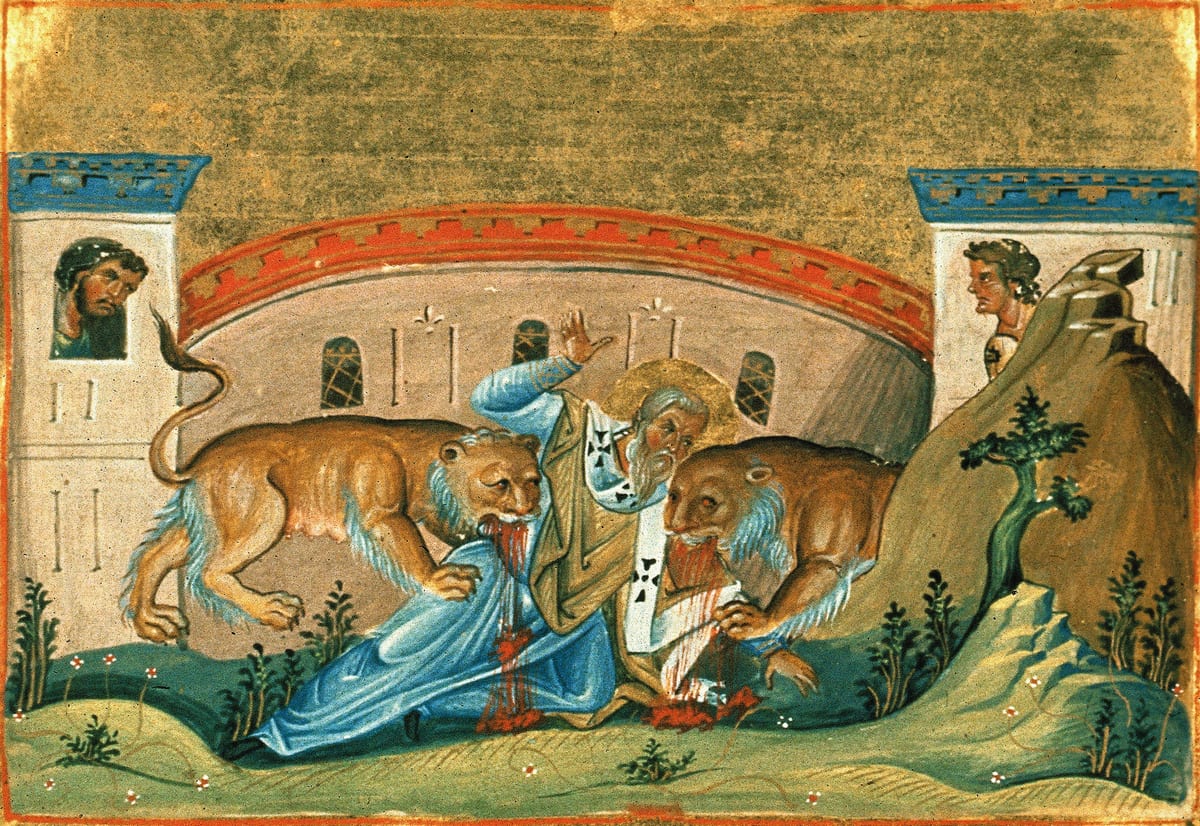
Martyrdom of St. Ignatius of Antioch, miniature from the Menologion of Basil II, Illuminators of the Menologion of Basil II, c. 985 AD Illuminators of the Menologion of Basil II, Vatican Library (Biblioteca Apostolica Vaticana) St. Ignatius died at Rome in the reign of Trajan, thrown to the wild beasts. St. John Chrysostom said it happened in the middle of the theatre, with the whole city seated above him as the beasts were let loose. According to longstanding Catholic Tradition, kept in the Roman Martyrology, he was given to the lions, whose teeth made of him a sacrifice to Christ.
As Catholic Tradition tells it in the Acts of his martyrdom, only the harder parts of his body were left, and they were wrapped in linen. The Acts say his companions spent the night after his death in tears and prayer. In the same account, some of them fell briefly asleep and saw St. Ignatius standing beside them and embracing them.
-
After c. 107 AD
Carried home
The remains of St. Ignatius go home to Antioch, and the Church keeps his words in her teaching.
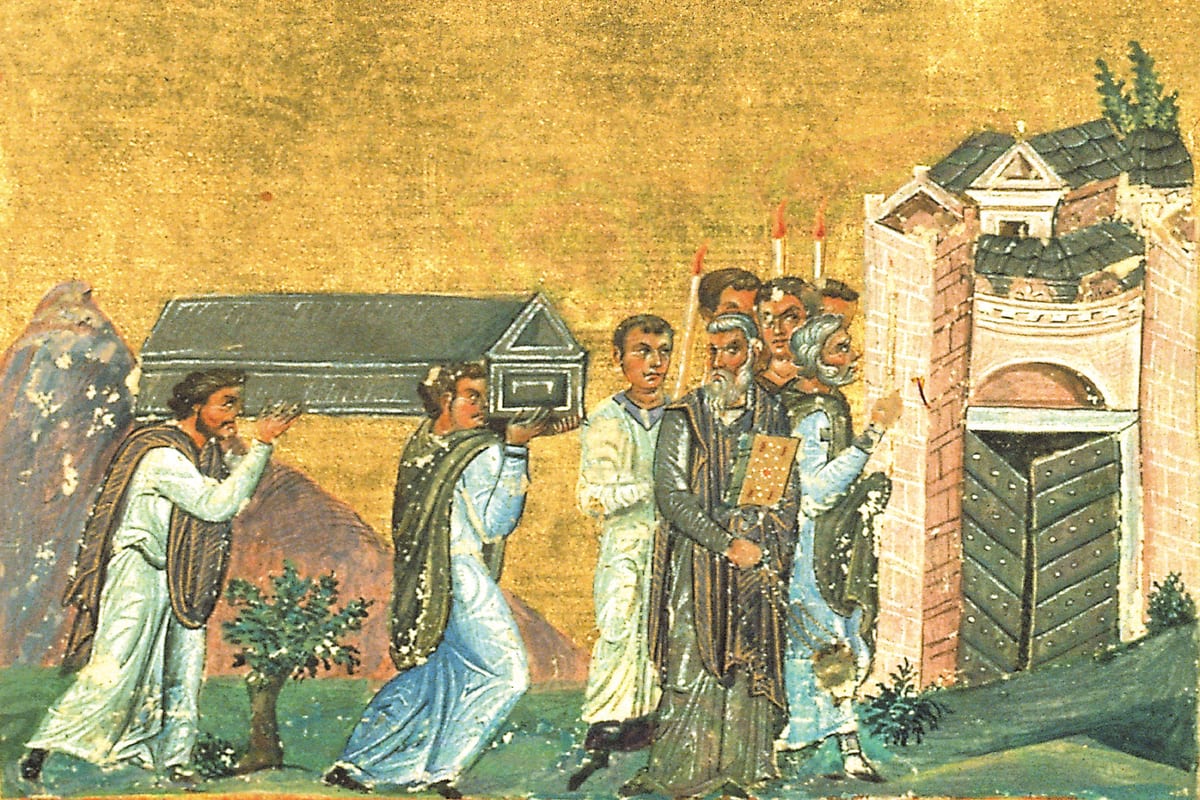
Translation of the relics of the hieromartyr Ignatius, miniature from the Menologion of Basil II, Illuminators of the Menologion of Basil II, c. 985 AD Illuminators of the Menologion of Basil II, Vatican Library (Biblioteca Apostolica Vaticana) Back at Smyrna, St. Polycarp gathered the letters of St. Ignatius and sent them to Philippi. He asked the Philippians to send him any sure news of St. Ignatius and the men with him. St. John Chrysostom said the cities along the road carried the remains of St. Ignatius on their shoulders back to Antioch.
His remains were laid in the cemetery outside Antioch's Daphne gate. Catholic Tradition holds that in 637 AD the relics were moved to the church of St. Clement in Rome. The Catechism of the Catholic Church quotes St. Ignatius on the Eucharist, on the bishop and on the Catholic Church.


.jpg)
Pray with the Church
His prayer at the sentence
Catholic Tradition gives these words to St. Ignatius on hearing Trajan's sentence at Antioch. They come from the Martyrdom of St. Ignatius, the Acts of his martyrdom, in the Ante-Nicene Fathers translation.
I thank you, O Lord, that You have vouchsafed to honour me with a perfect love towards You,and have made me to be bound with iron chains, like Your Apostle Paul .