
Saints Doctor of the Church · archbishop of Constantinople · died 407 AD
Saint John Chrysostom
Feast 13 September · Born 349 AD, Antioch, Roman Syria (modern Antakya, Turkey) · Died 407 AD, Comana in Pontus (near Tokat, Turkey)
He preached at Antioch for ten years, led the Church of Constantinople, and died under guard in a martyr's chapel at Comana in Pontus.
Begin the life
In brief
Saint John Chrysostom, also called John of Antioch, was born in Antioch, the capital of Roman Syria. He preached in his home city for ten years and then governed the Church of Constantinople as its bishop. After he took in monks driven out by the bishop of Alexandria, two councils deposed him, and he died under guard on the road to a more distant exile.
-
Born 345–349 AD
A widow's son
St. John Chrysostom's father dies while the boy is a baby, and his mother, widowed at twenty, spends her fortune on his future and sends him to the best schools of Antioch.
St. John Chrysostom's father, Secundus, a high-ranking officer of the Syrian army, died while his son was a baby. His mother, Anthusa, was left a widow at twenty with the baby and an elder daughter. She refused every offer of a second marriage, spent her own fortune and dowry on his future, and sent him to the best schools in Antioch.
His teacher of rhetoric was Libanius, the most famous pagan speaker of the age. When Libanius learned that Anthusa had stayed a widow for twenty years, he cried out in astonishment to the people around him. St. John Chrysostom left a promising career in the law for the study of Scripture, and St. Meletius, the bishop of Antioch, baptized him.
“Heavens! what women there are amongst the Christians.”
Chrysostom's pagan teacher (the sophist) to those present -
c. 370–374 AD
The friend taken instead
A mother's tears keep St. John Chrysostom at home, and when he and his closest friend are marked out as bishops, he hides and lets the friend go alone.
St. John Chrysostom's closest friend, Basil, who had studied under the same teachers, urged him to leave home so the two could live together as monks. When his mother saw what he was planning, she took him into her room, sat on the bed where she had given birth to him, and wept. He stayed in Antioch while she lived.
About 374 AD the two friends heard that both were to be made bishops, though neither had reached the required age of thirty. When the ordaining bishop arrived, St. John Chrysostom hid. Basil, who believed his friend had promised to be ordained with him, was taken away on a pretext and made a bishop. St. John Chrysostom later defended the deception in six books On the Priesthood, written as a dialogue with Basil.
“My child, it was not the will of Heaven that I should long enjoy the benefit of thy father's virtue.”
Anthusa to St. John Chrysostom, pleading with him not to leave her for monastic life -
c. 374–386 AD
The mountain
St. John Chrysostom lives among the hermits until cold and fasting break his health and force him back to Antioch, where years later he is ordained a priest.
After his mother's death St. John Chrysostom went up to the hermits in the mountains south of Antioch. He spent four years under an old man named Syrus, then two alone in a cave, going without sleep for most of them. Frost and fasting wrecked his health, and he came back to Antioch because he could no longer look after himself.
He served as a deacon, and in 386 AD St. Flavian, bishop of Antioch, ordained him priest. St. Flavian made St. John Chrysostom one of the most frequent preachers in the city's churches.
“I know my own soul, how feeble and puny it is: I know the magnitude of this ministry, and the great difficulty of the work; for more stormy billows vex the soul of the priest than the gales which disturb the sea.”
St. John Chrysostom to Basil, dialogue On the Priesthood -
387 AD
The year of the statues
A tax riot leaves Antioch waiting for the emperor's sentence, and its new priest preaches to the city almost every day.
Shortly before Lent in 387 AD, a crowd angry at a new tax dragged the statues of the Emperor Theodosius and his late wife through the streets. Magistrates put citizens to death by sword and fire, children among them. The emperor took away Antioch's privileges and gave its standing to its old rival, Laodicea.
St. Flavian set out in winter to plead with the emperor, though his sister was dying. While the city waited to hear whether it would be destroyed, St. John Chrysostom preached almost every day for twenty-two days to calm it and call it to repentance. St. Flavian came home on Easter Day with the emperor's pardon.
“Blessed be God, Who has granted us this day to celebrate this holy Feast with much joy and gladness; and has restored the head to the body, the shepherd to the sheep, the master to the disciples, the general to the soldiers, the High Priest to the Priests!”
St. John Chrysostom to the congregation of Antioch, homily celebrating Bishop Flavian's return -
398–402 AD
Taken to the capital
The people of Antioch seem ready to risk anything to keep their preacher, but the emperor has him sent to Constantinople, where he is consecrated bishop.
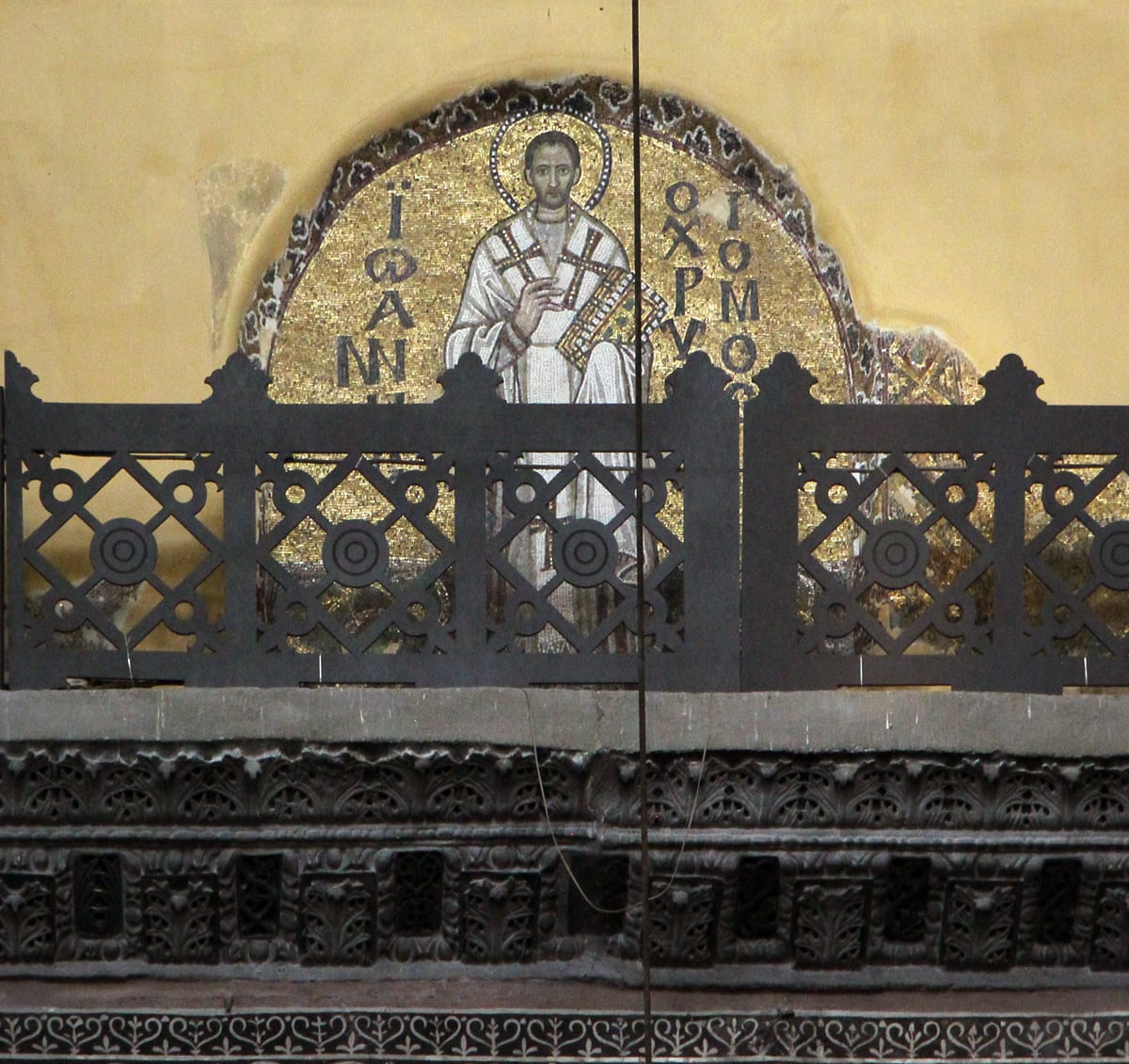
Hagia Sophia, interior, nave, tondi in the north tympanum with holy patriarchs, 9th century: 02 John Chrysostom, Anonymous Byzantine mosaicist (photograph by Francesco Bini, 'Sailko'), mosaic 9th century, set in the 880s AD under Basil I; photograph September 17, 2022 AD Anonymous Byzantine mosaicist (photograph by Francesco Bini, 'Sailko'), Hagia Sophia, Istanbul (formerly the Great Church of Constantinople) The people of Antioch seemed ready to risk anything to keep him, so the Emperor Arcadius had the Count of the East send him to Constantinople. He was consecrated bishop of Constantinople in February 398 AD. He founded hospitals and put two priests in charge of them, with physicians under them.
At Ephesus in 401 AD he deposed six bishops who had paid for their appointments. He also took in some fifty Egyptian monks whom Theophilus, the bishop of Alexandria, had driven out in a quarrel over the writings of Origen. When the monks brought charges against Theophilus, the emperor summoned him to answer them before a synod with St. John Chrysostom presiding.
“The needy person belongs to God, whether he is pagan or Jewish. He deserves help even if he does not believe.”
St. John Chrysostom to his congregation, preaching in Constantinople on the Letter -
403 AD
The Oak
The bishop of Alexandria, summoned to stand trial, holds his own court across the water and deposes the bishop of Constantinople.
Theophilus came to Constantinople in June 403 AD with twenty-nine bishops under his authority, money and gifts. Instead of standing trial, he held his own synod of thirty-six bishops at a villa called the Oak, on the far shore of the Bosphorus.
St. John Chrysostom refused to appear before a court made up of his accusers, and it declared him deposed. On the third day after the verdict he gave himself up to the waiting soldiers, to spare the city bloodshed. The angry crowds frightened the Empress Eudoxia, wife of the Emperor Arcadius, and so did a night of terror inside the palace; within days she recalled him.
“How can you judge me with any show of order, when you have not put forth from among you my enemies, and when you send my own clergy to summon me?”
St. John Chrysostom to the synod of The Oak, objecting to the process against him -
403–404 AD
Banished
St. John Chrysostom protests when the noisy dedication of the empress's silver statue disturbs the liturgy, and the city prefect reports his protest to the empress.
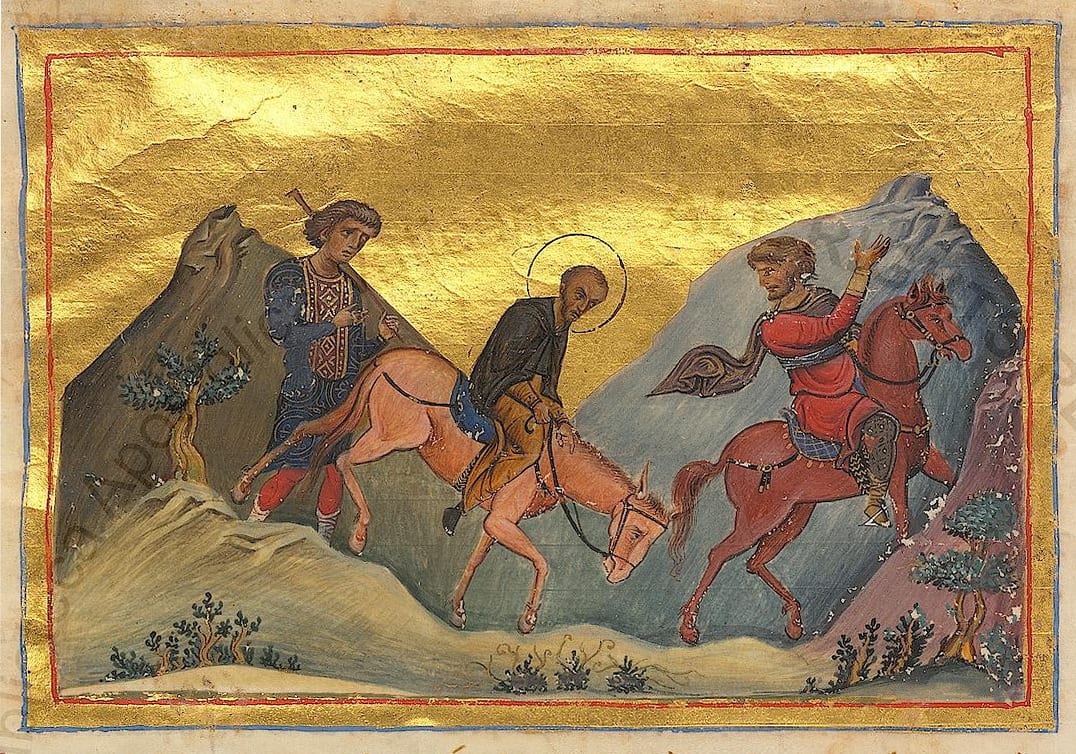
John Chrysostom sent into exile, Menologion of Basil II, Pantoleon, with Georgios, Michael the Younger, Michael of Blachernae, Symeon, Symeon of Blachernae, Menas and Nestor, c. 985 AD Pantoleon, with Georgios, Michael the Younger, Michael of Blachernae, Symeon, Symeon of Blachernae, Menas and Nestor, Biblioteca Apostolica Vaticana, MS Vat. gr. 1613 AD, p. 178 Men, women and children came out with lighted candles to bring him back into the city. Two months later a silver statue of the Empress Eudoxia was set up before his cathedral, and its noisy dedication disturbed the services. He protested, and the protest was reported to the palace as an attack on the empress.
At the end of 403 AD a second council confirmed his deposition and charged him with returning to his church without a synod restoring him. On the night before Easter 404 AD, soldiers broke into the baptistery and scattered the congregation as hundreds were being baptized. In June the Emperor Arcadius signed the order banishing him, and he never saw his church again.
“I have received this Church, from God our Saviour, for the care of the salvation of the people, and I cannot desert it; if, then, this is your will----for the city is yours----thrust me out by force, that I may plead your authority in defence of my desertion of my post.”
St. John Chrysostom to the king, refusal to abandon his post voluntarily -
407–438 AD
The road to Comana
Guards march the exiled bishop toward the Black Sea until he can go no farther.
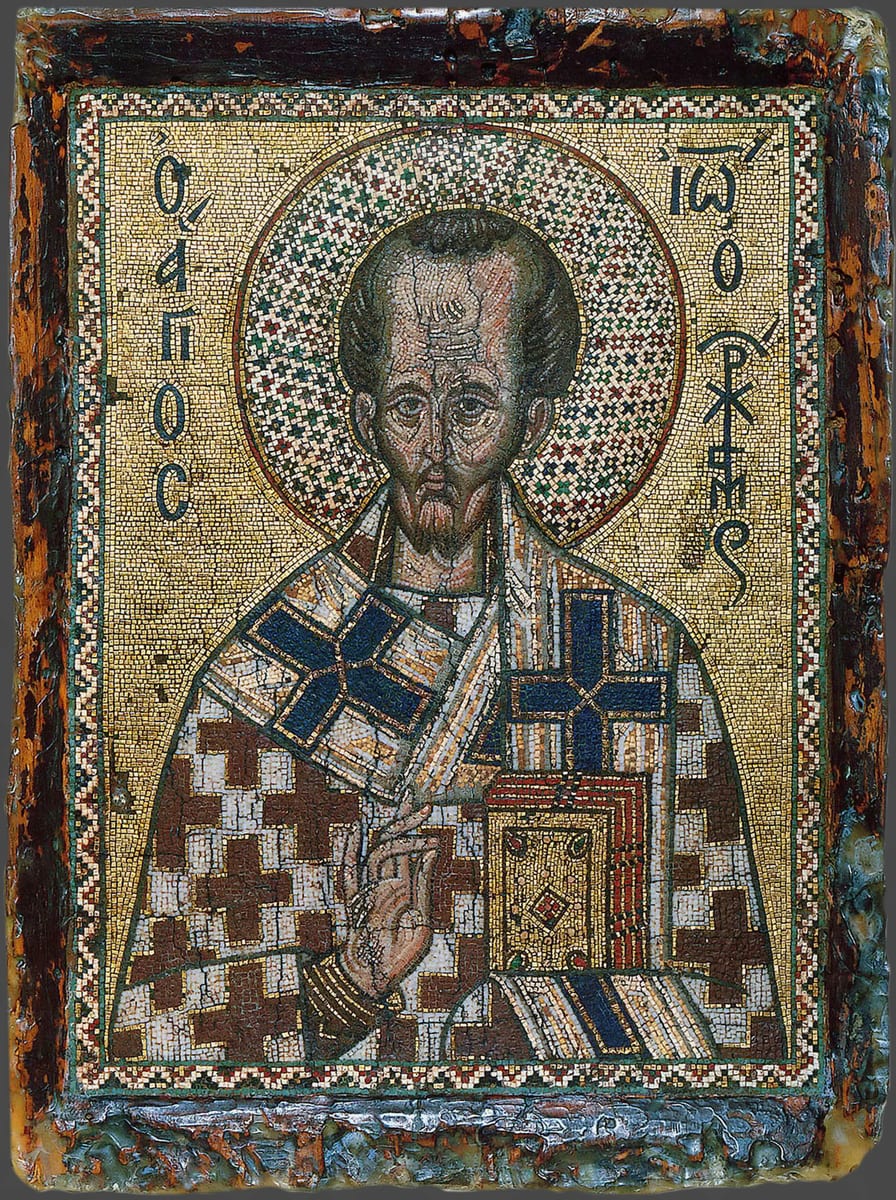
St. John Chrysostom, micromosaic icon, Anonymous Greek workshop, 14th century Anonymous Greek workshop, Vatopedi Monastery, Mount Athos; smalt micromosaic, 13 x 18 cm In 407 AD bishops in Syria, angry that his influence had grown in exile, obtained an order to march him on foot to Pithyus, on the Black Sea. One of his two guards hurried him through rain and hot sun for three months, hoping for promotion if he died on the road. According to longstanding Catholic Tradition, when the party lodged at the chapel of the martyr St. Basiliscus outside Comana, the martyr appeared to him and said the two would be together the next day.
In the morning he begged to rest there until eleven, but the guards marched on, and he fell so ill that they had to turn back to the chapel. There he put on white clothes, gave away his own, received the Eucharist, prayed a last time and died on September 14, 407 AD. Thirty-one years later his body was carried back into Constantinople and laid with the emperors and patriarchs beneath the altar of the Holy Apostles.
“Glory be to God for all things, Amen.”
St. John Chrysostom, last words before death


.jpg)

Pray with the Church
A Prayer of Saint John Chrysostom
The closing prayer of the twelfth of the Homilies on the Statues, preached at Antioch in the Lent of 387 AD, in the translation printed in the Nicene and Post-Nicene Fathers.
O God, Who willest not the death of a sinner, but that he should be converted and live;grant that we, having discharged this and every other precept, may be found worthy so to stand at the tribunal of Thy Christ, that having enjoyed great boldness, we may attain the kingdom to Thy glory.For to Thee belongeth glory, together with Thine only begotten Son, and the Holy Ghost, now and ever, and world without end.
All 8 reports on Saint John Chrysostom

About this picture
AI-generated image, in the manner of a Byzantine mosaic of glass and stone tesserae, from the paper's reference portrait based on St. John Chrysostom, micromosaic icon (Anonymous Greek workshop, 14th century, Vatopedi Monastery, Mount Athos) View source artwork.
Empress Eudoxia dies, and exiled St. John Chrysostom is not called back

About this picture
AI-generated image, in the manner of Byzantine wall mosaic, from the paper's reference portrait based on John Chrysostom, marginal miniature in the Chludov Psalter (Anonymous Byzantine illuminator, middle of the 9th century, the Chludov Psalter) View source artwork.

St. John Chrysostom answers his critics with his widowed mother's speech

St. John Chrysostom protests the noise at the empress's new silver statue

About this picture
AI-generated image, in the manner of a Byzantine mosaic of glass and stone tesserae, from the paper's reference portrait based on St. John Chrysostom, micromosaic icon (Anonymous Greek workshop, 14th century, Vatopedi Monastery, Mount Athos) View source artwork.
Refused a morning's rest, St. John Chrysostom dies outside Comana

About this picture
AI-generated image, in the manner of Byzantine glass and stone wall mosaic, from the paper's reference portrait based on St. John Chrysostom, micromosaic icon (Anonymous Greek workshop, 14th century, Vatopedi Monastery, Mount Athos) View source artwork.
A martyr tells St. John Chrysostom the march is over

About this picture
AI-generated image, in the manner of a Byzantine mosaic of glass and stone tesserae, from the paper's reference portrait based on St. John Chrysostom, micromosaic icon (Anonymous Greek workshop, 14th century, Vatopedi Monastery, Mount Athos) View source artwork.
Exiled St. John Chrysostom sends a book to a woman facing prosecution

About this picture
AI-generated image, in the manner of a Byzantine wall mosaic of glass and stone tesserae, from the paper's reference portrait based on Portrait of Saint John Chrysostom of Antioch (Hagios Ioannis Chrysostomos), Hagia Sophia (Anonymous Byzantine mosaicist, 9th century, Hagia Sophia, Istanbul) View source artwork.

Saint John Chrysostom preaches daily while Antioch waits for the emperor's sentence

About this picture
AI-generated image, in the manner of a Byzantine wall mosaic of glass and stone tesserae, from the paper's reference portrait based on John Chrysostom, marginal miniature in the Chludov Psalter (Anonymous Byzantine illuminator, middle of the 9th century, The Chludov Psalter; the holding institution is not named on the source page). View source artwork.