Saints Mother of God · Feast of the Holy Rosary, October 7
Our Lady of the Rosary
Feast 7 October
The Blessed Virgin Mary said yes to an angel at Nazareth, stood at her Son's cross, prayed with his apostles for the Spirit, and was taken up body and soul into heavenly glory.
Begin the life
In brief
Our Lady of the Rosary, also called the Queen of the Most Holy Rosary, is the Blessed Virgin Mary as she is honoured in the Rosary. In that prayer the Hail Mary is said in tens, with the Lord's Prayer at each ten, while the one praying recalls the joyful, luminous, sorrowful and glorious mysteries of her Son's life and hers. Pope Paul VI wrote in Marialis Cultus that the Rosary asks for a quiet, lingering pace, so that the one praying meditates on the mysteries of the Lord's life through the eyes of the woman who was closest to him. Her feast on October 7 keeps the day Pope Saint Pius V set aside in thanks to Our Lady of Victory after a Christian fleet defeated the Turkish fleet off Lepanto in 1571 AD.
-
The Joyful Mysteries · Annunciation and Visitation
An angel at Nazareth
Our Lady asks the angel how she can bear a son, gives her consent and hurries to her relative in the hill country.
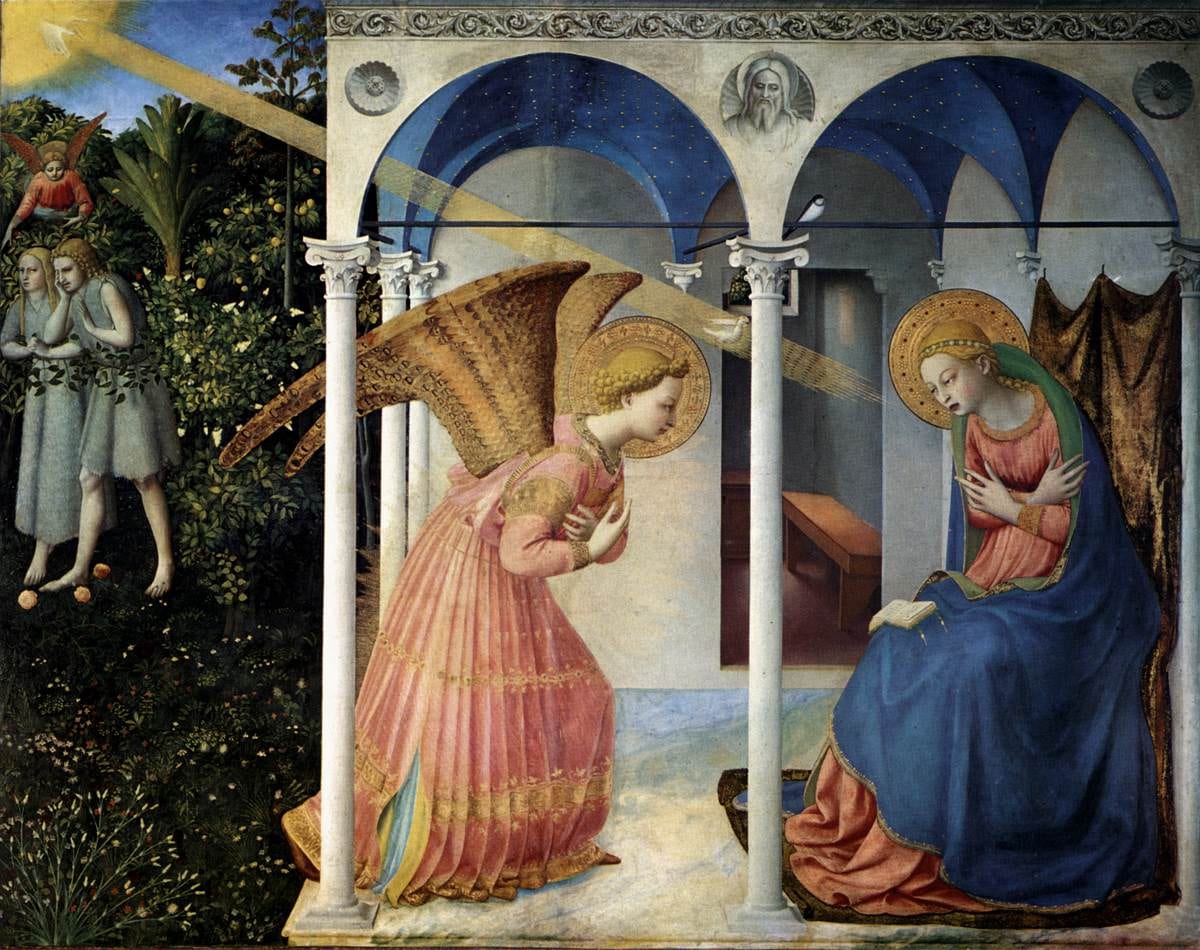
The Annunciation, Fra Angelico, 1430–1432 AD Fra Angelico, Museo del Prado, Madrid At Nazareth, Saint Gabriel the Archangel greeted Our Lady as full of grace, and she was deeply troubled, wondering what kind of greeting it was. He told her not to be afraid, for she had found favour with God, and that she would bear a son and name him Jesus, and when she asked how, since she had no husband, he said the Holy Spirit would come upon her. Our Lady gave her consent.
The angel had told her that her relative Saint Elizabeth, who had conceived a son in her old age, was in her sixth month, and Our Lady set out in haste for the hill country of Judah. At the sound of her voice the child in St. Elizabeth's womb leapt for joy, and St. Elizabeth called her the mother of her Lord. Our Lady answered with a hymn of praise to God and stayed about three months.
“Behold, I am the handmaid of the Lord; let it be to me according to your word.”
Our Lady of the Rosary to the angel Gabriel, her consent at the Annunciation, in Nazareth -
The Joyful Mysteries · Nativity, Presentation and Finding in the Temple
A manger, a prophecy and a lost boy
Our Lady gives birth in Bethlehem, hears of a sword in the Temple, and searches three days for her twelve-year-old Son.
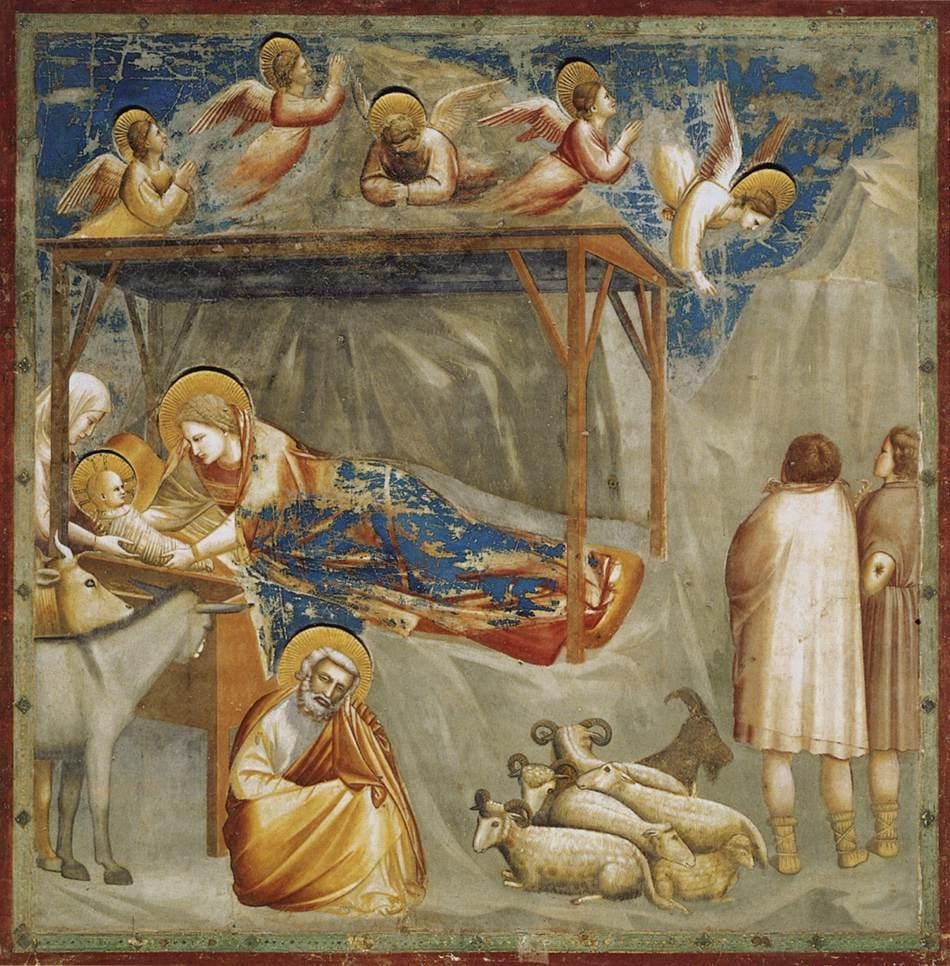
The Nativity (Scenes from the Life of Christ, no. 17), Giotto, 1304–1306 AD Giotto, Scrovegni Chapel, Padua Saint Joseph went up to Bethlehem to be enrolled, because he was of the house of David, and Our Lady, who was with child, went with him. She gave birth to her Son there and laid him in a manger, and shepherds came at an angel's word. At the time of her purification she and St. Joseph presented him in the Temple, where Saint Simeon, a devout man promised by the Holy Spirit that he would see the Lord's Christ before he died, told her a sword would pierce her heart.
When he was twelve, she and St. Joseph lost him on the road home from Jerusalem, and after three days of searching they found him in the Temple. When she asked him why he had treated them so, he answered that he had to be in his Father's house, and they did not understand what he meant. Pope Saint John Paul II wrote that the memories she kept in her heart were, in a way, the rosary she prayed throughout her earthly life.
“Son, why have you treated us so? Behold, your father and I have been looking for you anxiously.”
Our Lady of the Rosary to the twelve-year-old Jesus, on finding him in the Temple after three days' search -
The Luminous Mysteries · Baptism in the Jordan and the Wedding at Cana
The wine runs out at Cana
Our Lady's Son is baptised in the Jordan, and at a wedding she tells him the wine is gone.
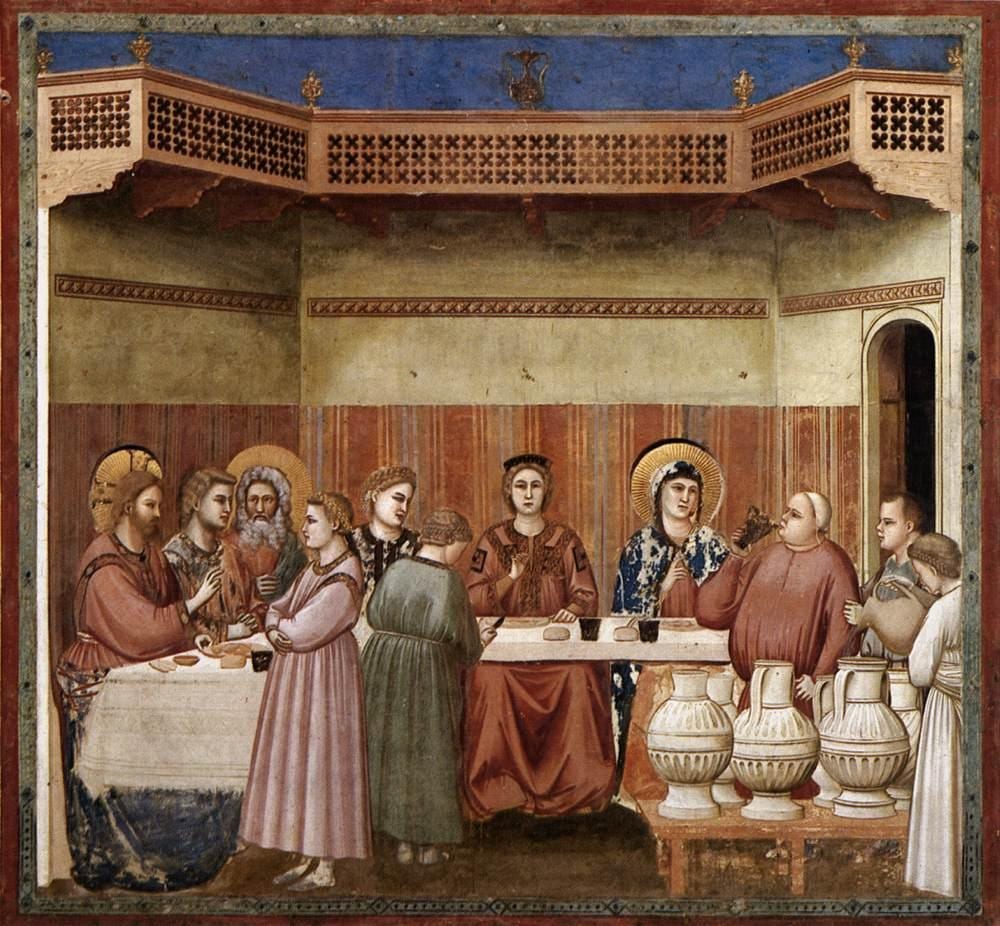
The Marriage at Cana (Scenes from the Life of Christ, no. 24), Giotto, 1304–1306 AD Giotto, Scrovegni Chapel, Padua Saint John the Baptist baptised her Son in the Jordan. Our Lady was a guest at a wedding in Cana of Galilee, and her Son and his disciples were invited too. When the wine ran out she told her Son, and he answered that his hour had not yet come.
Then she told the servants to do whatever he told them. Pope St. John Paul II wrote in Rosarium Virginis Mariae that Cana shows her as a teacher, urging the servants to do what Jesus commands. The water in six stone jars became wine, the first of his signs, and his disciples believed in him.
“Do whatever he tells you.”
Our Lady of the Rosary to the servants, at the wedding at Cana -
The Luminous Mysteries · Proclamation of the Kingdom, Transfiguration and Institution of the Eucharist
Hearing her Son preach
Our Lady hears her Son preach in Galilee, and he is transfigured on a mountain and gives the apostles the Eucharist.
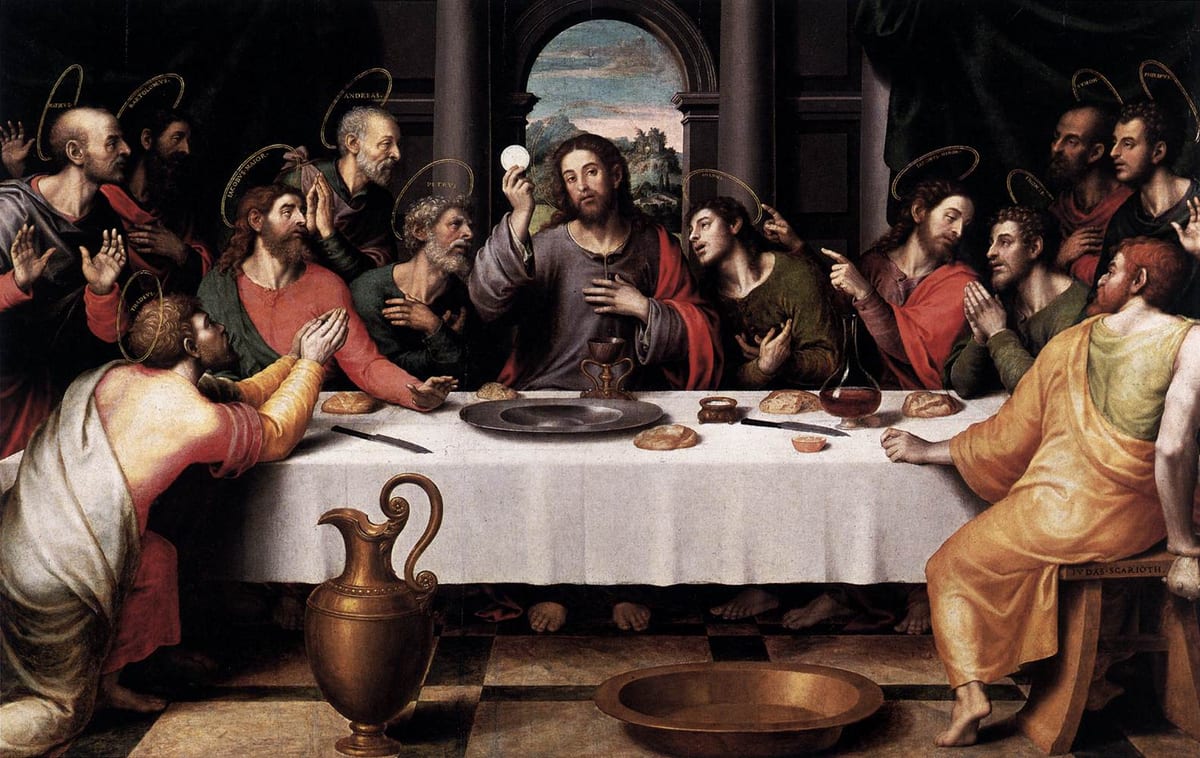
The Last Supper, Juan de Juanes, c. 1562 AD Juan de Juanes, Museo del Prado, Madrid Her Son went into Galilee preaching the gospel of God, and the Second Vatican Council teaches that during his preaching she heard him call blessed those who hear the word of God and keep it, as she was doing.
On a mountain, Moses and Elijah appeared talking with him before Saints Peter, James and John. At the Passover supper in Jerusalem he instituted the Eucharist, taking the cup, giving thanks and sharing it among the apostles. Saint Bartolo Longo, founder of the Shrine of Pompeii, wrote that the Eucharist is the living Rosary and that all the mysteries are found in the Holy Sacrament.
-
The Sorrowful Mysteries · Agony in the Garden, Scourging and Crowning with Thorns
The night of the arrest
Our Lady's Son prays in anguish, is betrayed and condemned, and is scourged and crowned with thorns.
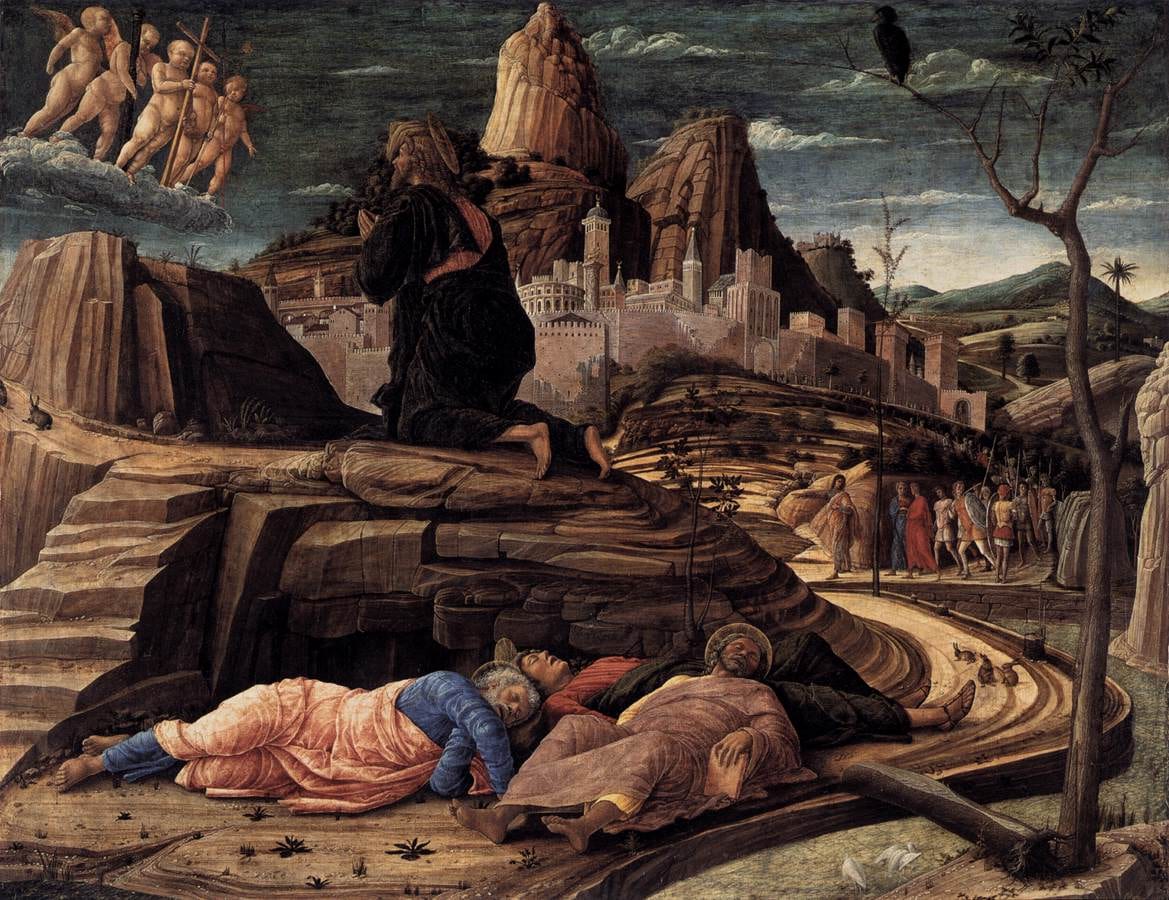
The Agony in the Garden, Andrea Mantegna, c. from 1455 AD until 1456 AD Andrea Mantegna, National Gallery, London After the Passover supper Our Lady's Son prayed in anguish on the Mount of Olives. Judas betrayed him there with a kiss, and all the disciples ran away. In the morning Pilate released Barabbas and handed Jesus over to be crucified.
Her Son was scourged, and the soldiers crowned him with thorns, dressed him in purple and mocked him as a king. Pope Leo XIII wrote that in the scourging and the crowning with thorns, those who pray the Rosary also reflect on his Mother's grief.
-
The Sorrowful Mysteries · Carrying of the Cross and Crucifixion
Standing by the cross
Our Lady stands at Golgotha while her Son dies, and he gives her the beloved disciple as her son.
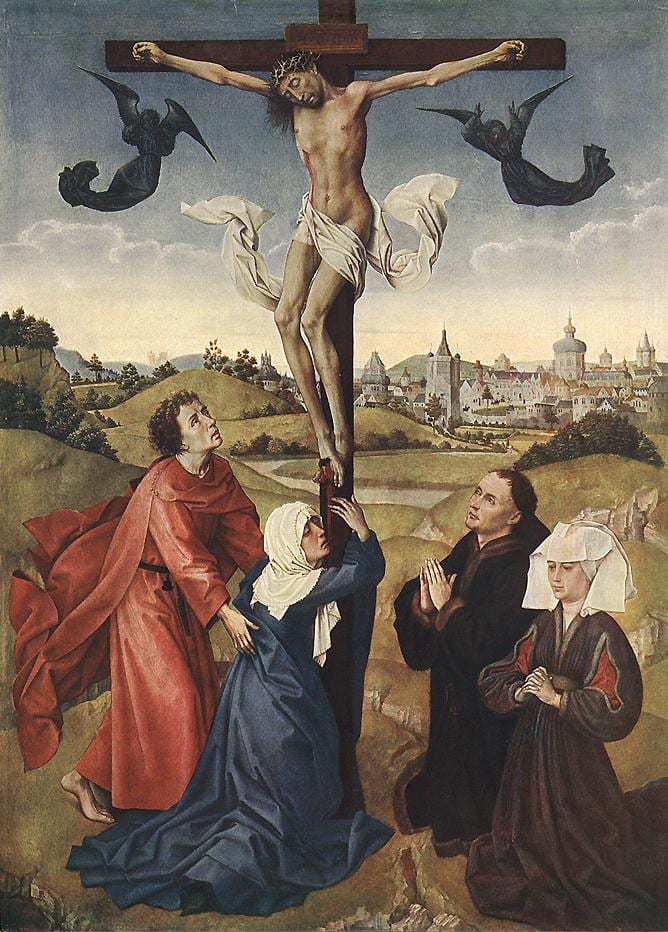
Crucifixion Triptych (central panel), Rogier van der Weyden, c. 1445 AD Rogier van der Weyden, Kunsthistorisches Museum, Vienna Jesus went out carrying his own cross to Golgotha, and Simon of Cyrene, a man coming in from the country, was made to carry it for him. By the cross stood Our Lady, her sister, Mary the wife of Clopas, and Saint Mary Magdalene. Pope Pius XII wrote that St. Simeon's sword pierced her heart as she stood under the cross.
From the cross Jesus entrusted his mother to Saint John the Apostle, the disciple he loved, and gave St. John to her as her son. The Catechism teaches that even at the foot of the Cross she held without wavering to the consent she had given the angel at the Annunciation. Jesus said that it was finished, bowed his head and gave up his spirit.
“Woman, behold your son.”
Jesus to Our Lady, from the cross -
The Glorious Mysteries · Resurrection, Ascension and Descent of the Holy Spirit
Waiting in the upper room
Our Lady's Son rises and ascends, and she prays with the apostles in the upper room before the Spirit comes at Pentecost.
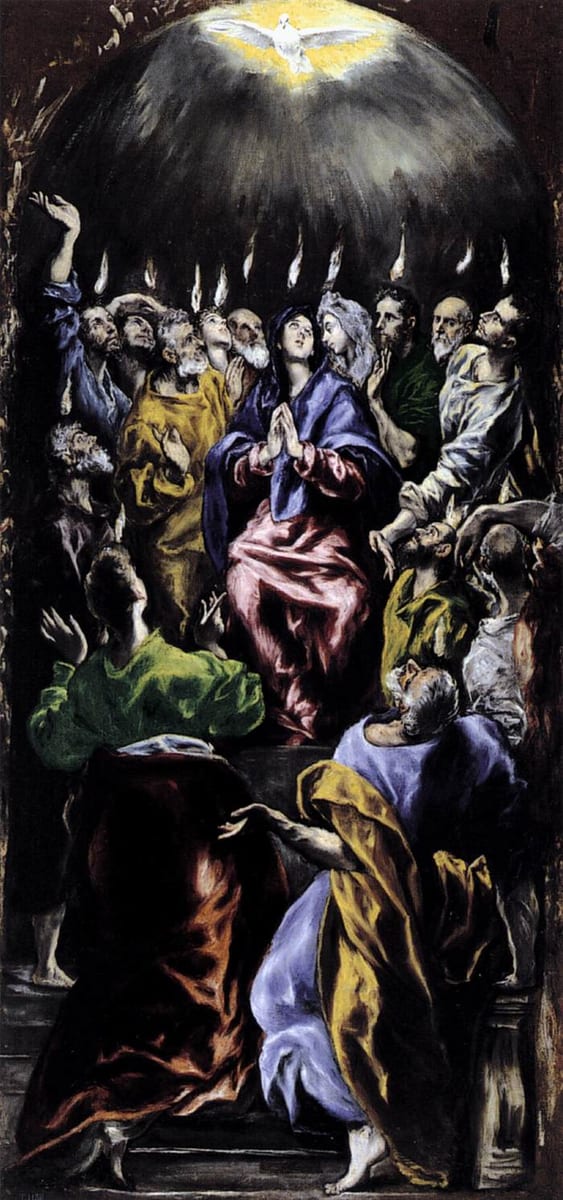
The Pentecost, El Greco, c. 1600 AD El Greco, Museo del Prado, Madrid At dawn on the first day of the week, an angel told St. Mary Magdalene and the other Mary at the tomb that Jesus had risen. Pope St. John Paul II wrote that on Easter morning Our Lady's gaze was radiant with the joy of the Resurrection. For forty days the risen Lord appeared to the apostles, and then a cloud took him from their sight.
The apostles stayed together in the upper room in Jerusalem and prayed there with several women and with Our Lady. At Pentecost tongues as of fire came to rest on each of those gathered. Pope St. John Paul II wrote that Pentecost reveals the face of the Church as a family gathered together with Our Lady.
-
The Glorious Mysteries · Assumption and Coronation
Taken up body and soul
At the end of her earthly life Our Lady is taken up into heavenly glory and exalted as Queen.
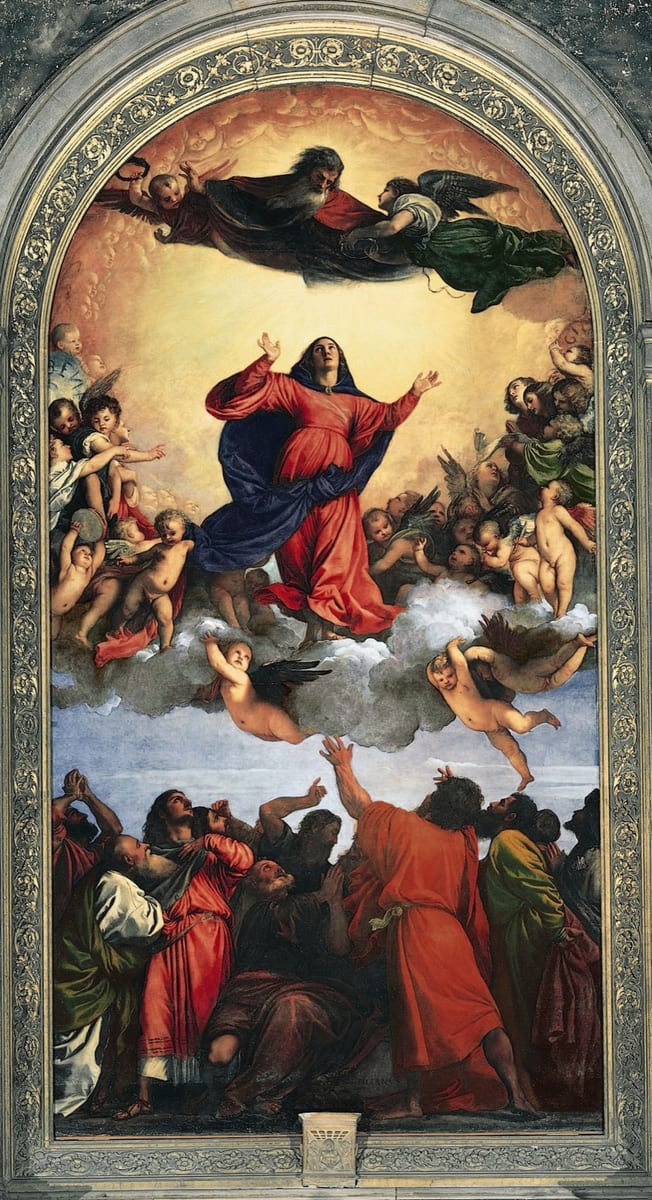
The Assumption of the Virgin, Titian, 1516–1518 AD Titian, Basilica di Santa Maria Gloriosa dei Frari, Venice As Catholic Tradition tells it, in the account Saint Alphonsus Liguori gathers, the apostles came to Our Lady's bedside as her death drew near, and she blessed them. The Church teaches that when the course of her earthly life was finished, she was taken up body and soul into heavenly glory. Pope Pius XII defined this as a dogma of faith at St. Peter's on November 1, 1950 AD.
The Church also teaches that the Lord exalted her as Queen over all things. Pope Pius XII wrote that Christians have long meditated on her reign as Queen in the fifth glorious mystery of the Rosary. Saint Thérèse of Lisieux said in her last illness that Our Lady is more Mother than Queen.


Pray with the Church
Collect of the Mass of the Most Holy Rosary
The Collect of the Mass of the feast of the Most Holy Rosary, in the English printed in Dom Prosper Guéranger's The Liturgical Year, vol. 14 (1910 AD).
O God, whose only-begotten Son, by his life, death, and resurrection, procured for us the rewards of eternal salvation;grant, we beseech thee, that commemorating these mysteries in the most holy rosary of the blessed Virgin Mary,we may imitate what they contain, and possess what they promise.
All 1 report on Our Lady of the Rosary
