
Saints Evangelist and companion of St. Paul · Feast October 18
Saint Luke
Feast 18 October · Born Antioch, Syria
A physician from Antioch became St. Paul's travelling companion, wrote a Gospel and the Acts of the Apostles, and was the one companion still with St. Paul in his last imprisonment, after the others had gone.
Begin the life
In brief
Saint Luke, also called Luke the Evangelist, was a physician from Antioch in Syria who travelled with St. Paul. He wrote the Gospel according to Luke and the Acts of the Apostles, drawing his Gospel from people who had seen the events from the beginning. In St. Paul's last imprisonment, after the others had left, St. Paul wrote that only St. Luke was still with him.
-
First century AD
Named in St. Paul's letters
St. Paul names St. Luke in his letters to the Colossians, to Philemon and to St. Timothy, and in the letter to St. Timothy St. Luke is the only companion left with him.
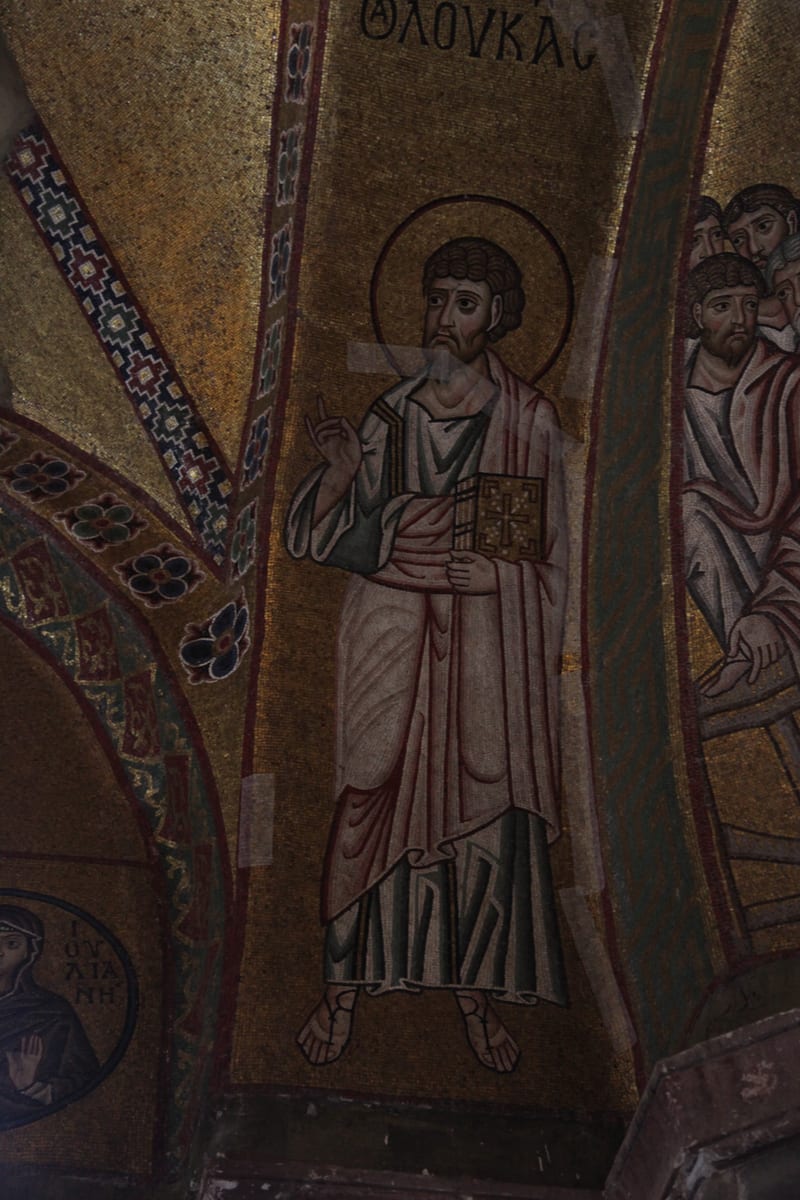
St. Luke the Evangelist, mosaic on the first arch of the west wall of the narthex, katholikon of Hosios Loukas, Phokis, Byzantine mosaicists, first half of the 11th century Byzantine mosaicists, Monastery of Hosios Loukas, Phokis, Greece St. Paul names St. Luke in three of his letters: to the Colossians, to Philemon and to St. Timothy. In the Letter to the Colossians, written from prison, St. Paul sent on St. Luke's greetings and called him a physician. In the Letter to Philemon, St. Paul listed him among the men working beside him.
St. Paul wrote his last letter to St. Timothy as a prisoner in Rome who expected to die soon. Demas had deserted him and others had gone to Galatia and Dalmatia, and St. Paul wrote that only St. Luke was still with him. St. Irenaeus read that line as proof that St. Luke was inseparable from St. Paul.
“Luke alone is with me.”
St. Paul to St. Timothy, in his last letter to Timothy, written from prison -
c. 51 AD
Across the sea to Philippi
After a night vision at Troas, the narrative of Acts turns to the first person, St. Paul's company crosses into Macedonia, and a woman at Philippi is baptized.
At Troas, St. Paul saw in a night vision a man of Macedonia begging him to come over and help. From that point the narrator of the Acts of the Apostles writes we, as one of St. Paul's own party. St. Irenaeus read the word we in Acts as St. Luke's own testimony that he travelled with St. Paul, and counted St. Luke's voyages from this sailing out of Troas.
The company sailed by Samothrace and Neapolis to Philippi, a Roman colony and the leading city of its district. On the sabbath they went out to the river, where they expected to find a place of prayer, and spoke to the women gathered there. Lydia was baptized with her household and insisted that the company stay in her house.
“One who heard us was a woman named Lydia, from the city of Thyatira, a seller of purple goods, who was a worshiper of God.”
St. Luke, St. Luke's narration of the first conversion at Philippi, in the Acts of the Apostles -
The 50s AD
Warned at Caesarea, seized in the Temple
St. Paul's company sails for Jerusalem, hears at Caesarea that he will be bound, and he is seized in the Temple.
Later, when St. Paul came back through Macedonia, the narrative turned to we again at Philippi, where it had stopped. St. Irenaeus read this second we, too, as St. Luke's own witness. At Tyre the disciples, with their wives and children, walked the company to the beach, and everyone knelt there to pray before parting.
At Caesarea, in the house of Philip the evangelist, the prophet Agabus tied his own hands and feet with St. Paul's belt and said its owner would be bound at Jerusalem. St. Paul's companions and the people of Caesarea begged him not to go up, and when he would not be persuaded, his companions stopped and left it to the will of the Lord. In Jerusalem a crowd seized St. Paul in the Temple and beat him, until a Roman tribune came with soldiers and had him bound with two chains.
“What are you doing, weeping and breaking my heart? For I am ready not only to be imprisoned but even to die at Jerusalem for the name of the Lord Jesus.”
St. Paul to his companions and the Christians of Caesarea, when they begged him not to go up to Jerusalem -
c. 61 AD
Shipwreck off Malta
St. Paul sails for Rome as a prisoner, and after fourteen days in a storm the ship breaks up off Malta with everyone saved.
St. Paul had appealed to Caesar, and he sailed for Italy as a prisoner of a centurion named Julius. The narrative turns to we again on this voyage, and St. Irenaeus wrote that St. Luke was present for the journey and set it down with care. Past Crete a northeaster drove the ship for many days with neither sun nor stars in sight, until everyone aboard gave up hope.
St. Paul then stood among them and said an angel of God had promised him in the night that every life aboard would be spared, and only the ship lost. At dawn on the fourteenth day without food, St. Paul took bread, gave thanks to God in front of everyone and ate. The ship struck a shoal and broke up in the surf, and all 276 people aboard reached land on Malta.
“we then learned that the island was called Malta”
St. Luke, St. Luke's narration after the shipwreck, in the Acts of the Apostles -
First century AD
A Gospel written for Theophilus
St. Luke writes the only Gospel with the shepherds at the Nativity, the Good Samaritan and the Prodigal Son, and the early Church names him its author.
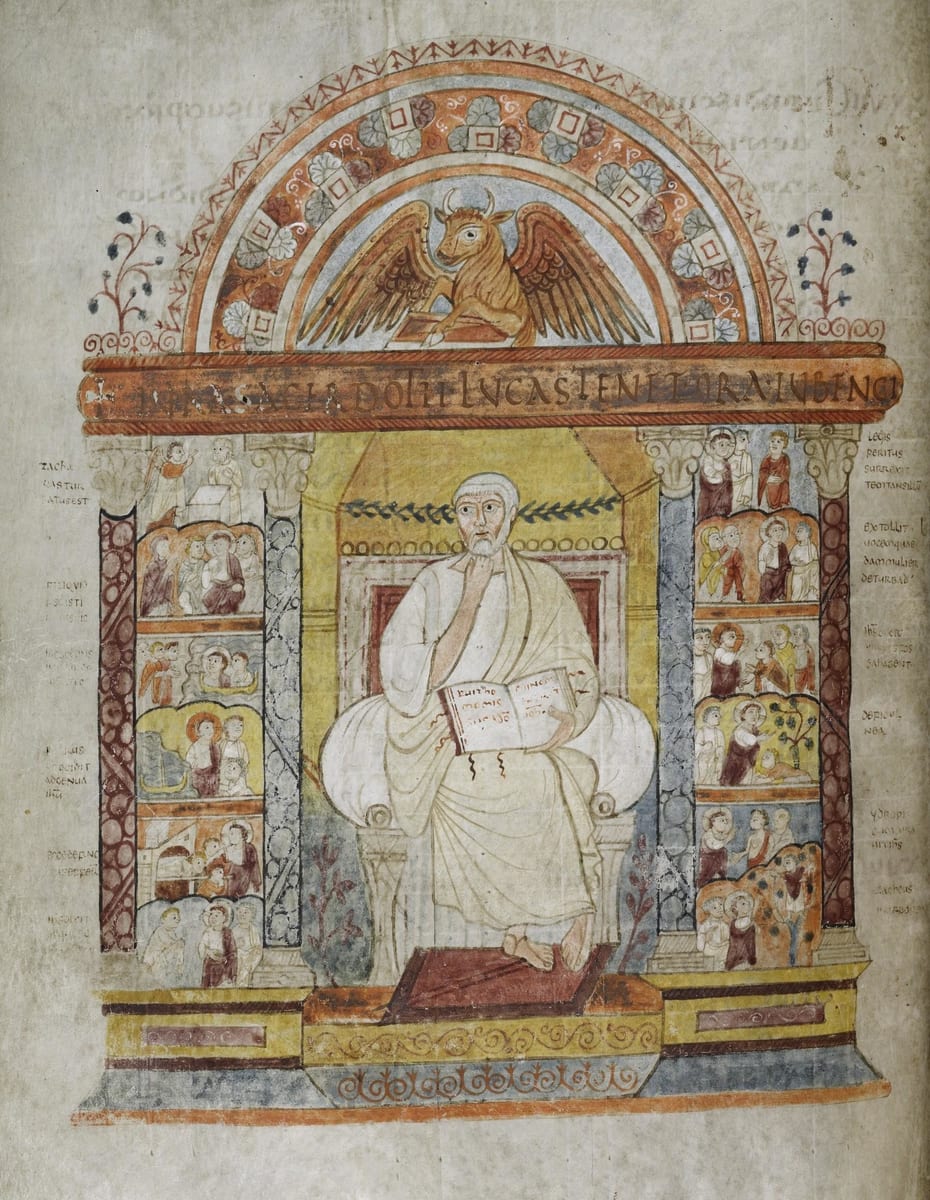
St. Luke, evangelist portrait, St Augustine Gospels, fol. 129r, Unknown Italian illuminator, late 6th century Unknown Italian illuminator, Corpus Christi College, Cambridge, MS 286 (digitised by Stanford University) St. Luke wrote his Gospel for a man named Theophilus, so that Theophilus could be sure of what he had been taught. Only his Gospel tells of the shepherds keeping watch by night when an angel appeared to them. Only his Gospel has the parables of the Good Samaritan and the Prodigal Son, and its last chapter has two disciples at Emmaus recognizing the risen Jesus in the breaking of the bread.
St. Irenaeus wrote that St. Luke recorded in a book the Gospel St. Paul preached. The Muratorian fragment, an early list of the Church's Scriptures, calls him the well-known physician and says he never saw the Lord in the flesh. St. Jerome wrote that St. Luke composed the Gospel from what he heard and the Acts of the Apostles from what he saw.
“Even as they delivered them unto us, who from the beginning were eye-witnesses and ministers of the Word.”
St. Luke to Theophilus, in the preface of his Gospel (Luke 1:2) -
First–ninth century AD
The Virgin Mary in his pages, and the old story of the painter
St. Luke's Gospel follows the Virgin Mary from Nazareth to Bethlehem, and a later Tradition makes him her painter.
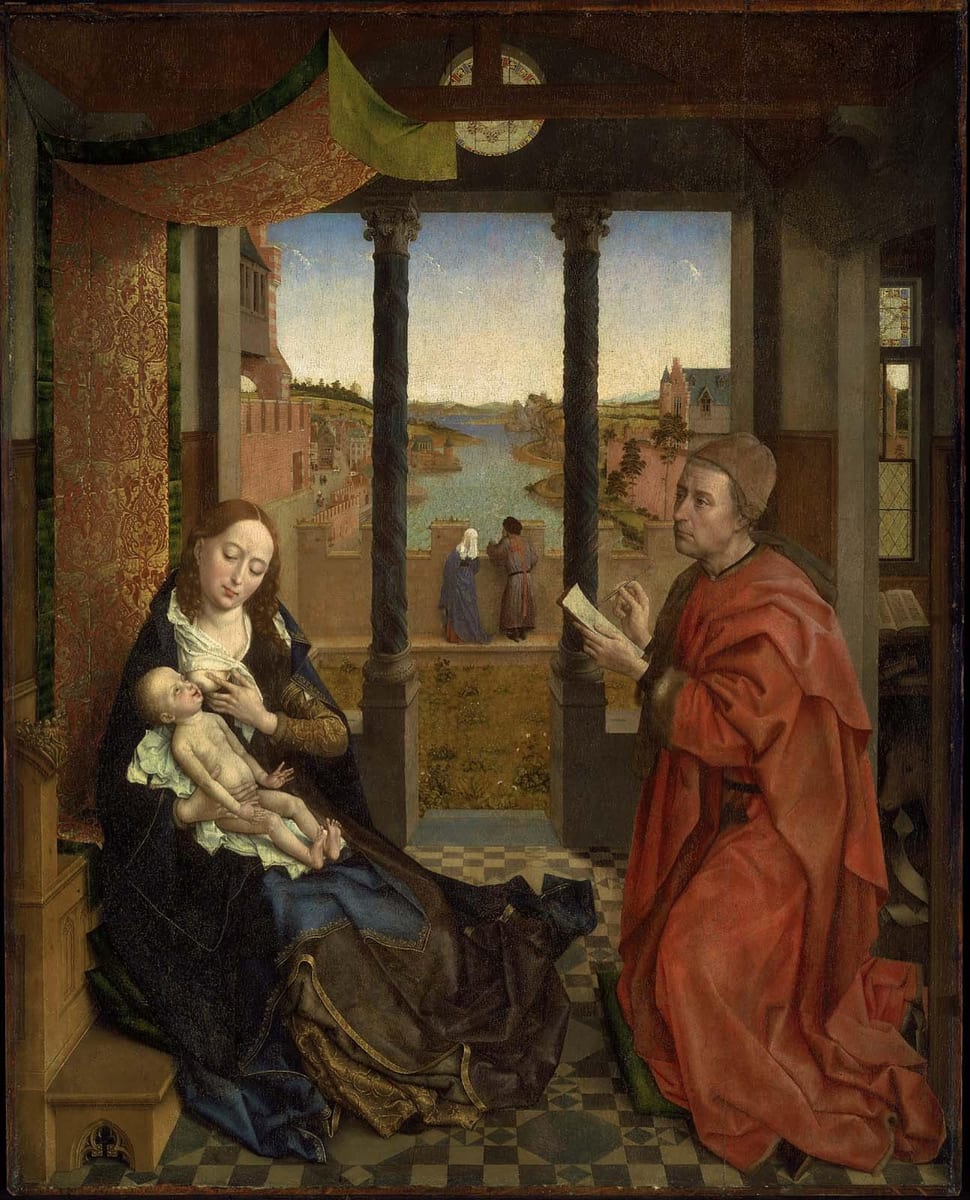
Saint Luke Drawing the Virgin, Rogier van der Weyden, c. 1435–1440 AD Rogier van der Weyden, Museum of Fine Arts, Boston (gift of Mr. and Mrs. Henry Lee Higginson, 1893 AD) St. Luke's Gospel follows the Virgin Mary from the angel Gabriel's visit at Nazareth to her three months with St. Elizabeth in the hill country. His Gospel gives the Blessed Virgin the canticle known as the Magnificat. His Gospel tells of the birth of Jesus at Bethlehem and says that the Virgin Mary kept all these events in mind and thought them over.
According to longstanding Catholic Tradition, St. Luke also painted the Virgin Mary. Theodore Lector, writing in the early sixth century, tells of a portrait of her by St. Luke that was sent from Jerusalem to Constantinople. In Rome, a picture of the Virgin in the Basilica of Santa Maria Maggiore is ascribed to St. Luke, and its history can be followed back to 847 AD.
-
First century–2000 AD
His bones carried to Constantinople
St. Luke's bones are carried to Constantinople in 357 AD, Catholic Tradition places his relics at Padua, and the Church keeps his feast each October 18.
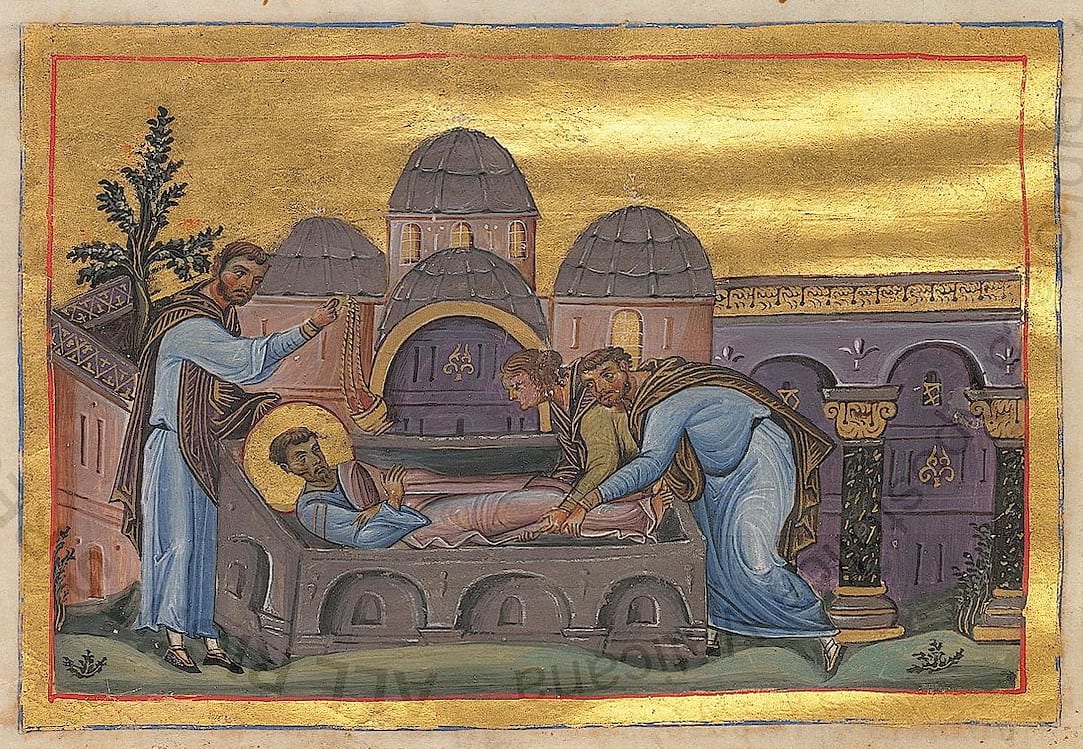
The burial of St. Luke the Evangelist, miniature for October 18 in the Menologion of Basil II, Illuminators of the Menologion of Basil II, c. 985 AD Illuminators of the Menologion of Basil II, Vatican Library (Biblioteca Apostolica Vaticana), Vat. gr. 1613 AD, p. 143 (digi.vatlib.it/view/MSS_Vat.gr.1613/0143 AD) The Roman Martyrology records that St. Luke suffered much for the name of Christ and died filled with the Holy Spirit. In 357 AD, the twentieth year of the Emperor Constantius, his bones were carried to Constantinople with those of the apostle St. Andrew. Catholic Tradition holds that the Church of Padua keeps his relics in the Basilica of Santa Giustina.
The Church keeps the feast of St. Luke the Evangelist on October 18. Writing to Padua for the feast in 2000 AD, Pope St. John Paul II called the Gospel and the Acts of the Apostles the true treasure St. Luke left the Church.
“His relics were taken to Constantinople, and thence conveyed to Padua.”
The Roman Martyrology, its entry for 18 October


_-_West_wall,_1st_arch_(S.Luke)_02.jpg)


.jpg)
Pray with the Church
Collect for the Feast of St. Luke
The Collect of the Mass for the Feast of St. Luke, Evangelist, October 18, from The Roman Missal
Lord God, who chose Saint Luketo reveal by his preaching and writingsthe mystery of your love for the poor,grant that those who already glory in your namemay persevere as one heart and one souland that all nations may merit to see your salvation.Through our Lord Jesus Christ, your Son,who lives and reigns with you in the unity of the Holy Spirit,God, for ever and ever. Amen.