
Saints Virgin and martyr of Alexandria · Feast November 25
Saint Catherine of Alexandria
Feast 25 November · Died 305 AD, Alexandria, Egypt
A learned young woman of Alexandria, as Catholic Tradition tells it, stood up to an emperor, won his fifty orators to Christ, came through the spiked wheel and died by the sword, and her body is venerated on Mount Sinai to this day.
Begin the life
In brief
Saint Catherine of Alexandria, also called Catherine of the Wheel, is the saint the Roman Martyrology enters on November 25. According to longstanding Catholic Tradition, she was a royal and learned young woman who defied an emperor and died for Christ early in the fourth century. Her body is venerated in the monastery on Mount Sinai that bears her name, where Pope St. John Paul II came to pray as a pilgrim in 2000 AD.
-
Early fourth century AD
The scholar who took a ring
A noble girl of Alexandria gives herself to study, refuses marriage, and is baptized in the desert and given a ring as the bride of Christ.
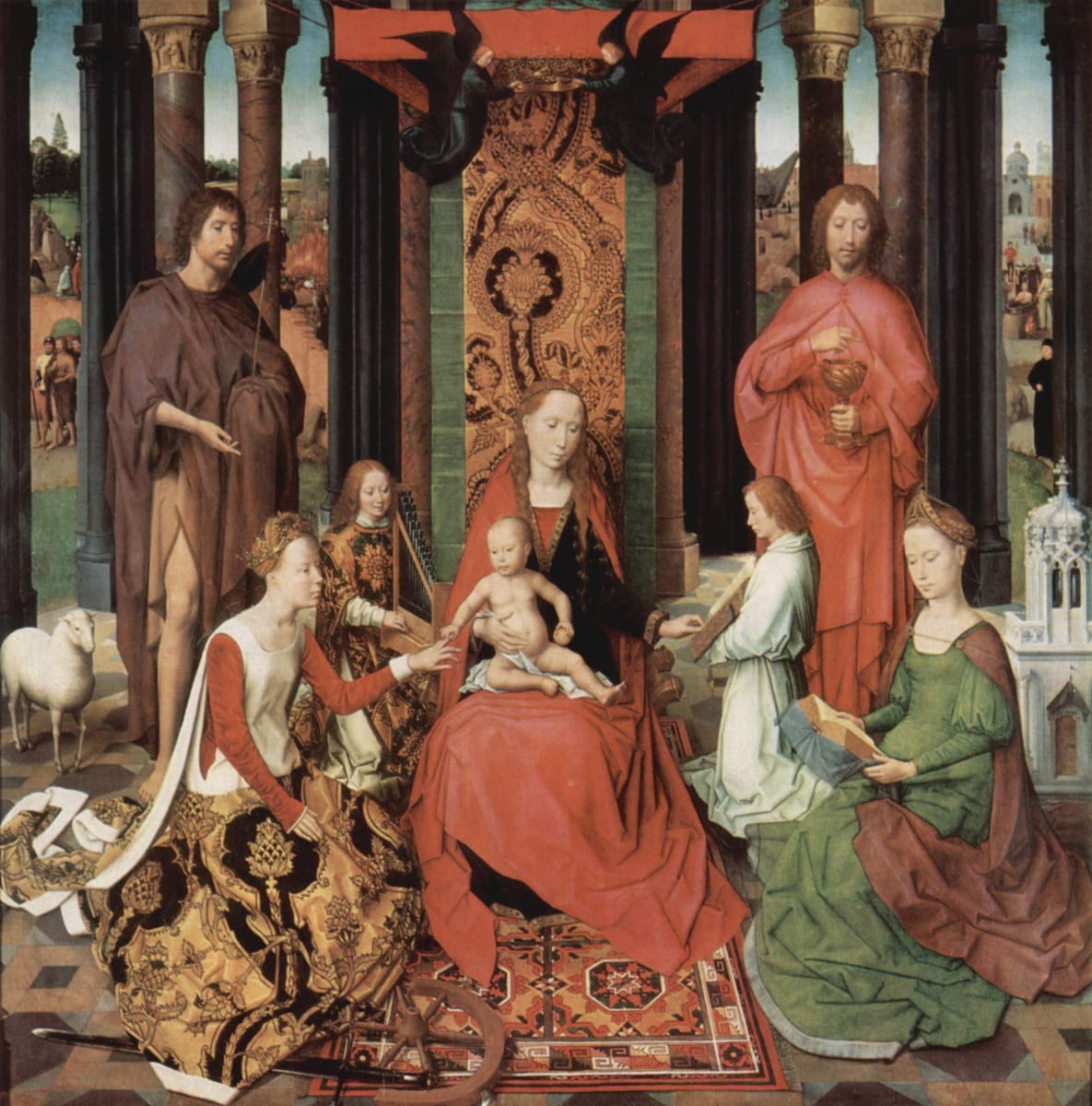
Sacra Conversazione (Mystic Marriage of St. Catherine), centre panel of the St John Altarpiece, Hans Memling, 1479 AD Hans Memling, Memlingmuseum (Sint-Janshospitaal), Bruges In Catholic Tradition, St. Catherine of Alexandria was a noble girl of Alexandria who studied the liberal arts from her earliest years. She had mastered Aristotle, Homer and Plato, and Hippocrates and Galen. She had resolved to keep her virginity even at the cost of her life, so she refused to marry.
The Golden Legend tells that Our Lady sent Adrian, a hermit who had lived in penance near Alexandria for thirty years, to lead her secretly out of her palace and into the desert. There Adrian baptized her, with Our Lady as her godmother, and Christ took her as his bride and put a ring on her finger as the sign of their marriage. She came home to find her mother dead, and she brought many people to the Christian faith.
-
Early fourth century AD
Into the emperor's temple
At eighteen she walks in on a public sacrifice and rebukes the emperor to his face.
As Catholic Tradition tells it, the emperor, called Maxentius in the Golden Legend, sat on his tribunal at Alexandria and ordered everyone under his rule to sacrifice to the gods. St. Catherine of Alexandria heard the noise of the sacrifices from her house. She was eighteen.
She made the sign of the cross and went to the temple with her servants. There she saw Christians sacrificing out of fear of death, and she rebuked the emperor for his cruelty. She urged him to acknowledge the one true God, who had given him his empire, and he had her held under guard in his palace.
-
Early fourth century AD
Fifty orators fall silent
The emperor brings in the best speakers of his provinces to defeat her, and they turn to Christ instead.
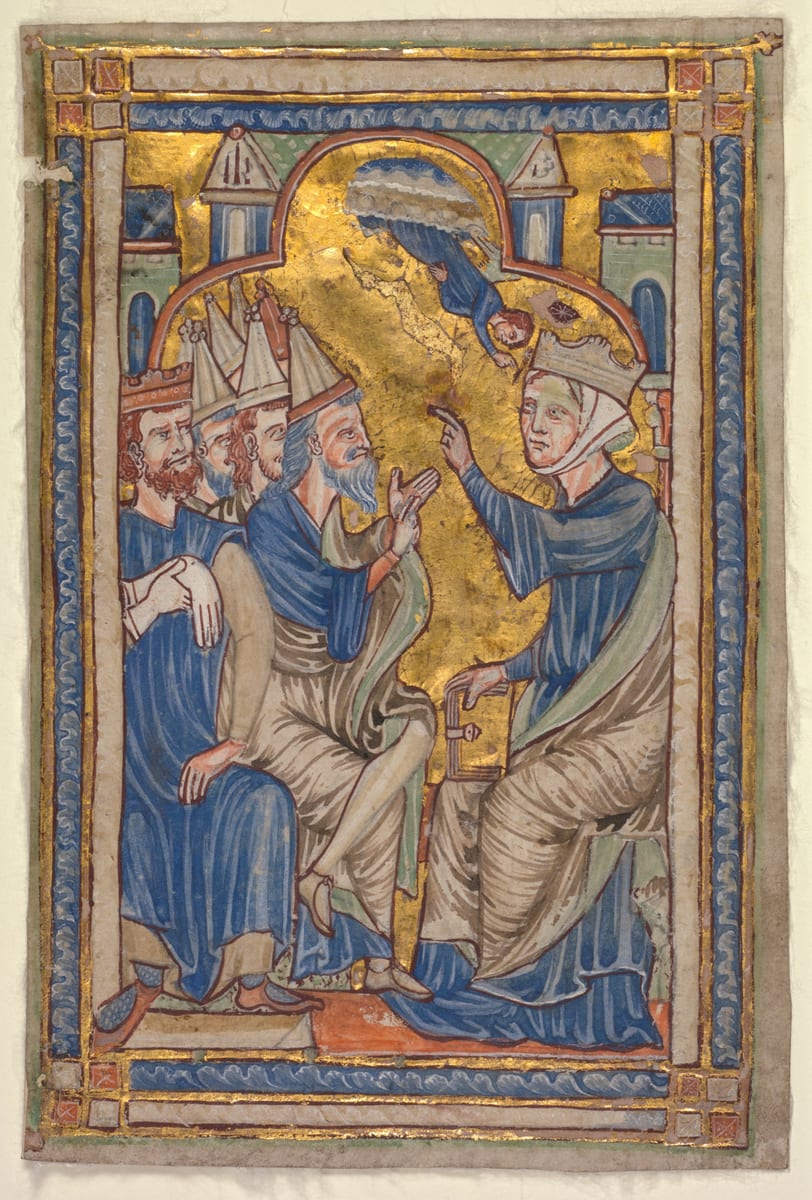
Miniature from a Compendium of Saints' Lives: Saint Catherine of Alexandria Disputing with the Fifty Philosophers, Unknown illuminator, northeastern France, c. 1200-1210 AD Unknown illuminator, northeastern France, Cleveland Museum of Art, 1997.12 (open access) Catholic Tradition holds that the emperor could not answer her, so he summoned fifty orators to Alexandria and promised them great rewards if they beat her. Before the debate an angel told her not to be afraid, because she would win them for God. She told the emperor it was unjust to set fifty orators, all promised rewards, against one girl who stood to gain nothing.
She argued from the prophets, and from the teaching that Christ is God made man and rose from the dead, until the orators fell silent and their leader told the emperor they would all turn to Christ. The emperor had a fire lit in the middle of the city to burn them, and when they begged her for baptism, she told them their blood would count as their baptism. They died in the fire, and that evening Christians found their bodies whole, with not a hair or a garment burned.
-
Early fourth century AD
Visitors in the prison
She refuses the emperor's offer, is beaten and shut in prison without food, and wins his wife and the commander of his soldiers to Christ in her cell.
Tradition holds that the emperor, though he was married, then offered to make her second only to the empress in his palace and to raise her image in the city. She refused, saying she had vowed herself to Christ as his bride. He had her stripped of her royal purple, scourged and shut in a dark prison without food.
The empress had heard of St. Catherine of Alexandria's wisdom and longed to see her, but she feared the emperor, so Porphyrius, commander of the soldiers, brought the empress to the prison at night. St. Catherine of Alexandria told the empress not to be afraid, and foretold that after three days the empress would suffer for Christ and receive a martyr's crown. When Porphyrius asked St. Catherine of Alexandria what reward Christ gives his soldiers, she told him this world is a dark prison in which everyone born must die, and he believed, with two hundred of his men.
-
Early fourth century AD
The wheel breaks
A machine of spiked wheels is built to tear her apart and shatters as she prays, and the empress and the commander of the soldiers die for Christ.
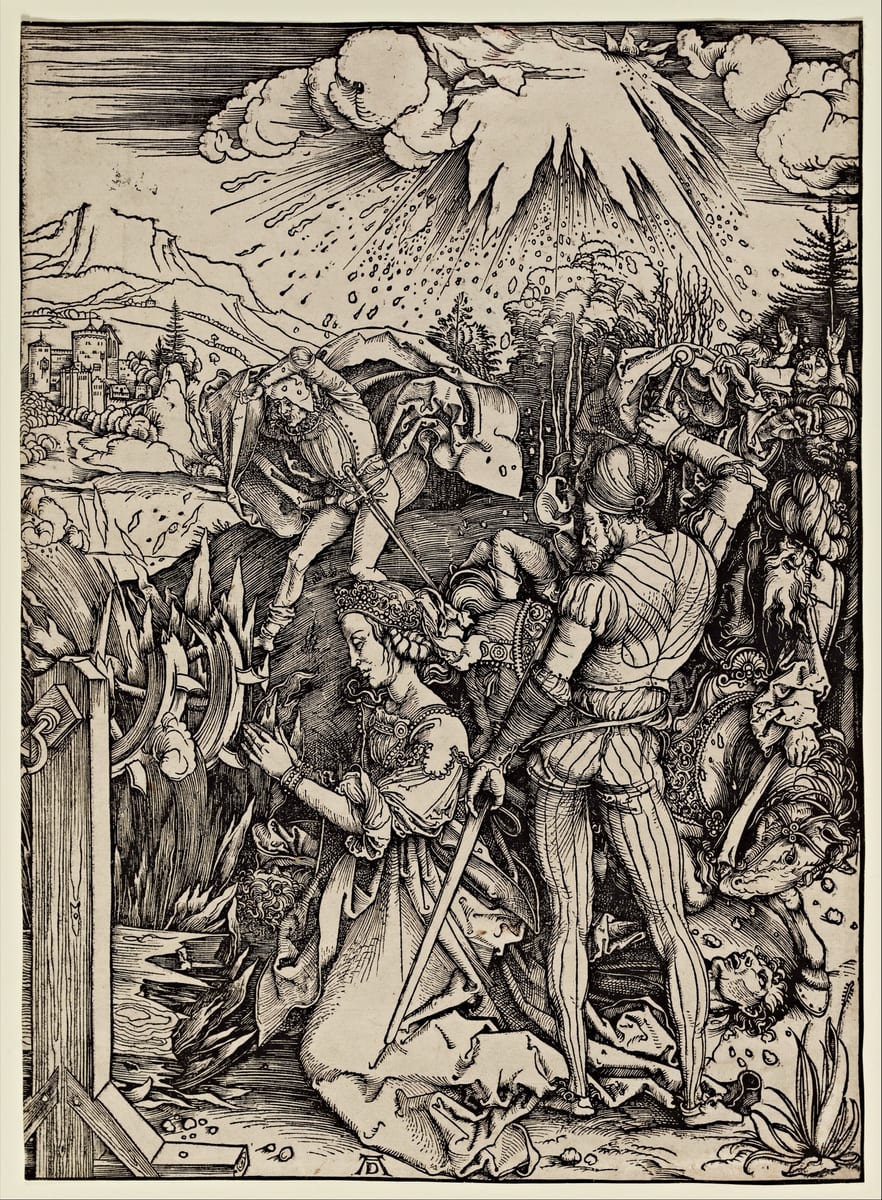
The Martyrdom of St. Catherine of Alexandria, Albrecht Dürer, 1496/1497 AD Albrecht Dürer, Cantor Arts Center, Stanford University, 2008.6 Catholic Tradition goes on to tell that a city prefect urged the emperor to build four wheels studded with saws and sharp nails, to tear her body apart. St. Catherine of Alexandria was bound to the wheels, and they were set turning. As she prayed, an angel came down from heaven, freed her and smashed the machine, and the flying pieces killed many in the crowd.
The onlookers cried out that the God of the Christians is the one God. The empress, who had been watching in secret, came down from the palace and confessed Christ before her husband, and he had her put to death outside the city. Porphyrius and his two hundred soldiers declared themselves Christians, and they too were beheaded.
-
Early fourth century AD
Outside the city
Offered her life one last time, she refuses, prays for all who will call on her and is beheaded.
As her Passion tells it, the emperor offered her life and honour one last time if she would worship the gods, and she refused. She was taken outside the city, and a large crowd followed, with the most distinguished women of Alexandria at its head. She asked the soldiers for time to pray, and she prayed that anyone who remembered her passion and called on her in need would be heard.
A voice from heaven called her to her Father's house, and she told the executioner to carry out his orders. When her head was struck off, milk instead of blood flowed onto the ground, and many who saw it praised God. The Roman Martyrology marks her death on November 25 and records that angels carried her body to Mount Sinai.
-
Eighth century AD onward
The monastery on Sinai
Her body is found on Mount Sinai, her relics travel west, and her statue fills the churches of Europe.
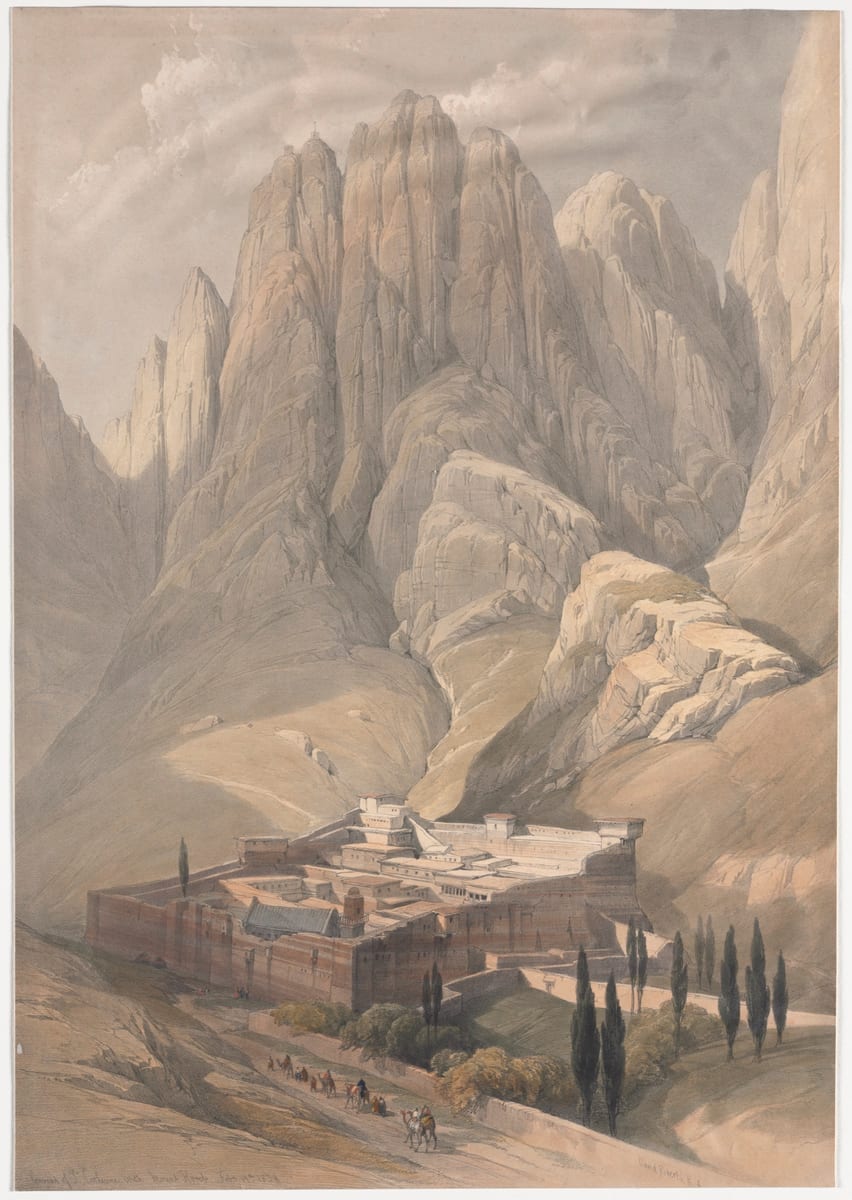
Convent of St. Catherine with Mount Horeb, David Roberts, 1839 AD (drawn February 11, 1839 AD) David Roberts, Cleveland Museum of Art, 1927.90 (open access) Catholic Tradition holds that Christians found her body on Mount Sinai in about the eighth century, and that most of her remains lie in a marble chest in the monastery church there. The Roman Martyrology of 2004 AD records that her body is venerated in that monastery. In the eleventh century Simeon, a monk of Sinai, carried relics of her to Rouen in Normandy.
After the Crusades devotion to her grew greatly across Europe, and her statue with the wheel came to stand in nearly every church. Theologians, preachers and philosophers asked her prayers before they studied, wrote or preached, and she became the patroness of young women and of female students.
“here the body of the martyr Catherine found a final resting-place”
St. John Paul II to pilgrims at the Celebration of the Word at Mount Sinai, February 26, 2000 AD -
1431 AD
The voice St. Joan heard
Saint Joan of Arc, on trial for her life, tells her judges that St. Catherine of Alexandria counselled her.
At her trial in Rouen in 1431 AD, Saint Joan of Arc testified that St. Catherine of Alexandria and St. Margaret had guided her for years. St. Joan said the two saints told her that God wanted her to go to the rescue of Orléans. She had sent to the church of Sainte-Catherine-de-Fierbois for a sword, and it was found buried behind the altar of St. Catherine of Alexandria.
In prison St. Joan said she lit candles in honour of St. Catherine of Alexandria and had embraced her. After she had recanted to save her life, St. Joan told her judges she had never meant to deny her voices, and had spoken from fear of the fire. At her death St. Joan commended herself to God, St. Michael, St. Catherine of Alexandria and all the saints.
“illa vox erat sanctœ Katharinœ et sanctœ Margaretœ. Et figurae earum sunt coronatae pulchris coronis , multum opulenter et multum pretiose. Et de hoc, inquit, habeo licentiam a Domino. (It is the Voice of Saint Catherine and of Saint Margaret. Their faces are adorned with beautiful crowns, very rich and precious. To tell you this I have leave from Our Lord.)”
St. Joan of Arc to her judges at Rouen, at her trial, describing her voices, 1431 AD


Pray with the Church
The prayer of St. Catherine of Alexandria at the place of her death
As Catholic Tradition tells it in the Golden Legend, the prayer she said when she was brought to the place of her execution; William Caxton's English of 1483 AD, edited by F. S. Ellis (1900 AD).
O ! Jesu Christ, hope of and help of them that believe in thee!O beauty and glory of virgins!Good king, I beseech and pray thee that whosomever shall remember my passion,be it at his death or in any other necessity, and call me,that he may have by thy mercy the effect of his request and prayer.
All 1 report on Saint Catherine of Alexandria
