
Saints Lisbon to Padua, 1195–1231 AD
Saint Anthony of Padua
Feast 13 June · Born 1195 AD, Lisbon, Portugal · Died 1231 AD, Arcella, at the gates of Padua, Italy
He sailed to Morocco to be martyred, was blown onto Sicily by a storm, and was found out as a preacher only because nobody else at Forlì was ready to speak.
Begin the life
In brief
Saint Anthony of Padua was born at Lisbon in 1195 AD and baptised Ferdinand. He died at Arcella, outside the gates of Padua, on June 13, 1231 AD, aged thirty-six. Pope Pius XII declared St. Anthony a Doctor of the Universal Church on January 16, 1946 AD.
-
1195–1218 AD
The canon of Lisbon and Coimbra
A noble boy of Lisbon enters the Canons Regular at fifteen and gives eight years to study.
He was born at Lisbon in 1195 AD to noble parents who lived near the cathedral. He learned the Scriptures at the cathedral school of St Mary, a short walk from the house.
At fifteen, in September 1210 AD, he entered the Canons Regular of St Augustine outside the walls. Two years later he asked to be sent a hundred miles away to Coimbra, because relatives and friends kept visiting him. Eight years there went to the Scriptures and the Fathers, and he was ordained priest about 1218 AD.
-
1220 AD
The martyrs come to Coimbra
The bodies of five Friars Minor killed in Morocco are carried into the canon's own church.
On January 16, 1220 AD five Friars Minor were put to death in Morocco for preaching the faith. The Infante Don Pedro brought their bodies back, and they were received into the church of the Holy Cross at Coimbra. Seeing them, the young canon resolved to become a Friar Minor and preach to the Saracens.
Friars from the poor house at Olivares came to the monastery to beg alms, and he asked them to receive him. He took their habit that year and asked to be called after St. Anthony, the saint of their convent. Jean Rigauld records that he wanted an unknown name to spare him his old visitors.
“I will take their habit, and so will I, too, go to the fight.”
St. Anthony of Padua, 1220 AD -
1220–1221 AD
The mission that failed
He crosses to Morocco to die for the faith, falls ill all winter, and is driven back to Italy.
In December 1220 AD St. Anthony sailed for Morocco, hoping to be killed there for the faith. A severe illness held him down the whole winter, and he preached nothing. Rigauld records that he understood God had decided otherwise.
In the spring his ship home was driven by a violent storm onto the coast of Sicily. He reached the general chapter at Assisi on May 30, 1221 AD and met St. Francis of Assisi there. Butler records that no superior would take him, so sickly was his aspect, and that he offered himself only for the kitchen.
-
1221–1222 AD
Told to preach at Forlì
A hermitage priest nobody rates is ordered to speak when every other friar declines.
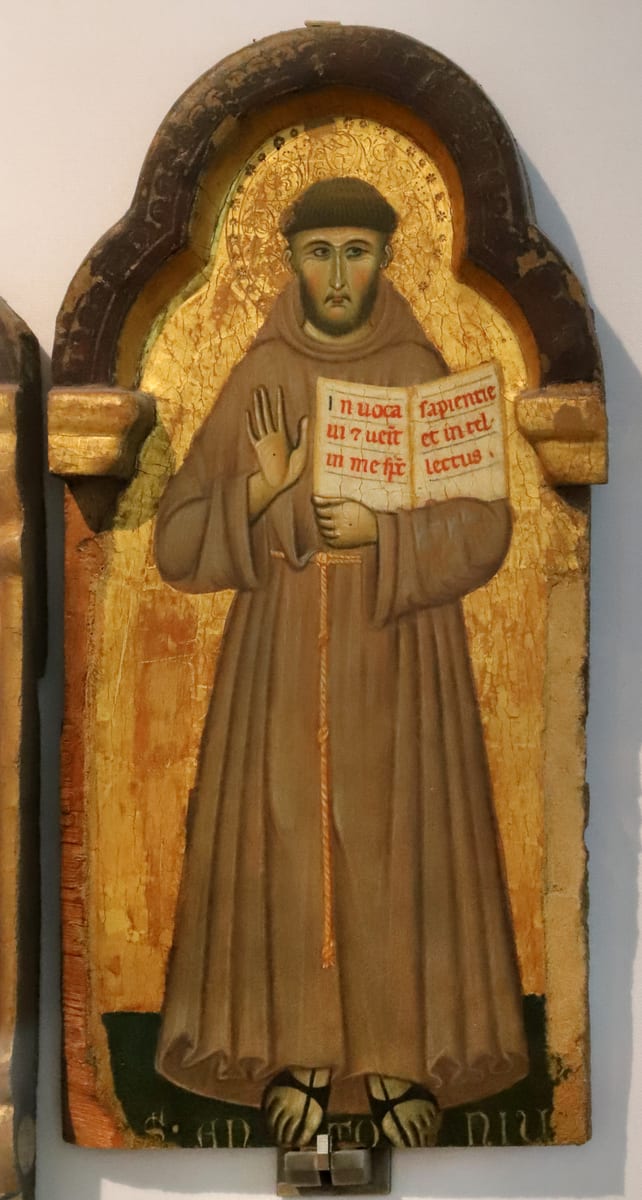
St Anthony of Padua, from the fragments of a double-sided dossal from San Francesco al Prato, Perugia, Master of Saint Francis (Maestro di San Francesco); photograph by Sailko, 2020 AD, c. 1272 AD Master of Saint Francis (Maestro di San Francesco); photograph by Sailko, 2020 AD, Galleria Nazionale dell'Umbria, Perugia Friar Gratian sent him to the hermitage of Montepaolo to say Mass for the lay brothers. He hid his learning so completely that the friars thought him fit only to read the Missal and recite the Breviary.
At an ordination at Forlì in 1222 AD no preacher had been appointed, and every friar asked declined for want of preparation. Ordered under obedience to speak, he opened the Scriptures with a depth of learning that astounded the room. He was sent out to preach across the Romagna, and at Rimini he brought back a heresiarch of thirty years' standing.
-
1223–1226 AD
The first lector, and France
St. Francis gives him leave to teach, and he opens the Order's first school of theology.
St. Francis wrote to him with leave to teach the friars theology. In 1223 AD he opened a school of theology at Bologna and became the first lector of the Franciscan Order. He taught afterwards at Toulouse and Montpellier, in the Order's own convent schools rather than the universities.
At the provincial chapter of Arles in 1224 AD, as he preached on the title over the Cross, St. Francis appeared at the chapter-room door with his arms outstretched, blessing the friars. The Bollandist Van Ortroy concluded that St. Anthony wrote his Sunday Sermons at Limoges, most probably in 1226 AD.
“I have collected together and concorded each of these, as divine grace has granted and as far as my slender and paltry knowledge allows, following the reapers with Ruth the Moabitess, to gather the fallen ears in the field of Boaz, with fear and modesty as one inadequate for so great and important a burden; yet conquered by the prayers and love of brothers who have constrained me to it.”
St. Anthony of Padua -
1230–1231 AD
The last Lent at Padua
He gives up governing a province, and a city changes its law under his preaching.
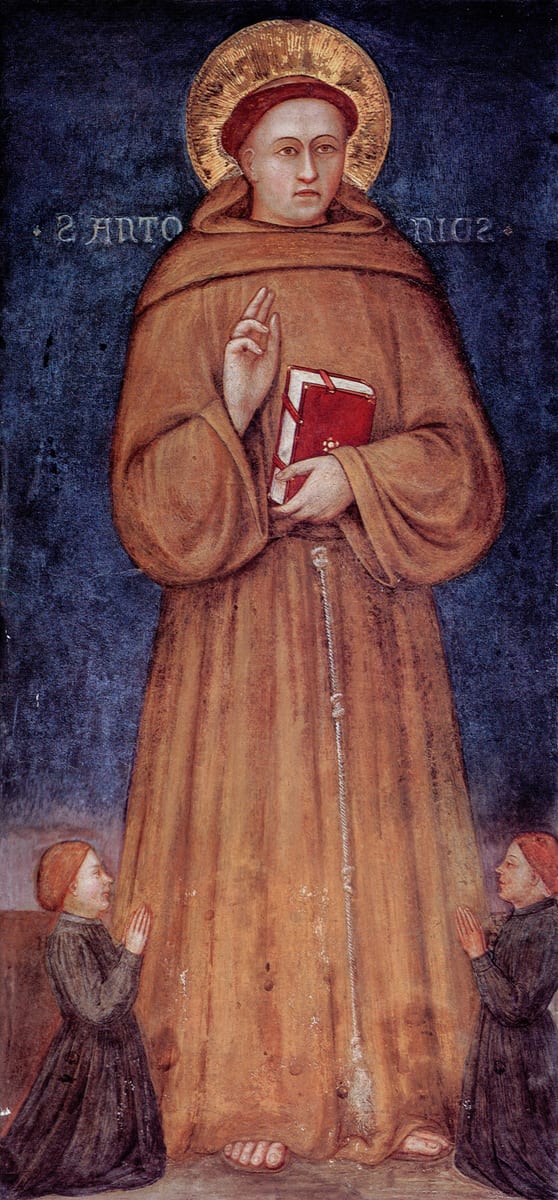
Sant'Antonio, vera effigie, Anonymous Paduan painter; reproduced from Camillo Semenzato, Sant'Antonio in settecentocinquant'anni di storia dell'arte (Padua, 1985 AD), 14th century, c. 1350 AD Anonymous Paduan painter; reproduced from Camillo Semenzato, Sant'Antonio in settecentocinquant'anni di storia dell'arte (Padua, 1985 AD), Basilica di Sant'Antonio (the Basilica del Santo), Padua At the general chapter of Assisi on May 30, 1230 AD he resigned the office of provincial to give his time to preaching. He spent the winter at Padua revising his sermons for the Order's preachers and teachers.
In Lent 1231 AD the crowds ran to thirty thousand and more, and no church would hold them, so he preached in the fields. Shopkeepers shut their shops and would sell nothing until the sermon was over. On March 15, 1231 AD the municipality passed a law in favour of debtors who could not pay, and a copy of it survives in the city museum.
“Christ who is your life is hanging before you, so that you may look at the Cross as in a mirror. There you will be able to know how mortal were your wounds, that no medicine other than the Blood of the Son of God could heal. If you look closely, you will be able to realize how great your human dignity and your value are. Nowhere other than looking at himself in the mirror of the Cross can man better understand how much he is worth.”
St. Anthony of Padua -
June 1231 AD
Camposampiero and Arcella
He rests in a cell built among the branches of a tree, and dies at the gates of the city.
When Lent ended he withdrew to Camposampiero, where the knight Tiso built cells in the branches of a great tree for him and his two companions. John Peckham records that two weeks before his death he stood on a hill above Padua and blessed the city.
On June 13, 1231 AD his strength failed at table, and he asked to be taken to the convent of Saint Mary at Padua. A friar met the cart near the city and turned it aside to Arcella, where friars served the Poor Clares. There he made his confession, received Viaticum, and died in the friars' arms about half an hour later.
“I see my Lord.”
St. Anthony of Padua, June 13, 1231 AD -
1231–1263 AD
What Padua did with him
The children break the news, the city fights over the body, and Rome canonises him in eleven months.
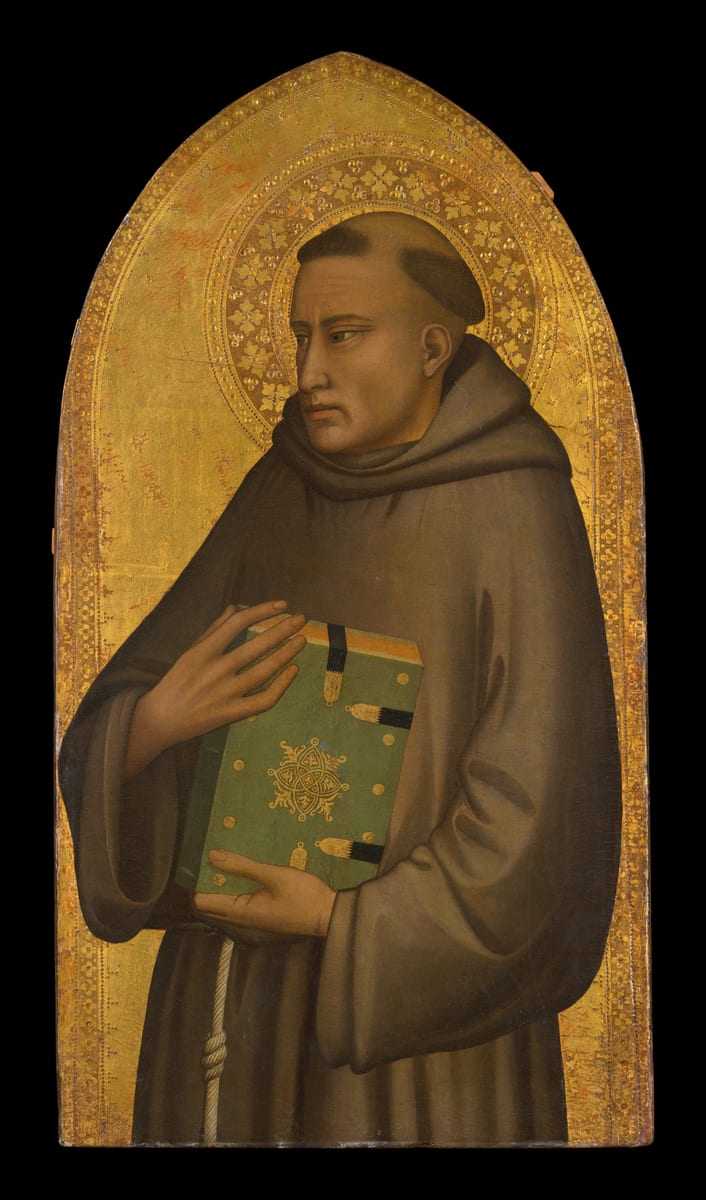
Saint Anthony of Padua, Maso di Banco, c. 1340 AD Maso di Banco, The Metropolitan Museum of Art, New York (Maitland F. Griggs Collection, Bequest of Maitland F. Griggs, 1943 AD; acc. 43.98.13) The friars meant to keep the death quiet, and the children of Padua ran through the streets crying it instead. The city armed itself over the body for four days, until the bishop decreed for the friars' church and the funeral went through on June 17, 1231 AD.
Pope Gregory IX canonised him at Spoleto on May 30, 1232 AD, eleven months after the death. In 1242 AD the Franciscans adopted an Office by Friar Julian of Speyer, who first urged the faithful to invoke St. Anthony for things lost. On April 8, 1263 AD St. Bonaventure opened the coffin after thirty-two years and found the bones bare and the tongue whole.


Pray with the Church
A prayer of Saint Anthony of Padua to Our Lady
The closing prayer of his sermon for the Assumption of the Blessed Virgin Mary, written between about 1226 AD and 1231 AD, in the translation of the Revd Dr S. R. P. Spilsbury from the critical Latin edition.
We ask you then, our Lady, great Mother of God, lifted high above the choirs of angels, to fill the cup of our heart with heavenly grace; to make it gleam with the gold of wisdom; to make it solid with the power of your virtue; to adorn it with the precious stone of virtues; to pour upon us, O blessed olive-tree, the oil of your mercy to cover the multitude of our sins.By you may we be found fit to be raised to the height of heavenly glory, and to be blessed with the blessed; by the power of Jesus Christ your Son, who this day has raised you above the choirs of angels, crowned you with the diadem of his kingdom, and set you upon the throne of eternal light.To him be honour and glory through endless ages.Let the whole Church say: Amen. Alleluia.
All 4 reports on Saint Anthony of Padua

About this picture
AI-generated image, in the manner of a Trecento buon fresco, from the paper's reference portrait based on St Anthony of Padua, from the fragments of a double-sided dossal from San Francesco al Prato, Perugia (Master of Saint Francis, c. 1272 AD, Galleria Nazionale dell'Umbria, Perugia) View source artwork.
St. Francis appears in the doorway at Arles as St. Anthony preaches

About this picture
AI-generated image, in the manner of a Trecento buon fresco, from the paper's reference portrait based on St Anthony of Padua, from the fragments of a double-sided dossal from San Francesco al Prato, Perugia (Master of Saint Francis, c. 1272 AD, Galleria Nazionale dell'Umbria, Perugia) View source artwork.
At fifteen, Saint Anthony of Padua leaves home for the canons

Portugal promotes St. Anthony of Padua to captain, 462 years dead

About this picture
AI-generated image, in the manner of a Trecento buon fresco, from the paper's reference portrait based on St Anthony of Padua, from the fragments of a double-sided dossal from San Francesco al Prato, Perugia (Master of Saint Francis (Maestro di San Francesco); photograph by Sailko, 2020, c. 1272 AD, Galleria Nazionale dell'Umbria, Perugia) View source artwork.