
Saints Life of a Saint
Saint Francis of Assisi
Feast 4 October · Born 1181 AD, Assisi, Duchy of Spoleto (Umbria, Italy) · Died 1226 AD, St Mary of the Angels at the Porziuncola, below Assisi (Umbria, Italy)
The cloth merchant's son who gave back his clothes, begged his bread, and came down a Tuscan mountain marked with the stigmata.
Begin the life
In brief
Saint Francis of Assisi was born about 1181 AD at Assisi, son of Pietro Bernardone, a wealthy cloth merchant. He gave his father back the money and the clothes he had of him, and lived afterwards by begging. The bull Mira circa nos set his feast on October 4, the day it names as his entry into the kingdom of heaven.
-
1181–1203 AD
A merchant's son at Assisi
He learned the cloth trade, led the young men of the city, and came home from a Perugian prison after more than a year.
His mother, Pica, had him baptised John. His father was away in France on business and renamed the boy Francesco on his return. Grown, St. Francis practised his father's trade and spent his profits on banquets and songs.
Perugia beat Assisi in the plain in 1202 AD, and St. Francis was taken prisoner. He was held more than a year and caught a low fever there. He alone kept company with a knight the other prisoners shunned.
“What think ye of me? I shall be worshipped by the whole world.”
St. Francis of Assisi -
1204–1205 AD
Turned back at Spoleto
A knight's outfit, a voice on the road south, and a leper met in the plain below the town.
After a long sickness St. Francis found that neither the fields nor the vineyards could delight him. He fitted himself out in the costliest stuffs he could get to be made a knight in Apulia. He got as far as Spoleto, fell ill, and heard a voice ask why he left the lord for the servant.
He turned home, and riding near Assisi he met a leper. He dismounted, gave the man money and kissed his hand. A few days later he went to the lepers' hospital and kissed every hand there.
“The Lord gave to me, Brother Francis, thus to begin to do penance; for when I was in sin it seemed to me very bitter to see lepers, and the Lord Himself led me amongst them and I showed mercy to them. And when I left them, that which had seemed to me bitter was changed for me into sweetness of body and soul.”
St. Francis of Assisi, 1226 AD -
1205–1206 AD
He gives back the clothes
A crucifix in a ruinous church, a father who locked him up, and a mother who let him go.
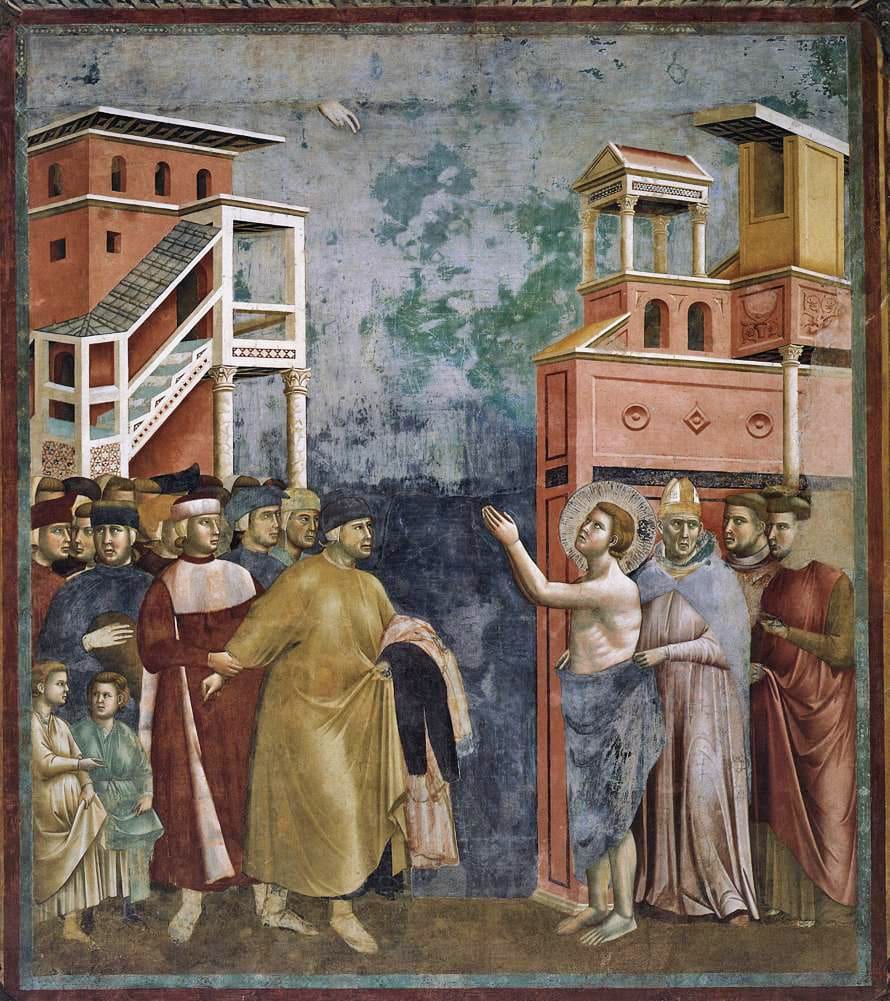
Legend of St. Francis, scene 5: Renunciation of Worldly Goods, Giotto di Bondone, 1297–1300 AD Giotto di Bondone, Upper Church, Basilica of San Francesco, Assisi Praying before the crucifix at San Damiano, St. Francis was told to repair the house he saw falling into ruin. He took cloth from his father's stock, sold it with his horse at Foligno, and carried the money to the priest. Pietro Bernardone dragged him home and shut him for many days in a dark place.
His mother broke his bonds and let him go while her husband was away. Before Bishop Guido he took off everything and laid the clothes with the money on the floor. The bishop put his arms round him and covered him with his own pall.
“Hear all ye, and understand:—until now have I called Peter Bernardone my father, but, for that I purpose to serve the Lord, I give back unto him the money, over which he was vexed, and all the clothes that I have had of him, desiring to say only, "Our Father, Which art in Heaven," not "my father, Peter Bernardone."”
St. Francis of Assisi, 1206 AD -
1207–1211 AD
A rule in few words
Stones carried through Assisi, a Gospel heard at Mass, and eleven men on the road to Rome.
St. Francis begged stones through the streets and rebuilt San Damiano on his own shoulders. At Mass at the Porziuncola he heard Christ send out the disciples without money, shoes or staff. He put off his shoes and made a tunic of the roughest stuff in the shape of a cross.
Bernard of Quintavalle sold everything he had and gave it among the poor of the city. With eleven brethren St. Francis went to Rome, and Pope Innocent III approved his rule by word and told them to preach repentance. Back in Umbria the brothers lived on begged turnips in a forsaken hovel at Rivo Torto.
“This is that which I am fain with all my might to fulfil.”
St. Francis of Assisi, 1208 AD -
1212–1219 AD
St. Clare, the birds and the sultan
A young heiress at the Porziuncola by torchlight, a flock near Bevagna, and a crossing into the enemy camp.
Saint Clare of Assisi, an heiress of eighteen, left her father's house by night for the Porziuncola. St. Francis cut off her hair and clothed her in the Minorite habit. He afterwards settled her, her sister Agnes and the other maidens at San Damiano.
Near Bevagna he found a great number of birds and begged them to hear the word of God. In 1219 AD he sailed from Ancona for Saint-Jean d'Acre, and a few days after landing he set out for Egypt, where the crusaders were concentrated before Damietta. The sultan's men seized and beat him, and Malik al-Kamil then heard him very willingly.
“My brother birds, much ought ye to praise your Creator, and ever to love Him who has given you feathers for clothing, wings for flight, and all that ye had need of. God has made you noble among His creatures, for He has given you a habitation in the purity of the air, and, whereas ye neither sow nor reap, He Himself doth still protect and govern you without any care of your own.”
St. Francis of Assisi -
1220–1223 AD
He gives up the order
He came home to fasts he had never asked for, handed the government to another man, and made a manger at Greccio.
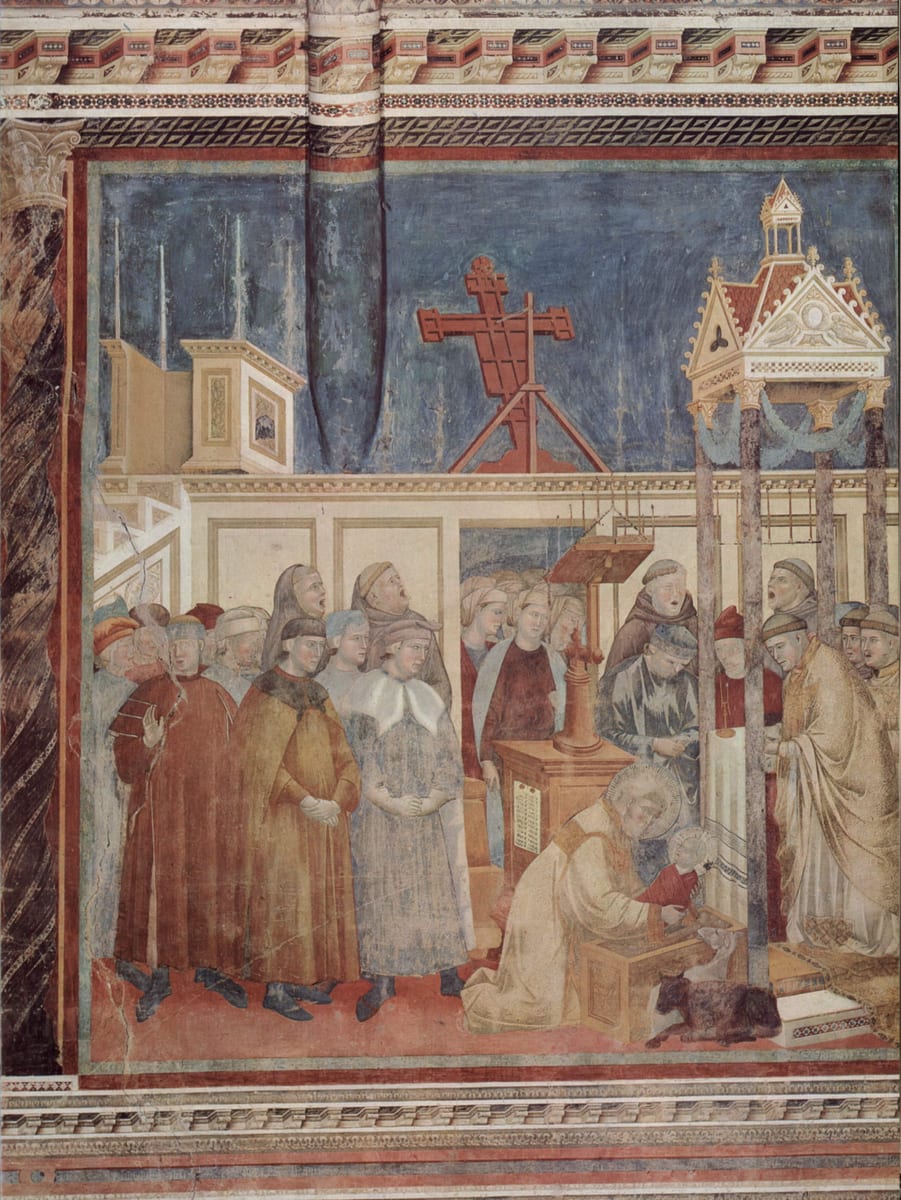
Legend of St. Francis, scene 13: Institution of the Crib at Greccio, Giotto di Bondone and workshop, 1296–1298 AD Giotto di Bondone and workshop, Upper Church, Basilica of San Francesco, Assisi News reached St. Francis in the East that his vicars had imposed fasts the rule never required. At the Michaelmas chapter of 1220 AD he handed the direction of the order to Peter of Cattaneo. The friars could not restrain their tears.
Pope Honorius III sealed the Rule of the Friars Minor on November 29, 1223 AD. That Christmas he had a manger, hay, an ox and an ass made ready at Greccio. Being a deacon, he chanted the Gospel over the manger and preached on the birth of the poor King.
“If thou wilt that we celebrate the present festival of the Lord at Greccio, make haste to go before and diligently prepare what I tell thee. For I would make memorial of that Child who was born in Bethlehem, and in some sort behold with bodily eyes His infant hardships; how He lay in a manger on the hay, with the ox and the ass standing by.”
St. Francis of Assisi, December 1223 AD -
1224–1225 AD
The seraph on La Verna
He came down the mountain with the wounds of the Crucified, and made a song of praise when he could no longer see.
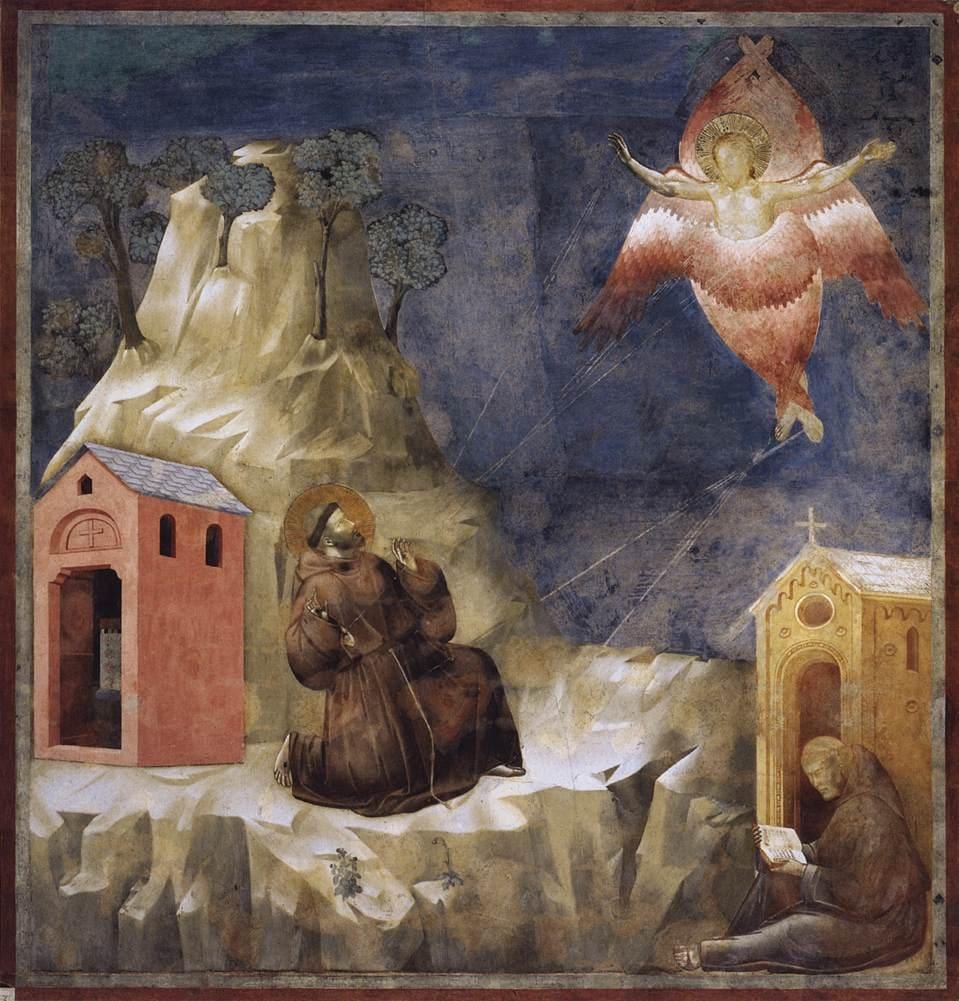
Legend of St. Francis, scene 19: Stigmatization of St. Francis, Giotto di Bondone, 1297–1300 AD Giotto di Bondone, Upper Church, Basilica of San Francesco, Assisi Praying on Mount La Verna in September 1224 AD, St. Francis saw a six-winged seraph bearing the figure of a man crucified. The stigmata opened in his hands, in his feet and in his right side. He hid the marks, and told the vision only when Brother Illuminato pressed him.
His sight failed, and doctors at Rieti cauterised his head from ear to eyebrow to no purpose. Almost blind, in a hut of reeds in the garden at San Damiano, he made the Canticle of the Creatures.
“Praise be to Thee, my Lord, with all Thy creatures, / Especially to my worshipful brother sun, / The which lights up the day, and through him dost Thou brightness give; / And beautiful is he and radiant with splendor great; / Of Thee, most High, signification gives.”
St. Francis of Assisi, 1225 AD -
1226–1228 AD
Naked on the ground
Carried home under guard, he ended where he had begun, and Rome enrolled him among the saints within two years.
At the bishop's palace in Assisi, John Good, a leech of Arezzo, told him his dropsy was incurable and named the month of his death. He added to the Canticle the verses on the death of the body. In July 1226 AD he was carried home to Assisi by a roundabout road, away from Perugia.
He had himself borne down to the Porziuncola, where the order had begun. He took off his habit, lay down naked on the bare ground, and died on the evening of October 3, 1226 AD. Pope Gregory IX numbered him among the saints at Assisi on July 16, 1228 AD.
“I have done my duty, may Christ teach you yours.”
St. Francis of Assisi, October 3, 1226 AD


_007.jpg)

Pray with the Church
Prayer to Obtain Divine Love
A prayer of St. Francis whose authenticity rests on St. Bernardine of Siena and Ubertino da Casale and is accepted by the Quaracchi editors; translated by Paschal Robinson OFM, 1906 AD.
I beseech Thee, O Lord, that the fiery and sweet strength of Thy lovemay absorb my soul from all things that are under heaven,that I may die for love of Thy loveas Thou didst deign to die for love of my love.
All 12 reports on Saint Francis of Assisi

Every church named for St. Francis offers a plenary indulgence until January

About this picture
AI-generated image, in the manner of buon fresco of the Assisi cycle, from the paper's reference portrait based on Legend of St. Francis, scene 19: Stigmatization of St. Francis (Giotto di Bondone, 1297–1300 AD, Upper Church, Basilica of San Francesco, Assisi) View source artwork.
St. Francis dies in a borrowed habit, after lying naked on the earth

St. Clare's sisters kiss St. Francis's wounded hands at their choir window

About this picture
AI-generated image, in the manner of the Assisi frescoes of Cimabue and Giotto, from the paper's reference portrait based on Legend of St. Francis, scene 19: Stigmatization of St. Francis (Giotto di Bondone, 1297–1300 AD, Upper Church, Basilica of San Francesco, Assisi) View source artwork.
St. Francis kneels on the mountain path to say goodbye to La Verna

About this picture
AI-generated image, in the manner of buon fresco of the Assisi cycle, from the paper's reference portrait based on Legend of St. Francis, scene 13: Institution of the Crib at Greccio (Giotto di Bondone and workshop, 1296–1298 AD, Upper Church, Basilica of San Francesco, Assisi) View source artwork.
St. Francis lies at a friar's feet and promises to obey him

Before the bishop, St. Francis returns his father's money and his clothes

About this picture
AI-generated image, in the manner of buon fresco at Assisi, from the paper's reference portrait based on Legend of St. Francis, scene 13: Institution of the Crib at Greccio (Giotto di Bondone and workshop, 1296–1298 AD, Upper Church, Basilica of San Francesco, Assisi) View source artwork.
Pope Honorius III sets a year's wait on joining St. Francis's friars

About this picture
AI-generated image, in the manner of medieval Italian fresco painting of the Assisi cycle, from the paper's reference portrait based on Legend of St. Francis, scene 19: Stigmatization of St. Francis (Giotto di Bondone, 1297–1300 AD, Upper Church, Basilica of San Francesco, Assisi) View source artwork.
On La Verna, the wounds of Christ open in St. Francis's flesh

About this picture
AI-generated image, in the manner of buon fresco on lime plaster of the Assisi cycle, from the paper's reference portrait based on Legend of St. Francis, scene 1: Homage of a Simple Man (Giotto di Bondone, 1296–1298 AD, Upper Church, Basilica of San Francesco, Assisi) View source artwork.

Saint Francis of Assisi goes home after a year in Perugia's prison

About this picture
AI-generated image, in the manner of buon fresco of the Assisi cycle, from the paper's reference portrait based on Legend of St. Francis, scene 1: Homage of a Simple Man (Giotto di Bondone, 1296–1298 AD, Upper Church, Basilica of San Francesco, Assisi) View source artwork.
Saint Francis sold cloth. Perugia locked him in with knights.

About this picture
AI-generated image, in the manner of buon fresco of the Assisi cycle, from the paper's reference portrait based on Legend of St. Francis, scene 19: Stigmatization of St. Francis (Giotto di Bondone, 1297–1300 AD, Upper Church, Basilica of San Francesco, Assisi) View source artwork.
Blind at San Damiano, St. Francis makes the Praises of the Creatures

About this picture
AI-generated image, in the manner of buon fresco of the Assisi cycle, from the paper's reference portrait based on Frater Franciscus — bust detail of the portrait of St. Francis in the Sacro Speco (Anonymous, attributed to a Benedictine of Subiaco, c. 1224–1229 AD, Monastero del Sacro Speco, Subiaco) View source artwork.
