
Saints The Poor Ladies of San Damiano
Saint Clare of Assisi
Feast 11 August · Born 1194 AD, Assisi, Umbria, Italy · Died 1253 AD, San Damiano, below the walls of Assisi, Umbria, Italy
She left a knight's house at eighteen for a repaired church below the walls of Assisi, and never moved again.
Begin the life
In brief
Saint Clare of Assisi was born into a knightly family of the city, in the valley of Spoleto. She left her father's house at eighteen and lived the rest of her life at San Damiano. Pope Benedict XVI names her the first woman in the Church to write a rule a pope approved.
-
Before 1212 AD
The knight's daughter
A rich child who sent the food out of the house, and refused the marriage her family arranged.
St. Clare learned the rudiments of the faith from her mother, Ortolana. Her family was among the nobles of Assisi exiled to Perugia in the years 1198–1210 AD. From the abundance of her father's house she sent food out secretly to hungry orphans.
Having no prayer-beads, she counted her Our Fathers on a heap of pebbles. Under her soft and costly clothes she wore a little hair shirt. When her family pressed a noble marriage on her, she refused and commended her virginity to God.
-
March 1212 AD
The palm, and the walled-up door
The bishop came down the sanctuary steps to her, and that night she broke a way out of her father's house.
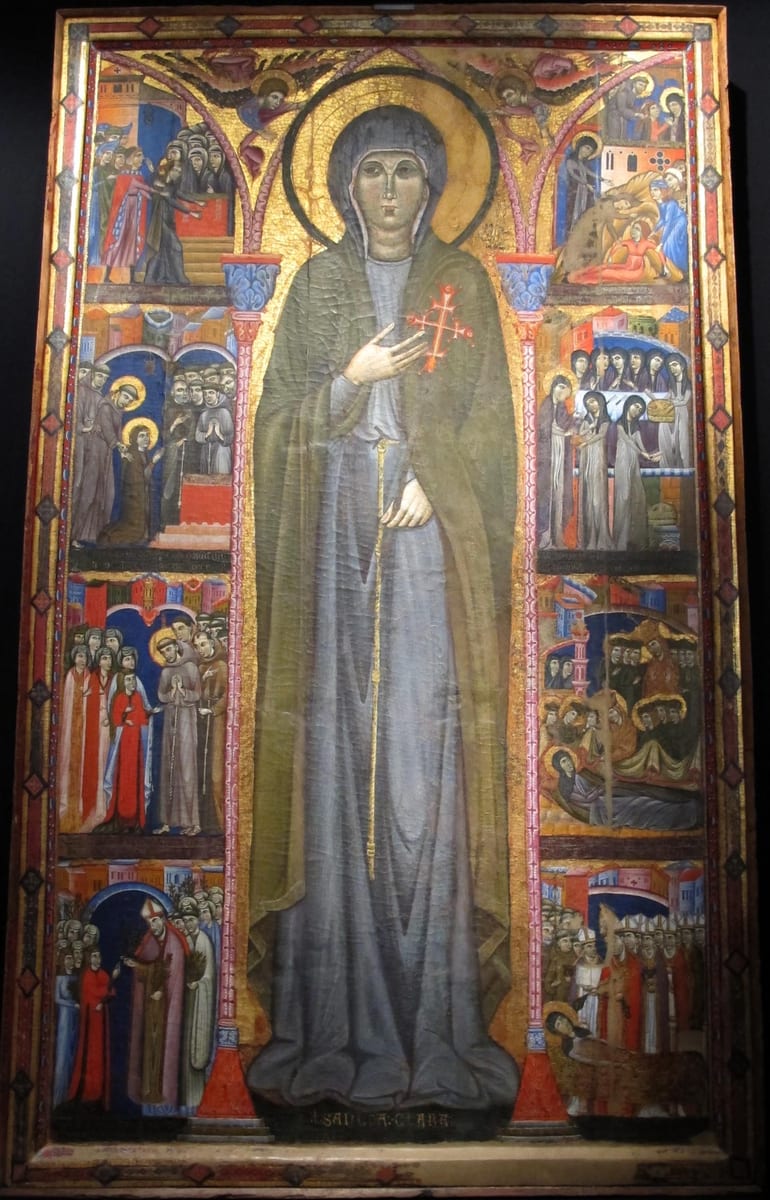
Santa Chiara e otto storie della sua vita (St Clare and eight scenes from her life), Maestro di Santa Chiara, 1283 AD (painted in the pontificate of Martin IV, 1281-1285 AD, per the inscription at the base) Maestro di Santa Chiara, Basilica di Santa Chiara, Assisi (left transept, right wall; originally on the pergola of the high altar). Photograph by Sailko, April 1, 2012 AD. St. Francis told her to come adorned to the blessing of the palms, and to leave that night. When the rest pressed forward for their branches, she stayed in her place without moving. Bishop Guido II came down from the steps and put a palm into her hands.
That night St. Clare broke open a door walled up with a mass of beams and stones. Friars keeping vigil with lighted torches received her at the Porziuncola. There her hair was shorn and she received the habit of penance.
-
Spring 1212 AD
Her kinsmen come for her
The family fought for both daughters, at the altar of San Paolo and on the slope below Panzo.
St. Francis led her to the Benedictine nuns of San Paolo, near Bastia. Her kinsfolk ran there in a body, using force, harsh counsels and bland promises. She laid hold of the altar cloths, bared her shorn head, and refused to leave the service of Christ.
Sixteen days later her younger sister, St. Agnes of Assisi, came to join her. The next day twelve of the family's men hauled St. Agnes down the slope by her hair. St. Clare prayed, and several men together could not carry the girl across a little brook.
“I give thanks to God, most sweet sister, that He hath hearkened to my solicitude concerning thee.”
St. Clare of Assisi, 1212 AD -
1212–1215 AD
San Damiano
She sold the inheritance, took in the women who came, and accepted the office of abbess only under pressure.
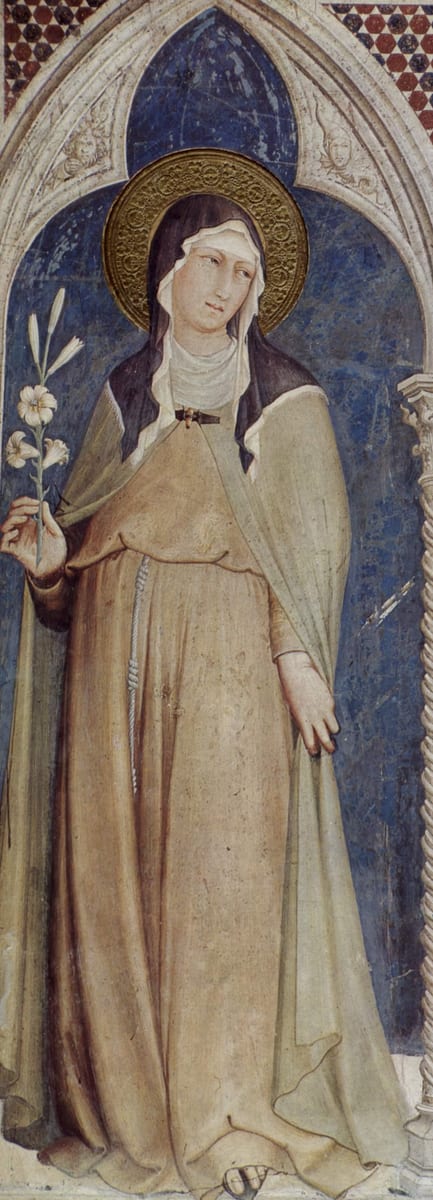
Santa Chiara d'Assisi — single-figure detail of the fresco of St Clare and St Elizabeth of Hungary, Simone Martini (ca. 1284-1344 AD), 1322-1326 AD Simone Martini (ca. 1284-1344 AD), Cappella di San Martino, Lower Basilica of San Francesco, Assisi. Reproduction from The Yorck Project, 10.000 Meisterwerke der Malerei (2002 AD). By the advice of St. Francis she moved to San Damiano, the church he had repaired. She had her paternal inheritance sold and gave the whole price to the poor. Thomas of Celano writes that she spent forty-two years in that narrow retreat.
St. Francis wrote a short form of life for the sisters, which she later copied into her own Rule. Women came from every side, and houses of the same life rose across Italy and Germany. For three years she declined the office of abbess, and took it only when St. Francis urged her.
-
1228–1230 AD
She will not be released
A pope offered to lift her vow, then wrote her the charter no one had asked for before.
Pope Gregory IX pressed her in 1228 AD to accept possessions for the monastery. He offered to release her from her vow of poverty, and she refused. On September 17, 1228 AD he granted that no one might constrain the sisters to receive possessions.
Two years later the same pope barred the friars from her monastery without his leave. St. Clare sent back the questing brothers who fetched the sisters' food as well. Pope Gregory IX at once mitigated the prohibition.
“Holy Father, never do I wish to be released in anywise from following Christ forever.”
St. Clare of Assisi, 1228 AD -
1234–1238 AD
Letters to Prague
A king's daughter in Bohemia was under the same pressure, and St. Clare wrote to her about it.
St. Agnes of Prague, daughter of the king of Bohemia, refused marriage to the Emperor Frederick II. She founded a monastery at Prague and asked for the form of life of San Damiano. St. Clare wrote to her four times, and the four letters survive.
Pope Gregory IX conceded an endowed hospital and all its revenues to the Prague house. St. Clare told her to stand by the vocation she had begun, whoever advised otherwise. In 1238 AD the pope granted the Prague sisters their own privilege of poverty.
“Indeed, if someone tells you something else or suggests anything to you that may hinder your perfection and that seems contrary to your divine vocation, even though you must respect him, still, do not follow his advice”
St. Clare of Assisi, 1235–1238 AD -
The imperial wars in Umbria
Soldiers at the door
Troops of the Emperor Frederick II got into the cloister, and St. Clare, who was ill, was carried out to meet them.
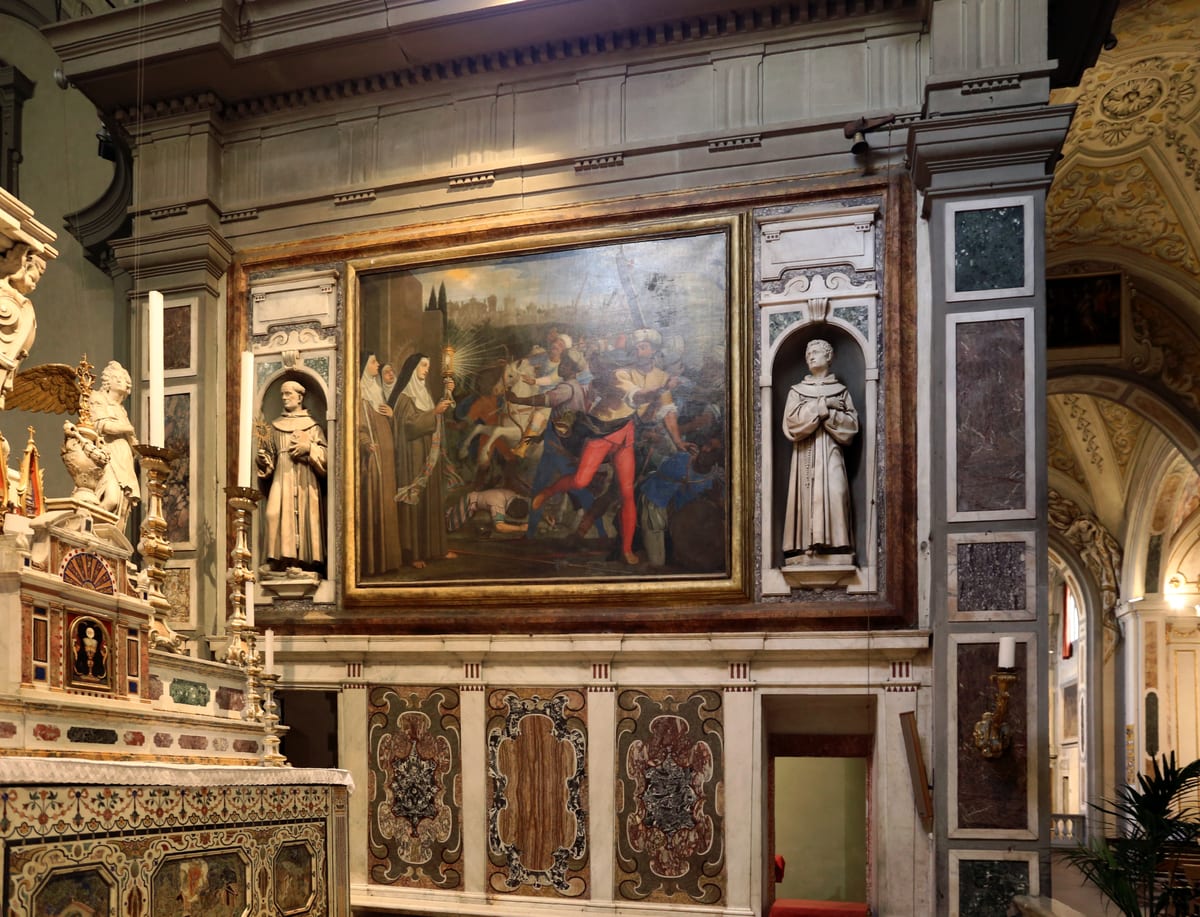
Santa Chiara che mette in fuga i saraceni (St Clare puts the Saracens to flight), Cosimo Gamberucci, ca. 1605 AD Cosimo Gamberucci, Chiesa di Ognissanti, Florence (cappella maggiore). Photograph by Sailko, August 30, 2017 AD. Saracen archers and imperial soldiers under the Emperor Frederick II laid waste the valley of Spoleto. They broke into the cloister at San Damiano. St. Clare was ill, and had herself carried to the door with the Blessed Sacrament before her.
She prayed for the handmaids she could not defend, and the attackers went back down the walls. When Vitalis d'Aversa afterwards besieged Assisi, she put ashes on her own bare head and on her sisters'. By the next morning the besieging army had broken up.
“From this city, dearest daughters, we have daily received many benefits: it would be most ungrateful if we were not to aid it so far as we can in the time of its need.”
St. Clare of Assisi, 1241 AD -
1252–1253 AD
The last Christmas, and the last days
Alone in her sickbed she heard the office two kilometres off; a pope confirmed her Rule two days before she died.
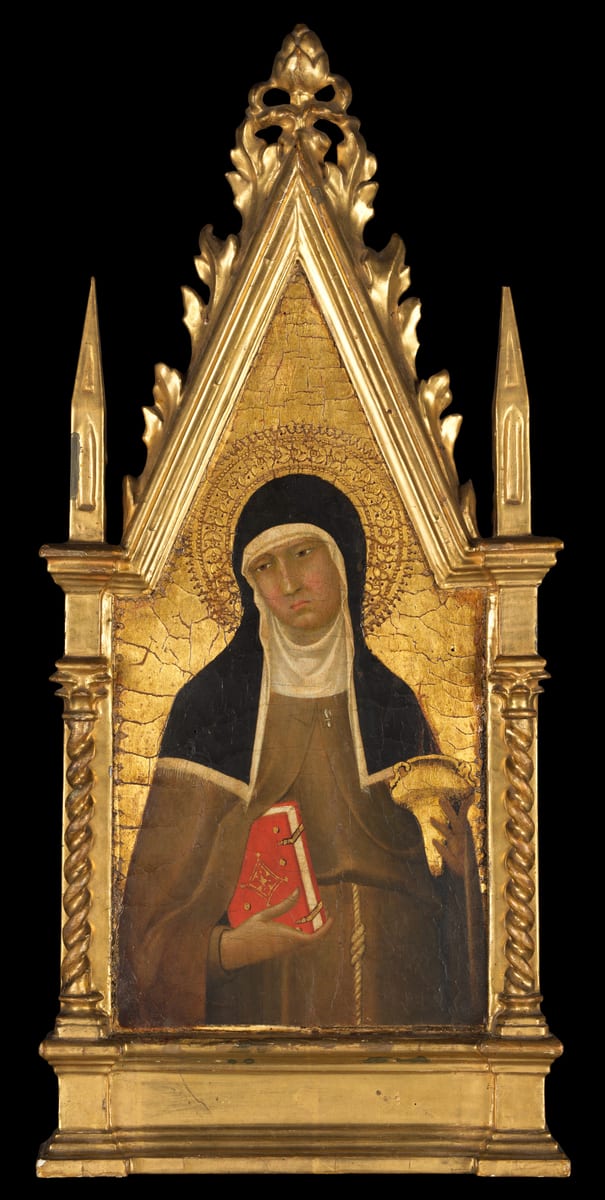
Saint Clare, Lippo Memmi (Filippo di Memmo), Italian, Sienese, active by 1317 AD, died 1356 AD, ca. 1330 AD Lippo Memmi (Filippo di Memmo), Italian, Sienese, active by 1317 AD, died 1356 AD, The Metropolitan Museum of Art, New York; Gift of Irma N. Straus, 1964 AD (acc. 64.189.4). Tempera on wood, gold ground; painted surface 39.4 x 19.1 cm. A pinnacle of the altarpiece painted ca. 1325-1330 AD for San Francesco, San Gimignano. On Christmas night the sisters went to Matins and left St. Clare alone, weighed down with illness. She heard the friars chanting the psalter in San Francesco, two kilometres away, and the organ with them.
Pope Innocent IV confirmed the Rule she had written on August 9, 1253 AD. A contemporary hand wrote on the back of the parchment that she touched and kissed it many times. She died toward dawn at San Damiano on August 11, 1253 AD.
“Go forth without fear. For thou hast a good guide for thy journey. Go forth, for He who created thee hath sanctified thee and, protecting thee always, loveth thee with a love as tender as that of a mother for her son. Blessed be Thou, Lord, who hast created me.”
St. Clare of Assisi, August 11, 1253 AD


.JPG)

Pray with the Church
The prayer of St. Clare at the door of San Damiano
Her own words, prayed before the Blessed Sacrament at the door of the monastery when imperial troops broke into the cloister, recorded in the Life of Saint Clare written at the command of Pope Alexander IV after her canonization, its author having had recourse to the community of the virgins of Christ who lived with her.
Doth it please Thee, my Lord, to deliver Thy defenceless handmaids, whom I have nourished with Thy love, into the hands of the pagans?Defend, O Lord, I beseech Thee, these Thy servants whom I in this hour am unable to defend.
All 10 reports on Saint Clare of Assisi

St. Clare's sisters kiss St. Francis's wounded hands at their choir window

About this picture
AI-generated image, in the manner of an Umbrian panel painting in egg tempera on poplar, from the paper's reference portrait based on Santa Chiara d'Assisi — single-figure detail of the fresco of St Clare and St Elizabeth of Hungary (Simone Martini, 1322-1326 AD, Cappella di San Martino, Lower Basilica of San Francesco, Assisi) View source artwork.
St. Clare gives up her sisters' bread, and Pope Gregory IX backs down

About this picture
AI-generated image, in the manner of a pencil-and-wash drawing on toned paper.
Pope Alexander IV declares St. Clare a saint and fixes her feast

About this picture
AI-generated image, in the manner of a nineteenth-century reportage drawing in brush and ink with grey and umber wash.
Assisi digs under its own high altar and finds St. Clare's coffin

About this picture
AI-generated image, in the manner of an Umbrian panel painting in egg tempera on poplar over a burnished, tooled gold ground, from the paper's reference portrait based on Santa Chiara d'Assisi — single-figure detail of the fresco of St Clare and St Elizabeth of Hungary (Simone Martini, 1322-1326 AD, Cappella di San Martino, Lower Basilica of San Francesco, Assisi) View source artwork.
Pope bars anyone from forcing property on St. Clare's sisters

About this picture
AI-generated image, in the manner of an Umbrian panel painting in egg tempera on poplar over a burnished, tooled gold ground, from the paper's reference portrait based on Saint Clare (Lippo Memmi, ca. 1330 AD, The Metropolitan Museum of Art, New York) View source artwork.
Cardinal approves the rule St. Clare wrote for her own sisters

About this picture
AI-generated image, in the manner of an Umbrian panel painting in egg tempera on poplar over a burnished, tooled gold ground, from the paper's reference portrait based on Saint Clare (Lippo Memmi, ca. 1330 AD, The Metropolitan Museum of Art, New York, acc. 64.189.4) View source artwork.
St. Clare, dying, asks a cardinal for the right to own nothing

About this picture
AI-generated image, in the manner of an Umbrian panel painting in egg tempera on poplar over a burnished, tooled gold ground, from the paper's reference portrait based on Santa Chiara d'Assisi — single-figure detail of the fresco of St Clare and St Elizabeth of Hungary (Simone Martini, 1322-1326 AD, Cappella di San Martino, Lower Basilica of San Francesco, Assisi) View source artwork.
Soldiers scale the convent wall; St. Clare is carried to the door

About this picture
AI-generated image, in the manner of buon fresco of the Assisi cycle, from the paper's reference portrait based on Legend of St. Francis, scene 19: Stigmatization of St. Francis (Giotto di Bondone, 1297–1300 AD, Upper Church, Basilica of San Francesco, Assisi) View source artwork.

Blind at San Damiano, St. Francis makes the Praises of the Creatures

About this picture
AI-generated image, in the manner of an Umbrian panel painting in egg tempera on poplar over a burnished, tooled gold ground, from the paper's reference portrait based on Santa Chiara e otto storie della sua vita (Maestro di Santa Chiara, 1283 AD, Basilica di Santa Chiara, Assisi; photograph by Sailko, CC BY-SA 3.0) View source artwork.