
Saints Apostle and martyr · Feast November 30
Saint Andrew the Apostle
Feast 30 November · Born Bethsaida, Galilee · Died Patras, Achaia, Greece
A Galilean fisherman left St. John the Baptist to follow Jesus, brought his brother St. Peter to him and was sent out to all nations, and Catholic Tradition holds that he died on a cross at Patras.
Begin the life
In brief
Saint Andrew the Apostle, also called Andrew the First-Called, was a fisherman of Bethsaida in Galilee and the brother of St. Peter. He was the first of the Apostles to follow Jesus, and he brought his brother to him. According to longstanding Catholic Tradition, he died on a cross at Patras in Greece on November 30, the day the Church keeps his feast.
-
At the Jordan, first century AD
The first called
A disciple of St. John the Baptist follows Jesus, spends the day with him and goes to find his brother.
St. Andrew had become a disciple of St. John the Baptist. One day St. John the Baptist pointed to Jesus as the Lamb of God, and St. Andrew and another disciple followed him. Jesus turned, asked what they were looking for, and invited them to come and see. They stayed with him the rest of that day.
The first thing St. Andrew did afterwards was find his brother Simon — St. Peter — and bring him to Jesus. Jesus looked at St. Peter and told him he would be called Cephas. Pope St. Paul VI said this account earned St. Andrew the title of first called.
“We have found the Messiah”
St. Andrew the Apostle to his brother Simon (St. Peter), after his first day with Jesus -
Galilee, first century AD
Called from the nets
Jesus calls two fishermen brothers from their work and comes to their house at Capernaum.
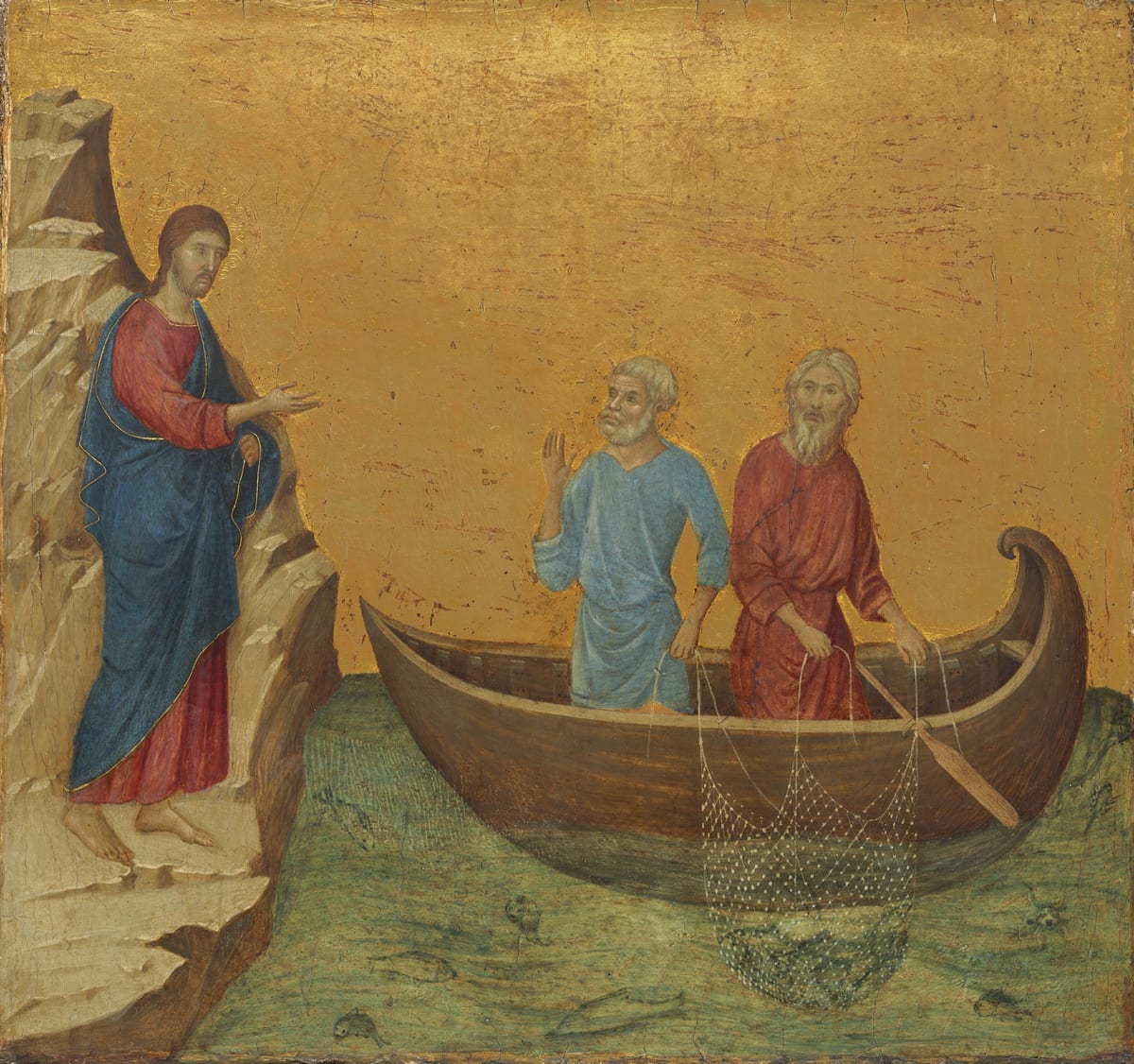
The Calling of the Apostles Peter and Andrew (panel from the predella of the Maestà, Siena Cathedral), Duccio di Buoninsegna, 1308–1311 AD Duccio di Buoninsegna, National Gallery of Art, Washington Later, walking by the Sea of Galilee, Jesus saw the two brothers at work, casting a fishing net into the water. Jesus called them to follow him, and they left their nets at once.
The brothers shared a house at Capernaum. Jesus came there from the synagogue with St. James and St. John, and healed St. Peter's mother-in-law of a fever.
“Follow me, and I will make you fishers of men.”
Jesus to St. Peter and St. Andrew, by the Sea of Galilee, as they cast a net -
Galilee and Jerusalem, first century AD
Among the Twelve
Named among the Twelve, St. Andrew finds a boy with five loaves when a crowd must be fed.
After a night of prayer in the hills, Jesus chose twelve apostles and named St. Andrew among them. The Gospels of St. Matthew and St. Luke list him second, right after his brother; St. Mark's Gospel and the Acts of the Apostles list him fourth. With St. Peter, St. James and St. John, he asked Jesus privately on the Mount of Olives when the Temple would fall.
Near the Passover, with a great crowd to feed, St. Andrew pointed Jesus to a boy who had five barley loaves and two fish. Jesus gave thanks and fed everyone, and twelve baskets of scraps were gathered afterwards. Pope Benedict XVI singled out St. Andrew's realism in noticing the boy and doubting that so little could be enough.
“There is a lad here who has five barley loaves and two fish; but what are they among so many?”
St. Andrew the Apostle to Jesus, before the feeding of the five thousand -
Jerusalem, first century AD
The Greeks, and the upper room
Greeks ask to see Jesus, and after the Ascension St. Andrew prays with the Blessed Virgin Mary in the upper room.
At a feast in Jerusalem, some Greeks who had come to worship asked St. Philip to let them see Jesus. St. Philip told St. Andrew, and the two went together to tell Jesus. Pope Benedict XVI pointed out that St. Andrew spoke Greek, and called him and St. Philip the apostles of the Greeks who came to Jesus.
After the Ascension, the apostles went back to the upper room in Jerusalem where they were staying. St. Andrew prayed there with the others, with the women and with the Blessed Virgin Mary, the mother of Jesus.
“The hour has come for the Son of man to be glorified. Truly, truly, I say to you, unless a grain of wheat falls into the earth and dies, it remains alone; but if it dies, it bears much fruit.”
Jesus, answering St. Andrew and St. Philip to St. Andrew and St. Philip -
After the Ascension, first century AD
Sent to the nations
Early Christian writers place St. Andrew's preaching in Scythia, Thrace and Greece.
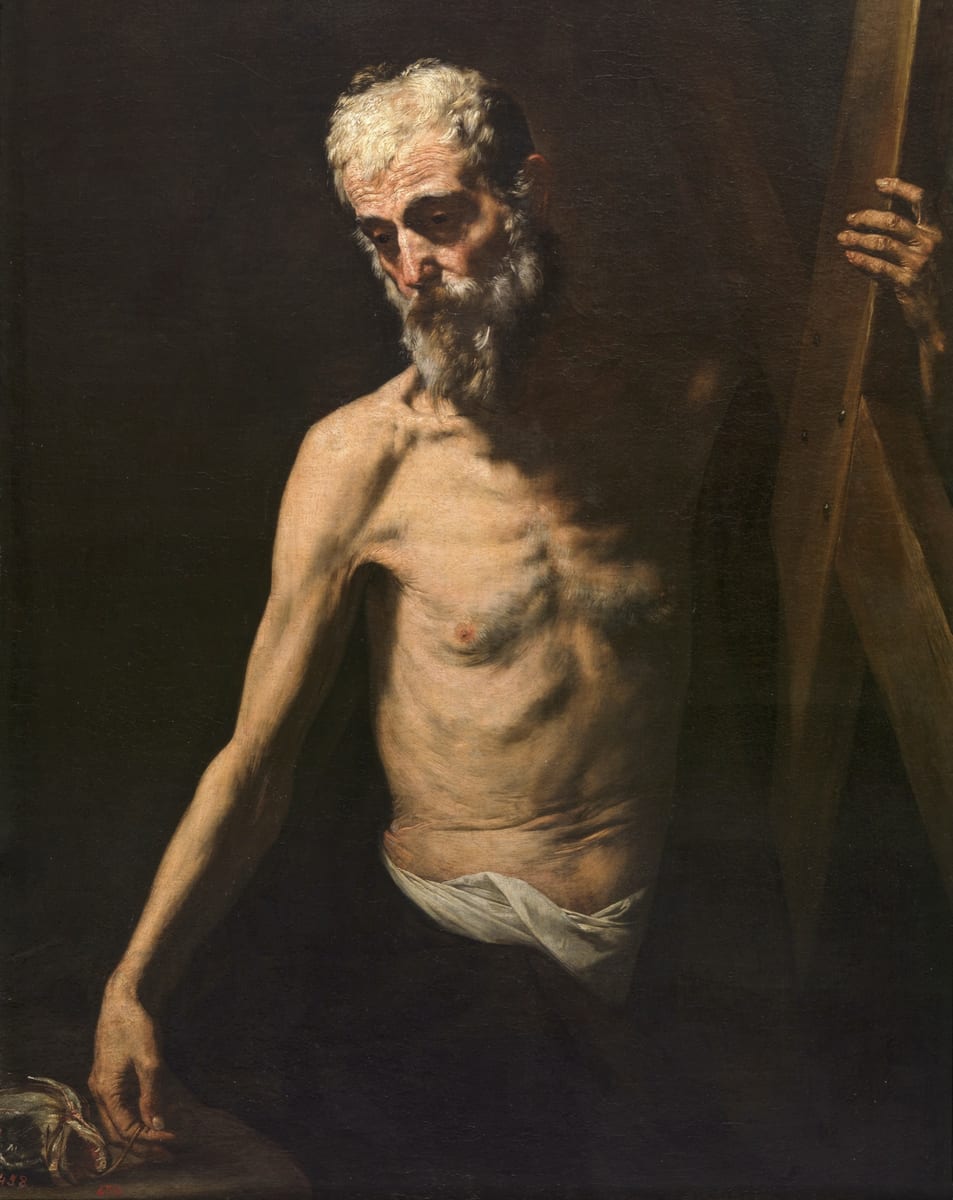
Saint Andrew, Jusepe de Ribera, circa 1630-1632 AD Jusepe de Ribera, Museo Nacional del Prado, Madrid Before his Ascension, the risen Lord sent St. Andrew out with the other apostles to make disciples of all nations. According to Origen, whom Eusebius follows, when the apostles divided the world among them, Scythia, north of the Black Sea, fell to St. Andrew. The Roman Martyrology keeps the Tradition that he preached the Gospel in Thrace and Scythia.
Tradition also sends St. Andrew to Greece: St. Gregory Nazianzen links him with Epirus, and St. Jerome with Achaia. St. Paulinus of Nola wrote that at Argos St. Andrew silenced all the philosophers. Catholic Tradition also places St. Andrew in Asia Minor, south of the Black Sea.
-
Patras, first century AD
The cross by the sea
In Catholic Tradition, a provincial governor angered that his wife had become a Christian sent St. Andrew to a cross on the shore at Patras.
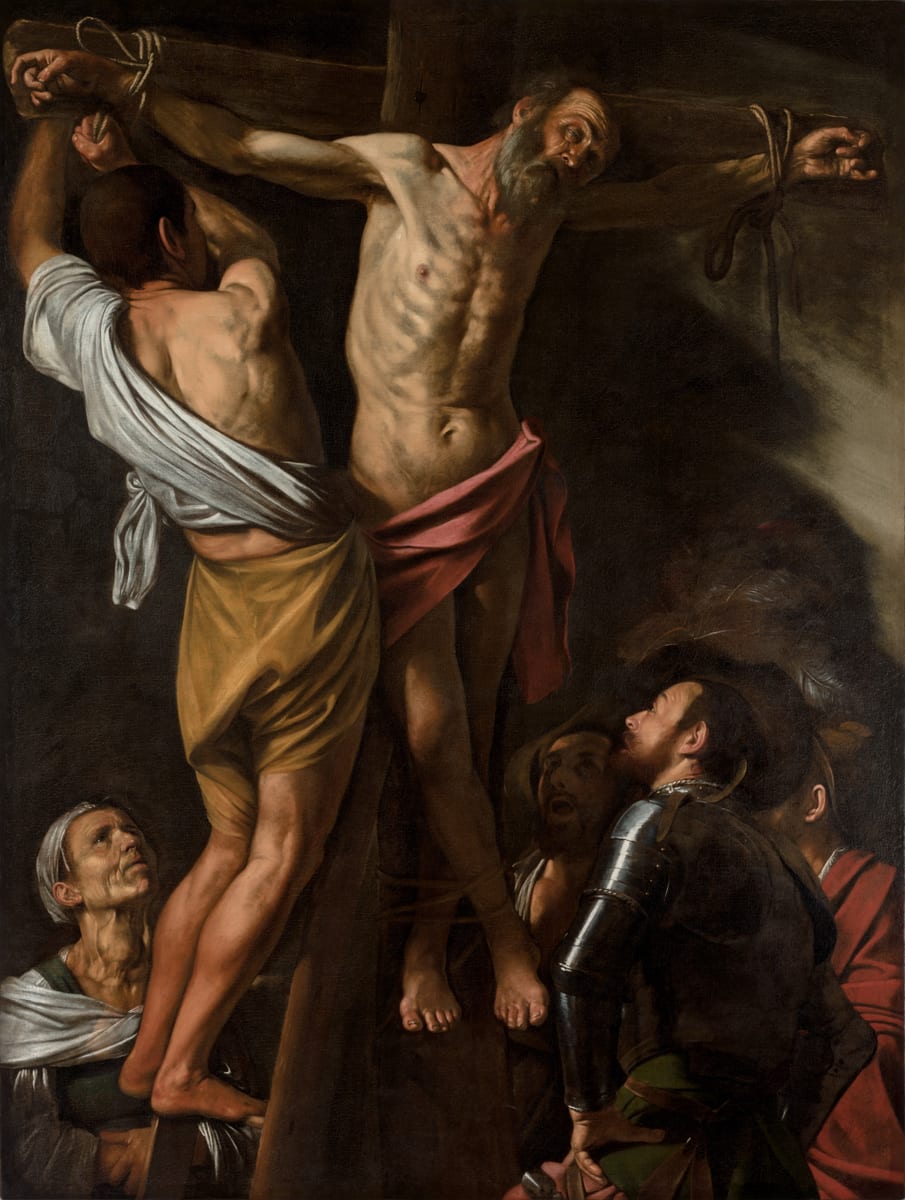
The Crucifixion of Saint Andrew, Caravaggio, 1606–1607 AD Caravaggio, The Cleveland Museum of Art As Catholic Tradition tells it, Aegeates, the governor of the province, came to Patras and began forcing Christians to worship idols. Aegeates was also angry with St. Andrew because the governor's wife, Maximilla, had become a Christian and no longer lived with him. He had St. Andrew imprisoned and scourged, and set up a cross for him at the edge of the sea.
When St. Andrew saw the cross, he went to it and greeted it with joy. Pope Benedict XVI quoted the greeting from a sixth-century text and said it treats the Cross not as an instrument of torture but as the way to become like the Redeemer. The Roman Martyrology records that St. Andrew lived two days on the cross, teaching the people, and died at Patras on November 30.
-
357–1964 AD
The journeys of his relics
His remains go to Constantinople and then Amalfi; his head goes to Rome and, five centuries later, back to Patras.
In 357 AD, St. Andrew's remains were moved from Patras to Constantinople with those of St. Luke. At the start of the thirteenth century AD, after the French took Constantinople, Cardinal Peter of Capua brought them to the cathedral of Amalfi in Italy.
On April 12, 1462 AD, Pope Pius II received St. Andrew's head in Rome. It had been brought from Patras for safety, because an invasion was feared. It was kept at St. Peter's for five centuries. In September 1964 AD, Pope St. Paul VI sent it back to Patras, to Metropolitan Constantine, the Orthodox bishop who had asked for it.
“testimoniare la Nostra venerazione verso la Chiesa greca ortodossa e la Nostra intenzione di aprire ad essa il Nostro cuore fraterno, nella fede e nella carità del Signore (to bear witness to Our veneration for the Greek Orthodox Church and Our intention to open Our brotherly heart to it, in the faith and charity of the Lord)”
Pope Paul VI to the College of Cardinals, June 23, 1964 AD -
1320–2014 AD
Patron of Scotland and of Constantinople
Scotland's nobles name him their protector, and Pope Benedict XVI and Pope Francis each kept his feast with the Patriarch of Constantinople.
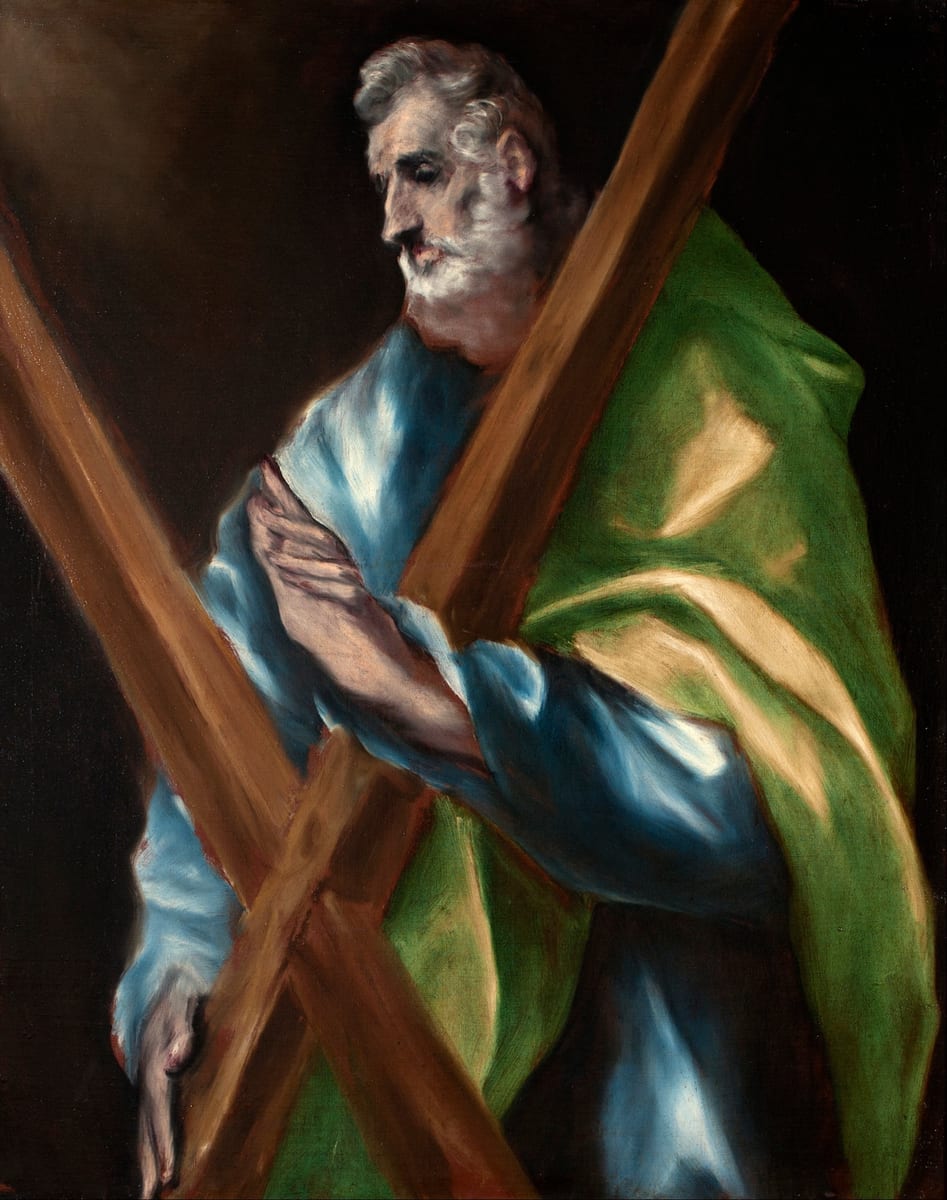
Saint Andrew, from the Apostolado, El Greco, circa 1610-1614 AD El Greco, Museo del Greco, Toledo On April 6, 1320 AD, the earls and barons of Scotland wrote to Pope John XXII from the abbey of Arbroath. Their letter, the Declaration of Arbroath, says Christ confirmed the Scots in the faith through St. Andrew and wished him to protect them for ever. The Scots honour him as their principal patron.
Catholic Tradition holds that St. Andrew founded the Church of Constantinople, as St. Peter founded the Church of Rome, and he is its patron. Pope Benedict XVI kept his feast with Ecumenical Patriarch Bartholomew I at the Phanar in Istanbul on November 30, 2006 AD. Pope Francis joined the Patriarch there for the same feast on November 30, 2014 AD.
“we are helped by the intercession of the Apostle Andrew and his brother Peter, held by tradition to be the founders of the Churches of Constantinople and of Rome. We ask God for the great gift of full unity, and the ability to accept it in our lives. Let us never forget to pray for one another.”
Pope Francis to Patriarch Bartholomew I, November 30, 2014 AD


Pray with the Church
Collect for the Feast of St. Andrew
The Roman Missal, Proper of Saints, November 30
We humbly implore your majesty, O Lord,that, just as the blessed Apostle Andrewwas for your Church a preacher and pastor,so he may be for us a constant intercessor before you.Through our Lord Jesus Christ, your Son,who lives and reigns with you in the unity of the Holy Spirit,God, for ever and ever.