
Saints Bishop and Doctor of the Church · Feast January 2
Saint Gregory Nazianzen
Feast 2 January · Born 330 AD, Arianzus, near Nazianzus, Cappadocia · Died 389 AD, Arianzus, near Nazianzus, Cappadocia
Promised to God before his birth, Saint Gregory Nazianzen fled the priesthood his father, St. Gregory the Elder, forced on him, preached the Trinity to a small flock at Constantinople, resigned its see to make peace among the bishops and died in retirement on his family estate.
Begin the life
In brief
Saint Gregory Nazianzen, also called Gregory of Nazianzus, was a priest and bishop of fourth-century Cappadocia and the lifelong friend of St. Basil the Great. In Constantinople in 380 AD he preached the five Theological Orations on the Trinity. He is known as the Theologian, and the Church keeps his memory with St. Basil on January 2.
-
Childhood · before 340 AD
Promised to God before he was born
His mother vowed him to God, and his father, St. Gregory the Elder, came to the faith through her.
St. Gregory Nazianzen came from Nazianzus, a small town in Cappadocia. His father, St. Gregory the Elder, was bishop there from 329 AD to 374 AD. St. Gregory the Elder had come to the Catholic faith through his wife, St. Nonna.
St. Nonna promised her son to God before he was born. She dedicated him to God as soon as he was born. He was not baptised as a baby.
-
The 340s AD
Unbaptised in a storm at sea
Sailing to Athens as a student, he nearly died without baptism.
As a student sailing from Alexandria to Greece, St. Gregory Nazianzen was caught in a violent storm. He was not yet baptised, and he dreaded dying without the sacrament.
His parents learned of his danger in a vision at night and prayed for him from land. A boy on board thought he saw St. Nonna walk on the sea and drag the ship to land. St. Gregory Nazianzen and his companions vowed to give themselves to God if they lived, and when they came through, they kept that vow.
-
Until 356 AD
About ten years at Athens, with St. Basil
He was reunited with his school friend St. Basil and studied alongside the prince Julian.
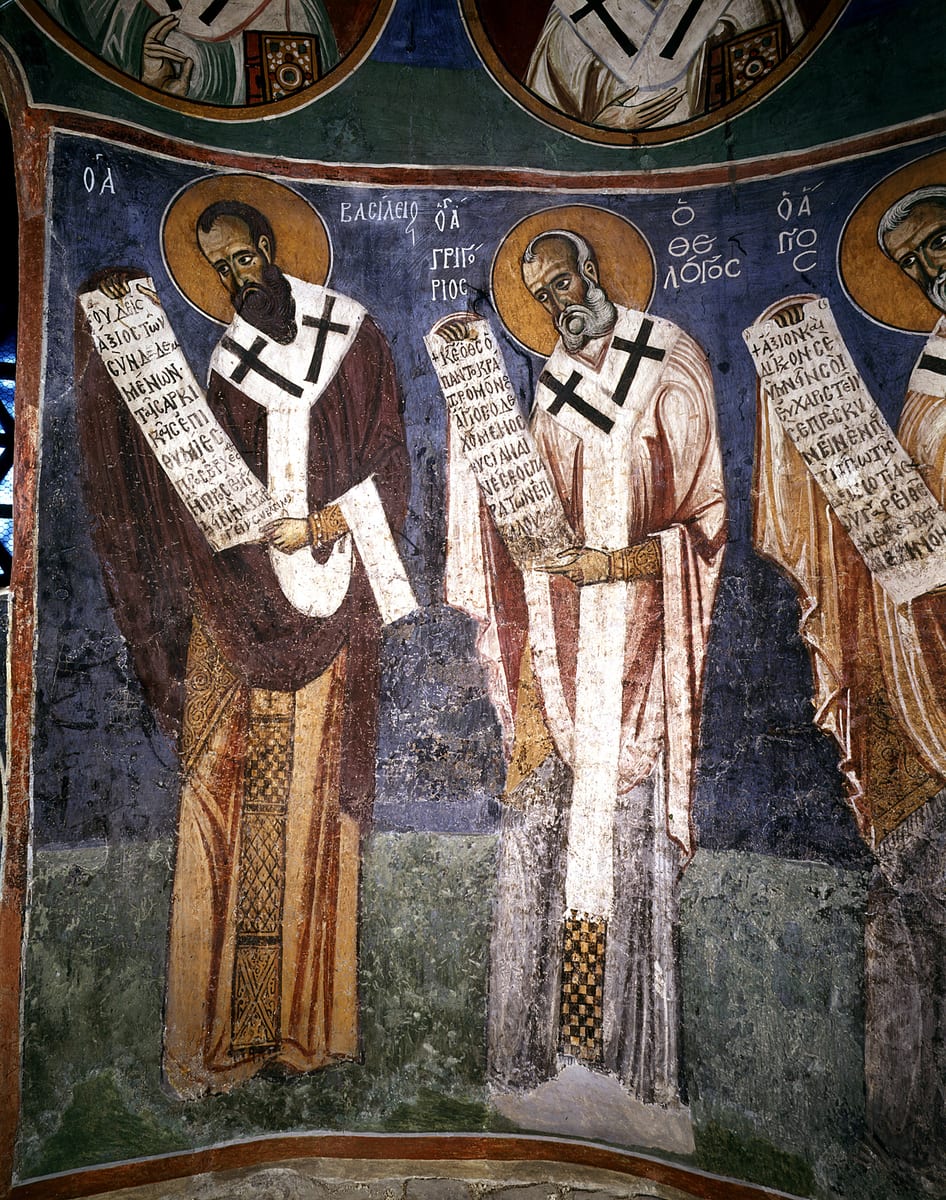
Panagia tou Arakos, Lagoudera, apse wall, south side, lower zone: Sts. Basil and Gregory the Theologian, Byzantine Institute staff, fresco 12th century AD; photographed 1968–1973 AD Byzantine Institute staff, Dumbarton Oaks, Trustees for Harvard University (MSBZ004_BF_T_Lag_B_3_3) At Athens, St. Gregory Nazianzen was reunited with St. Basil. Their friendship had begun at school in Caesarea, the capital of Cappadocia. In Athens the two friends went almost nowhere except to church and to their classes.
In 355 AD the prince Julian, the emperor's nephew, spent some months studying with them. When St. Basil went home first, the other students did all they could to keep St. Gregory Nazianzen at Athens. He set out for home in 356 AD, at about thirty.
-
356–362 AD
Ordained against his will
His father, St. Gregory the Elder, made him a priest in front of the congregation, and he ran.
Back at Nazianzus, St. Gregory Nazianzen was baptised and turned to the monastic life. He lived on bread, salt and water, slept on the ground and prayed through much of the night. He spent several years with St. Basil in a monastic retreat in Pontus.
On a great feast, probably Christmas 361 AD, his father, St. Gregory the Elder, ordained him priest before the congregation. He had not expected it, and he fled to St. Basil in Pontus. He came back by Easter 362 AD and preached his first sermon as a priest.
“Ἀναστάσεως ἡμέρα, καὶ ἡ ἀρχὴ δεξιὰ, καὶ λαμπρυνθῶμεν τῇ πανηγύρει, καὶ ἀλλήλους περιπτυξώμεθα (It is the Day of the Resurrection, and my Beginning has good auspices. Let us then keep the Festival with splendour, and let us embrace one another.)”
St. Gregory Nazianzen to the people of Nazianzus, opening his first sermon as a priest, on Easter Sunday -
369–379 AD
The see of Sasima
His brother died; then St. Basil made him bishop of a small town, and his parents and his closest friend died.
His younger brother, St. Caesarius, died suddenly at forty and left his whole estate to the poor. In 372 AD St. Basil, by then bishop of Caesarea, consecrated St. Gregory Nazianzen bishop of the small town of Sasima. That year St. Gregory Nazianzen went back to Nazianzus to share the work of his father, St. Gregory the Elder.
His father, St. Gregory the Elder, died in 374 AD in his hundredth year. St. Nonna died soon after him. St. Basil died on January 1, 379 AD, and a serious illness kept St. Gregory Nazianzen from the funeral.
“Ἐρωτᾷς πῶς τὰ ἡμέτερα. Καὶ λίαν πικρῶς. Βασίλειον οὐκ ἔχω, Καισάριον οὐκ ἔχω, τὸν πνευματικὸν ἀδελφὸν καὶ τὸν σωματικόν. (You inquire how I am; I answer, Very ill. I no longer have Basil, no longer Caesarius—the one my spiritual, the other my natural brother.)”
St. Gregory Nazianzen to Eudoxius, in a letter describing his low spirits -
379–380 AD
A house chapel in a city of Arian churches
He gathered a small flock at Constantinople, preached the Trinity and was enthroned by the emperor.
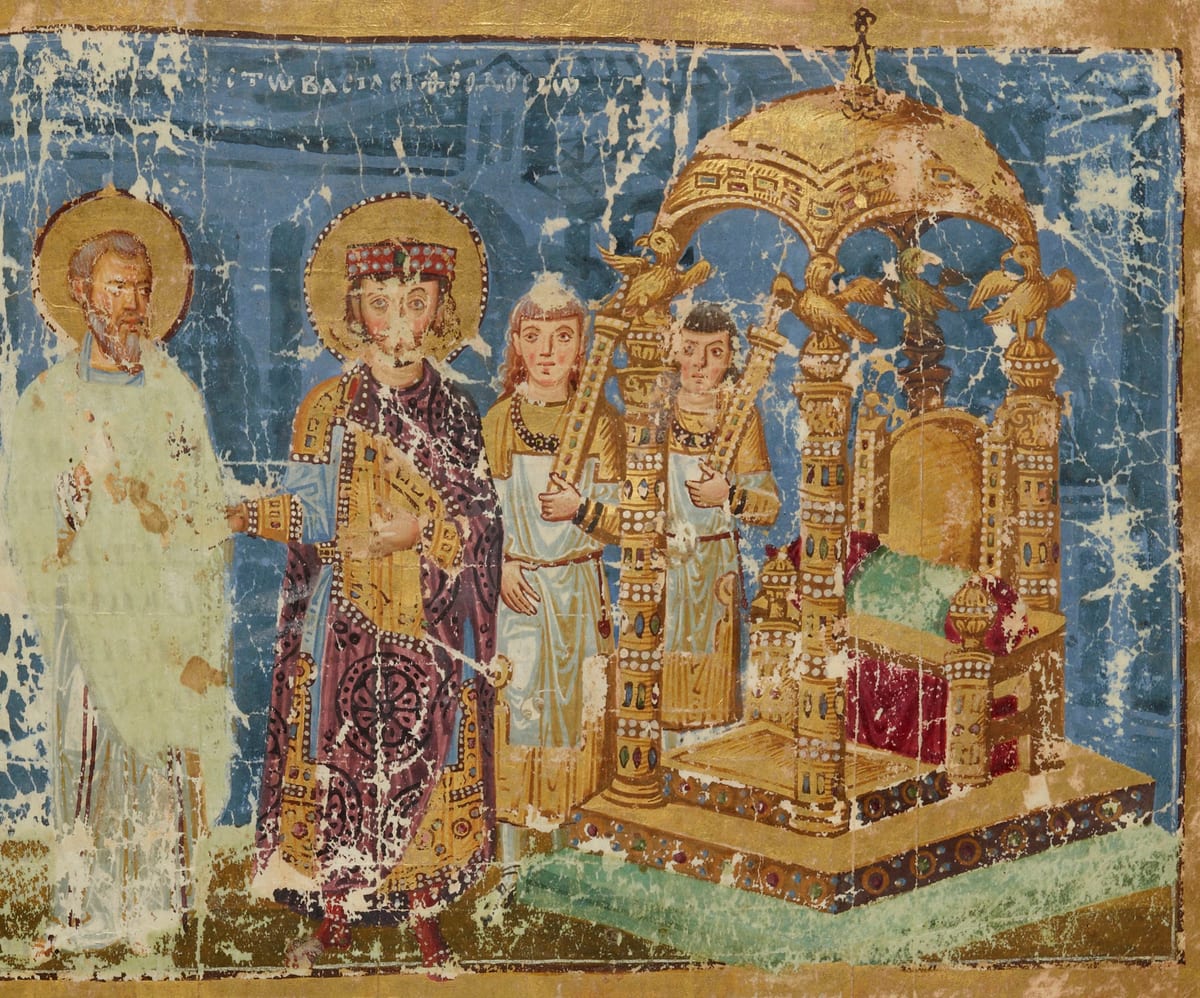
Homilies of St. Gregory Nazianzen, fol. 239r (detail): St. Gregory addresses the Emperor Theodosius I, Anonymous, imperial workshop, Constantinople, 879–883 AD Anonymous, imperial workshop, Constantinople, Bibliothèque nationale de France, Département des manuscrits, MS grec 510 AD; Commons reproduction CC BY-SA 4.0 Early in 379 AD St. Gregory Nazianzen went to Constantinople, the eastern capital. Its churches were held by the Arians, who rejected the faith of the Council of Nicaea. He began in a private house, which became a chapel called the Anastasia.
During 380 AD he preached his five Theological Orations in Constantinople. In November 380 AD the Emperor Theodosius entered the city and banished the Arian bishop, Demophilus. The emperor then led St. Gregory Nazianzen to St. Sophia's, where an immense crowd clapped as he was enthroned.
“Θεὸς τὸ Πνεῦμα; Πάνυ γε. (Is the Spirit God? Yes.)”
St. Gregory Nazianzen, in the Fifth Theological Oration, On the Holy Spirit -
May–June 381 AD
Resigning to end a quarrel among bishops
A council of 150 bishops elected him bishop of Constantinople, and he stepped down for the sake of peace.
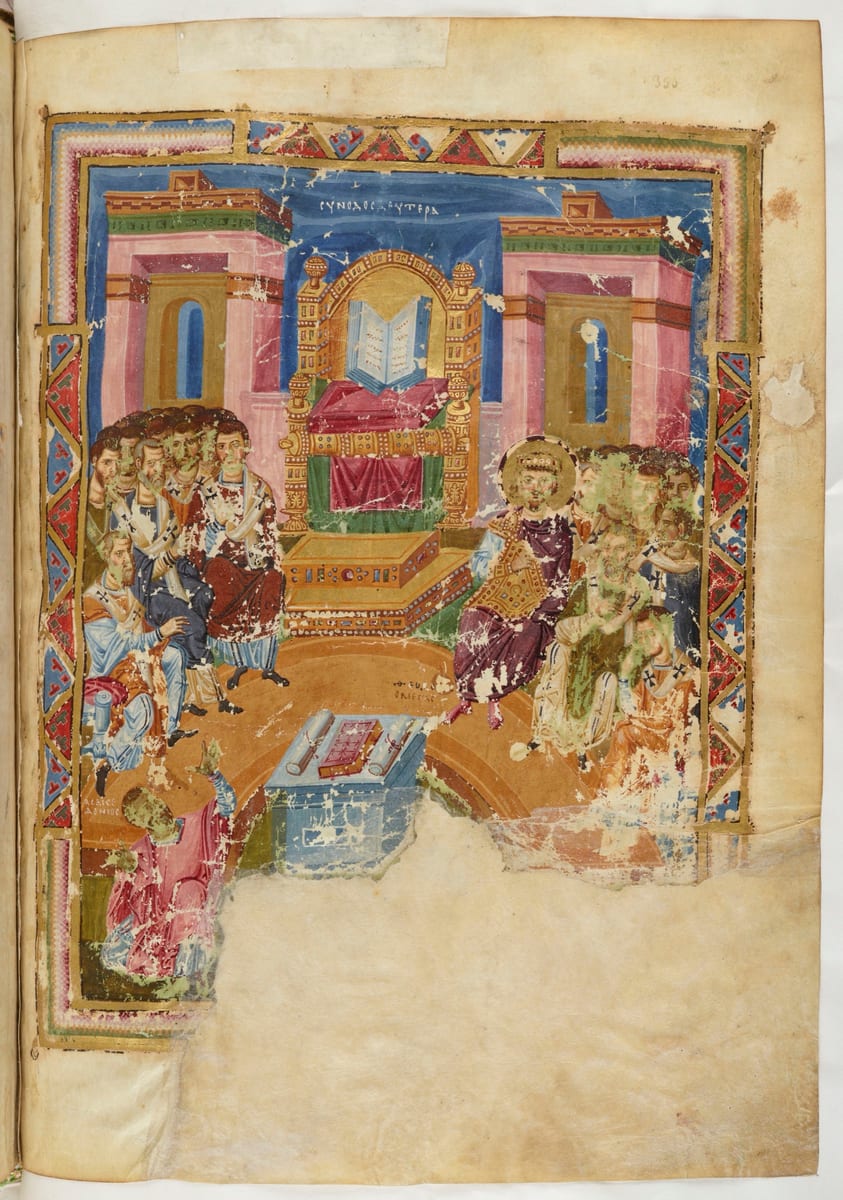
Homilies of St. Gregory Nazianzen, fol. 355r: the First Council of Constantinople (381 AD), Bibliothèque nationale de France (Gallica), 879–883 AD Bibliothèque nationale de France (Gallica), BnF, MS grec 510 AD In May 381 AD 150 bishops met at Constantinople to confirm the faith of Nicaea and choose the city's bishop. They elected St. Gregory Nazianzen, and St. Meletius of Antioch led his consecration. St. Meletius died soon afterwards, and the Council chose his successor at Antioch over St. Gregory Nazianzen's objection.
When the bishops from Egypt challenged his position, many of the bishops broke with them and celebrated the liturgy with him. He resigned, asking the bishops to put agreement among themselves above any wrong done to one man. In June 381 AD he preached his farewell before the Council and an overflowing congregation.
“Εἰ δὲ δυναστείαν ἠγάπησα, ἢ θρόνων ὕψος, ἢ βασιλέων πατεῖν αὐλὰς, μηδὲ ἄλλο τι λαμπρὸν ἔχοιμι, ἢ ῥίψαιμι κεκτημένος. (And if I have loved power, or the height of a throne, or to tread Kings' courts, may I never possess any distinction, or if I gain it, may I be hurled from it.)”
St. Gregory Nazianzen to the assembly at Constantinople, in his farewell oration -
381–389 or 390 AD
A silent Lent, then retirement to Arianzus
He refused a summons to another synod, kept a silent Lent and died on his family estate.
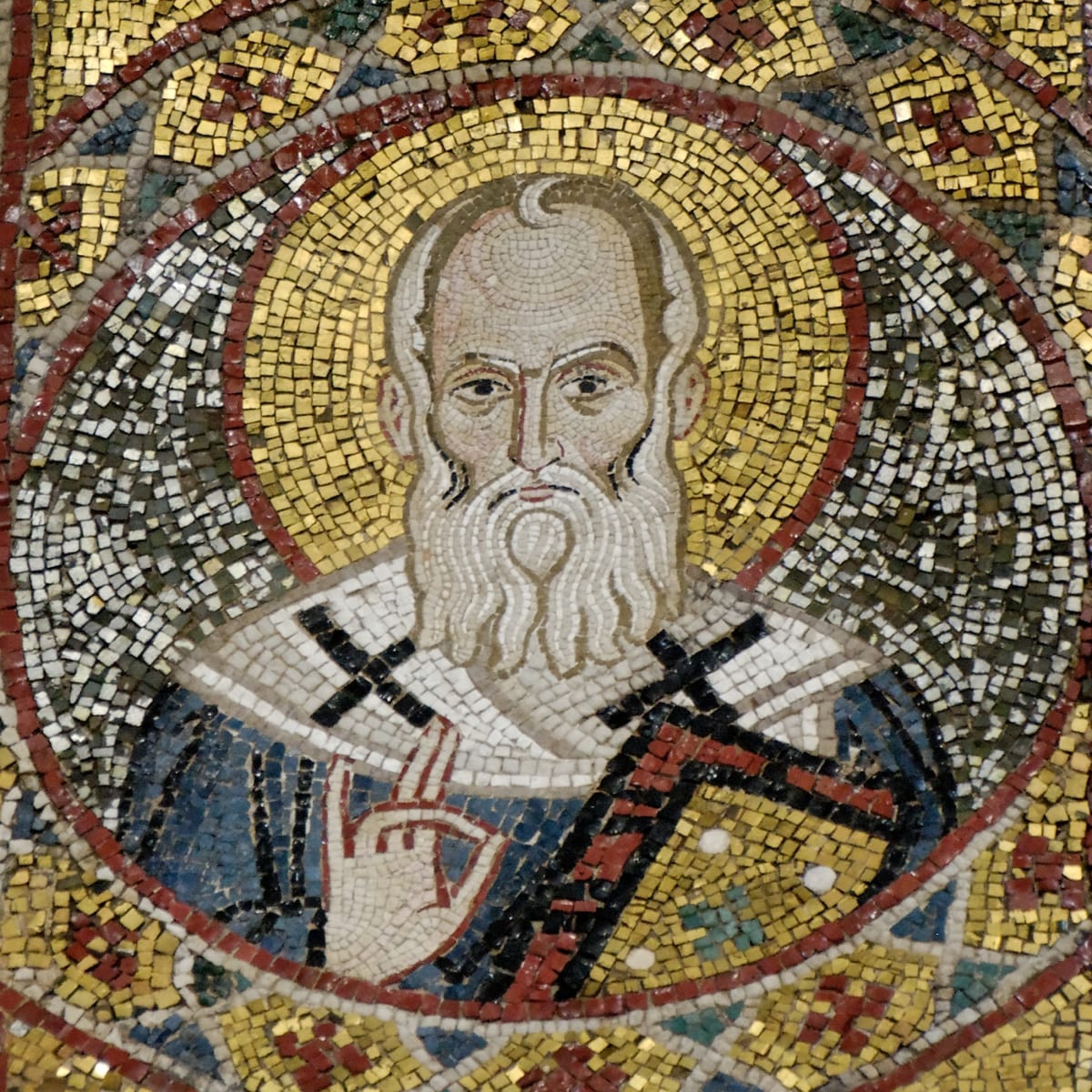
St. Gregory the Theologian, mosaic medallion, eastern arch (northern side) of the transept crossing, Santa Maria dell'Ammiraglio (La Martorana), Palermo, Anonymous Byzantine mosaicists; photograph by Marie-Lan Nguyen (Jastrow), 12th century AD (photographed August 27, 2008 AD) Anonymous Byzantine mosaicists; photograph by Marie-Lan Nguyen (Jastrow), Santa Maria dell'Ammiraglio (La Martorana), Palermo; photograph © Marie-Lan Nguyen / Wikimedia Commons, CC BY 2.5 St. Gregory Nazianzen went home to Cappadocia, probably in June 381 AD. Summoned to another synod at Constantinople in 382 AD, he refused to go. That year he kept the forty days of Lent in complete silence.
Late in 383 AD, once Eulalius had been chosen bishop of Nazianzus at his request, he moved for good to his family estate at Arianzus. He gathered his letters for his nephew by marriage, Nicobulus, and placed St. Basil's first. He died at Arianzus in 389 AD or 390 AD.


Pray with the Church
Prayer at the close of the Second Oration on Easter
Written by St. Gregory Nazianzen as the closing prayer of Oration XLV, the Second Oration on Easter; English translation by Charles Gordon Browne and James Edward Swallow, Nicene and Post-Nicene Fathers, Second Series, vol. VII (1894 AD).
O Pascha, great and holy and purifier of all the world--for I will speak to thee as to a living person--O Word of God and Light and Life and Wisdom and Might--for I rejoice in all Thy names--O Offspring and Expression and Signet of the Great Mind;O Word conceived and Man contemplated, Who bearest all things, binding them by the Word of Thy power;receive this discourse, not now as firstfruits, but perhaps as the completion of my offerings, a thanksgiving, and at the same time a supplication, that we may suffer no evil beyond those necessary and sacred cares in which our life has been passed;and stay the tyranny of the body over us; (Thou seest, O Lord, how great it is and how it bows me down) or Thine own sentence, if we are to be condemned by Thee.But if we are to be released, in accordance with our desire, and be received into the Heavenly Tabernacle, there too it may be we shall offer Thee acceptable Sacrifices upon Thine Altar, to Father and Word and Holy Ghost;for to Thee belongeth all glory and honour and might, world without end.Amen.
All 1 report on Saint Gregory Nazianzen

About this picture
AI-generated image, in the manner of a Middle Byzantine wall mosaic, from the paper's reference portrait based on St. Gregory the Theologian, mosaic medallion, La Martorana (anonymous Byzantine mosaicists, 12th century AD, Santa Maria dell'Ammiraglio (La Martorana), Palermo; photograph Marie-Lan Nguyen / Wikimedia Commons, CC BY 2.5) View source artwork.