
Saints Bishop of Caesarea and Doctor of the Church · died 379 AD
Saint Basil the Great
Feast 2 January · Born 330 AD, Caesarea Mazaca (Kayseri), Cappadocia · Died 379 AD, Caesarea in Cappadocia (Kayseri)
Saint Basil the Great went from the schools of Athens to a glen on the river Iris, and from there to the chief see of Cappadocia in the years of the Arian crisis.
Begin the life
In brief
Saint Basil the Great, also called Basil of Caesarea, was born in Cappadocia in about 330 AD. He gave up a career in rhetoric for the ascetic life, and died at Caesarea on January 1, 379 AD, not yet fifty. The Church keeps his memorial with Saint Gregory of Nazianzus on January 2.
-
330–350 AD
The house at Annesi
Born into a Cappadocian household that had already suffered for the faith, and raised in Pontus by his grandmother.
St. Basil was born in Cappadocia in about 330 AD, the eldest of five sons. His father was an advocate and a teacher of rhetoric with a high reputation in Pontus. His mother's father had been impoverished and put to death for Christ.
His grandparents had hidden about seven years in the mountains of Pontus during the persecution. His father died while he was young, and the household moved to Annesi on the river Iris. His grandmother, the elder Macrina, brought him up there, and he learned the Scriptures from infancy.
-
351–356 AD
Athens, and the way home
Athens ended in 356 AD with a celebrated young rhetorician back in Caesarea.
St. Basil went from Caesarea to Constantinople, and on to Athens in 351 AD. He worked through rhetoric, philosophy, astronomy, geometry and medicine. Saint Gregory of Nazianzus spared him the students' hazing, and the two became inseparable.
He came home early in 356 AD and taught rhetoric at Caesarea with success. His brother Saint Gregory of Nyssa remembered him coming home puffed up beyond measure with the pride of oratory. Neocaesarea offered him the teaching of its young men, and he refused.
-
356–358 AD
Roused from sleep
His sister turned him from the lecture hall, and Dianius baptized him at Caesarea.
His sister Saint Macrina had founded a religious community on the family estate. Under her influence St. Basil gave up his prospects and took to the religious life. The divisions among the Church's leaders horrified him.
Dianius, the bishop he had admired as a schoolboy, baptized him in 357 AD. He was ordained Reader soon afterwards. Then he travelled to the ascetics of Egypt, Palestine, Coele-Syria and Mesopotamia.
“One day, like a man roused from deep sleep, I turned my eyes to the marvellous light of the truth of the Gospel..., and I wept many tears over my miserable life”
St. Basil the Great, reflecting on his conversion from worldly success -
358–362 AD
The glen on the Iris
He found a glen across the river from home and made a common life there.
In 358 AD St. Basil settled in a wooded glen in Pontus, across the Iris from Annesi. Ascetics of the neighbourhood gathered to him, and he organised them into a common life. Until then such men had lived alone, or in groups of two or three.
St. Macrina kept her household on the far bank with their mother and youngest brother. He set rules for prayer, work, food and sleep, down to the hour of the single meal. The discipline he began there wore down his health.
“My state is something like this. I carry my own troubles with me, and so everywhere I am in the midst of similar discomforts. So in the end I have not got much good out of my solitude.”
St. Basil the Great to Gregory of Nazianzus, describing his experience of solitude -
c. 359–362 AD
The bishop who signed
His own bishop signed an Arianizing creed, and the breach lasted until the bishop's deathbed.
Dianius signed an Arianizing creed, and St. Basil withdrew from Caesarea. He went to Nazianzus for the company of his friend. For two years he shunned communion with his own bishop.
Falling sick in 362 AD, Dianius sent for him and called the Lord to witness. He said he had never meant to reject the creed put out at Nicaea. St. Basil communicated with him and gave over grieving.
“Such have been my relations with Dianius. If anyone avers that he is privy to any vile slander on my part against Dianius, do not let him buzz it slave-wise in a corner; let him come boldly out and convict me in the light of day.”
St. Basil the Great to Bosporius, letter 51, closing challenge to slanderers -
365–375 AD
The post of danger
Called back to Caesarea as Valens pressed Arianism on Cappadocia, and questioned by the prefect.
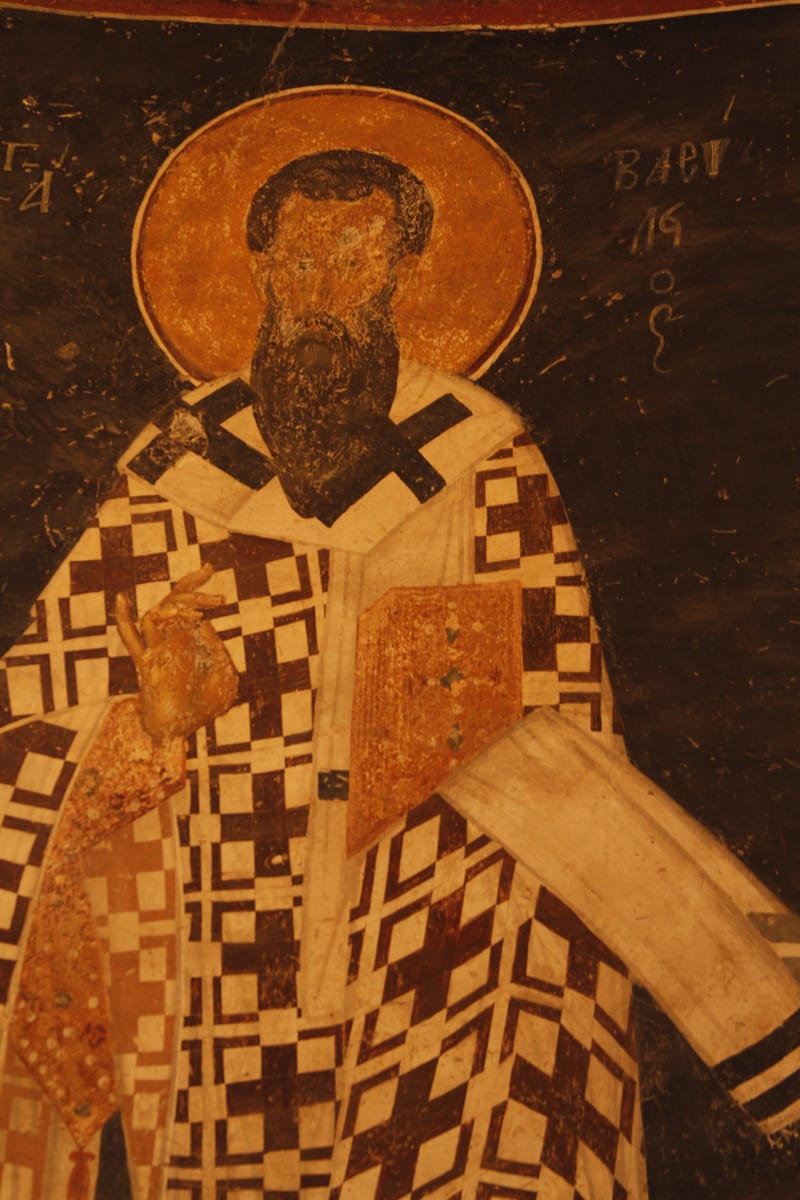
Saint Basil of Caesarea, fresco in the parecclesion, Chora Church (Kariye), Anonymous (workshop of the restoration under Theodore Metochites), fresco c. 1315-21 AD; photograph September 15, 2011 AD Anonymous (workshop of the restoration under Theodore Metochites), Chora Church (Kariye), Istanbul The Emperor Valens moved to impose Arianism on the clergy and people of Cappadocia. St. Basil left Pontus in 365 AD and took up the administration of the diocese. Saint Gregory of Nazianzus reconciled him to Bishop Eusebius.
The prefect Modestus questioned and threatened him, then reported his failure to the emperor. Illness kept St. Basil from the governor of the province, so he wrote instead. He had built a hospice outside Caesarea, and he answered an official complaint about it.
“Fear of what? How could it affect me?”
St. Basil the Great to the prefect, trial -
376–379 AD
The last winter
Worn out before fifty, he died on the first day of January, and the city mourned him as a public bereavement.
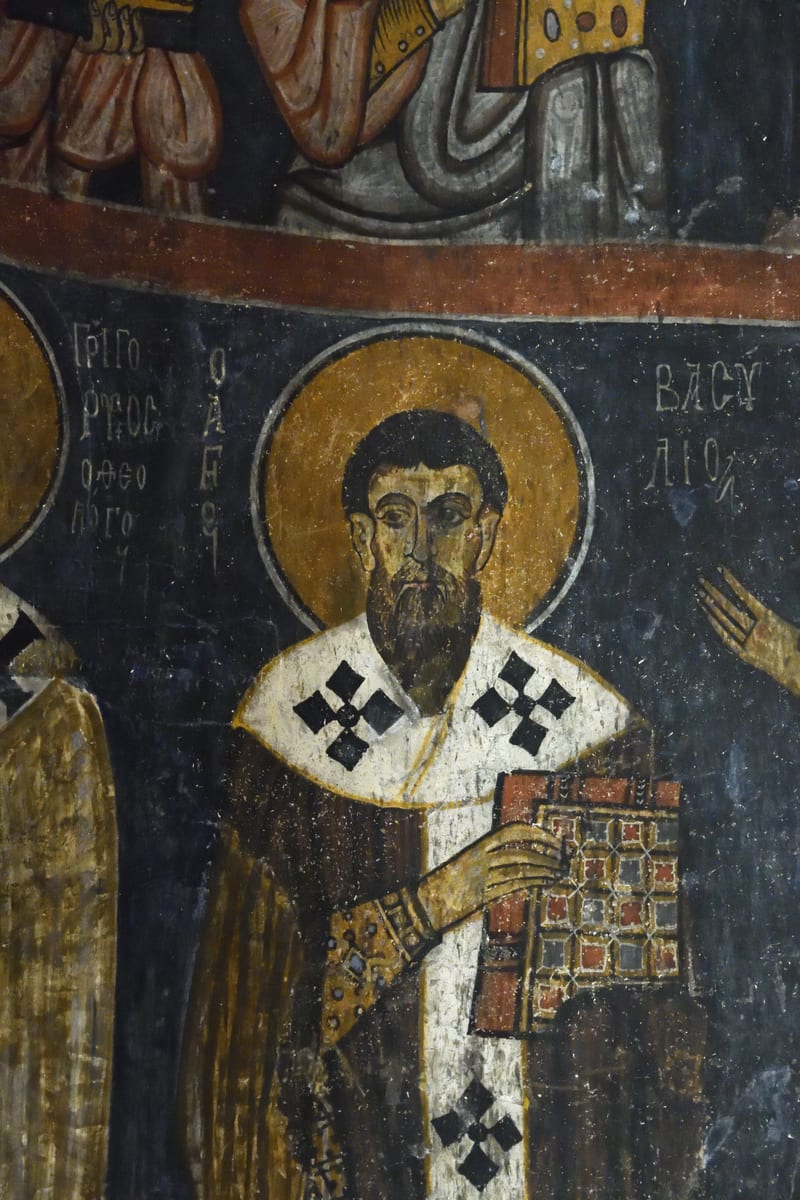
Gumusler Monastery, main apse, church fathers in the lowest band - Basil the Great of Kayseri, Gregory of Nyssa, Gregory of Nazianzus, Anonymous (Cappadocian rock-cut monastery painters); photograph by Dosseman (Dick Osseman), fresco 11th-12th century AD; photograph May 4, 2019 AD Anonymous (Cappadocian rock-cut monastery painters); photograph by Dosseman (Dick Osseman), Gumusler Monastery, Nigde province, Cappadocia, Turkey By 376 AD he had lost all his teeth, as he told Saint Amphilochius of Iconium. The Goths shook the empire in 378 AD, and he wrote nothing of it. The winter that followed dealt the last blow.
St. Basil died at Caesarea on January 1, 379 AD, not yet fifty. Jews, pagans and foreigners joined his own flock in doing him honour. Saint Gregory of Nazianzus told in the funeral oration that people died in the crush of the crowd.
“Into your Hands I commend my spirit”
St. Basil the Great to God, his last words before death -
397–1980 AD
After Caesarea
His rules went west in Latin, and the East joined him with two other teachers in one feast.
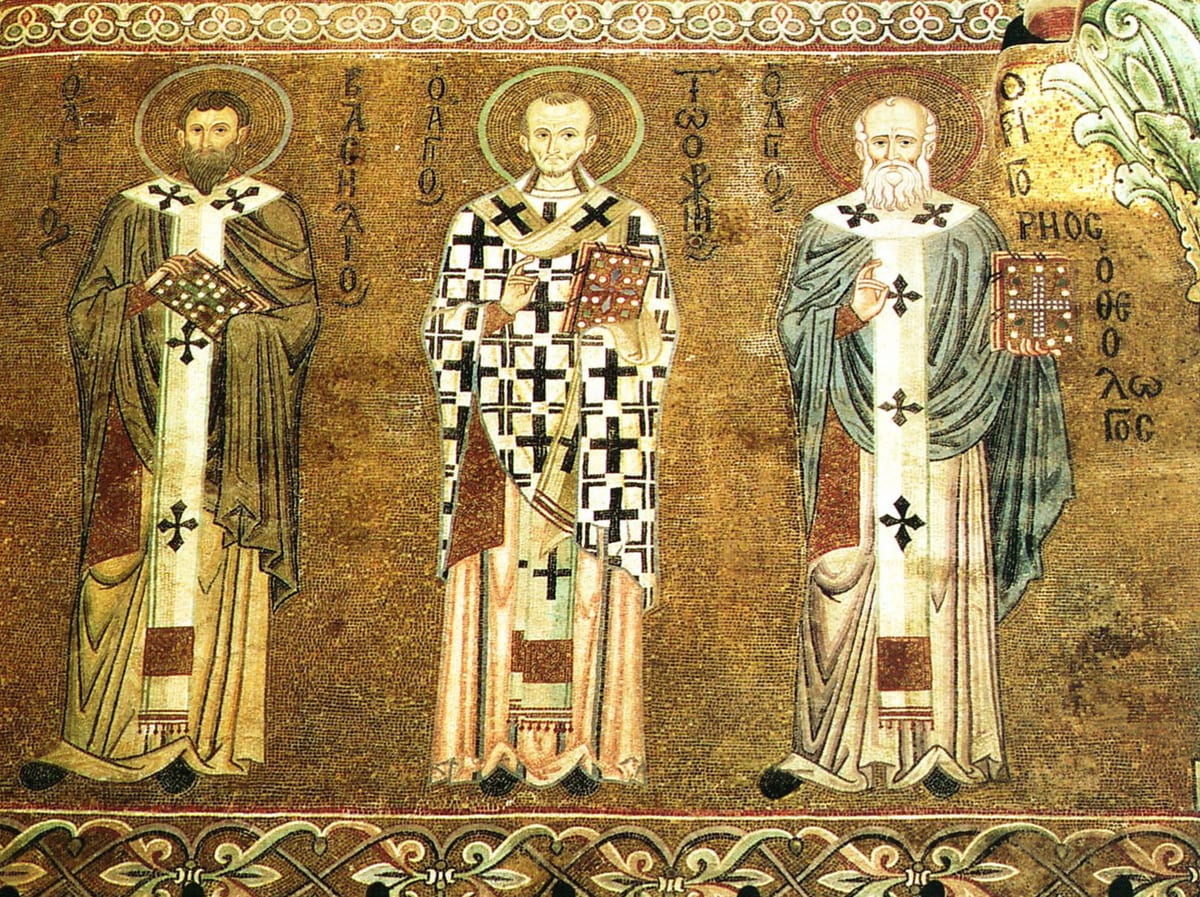
Mosaic of the Three Holy Hierarchs, Cefalu Cathedral, Anonymous (Byzantine workshop under Roger II), 1145-1148 AD Anonymous (Byzantine workshop under Roger II), Cathedral of the Santissimo Salvatore, Cefalu, Sicily In 397 AD Rufinus turned the monastic rules into Latin for Western monks. The Rule of Saint Benedict follows his teaching closely on private property. The Catholic Encyclopedia calls him the father of Oriental monasticism.
In 1081 AD the Patriarch John of Constantinople established the feast of the Three Holy Hierarchs, which the East has kept on January 30 ever since. The Roman memorial of St. Basil and Saint Gregory of Nazianzus falls on January 2. Pope John Paul II dated his letter Patres Ecclesiae on that memorial in 1980 AD.


Pray with the Church
A Doxology of Saint Basil the Great
One of the two forms of the doxology St. Basil used when praying with his people — the other ran through the Son in the Holy Ghost — and the form he was charged with introducing as a novelty, which he defended in his treatise On the Holy Spirit.
Glory be to the Father with the Son together with the Holy Ghost
All 3 reports on Saint Basil the Great

About this picture
AI-generated image, in the manner of a Byzantine wall mosaic, from the paper's reference portrait based on Parete palinsesto: Basilio e Giovanni Crisostomo (post 649) and Gregorio Nazianzeno e Basilio (705-707) (Anonymous, post 649 AD and 705-707 AD, Santa Maria Antiqua, Roman Forum, Rome) View source artwork.
,_annunciazione_(590_ca.),_basilio_e_giovanni_crisost._(post_649)_e_gregorio_nazianz._e_basilio_(705-707)_04.jpg)
Estranged bishop who baptised St. Basil dies in his arms

About this picture
AI-generated image, in the manner of Byzantine wall mosaic, from the paper's reference portrait based on Gumusler Monastery, main apse, church fathers in the lowest band - Basil the Great of Kayseri, Gregory of Nyssa, Gregory of Nazianzus (Anonymous (Cappadocian rock-cut monastery painters); photograph by Dosseman (Dick Osseman), fresco 11th-12th century AD, Gumusler Monastery, Nigde province, Cappadocia, Turkey) View source artwork.
St. Gregory comes to mourn St. Basil; St. Macrina argues instead

About this picture
AI-generated image, in the manner of Byzantine wall mosaic, from the paper's reference portrait based on Parete palinsesto: Madonna in trono con angelo (500-550 ca.), Annunciazione (590 ca.), Basilio e Giovanni Crisostomo (post 649), Gregorio Nazianzeno e Basilio (705-707) (Anonymous, post 649 AD and 705-707 AD, Santa Maria Antiqua, Roman Forum, Rome). No likeness of St. Basil the Great appears; the picture is a landscape. View source artwork.