
Saints Widow and mother of three virgin martyrs · Feast September 30
Saint Sophia
Feast 30 September · Died Rome, Italy
A Christian widow who, in Catholic Tradition, watched her three young daughters martyred at Rome, buried them outside the city and died at their grave three days later.
Begin the life
In brief
Saint Sophia, also called Sophia of Rome, is the widow the Roman Martyrology records at Rome on September 30 as the mother of three holy virgins, St. Faith, St. Hope and St. Charity. Her name is Greek for Wisdom, and in Latin she is Sapientia. According to longstanding Catholic Tradition, the three girls were put to death at Rome under the Emperor Hadrian while their mother was made to watch.
-
Before the trial
A widow and three daughters
Catholic Tradition holds that St. Sophia raised her daughters in the love of Jesus Christ, and that mother and daughters confessed their faith openly.
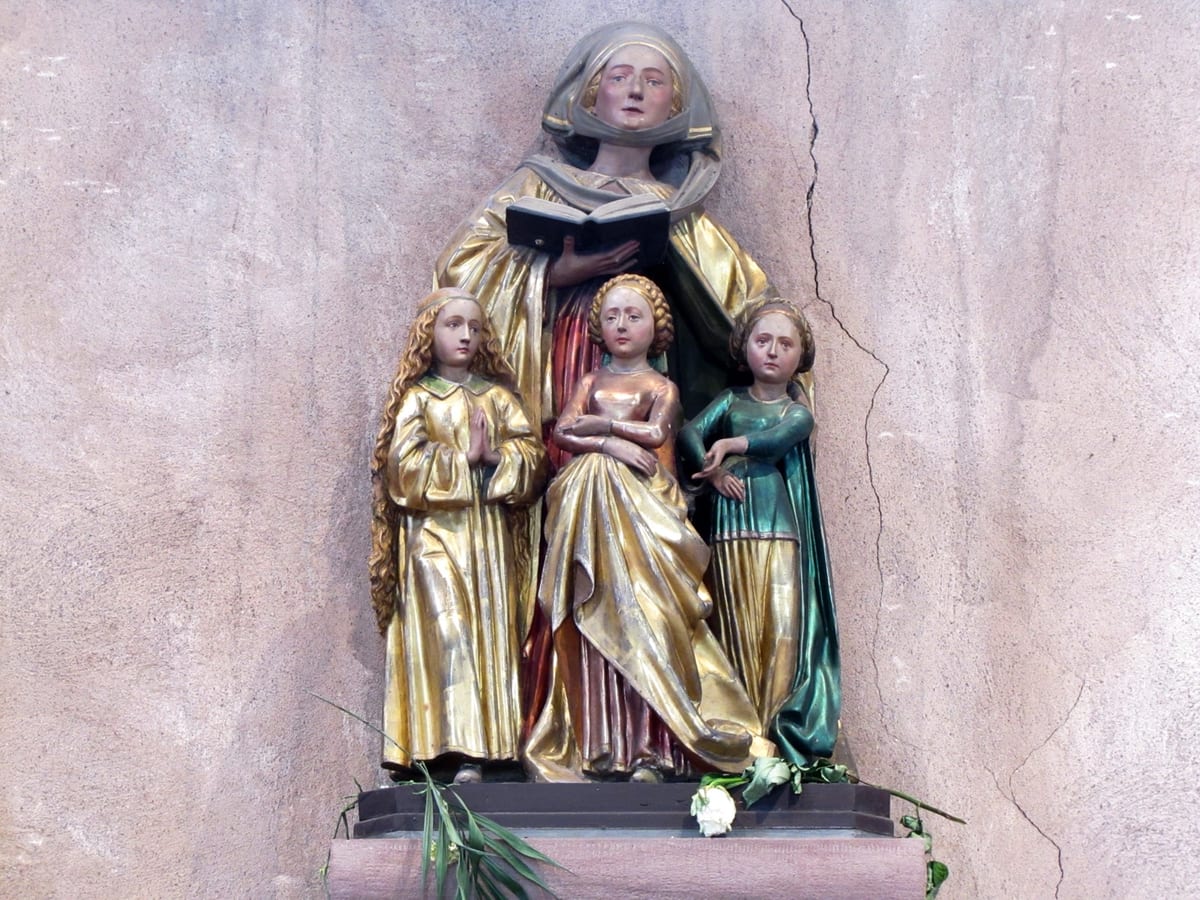
St. Sophia and her three daughters, St. Faith, St. Hope and St. Charity - carved group, limewood, painted and gilded, height 100 cm (Palissy PM67000074 / IM67000130), Unknown sculptor; photograph by Ralph Hammann, c. 1470 AD Unknown sculptor; photograph by Ralph Hammann, Church of Saint-Trophime, Eschau, Bas-Rhin (former abbey of Benedictine nuns), north transept; classed as a historic monument object April 2, 1969 AD In Catholic Tradition, St. Sophia was a devout Christian widow, born in Italy, with three daughters. She named the girls for the three Christian virtues: St. Faith, St. Hope and St. Charity. At the time of their trial St. Faith was twelve, St. Hope ten and St. Charity nine.
St. Sophia raised the girls in the love of Jesus Christ. She and her daughters let everyone know they were Christians.
-
Reign of the Emperor Hadrian, 117–138 AD
Denounced to the emperor
In Catholic Tradition, an official reports the family as Christians, and the Emperor Hadrian has them brought to Rome.
An official reported the family to the Emperor Hadrian as Christians, as Catholic Tradition tells it. The emperor, who ruled from 117 to 138 AD, ordered them brought to Rome. The girls knew they would stand before him, so they prayed to Jesus Christ for the strength not to fear torture and death.
When St. Sophia and her daughters came before the emperor, everyone present was amazed at how calm they were. They looked as if they had been brought to a festival, not to be tortured.
-
The trial at Rome
Three girls refuse to sacrifice
Tradition tells that the emperor urged each sister to sacrifice to the goddess Artemis, and that each refused and was tortured in front of her mother.
The Emperor Hadrian called the sisters before him one at a time, Catholic Tradition holds, and urged each to offer sacrifice to the goddess Artemis. Each girl refused, and he ordered all three tortured. St. Sophia was given a torment of her own: she was forced to watch.
The girls were burned over an iron grating, then thrown into a red-hot oven, then into a cauldron of boiling tar, and the Lord preserved them. St. Charity, the youngest, was also tied to a wheel and beaten with rods until welts covered her body. All three came through alive.
-
The executions
A mother made to watch
According to Catholic Tradition, St. Sophia stood by without fear, urged her daughters to endure for Christ and saw all three beheaded.
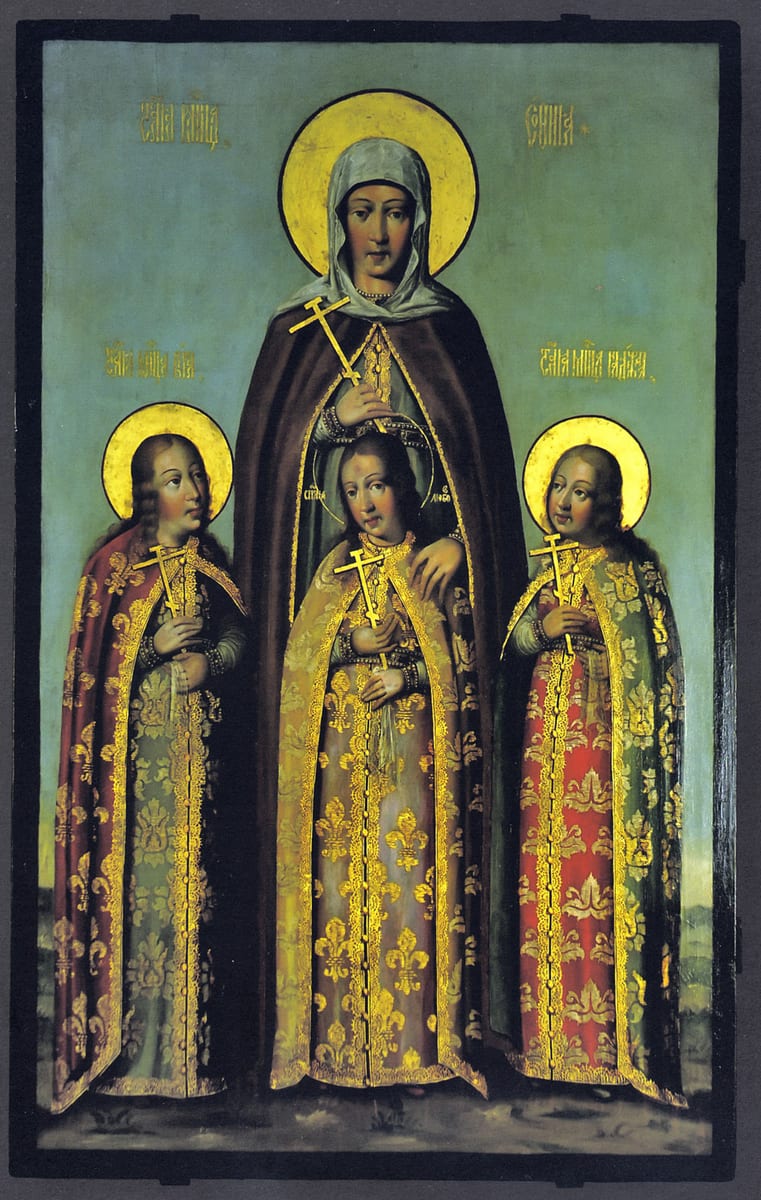
Martyrs Faith, Hope, Charity and their mother Sophia, Karp Zolotaryov, 1685 AD Karp Zolotaryov, Smolensk Cathedral, Novodevichy Convent, Moscow St. Sophia stood by without fear, in the Tradition of the Church, while her daughters were tortured. She urged them to endure the pain for Christ.
All three girls were then beheaded, and each bent her neck for the sword gladly. St. Faith, the eldest, died first, St. Hope after her and St. Charity last. St. Sophia rejoiced that her daughters had died as martyrs.
“the holy virgins, Faith, Hope and Charity, who won the crown of martyrdom under the Emperor Hadrian”
The Roman Martyrology, entry for 1 August, 1909 AD -
Three days later
Three days at the grave
Catholic Tradition holds that St. Sophia buried her daughters on a hill outside Rome, sat by the graves and died there.
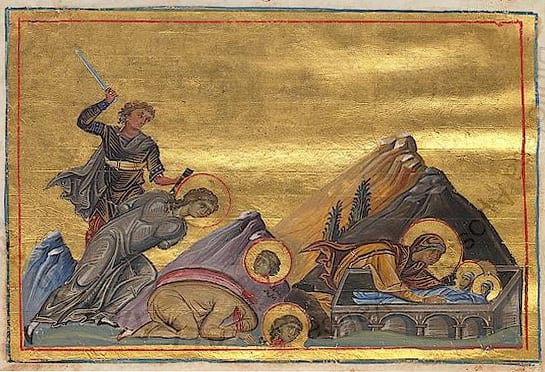
St. Sophia lays her three daughters in a sarcophagus - the right half of the miniature for September 17, Menologion of Basil II, p. 43, Byzantine illuminators of the Menologion of Basil II, Constantinople, c. 985 AD (as dated on the Commons file page) Byzantine illuminators of the Menologion of Basil II, Constantinople, Biblioteca Apostolica Vaticana, Vatican City (Vat. gr. 1613 AD, p. 43) To make St. Sophia suffer more, according to Tradition, the emperor let her take her daughters' bodies. She laid them in coffins, loaded them on a wagon, drove out past the city limits and buried them on a high hill. She sat by the graves for three days and then died there.
Believers buried her beside her daughters.
-
About 770–777 AD
A bishop carries St. Sophia to Alsace
Bishop Remigius of Strasbourg received St. Sophia's body from the Pope in Rome and carried it on his shoulders to his abbey of nuns.
Catholic Tradition holds that for many years pilgrims came to the tomb of St. Sophia and her daughters on the Aurelian Way at Rome, in a crypt beneath a church later built in honour of St. Pancratius. About 770 AD Bishop Remigius of Strasbourg built an abbey of Benedictine nuns on Eschau, an island in Alsace. He then went on pilgrimage to Rome, and Pope Hadrian I gave him the body of St. Sophia.
Remigius carried the body home from Rome on his own shoulders, and his attendants made the journey with him. It reached Eschau on May 10, 777 AD. He made St. Sophia patroness of the nuns' monastery.
-
926–1525 AD
The shrine at Eschau
The abbey at Eschau was destroyed and rebuilt, and St. Sophia's relics were laid in a new sarcophagus there.
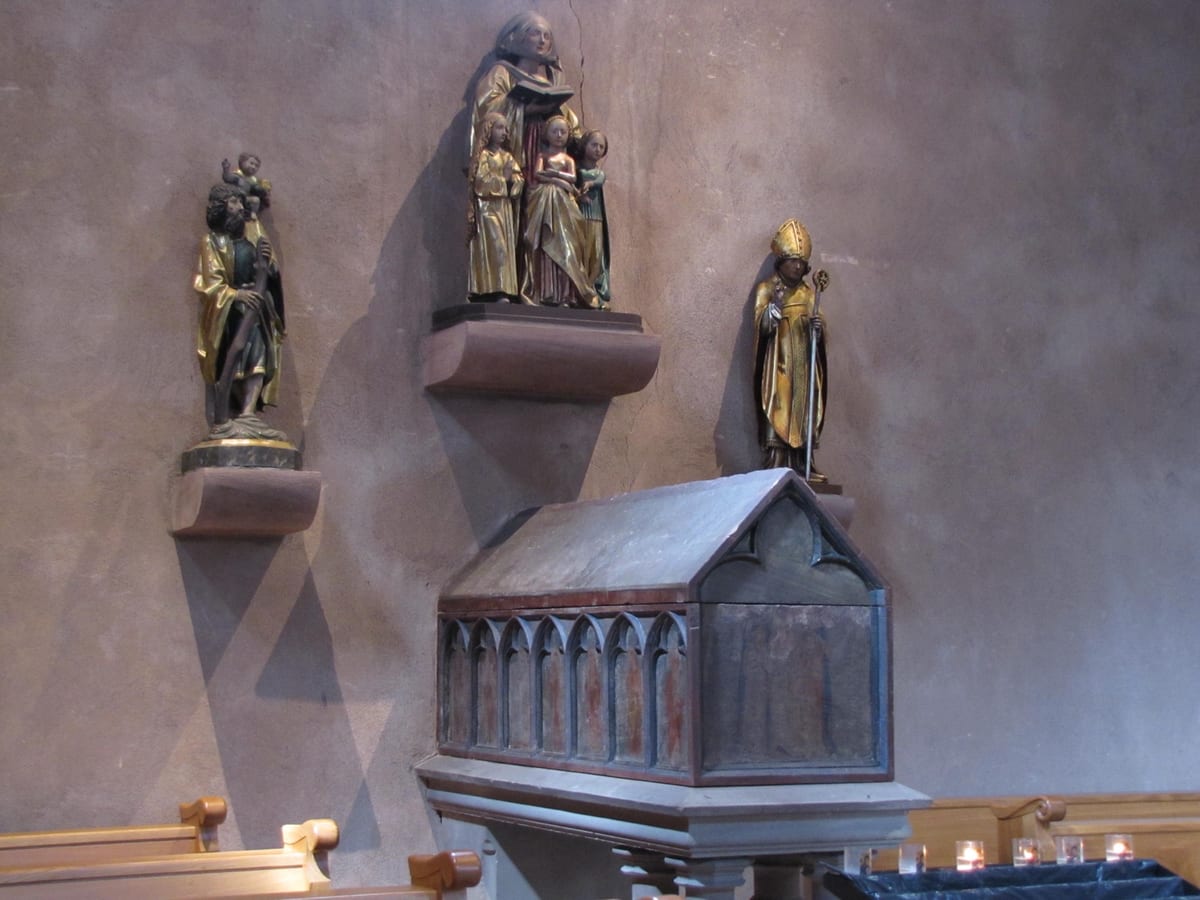
The reliquary of St. Sophia with the carved group above it, north transept of Saint-Trophime, Eschau (reliquary: Palissy PM67000076 / IM67000135), Unknown masons and sculptors; photograph by Ralph Hammann, Reliquary 14th century AD; statues 15th century AD; photographed August 4, 2010 AD Unknown masons and sculptors; photograph by Ralph Hammann, Church of Saint-Trophime, Eschau, Bas-Rhin Benedictine nuns lived at Eschau for seven and a half centuries, until the Peasants' War and the Reformation scattered them in 1525 AD. Long before that, in 926 AD, the Hungarians destroyed the abbey, and it lay in ruins for seventy years until Bishop Widerold of Strasbourg rebuilt the church and monastery in 996 AD. The abbess and the bishop of Strasbourg founded a hospital for pilgrims at Eschau in 1143 AD.
While the nuns were still there, about 1350 AD, the abbey acquired a Gothic sarcophagus, and the relics of St. Sophia were laid in it. A sculpture of St. Sophia with her three daughters followed about 1480 AD.
-
The feasts
Three feast days
The Roman Martyrology lists St. Sophia on September 30, and the Greek Churches keep her feast with her daughters on September 17.
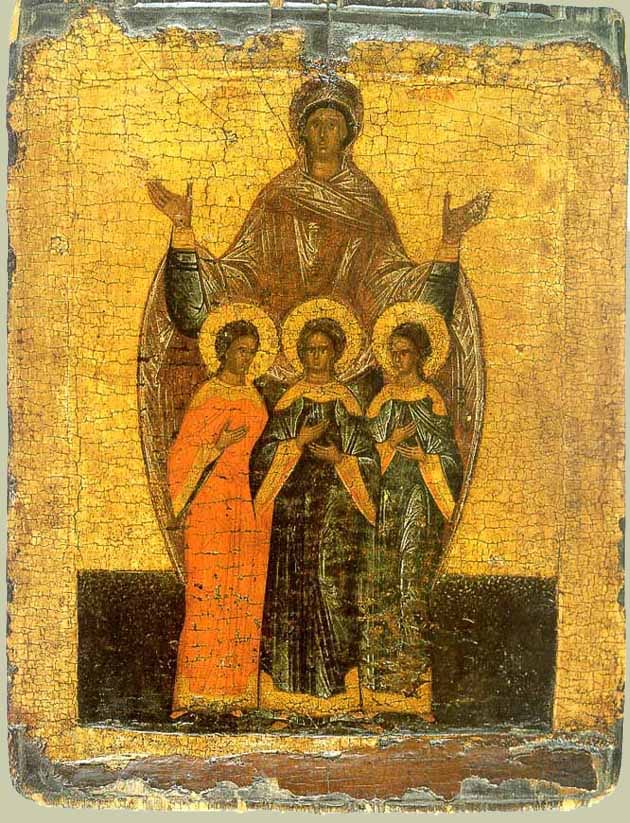
Faith, Hope, Love and their mother Sophia, Anonymous, Novgorod school, 16th century AD (c. 1550 AD) Anonymous, Novgorod school, State Tretyakov Gallery, Moscow The Roman Martyrology records St. Sophia at Rome on September 30 as a widow. It lists her three daughters on a different day, August 1.
The Greek Churches keep the feast of the mother and her daughters together on September 17. The Byzantine Ruthenian calendar lists St. Sophia that day as a holy martyr. Tradition holds that she did not suffer for Christ in her body but in her heart, and was not denied a martyr's crown.
“In the same city, St. Sophia, widow, mother of the holy virgins Faith, Hope, and Charity.”
The Roman Martyrology, entry for 30 September, 1916 AD


.jpg)


Pray with the Church
Hymn to St. Sophia from the Byzantine feast
A hymn sung on the Byzantine feast of St. Sophia and her three daughters, September 17, in the English printed by the Orthodox Church in America.
You blossomed in the courts of the Lordas a fruitful olive tree,holy martyr Sophia;in your contest you offered to Christ the sweet fruit of your womb,your daughters Faith, Hope, and Love.Together with them intercede for us all.
All 1 report on Saint Sophia
