
Saints Dominican teacher, Bishop of Regensburg and Doctor of the Church · Feast November 15
Saint Albert the Great
Feast 15 November · Born Lauingen on the Danube, Swabia (diocese of Augsburg), Germany · Died November 15, 1280 AD, Dominican convent of the Holy Cross, Cologne, Germany
A Swabian student who joined the Dominicans against his uncle's wishes taught St. Thomas Aquinas, defended the friars before the Pope, gave up the bishopric of Regensburg after two years and died at Cologne in 1280 AD, later to be named a Doctor of the Church.
Begin the life
In brief
Saint Albert the Great, also called Albertus Magnus, was a friar of the Order of Preachers, born at Lauingen on the Danube in Swabia. He taught theology at Paris and Cologne, served two years as Bishop of Regensburg, and wrote on Scripture and on nature. The Church keeps his feast on November 15, the day he died at Cologne in 1280 AD.
-
1220s AD
A student who watched
As a young man he studied at Padua and noted what he saw.
As a young man, St. Albert left his homeland for Padua, the seat of one of the most famous universities of the Middle Ages. There he studied the liberal arts, from grammar and rhetoric to astronomy and music.
At Padua he watched as a well, closed since ancient times, was opened, and the first two men who went down to clean it died of the fumes. At Venice he watched marble being sawn for a church wall, and one slab showed a crowned king's head with a long beard. He later described both in his books, and for the marble he first told what he had seen and tested himself, then explained the cause.
“Dico igitur quod me essente Venetiis, cum essem juvenis, incidebantur marmora per serras ad parietes templi ornandos: contigit autem in uno marmore iam inciso tabulis incisis sibi invicem applicatis apparere depictum caput pulcherrimum regis cum corona et longa barba... (I say, then, that when I was at Venice as a young man, marble was being cut with saws to adorn the walls of a church; and it happened that in one marble already cut, when the sawn slabs were laid against each other, there appeared, as if painted, a most beautiful head of a king with a crown and a long beard...)”
St. Albert the Great, in 'De mineralibus', on images formed by nature in stone -
c. 1223 AD
The call of the Friars Preachers
Afraid he would not persevere and opposed by his uncle, he received the Dominican habit from Blessed Jordan of Saxony.
At Padua St. Albert often visited the Dominican friars, but he held back because he feared he would join them and then leave. His uncle opposed the plan and made him swear to stay away from their house for a set time. One night St. Albert dreamed that he had entered the Order and then left it.
Blessed Jordan of Saxony, Master General of the Order, then preached a sermon that described those very doubts. St. Albert went to him afterwards and asked who had told him what was in his heart, and Blessed Jordan urged him at length to stand firm against the temptation. In 1223 AD St. Albert received the habit of the Order of Preachers from Blessed Jordan.
-
1245–1252 AD
Teacher of St. Thomas Aquinas
He became a master at Paris and opened the Cologne school with his student St. Thomas Aquinas.
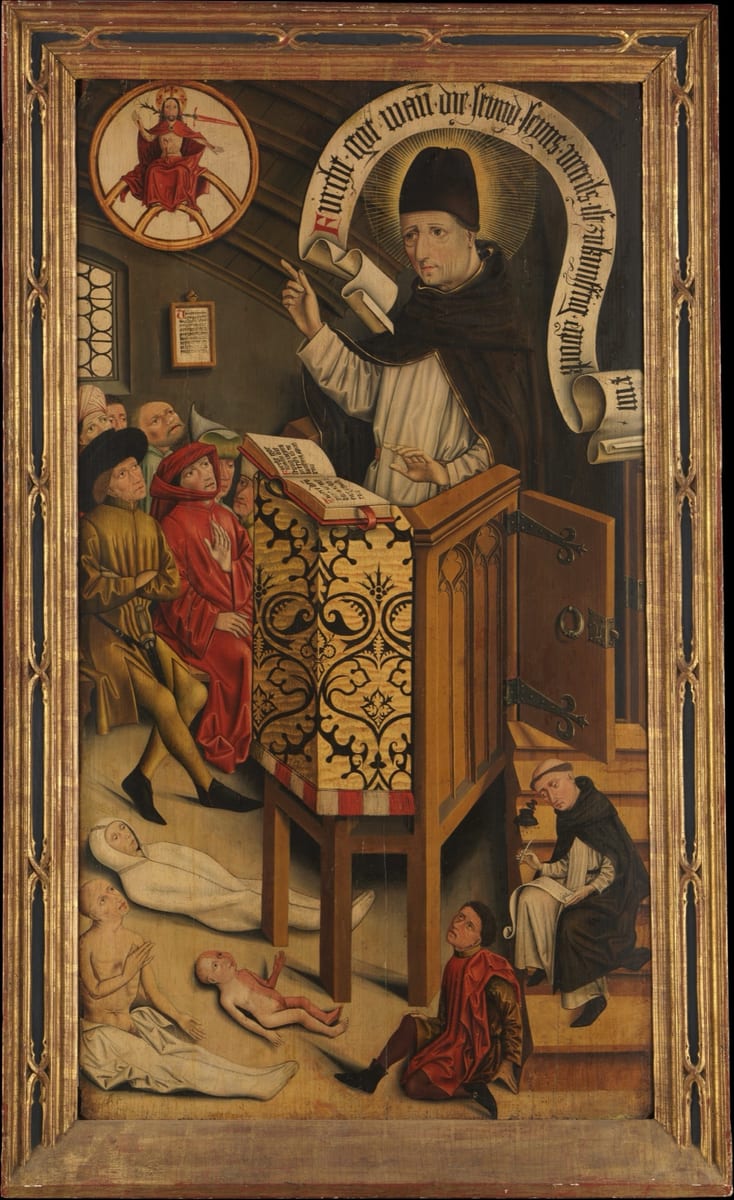
Sermon of Saint Albertus Magnus, Friedrich Walther, later 15th century AD Friedrich Walther, The Metropolitan Museum of Art, The Cloisters Collection (accession 64.215) After his ordination, St. Albert's superiors sent him to teach in the schools of Dominican convents. In 1245 AD he went to Paris, where he lectured and became a master in theology. For many years the friars of his Order asked St. Albert to write them a book on nature that would give them a complete course of natural science and help them understand Aristotle. He also wrote books on stones, plants and animals.
In June 1248 AD the Order decided to open a house of higher studies for Germany at Cologne. At the end of that year St. Albert left Paris to run it as its first regent, taking his student St. Thomas Aquinas with him. About 1252 AD St. Albert put St. Thomas forward to the Master of the Order to begin lecturing at Paris as a junior teacher.
“Scientie enim naturalis non est simpliciter narrata accipere, sed in rebus naturalibus inquirere causas. (The aim of natural science is not simply to accept the statements [narrata] of others, but to investigate the causes that are at work in nature)”
St. Albert the Great, in 'De mineralibus', book II -
1251–1254 AD
Judge and provincial
He judged a quarrel between Cologne and its archbishop, then walked his province as its elected superior.
In Lent 1251 AD Archbishop Conrad of Hochstaden landed war boats at Neuss to fight the citizens of Cologne, in a quarrel over the city's rights. In March 1252 AD both sides named the papal legate, Cardinal Hugh of St. Cher, and St. Albert to judge between them. St. Albert drew up the points of the ruling, which the two judges issued together that April.
In 1254 AD the friars meeting at Worms elected him superior of Teutonia, the Dominican province of the German lands. It held communities across a vast territory of Central and Northern Europe. He visited them on foot, with no money in his belt, begging his bread from door to door.
-
1256 AD
The friars' case before the Pope
Summoned to the papal court, he answered the Paris master who wanted the friars out of the University.
The secular masters of Paris, led by William of Saint-Amour, were trying to shut the Dominicans and Franciscans out of the University. Pope Alexander IV summoned St. Albert to the papal court at Anagni to answer William's book against the friars. When he arrived, he found that a scribe had a copy, paid the scribe's price, and had the book taken apart into sections and copied.
In October 1256 AD, before the cardinals in solemn consistory, he refuted the book point by point. St. Thomas Aquinas later shortened St. Albert's answers into a single booklet. Pope Alexander IV condemned William's book, and it was burned at Anagni with the Pope looking on.
“Numquam sic audivimus. (We have never heard anything like it.)”
Those who heard St. Albert in consistory at Anagni to one another, 1256 AD -
1260–1262 AD
A bishop's throne and an empty treasury
Made Bishop of Regensburg against his superior's plea, he gave the office up two years later.
In January 1260 AD Pope Alexander IV made St. Albert Bishop of Regensburg, though Humbert of Romans, Master of the Dominicans, wrote urging him to refuse. On March 30, Tuesday of Holy Week, he lay face down before the cathedral's high altar to pray, and was then enthroned. He found nothing in the treasury, no wine in the cellar and no grain in the granary.
In 1261 AD he handed the see's worldly business to trusted men and withdrew to Donaustauf castle, where he wrote a commentary on St. Luke's Gospel. That same year he set out for Rome to give up the see. Pope Urban IV accepted his resignation, and St. Albert went back of his own accord to teaching at Cologne. On May 11, 1262 AD the Pope confirmed his successor.
“Hic episcopatum Ratisbonensem coactus recepit, sed paulo post tanquam carbonem ardentem manum adurentem obtenta cessione rejecit, et ad paupertatem rediit. (Brother Albert was reluctantly burdened with the Church of Ratisbon; thus he casts it far from him, as a hot coal which burns the hand, as soon as he has obtained permission, and returns to the poverty of his Order.)”
Bernard Gui, on St. Albert's resignation of Regensburg, 1262 AD -
1274–1280 AD
The last years at Cologne
He outlived St. Thomas Aquinas, defended his writings at Paris and died in his cell at Cologne.
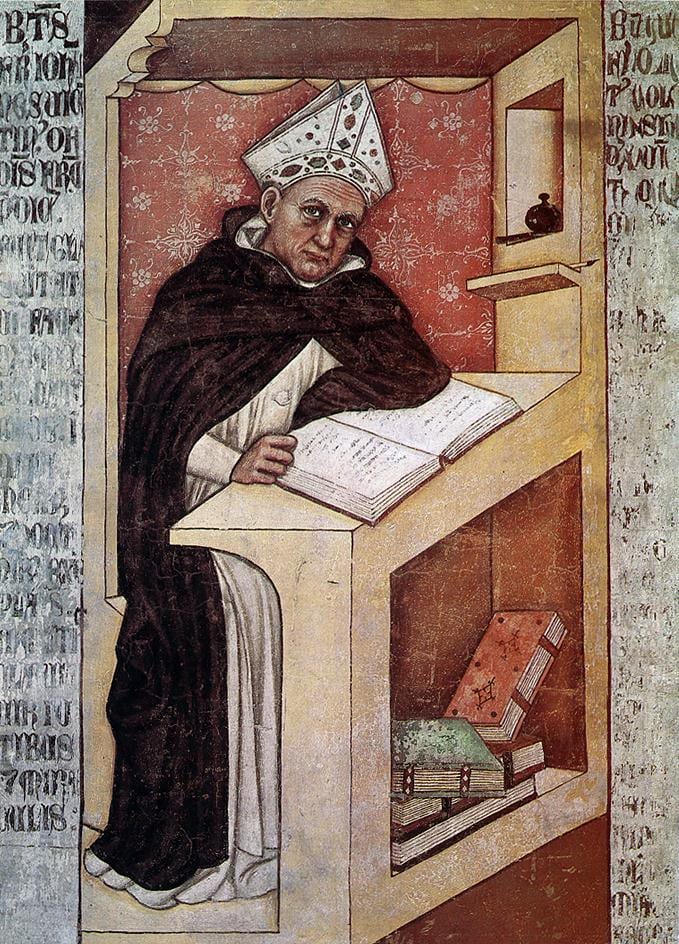
Albertus Magnus, from the series of forty illustrious Dominicans in the chapter house of San Nicolò, Treviso, Tommaso da Modena, 1352 AD Tommaso da Modena, Sala del Capitolo, former Dominican convent of San Nicolò (now Seminario Vescovile), Treviso St. Thomas Aquinas died at the abbey of Fossanova on March 7, 1274 AD. In 1277 AD Bishop Stephen Tempier of Paris and others moved to condemn St. Thomas's writings as too friendly to the unbelieving philosophers. St. Albert, by then an old man, went to Paris and defended his pupil's writings and teaching from June to November.
In January 1278 AD, still in good health, he left his books to the friars' library and his gold and gems to finish their choir. In his last years his memory failed, and worn out by age he gave up teaching for contemplation. He died in his cell at the convent of the Holy Cross in Cologne on November 15, 1280 AD.
“Tandem a. 1280 et ipse [Albertus] plusquam octogenarius beato fine quievit. (At last, in 1280, he too, more than eighty years old, came to rest in a blessed end.)”
Ptolemy of Lucca, recording St. Albert's death in his Church history, 1280 AD -
1280–1980 AD
Buried in the friars' choir
Buried at Cologne, he was canonised and named a Doctor of the Church in 1931 AD.
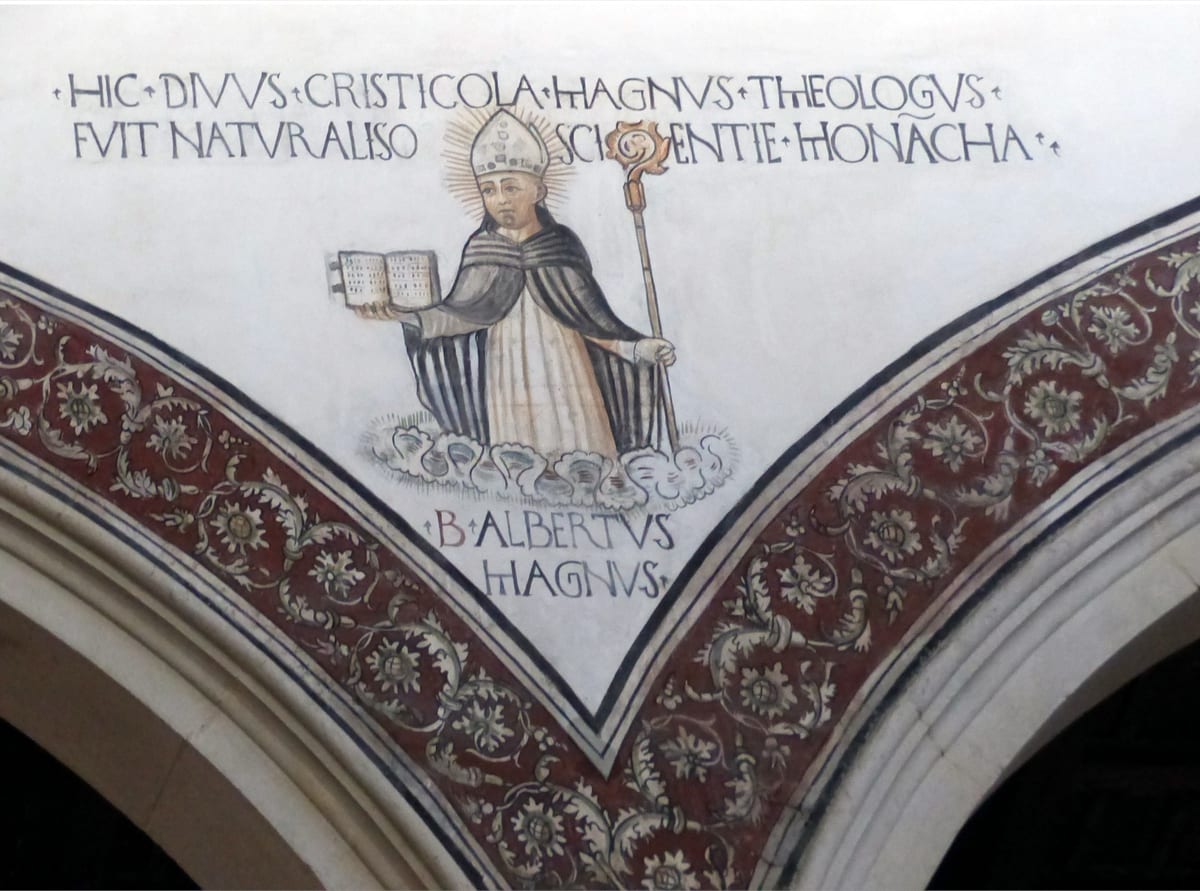
Fresco of Blessed Albertus Magnus, San Pietro Martire, Murano, Unknown painter, painted before the canonisation of 1931 AD Unknown painter, Parish church of San Pietro Martire, Murano, Venice — photograph CC BY-SA 4.0 (Wolfgang Sauber) Archbishop Siegfried of Cologne buried St. Albert before the high altar of the friars' choir, and wept as he did so. In 1484 AD Pope Innocent VIII let the friars of Cologne and Regensburg raise altars to him and keep his feast.
On December 16, 1931 AD, Pope Pius XI canonised him and proclaimed him a Doctor of the Church. On November 15, 1980 AD, seven hundred years to the day after his death, Pope St. John Paul II prayed at his tomb in St. Andrew's Church, Cologne.
“Gott, unsere Zuflucht und Stärke, du hast dem heiligen Bischof und Kirchenlehrer Albert die Kraft gegeben, das menschliche Wissen der ewigen Weisheit zuzuordnen. (God, our refuge and strength, you gave the holy bishop and Doctor of the Church Albert the strength to order human knowledge to eternal wisdom.)”
Pope St. John Paul II to God, his prayer at St. Albert's tomb in Cologne


Pray with the Church
Collect for the feast of St. Albert the Great
The collect (Oratio) of the Roman Breviary for November 15, St. Albert the Great, Bishop, Confessor and Doctor, in the English of the Divinum Officium
O God, Who made blessed Albert, thy Bishop and Doctor, eminent in the submission of human wisdom to divine faith,grant us, we beseech thee, so to follow the path of his teaching,that we may enjoy perfect light in heaven.
All 3 reports on Saint Albert the Great

Archbishop of Cologne buries St. Albert the Great in tears

About this picture
AI-generated image, in the manner of a Trecento fresco, from the paper's reference portrait based on Albertus Magnus, from the series of forty illustrious Dominicans in the chapter house of San Nicolò, Treviso (Tommaso da Modena, 1352 AD, Sala del Capitolo, former Dominican convent of San Nicolò (now Seminario Vescovile), Treviso) View source artwork.
St. Albert the Great defends his dead pupil's books before Paris masters

About this picture
AI-generated image, in the manner of a Trecento buon fresco, from the paper's reference portrait based on Sermon of Saint Albertus Magnus (Friedrich Walther, later 15th century AD, The Metropolitan Museum of Art, The Cloisters Collection) View source artwork.