
Saints Umbria, 1381–1457 AD
Saint Rita of Cascia
Feast 22 May · Born 1381 AD, Roccaporena, a hamlet about five kilometres from Cascia, diocese of Spoleto, Umbria, Italy · Died 1457 AD, her cell in the monastery of Saint Mary Magdalene, Cascia, Umbria, Italy
She forgave the men who killed her husband, was turned away three times from the monastery at Cascia, and carried a wound on her forehead for the last fifteen years of her life.
Begin the life
In brief
Saint Rita of Cascia was born about 1381 AD at Roccaporena, a hamlet five kilometres from Cascia in Umbria. She was a wife, a mother and a widow before she was an Augustinian nun. Pope Leo XIII canonized her in Saint Peter's on May 24, 1900 AD.
-
1381–1393 AD
A daughter born late at Roccaporena
An only child of elderly parents whose work in the valley was making peace.
Saint Rita was the only child of Antonio Lotti and Amata Ferri, born when her parents had nearly reached old age. They were so given to reconciling feuding neighbours that they were commonly called Peacemakers of Jesus Christ. She was baptised Margherita, and St. Rita is the familiar form she has always been known by.
About her eleventh year she made an oratory of a small room in her father's house and lived in it a full year. She hung its walls with pictures of the Passion and gave the poor children nearby the food her fasting spared. When she asked leave to enter the Augustinian convent at Cascia, her parents wept and begged their only child not to leave them, and she gave way.
-
1397–1406 AD
Wife at the Mulinaccio
Married into the Ghibelline faction of a valley that settled its quarrels by blood.
About 1397 AD St. Rita married Paolo di Ferdinando di Mancino, a young man of the Ghibelline faction in the Cascia valley. Connolly records that she consented only after prayer. Two sons were born to them, Giangiacomo and Paolo Maria.
The shrine at Cascia holds that the family then moved to the Mulinaccio, a property of Paolo's with a larger house and a grain mill. The clans of the valley were at feud throughout those years.
-
1406–1407 AD
The feud takes her husband; her sons die
An ambush outside Roccaporena, a hidden shirt, and two boys set on revenge.
Paolo Mancini was ambushed and stabbed to death a short distance outside Roccaporena. St. Rita hid his bloodstained shirt so that her sons should not see it and take up revenge. She forgave the killers and never revealed their names, at the cost of the resentment of his family, the Mancini.
The Order of Saint Augustine records that her words could not change her sons' hearts. She asked God to take them from this life before they stained their hands with blood. Both fell ill and died one shortly after the other, within about a year of their father.
-
1407 AD
Three refusals at the monastery door
The house of Saint Mary Magdalene turned the widow away until the families made peace.
St. Rita asked for the habit at the monastery of Saint Mary Magdalene at Cascia and was refused three times. Connolly gives the ground of refusal: a house intended for virgins did not receive a widow. The shrine at Cascia holds that a sister of Paolo's was in the house and would not accept her silence about the killers.
The Mancini made public peace with their enemies about 1407 AD, and the door opened. According to longstanding Catholic tradition, first written down by Cavallucci, her three patrons led her by night up the crag above Roccaporena and into the closed monastery. She received the Augustinian habit and kept the anniversary of that day as a feast for the rest of her life.
-
1407–1442 AD
Forty years enclosed
Penance, night prayer, and a grille where the town brought its sick.
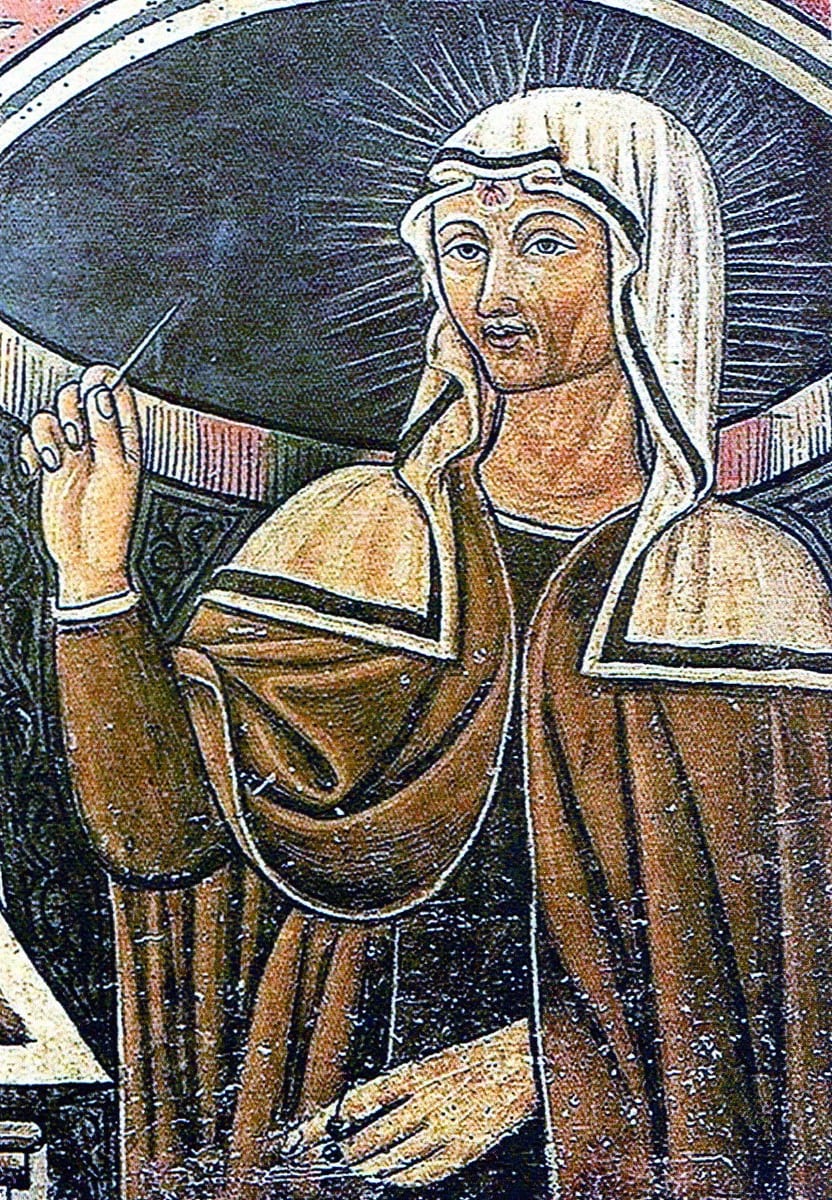
Portrait of St. Rita, detail from the painted sarcophagus (cassa solenne) that held her body, Sanctuary of Cascia, Unknown Umbrian painter, 1457 AD, 1457 AD Unknown Umbrian painter, 1457 AD, Monastery and Sanctuary of Santa Rita, Cascia, Umbria (photographic reproduction uploaded by Roscini Claudio, 2014 AD) Cavallucci records that St. Rita took the discipline three times a day, for the dead, for benefactors and for all sinners. She divided her cell into stations of the Passion and prayed from midnight until dawn.
A woman of Cascia asked her prayers for a sick daughter and found the girl well on returning home. People came from distant parts to visit her at the monastery. When Cascia divided in 1426 AD over the Bernardine tablet and the quarrel turned to crimes, the shrine holds that she worked to restore peace.
-
1442–1450 AD
The thorn
A wound on her forehead that closed once, for a journey, and then opened again.
St. Rita heard the Franciscan Saint James of the Marches preach at Cascia on the crown of thorns. Before the crucifix in the old oratory she begged to feel one of those thorns, and a thorn wounded her forehead. The wound festered and stank, and she withdrew from her sisters so as not to trouble them.
The superior refused her leave for the Jubilee of 1450 AD until the wound should heal, and after her prayer it closed. She walked to Rome at about sixty-nine, and threw away on the road the money given her for the journey. The wound opened again as soon as she was back inside the monastery.
“you bore the thorn for XV years”
The epitaph at her tomb, 1457 AD -
1453–1457 AD
A rose in January
Four years in bed, a flower found in the snow, and a death in the night.
In her seventy-second year St. Rita took to a hard bed with an illness that lasted four years. In January a kinswoman asked what she wanted, and she asked for a rose from the garden at Roccaporena. The valley was under snow, and the woman found a deep red rose blooming on the bush.
She asked afterwards for two figs from the same garden, and the woman found them and carried them to Cascia. She asked pardon of her sisters and received the last sacraments. She died in her cell in the night between May 21 and 22, 1457 AD, in her seventy-sixth year.
-
1457–1900 AD
The body at Cascia
Cures at the coffin within days, a town that would not bury her, and a canonization four centuries later.
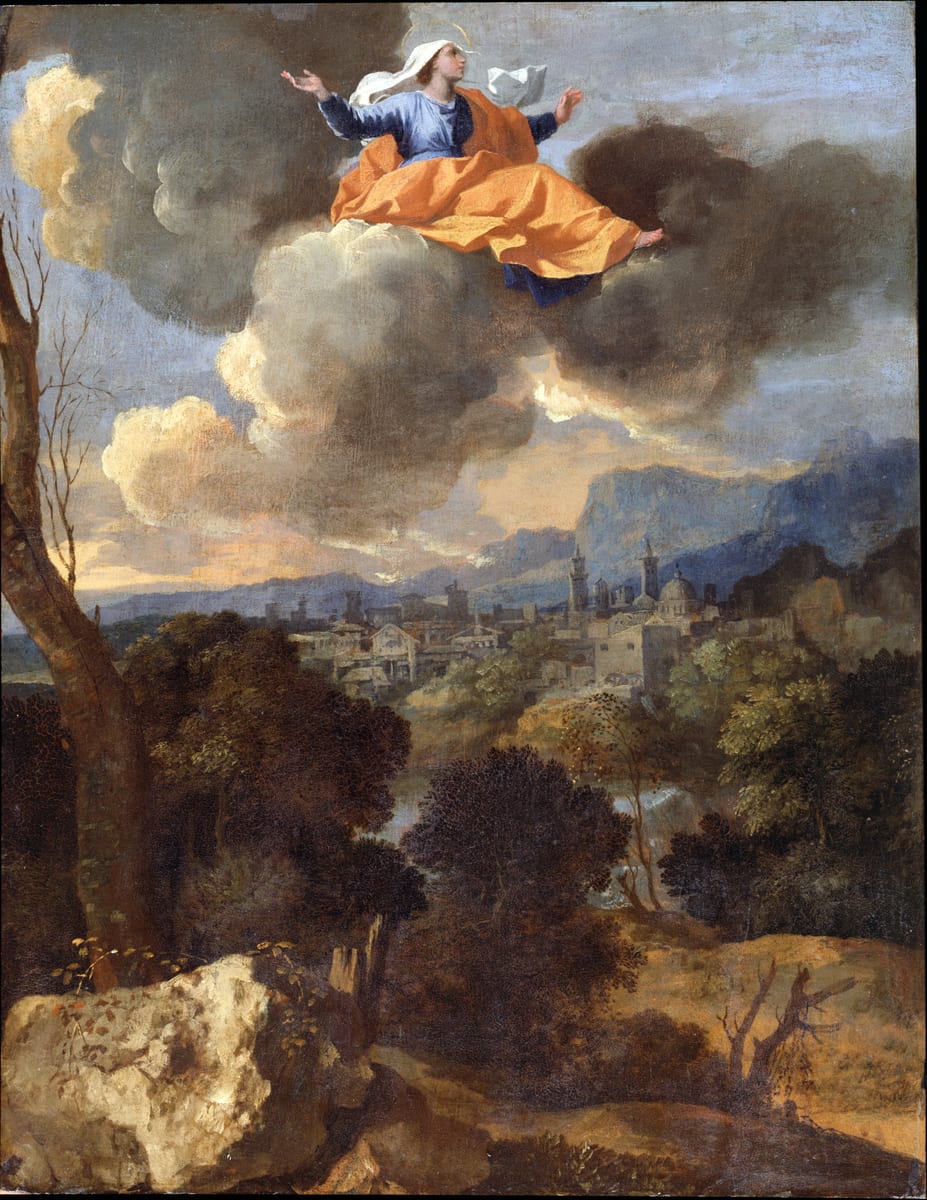
The Translation of Saint Rita of Cascia, Nicolas Poussin (1594-1665 AD), mid-1630s Nicolas Poussin (1594-1665 AD), Dulwich Picture Gallery, London (Google Art Project) The people of Cascia prevented the burial, and the body stayed in the church three days while cures were reported. Three days after her death Battista d'Angelo of Col Giacone recovered his sight. The shrine at Cascia calls that cure the most extraordinary of the miracles recorded in 1457 AD.
She was venerated at once as a protector from the plague, and in Spain came to be called the Saint of the Impossible. Pope Urban VIII granted her Office and Mass in 1627 AD, and she was beatified at Rome on July 16, 1628 AD. Pope Leo XIII canonized her in Saint Peter's on Ascension Day, May 24, 1900 AD.
“he chose to imprint upon her the seal of his charity and his passion”
Pope Leo XIII, May 24, 1900 AD


Pray with the Church
The Collect of the Mass of Saint Rita of Cascia
The Collect of her Mass on May 22, granted with her canonization in 1900 AD and carried in the Roman Missal.
O God, Who didst vouchsafe to confer on St. Rita so great grace that she loved her enemies and bore in her heart and on her brow the stigmata of Thy love and Passion,grant us, we beseech Thee, by her intercession and merits, so to spare our enemies and to meditate on the pains of Thy Passionthat we may obtain the rewards promised to the meek and to them that mourn.
All 5 reports on Saint Rita of Cascia

About this picture
AI-generated image, in the manner of Umbrian quattrocento tempera on panel, from the paper's reference portrait based on Portrait of St. Rita, detail from the painted sarcophagus (Unknown Umbrian painter, 1457, Monastery and Sanctuary of Santa Rita, Cascia) View source artwork.
Three saints lead St. Rita into the locked convent of Cascia

St. Rita asks God to take her two sons before they kill

About this picture
AI-generated, in the manner of Umbrian quattrocento tempera on gessoed panel, after the painted sarcophagus that held the body of St. Rita (unknown Umbrian painter, 1457, Monastery and Sanctuary of Santa Rita, Cascia, Umbria) View source artwork.
Roccaporena names two peacemakers each Lent to stop the valley's killing

Blind girl sorting corn at Cascia calls out that she can see

About this picture
AI-generated image, in the manner of Umbrian quattrocento tempera on gessoed panel, from the paper's reference portrait based on Portrait of St. Rita, detail from the painted sarcophagus (cassa solenne) that held her body (unknown Umbrian painter, 1457, Monastery and Sanctuary of Santa Rita, Cascia, Umbria). View source artwork.