Saints Jesuit priest at Cartagena · 1580–1654 AD
Saint Peter Claver
Feast 9 September · Born 1580 AD, Verdú, diocese of Solsona, Catalonia, Spain · Died 1654 AD, Cartagena de Indias, New Granada (Colombia)
The Catalan Jesuit who met the slave ships at Cartagena de Indias with fruit, wine and the sacraments, and bound himself by vow to the people who came off them.
Begin the life
In brief
Saint Peter Claver, also called Pedro Claver, was a Jesuit priest of the slave port of Cartagena de Indias. He landed there in 1610 AD and died in the city on September 8, 1654 AD. Pope Leo XIII canonized him on January 15, 1888 AD, and the Church keeps his memorial on September 9.
-
Verdú and Barcelona, to 1602 AD
A Catalan boy given to the Church
His parents set him aside for the Church and sent him to Barcelona to study.
Saint Peter Claver was born at Verdú, in the diocese of Solsona, in Catalonia. His father, Pedro Claver, and his mother, Ana Sabocano, intended him for the Church from his early childhood. Fleuriau's Life says his mother wished to imitate Anne the mother of Samuel and Anne the mother of Mary.
An uncle held a canonry at Solsona, but the boy was sent to Barcelona for grammar. He studied letters at the grammar school and virtue at the Jesuit college. The University of Barcelona gave him his first degrees, and the bishop conferred the tonsure and four minor orders.
“What we learn in our youth is never forgotten, and that which we sucked in with our mothers' milk will remain with us to our death”
St. Peter Claver to companions of his own age, familiar conversation in his youth -
1602–1608 AD
The novice and the porter of Majorca
He entered the Society at Tarragona and found a master at the college door in Majorca.
St. Peter Claver entered the Jesuit novitiate at Tarragona on August 7, 1602 AD. He made his first vows there on August 8, 1604 AD, before the Blessed Sacrament.
The Society sent him to the new college at Majorca in 1605 AD to study philosophy. He landed and went straight to Brother Alonso Rodríguez, the porter, who became his spiritual director. St. Alonso Rodríguez pressed him to evangelize the Spanish possessions in America, and St. Peter Claver asked his superiors for those missions.
“Ah, my dear Alphonso, what must I do to love Jesus Christ my God and Saviour with my whole heart? Do you teach me, you who are instructed in His own school: I feel that He inspires the desire to belong to Him alone, but I know not how to begin.”
St. Peter Claver to Alphonso Rodriguez, in a transport of fervour, speaking -
1608–1616 AD
Seville to Cartagena, and orders in the port
Leave for the Indies came before his theology was finished; he was ordained in the slave port itself.
He reached Barcelona in November 1608 AD to study theology. His provincial signed the leave for the Indies at Tarragona on January 23, 1610 AD, after two years of the course. St. Peter Claver sailed from Seville that April and landed at Cartagena, the main slave market of the New World.
He went inland to Santa Fe, where no studies could be established until 1612 AD. Orders returned him to Cartagena in the last days of November 1615 AD. The bishop of the city ordained him a priest on March 19, 1616 AD.
-
1617–1622 AD
He signs himself the slave of the enslaved
Left in sole charge of the ministry, he took the four vows only after adding one of his own.
Father Alonso de Sandoval was called to Lima in 1617 AD, and the whole ministry to the Africans landed at Cartagena fell to St. Peter Claver. Twelve to fourteen ships reached the port each year, each carrying between 300 and 600 captives in its hold.
Towards the end of 1622 AD he was ordered to make his solemn profession of four vows. He accepted only on condition that he might add a vow of his own, to serve the enslaved for ever. He then signed the act of profession in Latin.
“Peter, for ever the slave of the negroes.”
St. Peter Claver, signature on his vow of profession -
May 1627 AD
Trinity Sunday, 1627 AD: a ship unloads
He set down that day himself, in a letter the Church still reads on his feast.
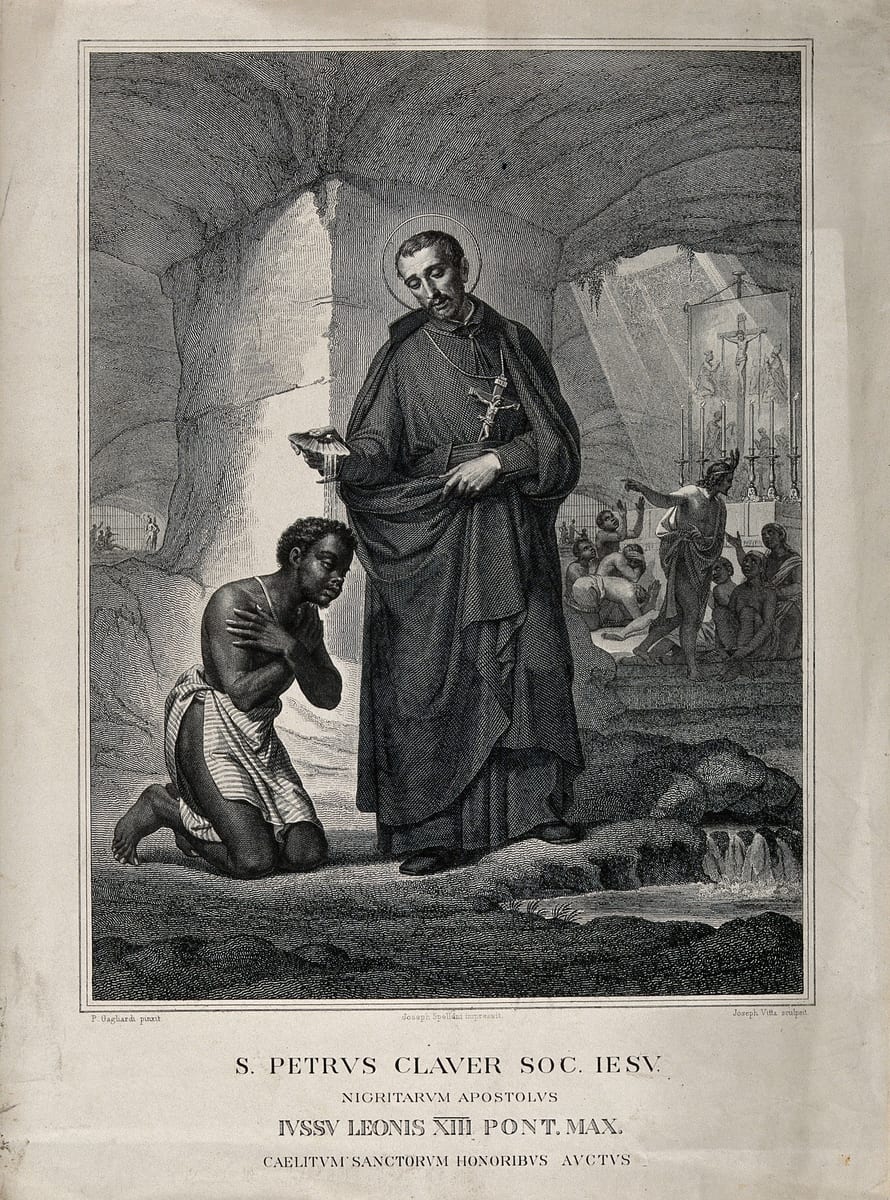
Saint Peter Claver. Engraving by J. Vitta after P. Gagliardi, Giuseppe Vitta (engraver, active 1888 AD) after Pietro Gagliardi (painter, 1809-1890 AD); printed by Joseph Spellani, after 1888 AD; Rome — the canonisation image, made by order of Pope Leo XIII Giuseppe Vitta (engraver, active 1888 AD) after Pietro Gagliardi (painter, 1809-1890 AD); printed by Joseph Spellani, Wellcome Collection, London (reference 6820i) On May 30, 1627 AD, the feast of the Most Holy Trinity, a large ship unloaded Africans at Cartagena. St. Peter Claver and his companion hurried down with two baskets of oranges, lemons and sweet biscuits. They laid aside their cloaks and built a platform to lift the sick off the wet ground.
Two men were already cold, their pulse scarcely to be found. The priests gathered live coals with a tile, threw on aromatics, and drove the smoke over them with their own cloaks. Then they knelt beside the sick, bathed their faces with wine, and began an instruction on baptism.
“This was how we spoke to them, not with words but with our hands and our actions. And in fact, convinced as they were that they had been brought here to be eaten, any other language would have proved utterly useless. Then we sat, or rather knelt, beside them and bathed their faces and bodies with wine. We made every effort to encourage them with friendly gestures and displayed in their presence the emotions which somehow naturally tend to hearten the sick.”
St. Peter Claver, letter describing ministry to newly arrived enslaved Africans, May 1627 -
The catechesis, 1616–1650 AD
The interpreters, and a method his house forbade
He taught through African interpreters and gave them the chairs; his own superior once stopped him.
The canonization process names at least thirty-two interpreters who worked with St. Peter Claver, among them Andrés Sacabuche and Ignacio Aluanil of Angola. When he catechized he seated the interpreters on chairs and stood, or sat on the floor himself. A priest who found an enslaved interpreter in a chair moved to strike him out of it, and St. Peter Claver stopped him.
A superior examined his teaching and forbade him his catechetical formulas and the images he used with them. The abstract method that replaced it failed, and the superior gave him full freedom to take up his own again.
“It matters little whether we are thought learned or ignorant, but it matters much that we be humble and obedient.”
St. Peter Claver to no one in particular, responding to being publicly called an ignoramus -
1650–1654 AD
Four years ill, and a death on Our Lady's feast
He came back sick from the coast missions and never resumed the work.
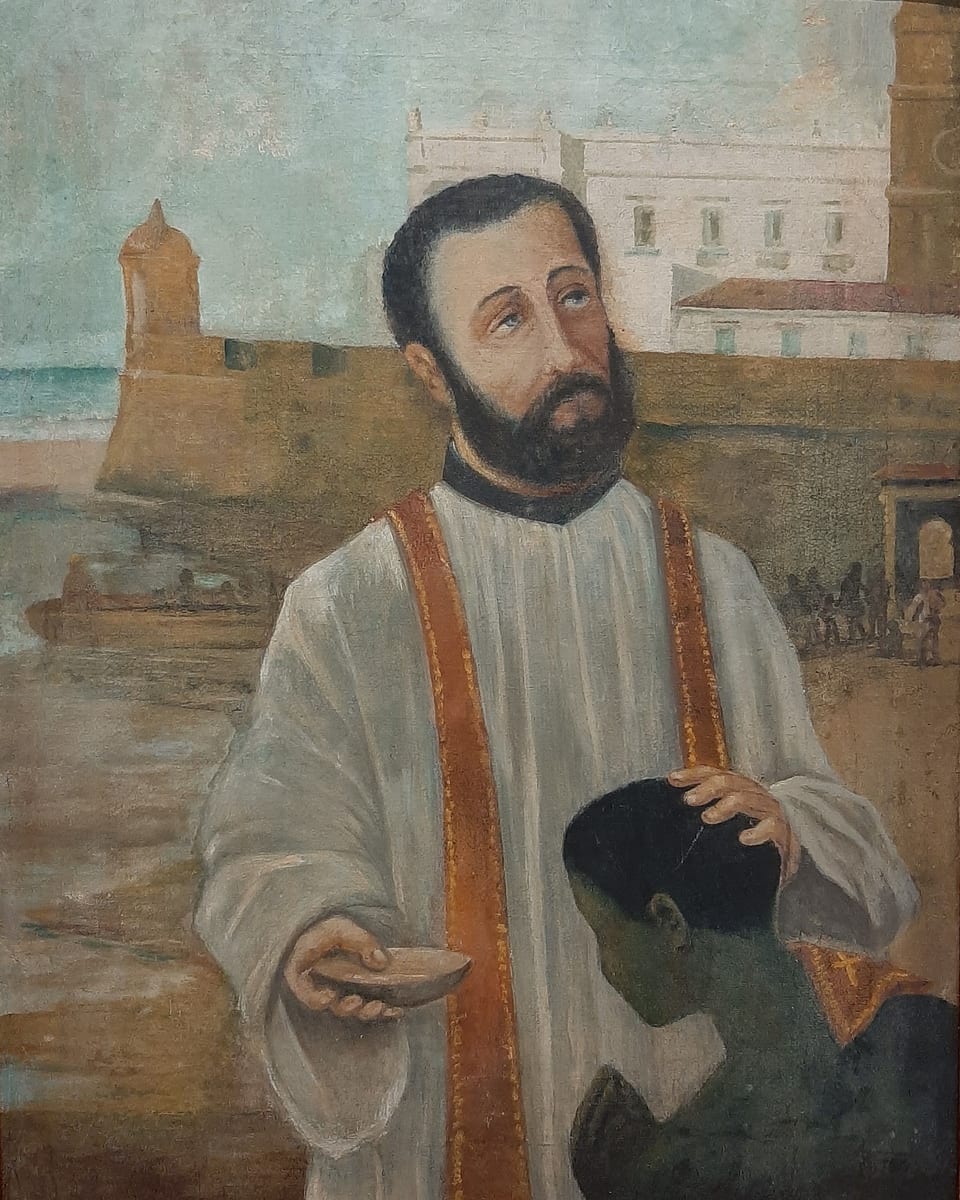
Portrait of St. Peter Claver, Museum of the Palace of the Inquisition, Cartagena de Indias, unknown; New Granadan colonial school, not recorded on the source page; the painting hangs at Cartagena and stands in the line of the portraits taken at his death in 1654 AD. Photographed December 23, 2019 AD unknown; New Granadan colonial school, Museo Palacio de la Inquisicion, Cartagena, Colombia (photograph by the Commons user Mill 1) St. Peter Claver came back to Cartagena ill from the missions of Tolú and Sinú in 1650 AD. His active ministry ended there, and he lived four more years in illness. La Civiltà Cattolica records that he spent those years in what Pope Francis called a frightful state of abandonment, neglected by the man set to care for him.
Ill at Cartagena, he signed a letter on October 28, 1651 AD depositing Brother Alonso Rodríguez's manuscript at the novitiate of Tunja. He told Brother Nicholas Gonzales that he would die on a feast of Our Lady. He died in the small hours of September 8, 1654 AD, the feast of the Nativity of the Blessed Virgin Mary.
“I am going to die; what do you desire of me in the next life?”
St. Peter Claver to the brother sacristan, passing the sacristy days -
1654–2017 AD
The city's verdict, and Rome's
Cartagena buried him with public honours; the Church took another two centuries to speak.
The religious of St. John of God sang a solemn Mass for him hours after his death. The Augustinians followed at nine with the city magistrates and the governor and his staff. The corporation of Cartagena celebrated a magnificent service on September 14, 1654 AD, and the governor repeated the honours the next day at his own expense.
Pope Pius IX beatified him on July 16, 1850 AD. Pope Leo XIII canonized him on January 15, 1888 AD together with St. Alphonsus Rodriguez, the porter of the college of Majorca, and gave his encyclical on the abolition of slavery that May. Pope John Paul II made an appeal at his tomb on July 6, 1986 AD, in the church where his remains are kept, and Pope Francis prayed the Angelus there on September 10, 2017 AD.


Pray with the Church
Collect of the Memorial of Saint Peter Claver, September 9
The Collect of the memorial in the Church's liturgy, printed with the Office of Readings and Mass of September 9.
O God, who made Saint Peter Claver a slave of slavesand strengthened him with wonderful charity and patienceas he came to their help,grant, through his intercession,that, seeking the things of Jesus Christ,we may love our neighbor in deeds and in truth.Through our Lord Jesus Christ, your Son,who lives and reigns with you in the unity of the Holy Spirit,God, for ever and ever.
All 7 reports on Saint Peter Claver

About this picture
AI-generated image, in the manner of a seventeenth-century Spanish oil painting, from the paper's reference portrait based on Saint Peter Claver. Engraving by J. Vitta after P. Gagliardi (Giuseppe Vitta after Pietro Gagliardi, after 1888 AD, Wellcome Collection, London) View source artwork.
Dying St. Peter Claver sends his old teacher's handwritten book to novices

About this picture
AI-generated image, an ink-and-wash drawing of the container terminal on the bay of Cartagena. No person appears in it.
Pope Francis says Mass in the port where the slave ships landed

About this picture
AI-generated image, in the manner of a seventeenth-century Spanish colonial oil painting on canvas, from the paper's reference portrait based on Portrait of St. Peter Claver, Museum of the Palace of the Inquisition, Cartagena de Indias (unknown, New Granadan colonial school, date not recorded; photographed 23 December 2019, Museo Palacio de la Inquisicion, Cartagena, Colombia) View source artwork.
The enslaved of Cartagena hold their own funeral for St. Peter Claver

About this picture
AI-generated image, in the manner of a seventeenth-century Spanish colonial oil painting on canvas, from the paper's reference portrait based on Saint Peter Claver. Engraving by J. Vitta after P. Gagliardi (Giuseppe Vitta, engraver, active 1888, after Pietro Gagliardi, painter, 1809-1890; printed by Joseph Spellani, after 1888 AD, Wellcome Collection, London, reference 6820i). View source artwork.
The Church reads St. Peter Claver's own letter about a slave ship

About this picture
AI-generated image, in the manner of a seventeenth-century Spanish colonial oil painting on canvas, from the paper's reference portrait based on Portrait of St. Peter Claver, Museum of the Palace of the Inquisition, Cartagena de Indias (unknown artist, New Granadan colonial school; date not recorded on the source page, photographed 23 December 2019, Museo Palacio de la Inquisicion, Cartagena, Colombia) View source artwork.
St. Peter Claver dies before dawn at Cartagena, on Our Lady's feast

About this picture
AI-generated image, in the manner of a seventeenth-century Spanish colonial oil painting on canvas, from the paper's reference portrait based on Portrait of St. Peter Claver, Museum of the Palace of the Inquisition, Cartagena de Indias (unknown; New Granadan colonial school, date not recorded on the source page; photographed 23 December 2019, Museo Palacio de la Inquisicion, Cartagena, Colombia) View source artwork.
Cartagena will bury Saint Peter Claver tomorrow at the city's charge

About this picture
AI-generated image, in the manner of a seventeenth-century Spanish colonial oil painting on canvas, from the paper's reference portrait based on Saint Peter Claver. Engraving by J. Vitta after P. Gagliardi (Giuseppe Vitta, engraver, active 1888, after Pietro Gagliardi, painter, 1809-1890; printed by Joseph Spellani, after 1888 AD, Wellcome Collection, London, reference 6820i) View source artwork.