
Saints Capuchin friar · 1887–1968 AD
Saint Pio of Pietrelcina
Feast 23 September · Born 1887 AD, Pietrelcina, Archdiocese of Benevento, Campania, Italy · Died 1968 AD, Friary of Our Lady of Grace, San Giovanni Rotondo, Apulia, Italy
A Capuchin friar bore the stigmata for fifty years, said a Mass that crowds waited through the night to attend, and began a hospital on his mountain with a gold coin.
Begin the life
In brief
Saint Pio of Pietrelcina, commonly known as Padre Pio, was a Capuchin friar born at Pietrelcina, in the Archdiocese of Benevento, on May 25, 1887 AD. He bore the stigmata for fifty years at the friary of San Giovanni Rotondo, where crowds came to him for Mass and confession. Pope John Paul II canonized him on June 16, 2002 AD, and the Church keeps his memorial on September 23, the day he died.
-
1887–1910 AD
A farmer's son takes the Capuchin habit
St. Pio grew up poor in Pietrelcina, entered the Capuchins and was ordained a priest in 1910 AD.
St. Pio was born Francesco Forgione, the son of peasant farmers in Pietrelcina. As a boy he could not bear to hear God's name taken in vain, and would run off to hide and pray. To pay for his schooling, his father, Grazio Forgione, twice crossed to the United States to work as a labourer on Long Island.
St. Pio entered the Capuchin novitiate at Morcone on January 6, 1903 AD, and took the name Brother Pio that month. A year later his parents found him so thin that they begged the Father Director to let them take him home, but he stayed and took his first vows. He was ordained a priest at Benevento on August 10, 1910 AD, while his father was working in America.
“I want to be a friar... with a beard.”
Padre Pio, 1897 AD -
1910–1916 AD
The first wounds, then the mountain friary
A month after his ordination St. Pio received the stigmata for the first time, but at his request the wounds could no longer be seen; in 1916 AD he settled at San Giovanni Rotondo.
On September 7, 1910 AD, a month after his ordination, St. Pio received the stigmata for the first time, while praying under an elm at Piana Romana, outside Pietrelcina. The wounds bled and hurt him badly, and he prayed that Jesus would take them away. At his request they could no longer be seen, though the pain stayed, and he told his spiritual director about them only a year later, in a letter of September 8, 1911 AD.
Poor health kept him living with his family in Pietrelcina until 1916 AD. On September 4, 1916 AD, he settled at the friary of San Giovanni Rotondo, high on Monte Gargano. After a few early absences, among them service in the army medical corps during the First World War, he never left the friary again for a single day.
“I am asking a charity, and I come to ask it all the more because Jesus compels me. He tells me the body must be given a little relief, to keep me ready for other trials to which he wishes to subject me. The charity I ask of you, my father, is to send me to spend some time at San Giovanni, where Jesus assures me I shall be better.”
Padre Pio, August 13, 1916 AD -
1918 AD
The stigmata return in the friary choir
After Mass on September 20, 1918 AD, St. Pio was found unconscious in the friary choir, bleeding from five wounds that stayed with him for fifty years.
On the morning of September 20, 1918 AD, St. Pio was alone in the friary choir, giving thanks after Mass. He saw Christ crucified, and when the vision ended his own hands, feet and side were bleeding. A friar, Padre Leone, ran to the choir and found St. Pio on the floor, unconscious, bleeding from five deep wounds.
St. Pio begged the friars to keep his secret, bound up the wounds and hid his hands in his sleeves. Two or three days later the friary's superior came to his cell to confront him, and St. Pio wept and told the superior everything that had happened. The wounds bled every day and night for the next fifty years.
“Dear Father, I am dying of pain because of the wounds and the resulting embarrassment I feel deep in my soul. I am afraid I shall bleed to death if the Lord does not hear my heartfelt supplication to relieve me of this condition.”
Padre Pio, October 22, 1918 AD -
1919–1934 AD
Examined, then silenced
A bishop sent by the Holy See found St. Pio's wounds were not faked; then St. Pio was barred from almost all his work as a priest until Pope Pius XI lifted the ban.
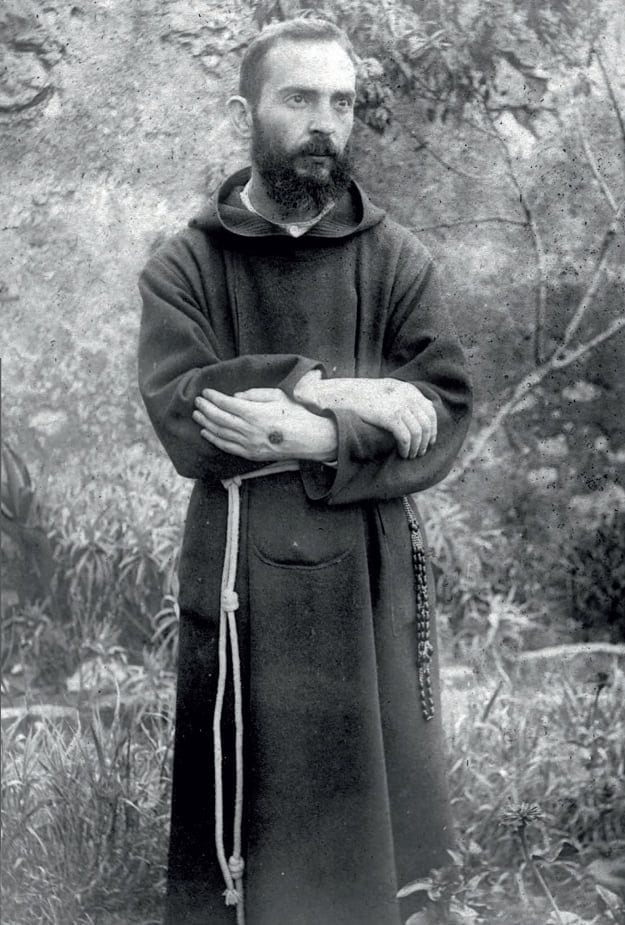
A young Padre Pio showing the stigmata (photo from August 19, 1919 AD), Placido Bux Placido Bux, Wikimedia Commons; credited to the Frati Minori Cappuccini di San Giovanni Rotondo News of the wounds spread, and pilgrims began climbing the mountain to see St. Pio, receive his blessing and go to confession. Some claimed he might have made the wounds with carbolic acid. Bishop Raffaele Rossi, sent by the Holy See in 1921 AD, judged that the wounds did not appear to have been inflicted from outside and were not the result of fraud.
From 1923 AD St. Pio was forbidden to write letters, and he was not allowed to preach; in 1931 AD the Holy Office ordered him to give up all his work as a priest except Mass, said in private, without the faithful. The Holy See's account of his life says he accepted every restriction with humility and kept silent in the face of unjust accusations. Pope Pius XI had the ban reversed in 1933 AD, and on March 25, 1934 AD, St. Pio could hear men's confessions again.
“I strive only to obey you, the good God having made known to me the one thing most acceptable to him and the one way for me to hope for salvation and to sing of victory.”
Padre Pio, 1931–1933 AD -
1934 AD–1950s AD
Up at 3.30, Mass at five
Crowds waited through the night for St. Pio's Mass, and penitents registered days ahead for his confessional.
St. Pio rose at 3:30 each morning and said Mass at five, and his Mass took an hour and ten minutes. By two in the morning the square before the church was usually full of people waiting for the doors to open. He heard women in the morning and men in the afternoon, and penitents registered and might wait ten days for their turn.
In early April 1948 AD, a young Polish priest, Karol Wojtyła, made his confession to St. Pio. Years later, as Pope John Paul II, Karol Wojtyła said he had benefited in his young years from St. Pio's readiness to hear penitents.
“I only want to be a poor friar who prays.”
Padre Pio -
1940–1956 AD
A gold coin, and a hospital on the mountain
St. Pio gave the first coin toward a hospital in 1940 AD; it opened sixteen years later.
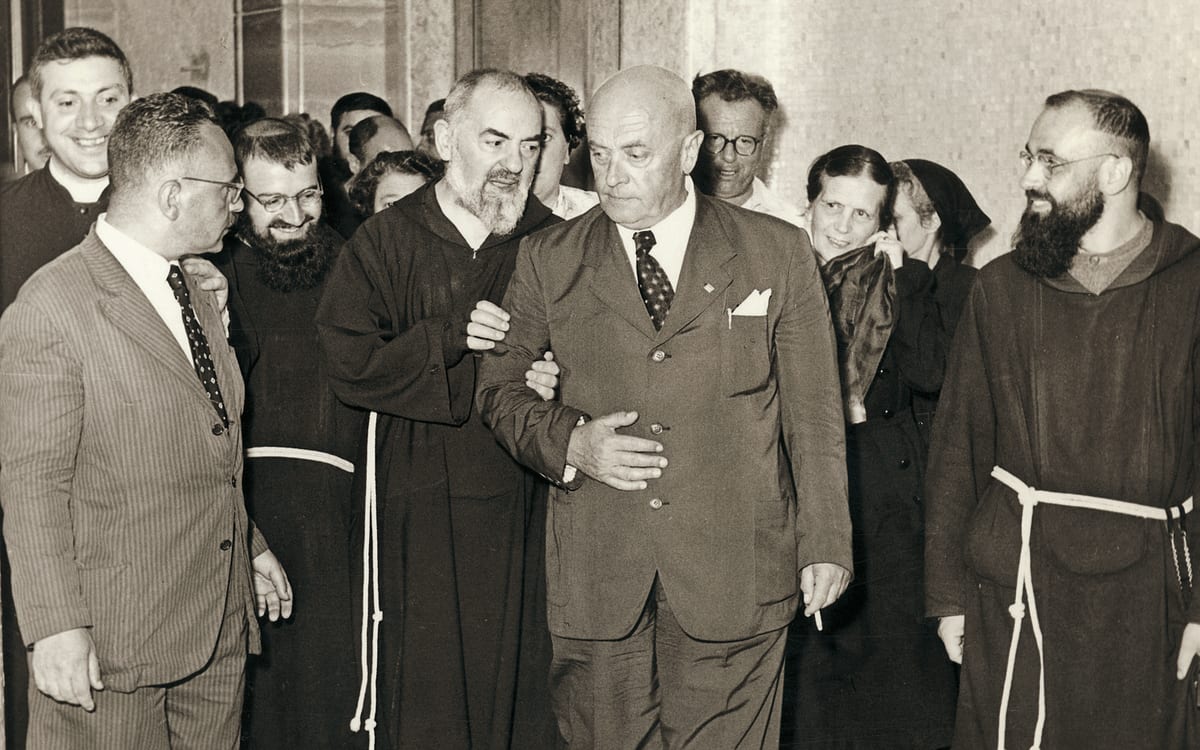
Padre Pio con il dottor Guglielmo Sanguinetti nei corridoi di CSS, Unknown; published by the Redazione e Amministrazione of Casa Sollievo della Sofferenza, circa 1952 AD Unknown; published by the Redazione e Amministrazione of Casa Sollievo della Sofferenza, Wikimedia Commons; from the hospital's own publication 'La Casa Sollievo della Sofferenza' On the evening of January 9, 1940 AD, St. Pio and three friends he guided spiritually made a start on a hospital, meeting in his room at the friary. He searched the pockets of his habit and handed them a small gold coin that had been given to him for his charities. A blind young man gave two lire the same evening.
The foundation stone was laid on the bare mountain slope on May 16, 1947 AD. The Casa Sollievo della Sofferenza, the House for the Relief of Suffering, opened on May 5, 1956 AD. Poor patients were treated free and handed a receipt like everyone else, so that they would never be humiliated.
“I wish to be the first to give a donation towards the Hospital.”
Padre Pio, January 9, 1940 AD -
1966–1968 AD
The last Mass
Frail and in a wheelchair, St. Pio said Mass for his prayer groups on the fiftieth anniversary of the stigmata, and died early on the morning after his last Mass.
From 1966 AD St. Pio said Mass seated, and from March 1968 AD he used a wheelchair. On September 20, 1968 AD, fifty years after the stigmata, he said Mass for members of the prayer groups he had begun in 1940 AD, who had come from seven countries. Two days later, on September 22, he said his last Mass and gave his last public blessing.
St. Pio died at 2:30 the next morning in his friary at San Giovanni Rotondo, aged eighty-one. The Holy See's account of his life says he met death well prepared and serene. When his body was examined just after he died, the stigmata had disappeared without leaving a trace.
“Love Our Lady and help others to love her. Always recite the Rosary.”
Padre Pio, September 23, 1968 AD -
1968–2002 AD
The funeral and the canonization
People in San Giovanni Rotondo hung St. Pio's picture from their windows for his funeral; the Church later beatified and canonized him.
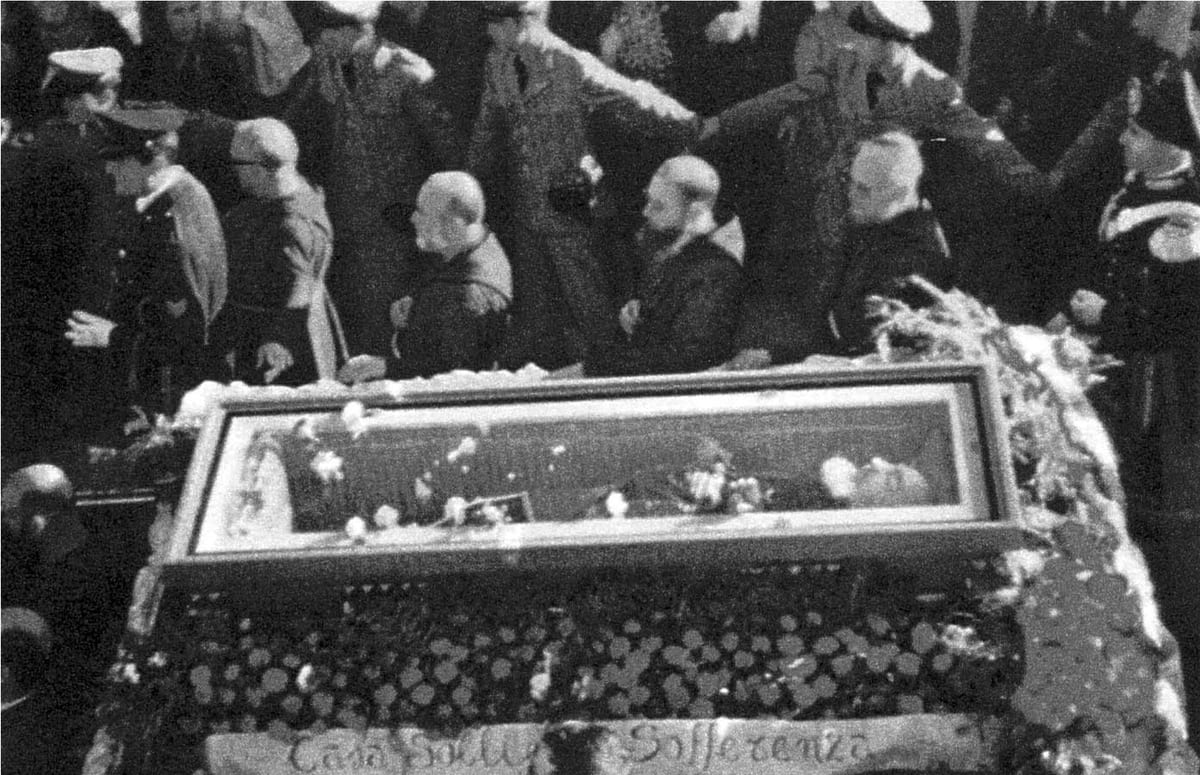
Funeral of Padre Pio, Unknown author, September 26, 1968 AD Unknown author, Wikimedia Commons; from caccioppoli.com, 'Last day, last hours, death, funeral; Way of the Cross' On September 26, 1968 AD, St. Pio's open hearse went a mile and a half down the hill into San Giovanni Rotondo. People along the route hung bedspreads and tablecloths from their windows, each with a framed picture of St. Pio edged in black cloth. There was no hysteria, and men and women, priests and religious, wiped away tears in public.
He was buried that day in the crypt of the church of Santa Maria delle Grazie. Pope John Paul II, who had made his confession to St. Pio as a young priest, beatified him on May 2, 1999 AD, and canonized him on June 16, 2002 AD.


Pray with the Church
Prayer to St. Pio
Pope John Paul II addressed this prayer to St. Pio in his homily at the canonization in St. Peter's Square, June 16, 2002 AD.
Teach us, we ask you, humility of heart so we may be counted among the little ones of the Gospel, to whom the Father promised to reveal the mysteries of his Kingdom.Help us to pray without ceasing, certain that God knows what we need even before we ask him.Obtain for us the eyes of faith that will be able to recognize right away in the poor and suffering the face of Jesus.Sustain us in the hour of the combat and of the trial and, if we fall, make us experience the joy of the sacrament of forgiveness.Grant us your tender devotion to Mary, the Mother of Jesus and our Mother.Accompany us on our earthly pilgrimage toward the blessed homeland, where we hope to arrive in order to contemplate forever the glory of the Father, the Son and the Holy Spirit.Amen.
All 11 reports on Saint Pio of Pietrelcina

St. Pio refuses chloroform so no surgeon can see his side wound

Rome doctor finds nothing in medicine to explain St. Pio's stigmata

A hundred thousand follow St. Pio's open coffin through San Giovanni Rotondo

Saint Pio dies before dawn in his cell above San Giovanni Rotondo

Sworn account of how St. Pio received the stigmata is published in Rome

Saint Pio found unconscious in the friary choir, bleeding from five wounds

About this picture
AI-generated image, in the manner of a brush-and-ink reportage drawing with grey wash.
The army hunts a deserter and finds St. Pio in his friary

New York Presbyterian hears St. Pio's Mass, becomes a Catholic and stays

About this picture
AI-generated image, in the manner of a 1910 black-and-white large-format plate photograph, reconstructed from the paper's dossier description of Piana Romana; no person appears and no reference likeness was used. The paper's reference photograph of St. Pio is Padre Pio da Pietrelcina — reproduction of an untouched 1947 portrait print (Federico Abresch, original photograph 1947; reproduction by Wikimedia user Muschio Di Quercia, 2019, Wikimedia Commons) — see the original: https://commons.wikimedia.org/wiki/File:Padre_Pio_da_Pietrelcina.jpg
A month after ordination, Saint Pio receives the wounds of Christ

About this picture
AI-generated image, in the manner of a 1916 black-and-white large-format plate photograph, reconstructed from historical descriptions of the friary, the road and the mountain; no person appears and no reference likeness was used. The paper's reference portrait of St. Pio is Padre Pio showing the stigmata — detail of the sitting of 19 August 1919 (Placido (Ferdinando) Bux, 19 August 1919, Wikimedia Commons; from the Frati Minori Cappuccini di San Giovanni Rotondo).
St. Pio returns to the mountain friary he will never leave
