
Saints Marian apparitions at Tepeyac · December 9–12, 1531 AD
Our Lady of Guadalupe
Feast 12 December
In December 1531 AD the Blessed Virgin Mary sent a poor Indian convert to a doubting bishop and left her image on his cloak as the sign; Mexico swore her its patroness, the Church crowned the image, and her feast is kept throughout America.
Begin the life
In brief
Our Lady of Guadalupe is the Blessed Virgin Mary as she appeared to Saint Juan Diego on the hill of Tepeyac, north of Mexico City, in December 1531 AD. The Church keeps her feast on December 12, the day the image appeared on St. Juan Diego's cloak. On that day the Roman Martyrology records that the faithful turn to her with confidence as the star of the evangelisation of peoples and the support of the indigenous and the poor.
-
December 9, 1531 AD
A voice on the hill of Tepeyac
Before dawn, a poor convert on his way to Mass hears singing on a hilltop and is called up it by name.
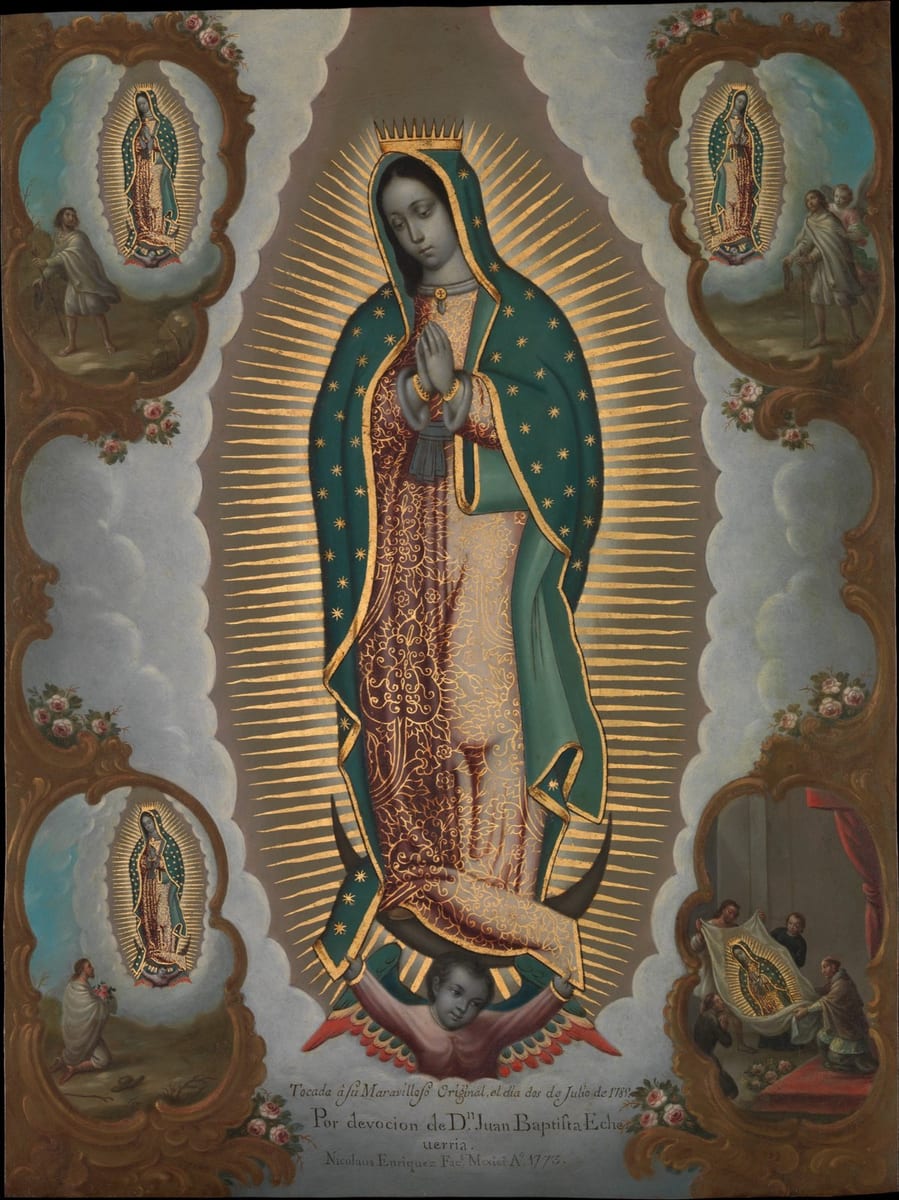
The Virgin of Guadalupe with the Four Apparitions, Nicolás Enríquez, 1773 AD Nicolás Enríquez, The Metropolitan Museum of Art, New York St. Juan Diego, a poor Indian convert who lived at Cuauhtitlán, set out before dawn on Saturday, December 9, 1531 AD, for Mass at Tlatelolco. As he passed the hill of Tepeyac, he heard singing from the top, like the song of many beautiful birds. When the singing stopped, a voice called him by name from the summit, and he climbed toward it.
Our Lady stood at the top, her clothing shining like the sun, and the thorny scrub around her glittered like emerald and gold. Speaking in his own language, she named herself the ever-Virgin Holy Mary, Mother of the true God, and asked him to go to the bishop of Mexico as her messenger and ask for a church on that spot.
“Maxicmatti, ma huel yuh ye in moyollo, noxocoyouh, canehuatl in nicenquizcacemicac Ichpochtli Santa María, in inantzin in huel nelli Teotl Dios, in ipalnemohuani, in teyocoyani, in tloque nahuaque, in ilhuicahua, in tlalticpaque. Huel nicnequi, cenca niquelehuiz inic nican nechquechilizque noteocaltzin, (Know, my dearest and youngest son, that I am the Prefect Ever Virgin, Holy Mary, Mother of the one great God of truth who gives us life, the inventor and creator of people, the owner and lord of all that is around us or touching us or very close to us, the owner and lord of the sky, the owner of the earth. I want very much for them to build a shrine for me here,)”
Our Lady of Guadalupe to St. Juan Diego, at the first apparition on Tepeyac, December 9, 1531 AD -
December 9–10, 1531 AD
The bishop asks for a sign
Told to come back another time, the messenger begs Our Lady to send someone else; she insists that he go, and the bishop asks for a sign.
Bishop Juan de Zumárraga, a Franciscan newly arrived in Mexico, heard St. Juan Diego out and told him to come back another time. At dusk St. Juan Diego climbed back to the hilltop and told Our Lady that the bishop seemed to think he had made the request up. He begged her to send someone of rank instead, calling himself a man of no account: a carrying strap, a back-frame, a tail, a wing.
Our Lady answered that she had servants and messengers enough, but that he was the one who had to go. On Sunday the bishop questioned him closely about where he had seen her and what she was like, and asked for a sign before he would believe. That evening Our Lady promised the sign and told him to come back for it the next day.
“Yece huel yuh monequi inic huel tehuatl ic tinemiz ipan titlatoz, huel momatica neltiz mochihuaz, in nocializ, in notlanequiliz. (But it is very necessary that you personally go and plead, that my wish may become a reality, that it may be carried out through your intercession.)”
Our Lady of Guadalupe to St. Juan Diego, December 9, 1531 AD -
December 11–12, 1531 AD
Our Lady comes down the hill
With his uncle dying, the messenger tries to slip round the hill; Our Lady meets him on the road, comforts him and sends him up for flowers.
On Monday St. Juan Diego did not go back, because his uncle Juan Bernardino lay dying of the fever called cocoliztli. Before dawn on Tuesday he set out to fetch a priest for his uncle's confession, and took the path round the far side of Tepeyac so that Our Lady would not stop him. Our Lady came down from the hilltop, met him beside the hill and asked where he was going.
She told St. Juan Diego not to be afraid, because his uncle was already well; Juan Bernardino had been healed at the moment she spoke. Then the Mother of God sent St. Juan Diego up to the summit, where in the December frost he found flowers of every kind in bloom. She took the flowers in her own hands and laid them back in his tilma, the loose cloak fastened over one shoulder.
“Cuix amo nican nica nimonantzin? Cuix amo nocehuallotitlan, necauhyotitlan in tica? Cuix amo nehuatl innimopaccayeliz? Cuix amo nocuixanco nomamalhuazco in tica? Cuix oc itla in motech moneoui? (Am I not here, I, who am your mother? Are you not under my shadow and protection? Am I not the source of your joy? Are you not in the hollow of my mantle, in the crossing of my arms? Do you need something more?)”
Our Lady of Guadalupe to St. Juan Diego, at the fourth apparition, reassuring him about his uncle, December 12, 1531 AD -
December 12, 1531 AD
The cloak opened before the bishop
The flowers fall to the floor, the image of the Mother of God appears on the cloth and the bishop kneels; the healed uncle brings the image its name.
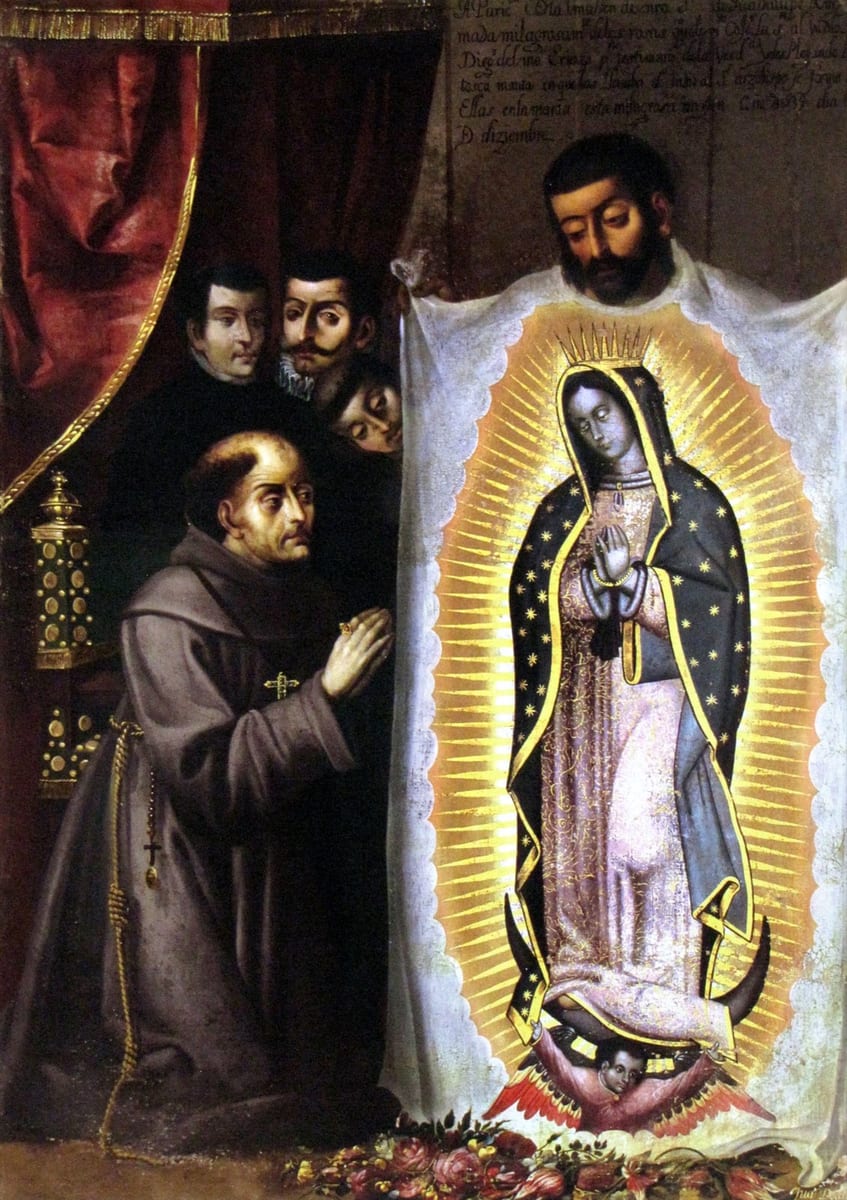
Cuarta aparición de la Virgen de Guadalupe (The Fourth Apparition of the Virgin of Guadalupe), Juan Dualte, 18th century Juan Dualte, Museo de la Colegiata de San Luis, Villagarcía de Campos, Spain At the bishop's house the doorkeeper and servants kept St. Juan Diego waiting, and three times they tried to take some of the flowers and could not. Before Bishop Zumárraga he told the whole story, said the flowers were the sign the bishop had asked for, and opened his white tilma. The flowers fell to the floor, and on the cloth appeared the image of the Mother of God.
Everyone in the room knelt, and the bishop wept and asked Our Lady's forgiveness for not doing her will at once. He untied the cloak from St. Juan Diego's neck, carried it to his private chapel and kept St. Juan Diego with him the rest of the day. Juan Bernardino later told the bishop that Our Lady had come to him at the moment of his healing and asked that her image be called the Perfect Virgin, Holy Mary of Guadalupe.
“"Notecuiyoé, Tlatoanié! Ca ye onicchiuh. Ca ye onicneltili in yuh otinechmonahuatili. (Your Excellency, sir! I have done it. I have carried out your orders.)”
St. Juan Diego to Bishop Juan de Zumárraga, before the bishop, with the flowers in his tilma, December 12, 1531 AD -
1648–1756 AD
The image on the cloak
Writers and painters who studied the cloth describe a young face with lowered eyes, a starred mantle, and the moon and an angel beneath.
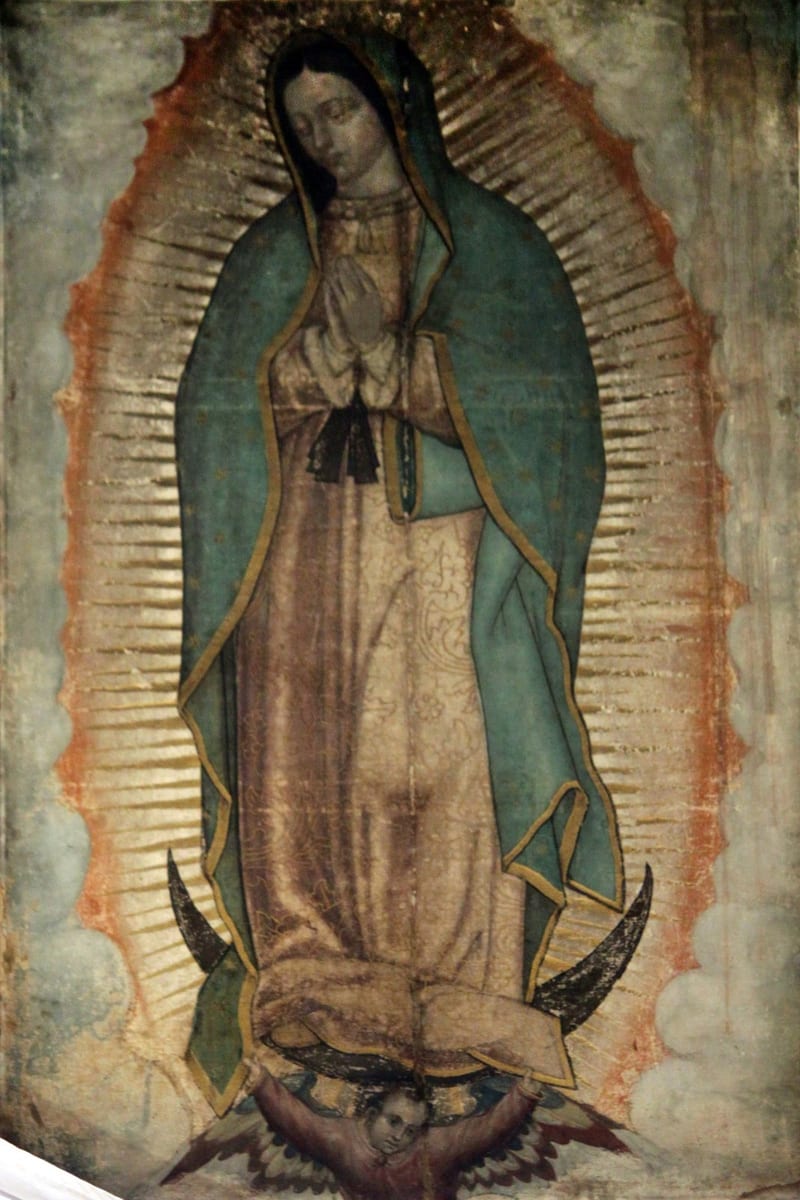
The image of Our Lady of Guadalupe on the tilma of St. Juan Diego, 1531 AD Basilica of Our Lady of Guadalupe, Mexico City The tilma is a coarse cloth of two strips sewn together, with a seam that runs up the middle of the figure and turns aside from the face. Our Lady stands with the moon beneath her feet, and an angel below holds her up. Miguel Sánchez, who printed the first history of the apparitions in 1648 AD, described a rose-coloured tunic and a gold brooch with a cross at the neck.
In March 1666 AD, during the cathedral chapter's inquiry into the apparition, the Jesuit Francisco de Florencia saw the image out of its case, touched the cloth and studied it front and back. The painter Miguel Cabrera, who inspected it with Mexico's leading painters in 1751 AD, judged that it shows Our Lady at fourteen or fifteen, with eyes lowered like a dove's. Cabrera counted forty-six stars on a mantle he found neither quite green nor blue.
“su celestial hermosura arrebata la menos devota atención con tal atractivo, que no áciertan los ojos á otro objeto en aquel Templo que al Divino Simulacro. Sola su vista basta á liquidar los corazones menos flexibles y más obstinados en afectos de amor, de gratitud, de respeto y veneración á Imagen tan portentosa. (Its celestial beauty draws the least devout attention with such attractive force that the eyes can turn to no other object in the temple but to that divine Figure. Its mere sight is enough to melt the most stubborn and obstinate hearts into affections of love, of gratitude, of respect, of veneration for so portentous a Picture.)”
The author of the Pensil Americano to his readers, writing of the image, 1793, 1793 AD -
1531–1737 AD
A hermitage becomes a shrine
A preacher attacks the crowds going to the chapel and the archbishop has him answered at the shrine; two centuries later the plague-struck city swears the Virgin of Guadalupe its patroness.
Bishop Zumárraga had a hermitage built at Tepeyac from the alms of the faithful. According to longstanding Catholic Tradition, St. Juan Diego withdrew to the shrine after the apparitions. He died in 1548 AD and was buried in the first chapel dedicated to the Virgin of Guadalupe.
On September 8, 1556 AD, the Franciscan provincial Fray Francisco de Bustamante preached before the viceroy against the crowds going to the shrine, and against Archbishop Alonso de Montúfar for sending them there. That afternoon the archbishop went to the shrine, where a crowd had gathered, and had a priest fluent in Nahuatl refute the sermon in front of them. In 1737 AD, with plague in the city, Mexico City's council decided its only remedy was the Virgin of Guadalupe's protection, and church and city swore her their Principal Patroness.
“Que por respecto del escándalo que hubo en la contradicción que hizo y de presente no se trata otra cosa sino decir que aunque pese a Bustamante, hemos de ir a servir a nuestra Sra. dondequiera que su imagen esté, y contradiga él la devoción cuánto quisiere, que antes es dar a entender que le pesa de que vayan españoles allí, de aquí adelante, si íbamos una vez iremos cuatro. (That because of the scandal caused by his attack, nothing else is being talked of at present except saying that, though it vex Bustamante, we must go and serve Our Lady wherever her image may be, and let him attack the devotion as much as he likes, for it rather shows that it grieves him that Spaniards go there; from now on, if we used to go once, we will go four times.)”
Francisco de Salazar, testifying in 1556 to what the city was saying, September 1556 AD -
1754–1976 AD
The Church approves and crowns
A papal brief approves the patronage, the image is crowned before forty bishops, and a Pope places the faith of the Americas in Our Lady's care.
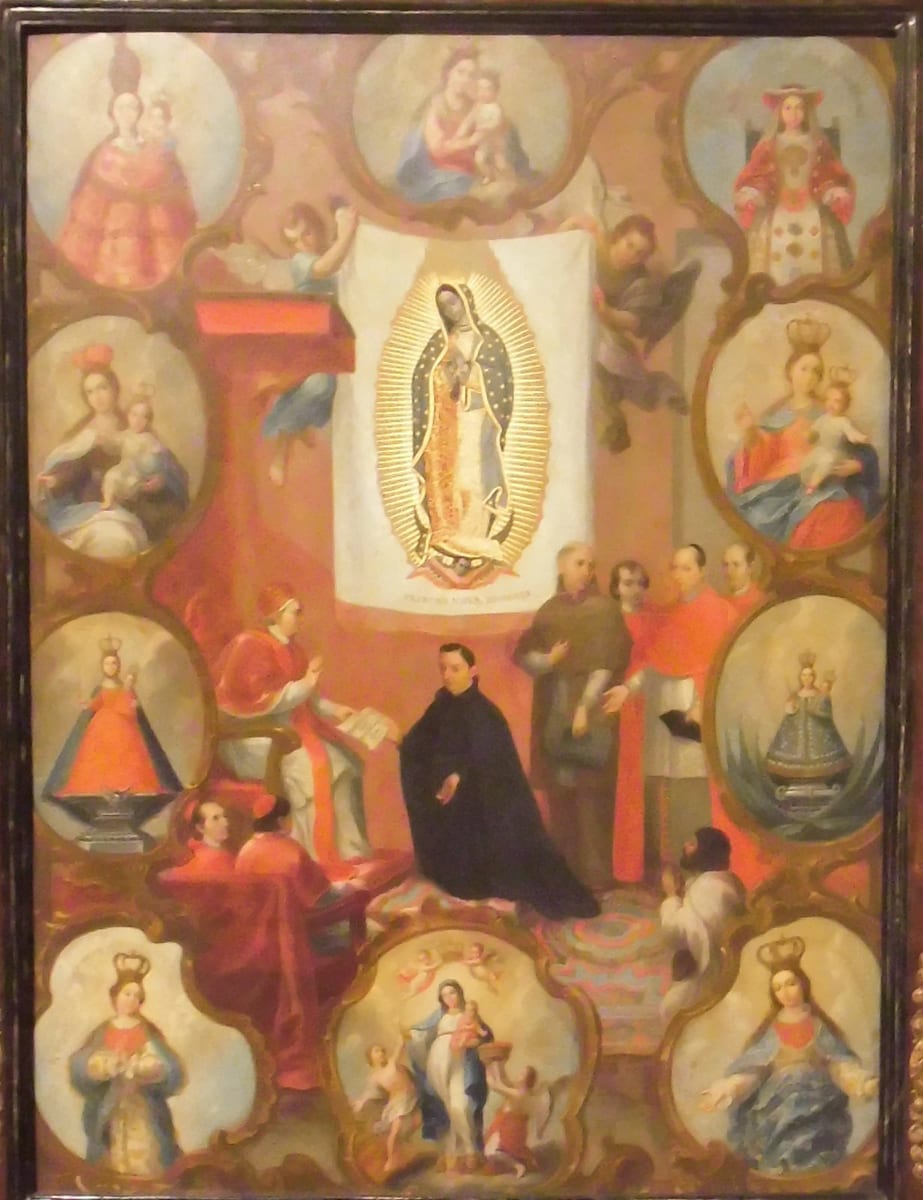
The Papal Proclamation of the Patronage of the Virgin of Guadalupe over New Spain, Attributed to Miguel Cabrera, c. 1756 AD Attributed to Miguel Cabrera, Photograph by ProtoplasmaKid, CC BY-SA 3.0 After the oath of patronage spread from Mexico City to all New Spain, Pope Benedict XIV approved Our Lady's patronage in a brief signed at St. Mary Major on May 25, 1754 AD. On October 12, 1895 AD, under a grant of Pope Leo XIII, the image was crowned before forty bishops, hundreds of priests and countless thousands of the faithful. Pope Pius XII later recalled the newly restored basilica that day as a blaze of gold, its naves packed with tens of thousands of pilgrims.
By 1910 AD, Pope St. Pius X had allowed priests in Mexico to say the Mass of Our Lady of Guadalupe on the 12th of every month. In 1945 AD, on the fiftieth anniversary of the crowning, Pope Pius XII spoke to Mexico by radio and placed the faith of the whole American continent under Our Lady's patronage. A new Basilica of Our Lady of Guadalupe was dedicated at Tepeyac in 1976 AD.
“¡Viva la Virgen de Guadalupe, Emperatriz de América y Reina de Méjico! (Long live the Virgin of Guadalupe, Empress of America and Queen of Mexico!)”
The crowd at the coronation of 1895, as recalled by Pope Pius XII to Our Lady of Guadalupe, October 12, 1895 AD -
1979–2024 AD
The Popes and Guadalupe
Pope St. John Paul II makes the basilica his first stop abroad, gives the feast to all America and canonizes the messenger; his successors keep the feast.
Pope St. John Paul II began his first journey abroad as Pope at the basilica on January 27, 1979 AD. On January 23, 1999 AD, he laid Ecclesia in America (*The Church in America*) at Our Lady's feet and declared December 12 her feast throughout America. On July 31, 2002 AD, he canonized St. Juan Diego in the same basilica.
Pope Benedict XVI kept her solemnity with a Mass for Latin America in St. Peter's Basilica on December 12, 2011 AD. Pope Francis said Mass at her basilica in Mexico City on February 13, 2016 AD. On her feast in 2024 AD, Pope Francis said the mystery of Guadalupe is the tilma, the rose and the Indigenous man.
“he venido aquí para poner a los pies de la Virgen mestiza del Tepeyac, Estrella del Nuevo Mundo, la Exhortación apostólica Ecclesia in America , que recoge las aportaciones y sugerencias pastorales de dicho Sínodo, confiando a la Madre y Reina de este Continente el futuro de su evangelización. (I have come here to place at the feet of the mestiza Virgin of Tepeyac, Star of the New World, the Apostolic Exhortation Ecclesia in America, which incorporates the contributions and pastoral suggestions of that Synod, entrusting to the Mother and Queen of this continent the future of its evangelization.)”
Pope St. John Paul II to the faithful in the basilica, Mass at her basilica, 23 January 1999, January 23, 1999 AD


Pray with the Church
Collect for the Feast of Our Lady of Guadalupe
The Roman Missal, Collect of the Mass for December 12
O God, Father of mercies, who placed your people under the singular protection of your Son's most holy Mother, grant that all who invoke the Blessed Virgin of Guadalupe, may seek with ever more lively faith the progress of peoples in the ways of justice and of peace.Through our Lord Jesus Christ, your Son, who lives and reigns with you in the unity of the Holy Spirit, God, for ever and ever.