Saints Priest and Martyr, 1894–1941 AD
Saint Maximilian Kolbe
Feast 14 August · Born 1894 AD, Zdunska Wola, near Lodz, Russian Poland (today Poland) · Died 1941 AD, Cell 18, basement of Block 11, Auschwitz I, Oswiecim, German-occupied Poland
From a poor weaver's home in Russian Poland to the largest friary in the world, and to a starvation cell at Auschwitz.
Begin the life
In brief
Saint Maximilian Kolbe, baptised Rajmund, was a Franciscan friar and priest who led the friary that ran the largest printing press in Central Europe. In 1917 AD he founded the Militia of the Immaculata to work for the conversion of sinners, and his magazine, the Knight of the Immaculata, came to print a million copies. He died at Auschwitz on August 14, 1941 AD, in a starvation cell he had entered in place of another prisoner.
-
1894–1910 AD
The weavers' son
A poor weavers' son nearly leaves the Franciscans for the army, and takes the habit at sixteen.
St. Maximilian Kolbe was born on January 8, 1894 AD, at Zdunska Wola, the son of poor weavers, and was baptised Rajmund. According to longstanding Catholic Tradition, Our Lady offered the boy two crowns, a white one for purity and a red one for martyrdom, and he said he would take both. He told no one but his mother, and she wrote the story down for the friars only after his death, in a letter of October 12, 1941 AD.
In 1907 AD he and his elder brother Franciszek entered the Franciscan seminary at Lwow, a school where priests are trained. At sixteen he set out to tell their superior, the Father Provincial, that he and Franciszek were leaving the order for a career in the army, when the parlour bell rang: their mother had arrived unannounced. Her visit turned both brothers back, and in 1910 AD he received the Franciscan habit and the name Maximilian.
-
1912–1919 AD
Rome
Studies, tuberculosis, the priesthood, and the founding of the Militia of the Immaculata.
In 1912 AD he was sent to Rome, where he took doctorates in philosophy in 1915 AD and in theology in 1919 AD. He caught tuberculosis there, and it never left him. In 1917 AD he watched processions marking two hundred years of Freemasonry cross Rome under banners declaring that Satan would reign in the Vatican.
He wrote in his notebook that the Church's enemies were at work while Catholics stayed idle. On October 16, 1917 AD he and six other friars founded the Militia of the Immaculata, to work for the conversion of sinners, above all Freemasons. He was ordained a priest in Rome on April 28, 1918 AD.
“The Immaculata alone has from God the promise of victory over Satan. However, assumed into heaven, the Mother of God now requires our cooperation. She seeks souls who will consecrate themselves entirely to her, who will become in her hands effective instruments for the defeat of Satan and the spreading of God's kingdom upon earth.”
St. Maximilian Kolbe, October 16, 1917 AD -
1919–1927 AD
Brother Machinery
St. Maximilian Kolbe begs in the streets of Krakow for the money to print the first issue of his monthly.
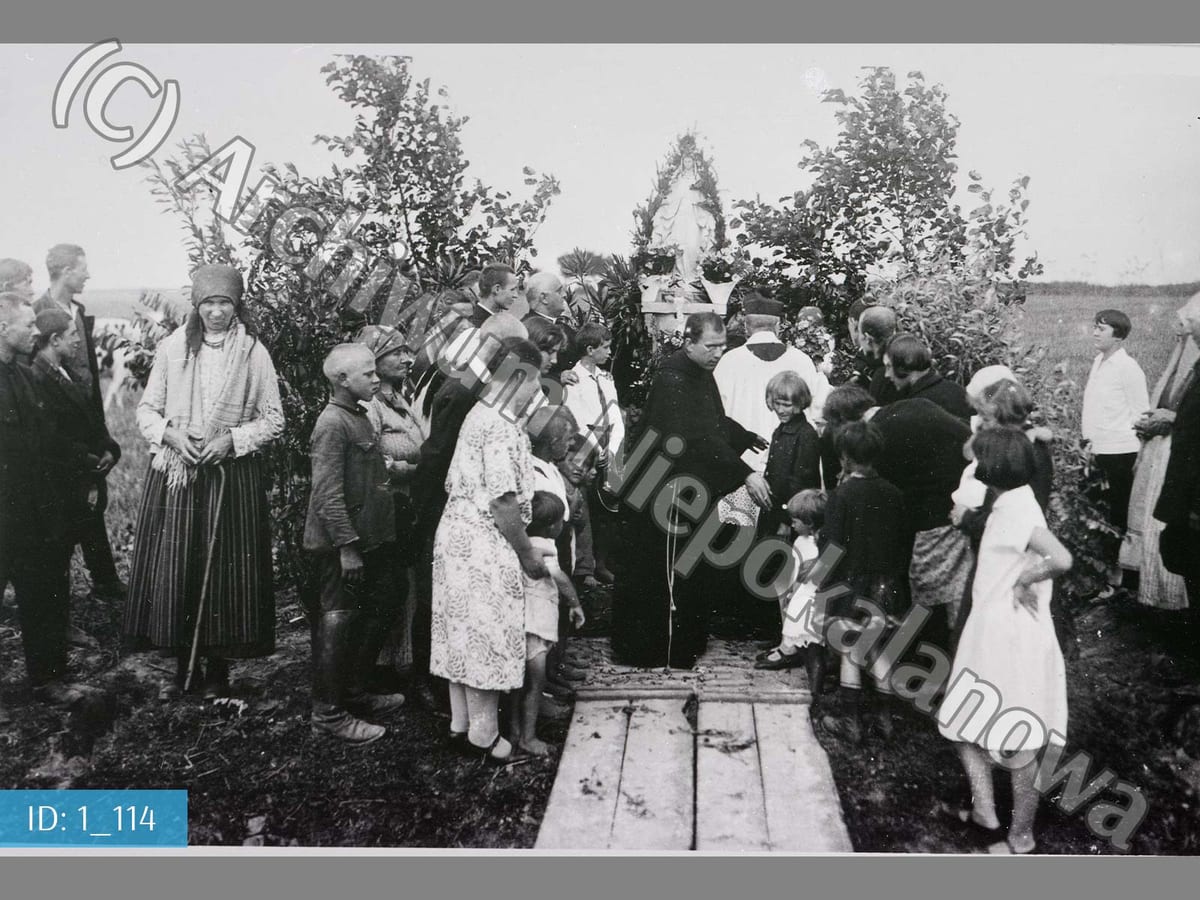
Niepokalanow, poswiecenie pierwszej figury Niepokalanej, sw. Maksymilian ustawia dzieci, Unknown, August 6, 1927 AD Unknown, Archiwum Niepokalanowa (catalogue arch-01-0114 AD) Back in Poland in 1919 AD, he was teaching at Krakow when doctors found one lung collapsed and gave him three months to live, and in June 1920 AD he was sent to the sanatorium at Zakopane for eighteen months. In January 1922 AD, paid for with money he had begged in the streets, the first issue of his monthly, the Knight of the Immaculata, came out in five thousand copies and sold out. In October 1922 AD his superior moved him to Grodno, where the magazine got printing machines of its own, which he called Brother Machinery.
In 1927 AD he found room for a bigger press on the fields of Prince Jan Drucki-Lubecki near Teresin, outside Warsaw, and on August 6 a statue of the Immaculata was blessed there. By the end of August the friars were clearing the ground with pickaxes and shovels, and sleeping on straw in a farmhouse. On December 8, 1927 AD the friary was consecrated and named Niepokalanow, the City of the Immaculata, and St. Maximilian Kolbe had the friars greet one another with the name Mary.
“To conquer the whole world, all hearts and each person individually, for the Queen, not only of Heaven, but also of Earth. To give true happiness to those poor unfortunates who seek it in the ephemeral pleasures of this world, this is our aim.”
St. Maximilian Kolbe, September 12, 1924 AD -
1930–1936 AD
Nagasaki
Five friars land in Japan with no money and no Japanese, and print within the month.
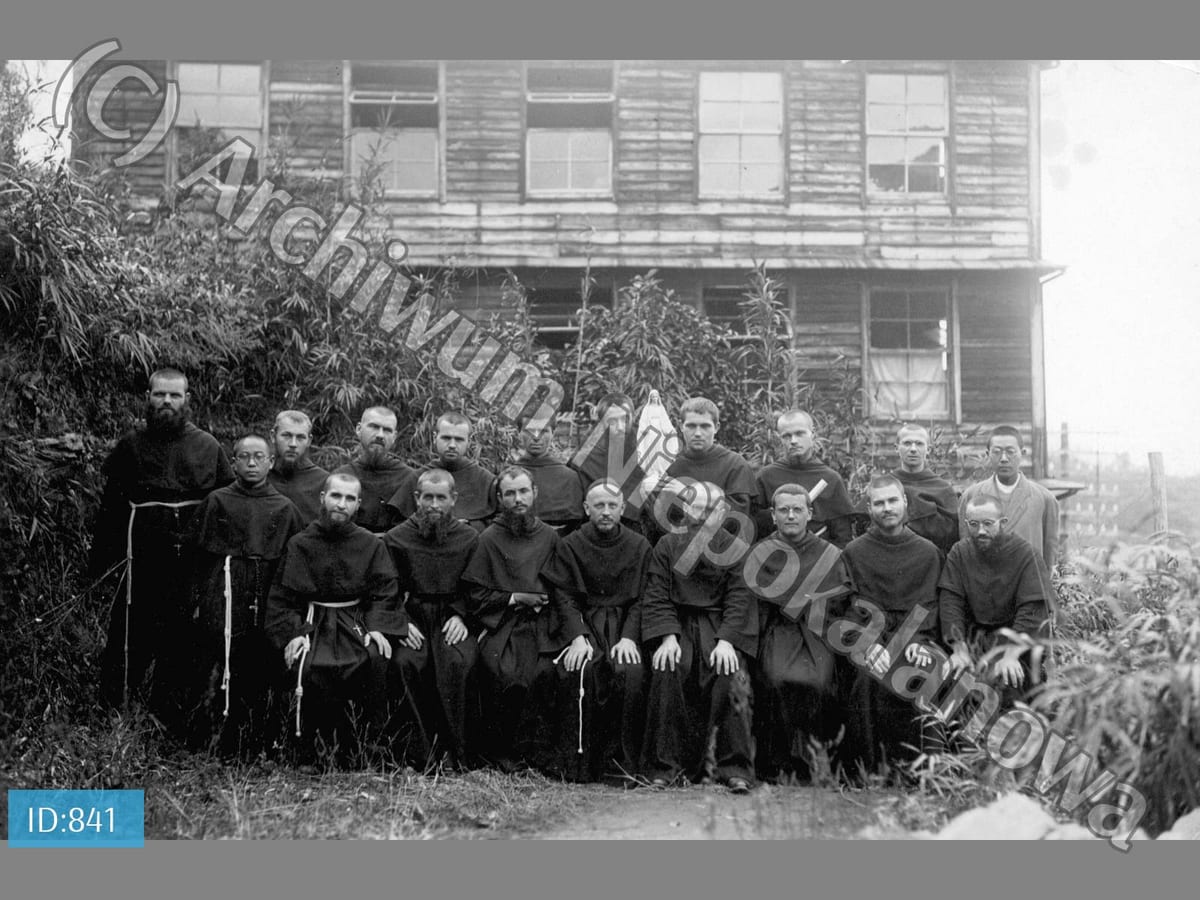
Mieszkancy Mugenzai no Sono, Nagasaki (Japonia), Unknown, October 4, 1933 AD Unknown, Archiwum Niepokalanowa (catalogue arch-05-0841 AD) In 1930 AD, answering Pope Pius XI's appeal for missionaries, he went to Japan to found a second City of the Immaculata. He and four friars landed at Nagasaki with no money and no Japanese, and their first lodging was an attic where snow blew in through the broken windows. Within a month he had permission to print, in return for teaching at the Nagasaki seminary, and brought out a Japanese Knight of the Immaculata.
He built the friary on a hillside behind a mountain, facing away from the city, and named it Mugenzai no Sono, the Garden of the Immaculate. Worn down by repeated illness, he left Japan for good in 1936 AD and was elected superior of Niepokalanow. When the atomic bomb fell on Nagasaki on August 9, 1945 AD, the mountain sheltered his friary, and it lost only a few panes of stained glass.
“If we have found her, all goes well.”
St. Maximilian Kolbe, 1930 AD -
1939–1941 AD
The presses stop
Invasion, a friary full of refugees, and the Gestapo at the gate.
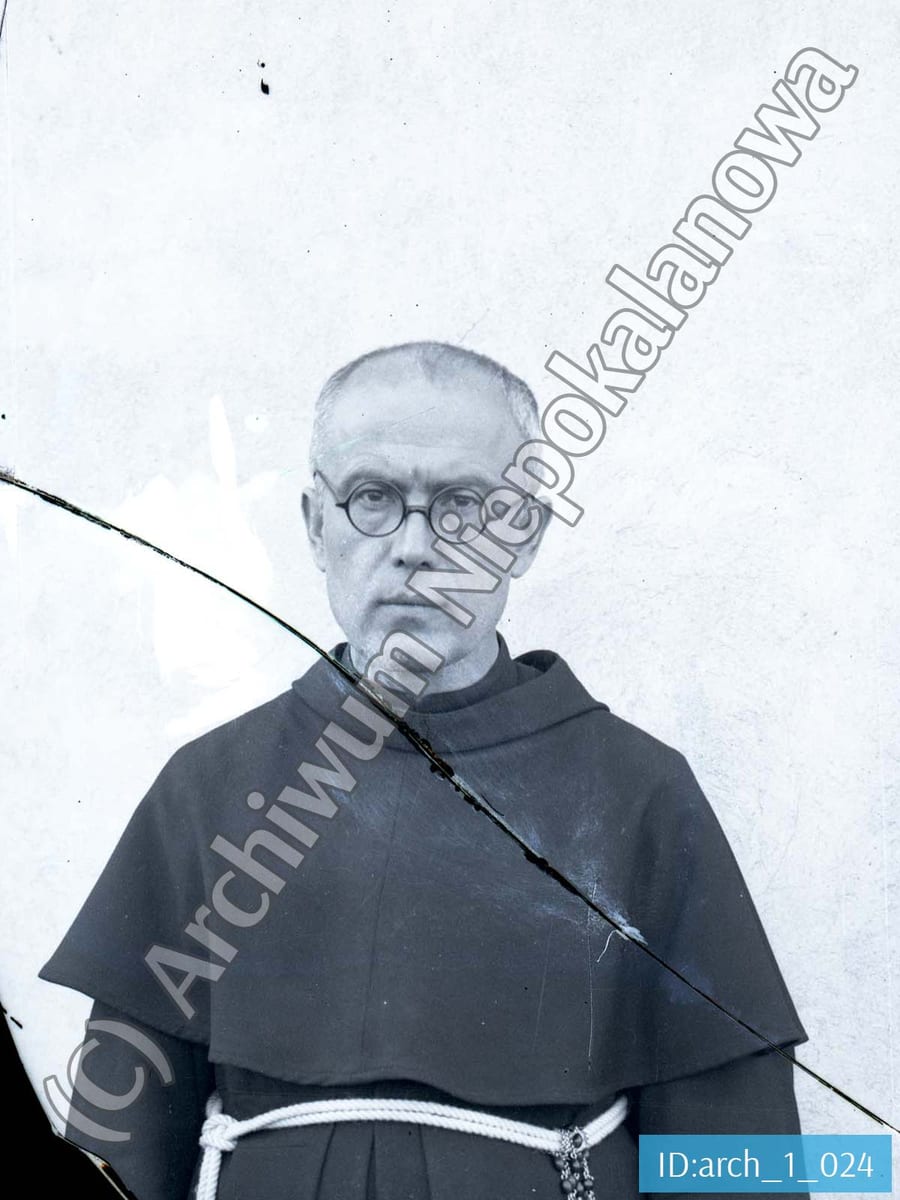
Niepokalanow, o. Maksymilian Kolbe z ogolona glowa (klisza stluczona), Unknown, 1940 AD Unknown, Archiwum Niepokalanowa (catalogue arch-01-0024 AD) Germany invaded Poland on September 1, 1939 AD, and within days the presses and editorial offices at Niepokalanow had shut. In 1940 AD the friary was ordered to take in some two thousand Poles and about 1,050 Jews, resettled from land annexed to Germany. St. Maximilian Kolbe was offered German citizenship, which would have taken him out of danger, and he refused it.
The friary's daily paper had angered the German police, and reports hostile to the friars were reaching the Gestapo in Warsaw. When the Gestapo came on February 17, 1941 AD, he met them in the good habit he kept for holy days. They arrested him with four other friars and took them to Pawiak prison in Warsaw.
“No one can change any truth. One can only seek the truth, find it, acknowledge it, conform one's life to it, walk on the path of truth in each matter. . . . Only truth can be and is the unshakable foundation of happiness, both for individuals and for the whole of humanity.”
St. Maximilian Kolbe, December 8, 1940 AD -
1941 AD
Prisoner 16670
At Auschwitz, a beating, a boxer who stopped it, and confessions heard at night.
At the end of May 1941 AD he reached Auschwitz and was registered as prisoner 16670. At Babice, where the priests were sent to build a fence round a field, he was badly beaten by Hans Krott, a camp functionary. Tadeusz Pietrzykowski, a fellow prisoner who had been a boxing champion before the war, stopped the beating by challenging Krott to a bout.
Twice, as Pietrzykowski was winning, St. Maximilian Kolbe put a hand on the boxer's arm and spoke to him. Unable to work after the beating, he spent several weeks in the camp hospital, and through June and July he heard confessions whispered at night. On July 15, 1941 AD he wrote to his mother from the camp and signed the letter with his baptismal name, Rajmund.
“Son, do not fight, do not hit.”
St. Maximilian Kolbe, June 1941 AD -
July 1941 AD
The roll call
A prisoner escapes, ten men are condemned to starve, and a priest steps out of the ranks.
At the end of July 1941 AD a prisoner from his block was missing at the count, and a search lasting a few days did not find him. By camp practice, ten men from the same block were then chosen to be starved to death in the bunker of Block 11. Karl Fritzsch, the SS officer running the selection, walked the ranks and picked the ten.
One of them, Franciszek Gajowniczek, cried out that he was a father with a wife and children. St. Maximilian Kolbe stepped out of the ranks and asked to die in Gajowniczek's place, because Gajowniczek had a family who needed him alive. Fritzsch asked St. Maximilian Kolbe who he was, learned that the prisoner in front of him was a Catholic priest, and agreed to the exchange.
“I am a Catholic priest.”
St. Maximilian Kolbe, July 1941 AD -
1941–1995 AD
Cell 18
The ten starve in the bunker, and the man St. Maximilian Kolbe saved lives to see him canonized.
The ten were stripped and locked in cell 18, in the basement of Block 11, without food or water. St. Maximilian Kolbe led them in prayers, hymns and the rosary as one by one they died, and prisoners in the cells nearby joined in. After about two weeks he was one of the few still alive, and on August 14, 1941 AD a prisoner brought from the camp hospital killed him with an injection of phenol.
Pope Paul VI beatified him on October 17, 1971 AD and called him a martyr of love. Pope John Paul II canonized him on October 10, 1982 AD and decreed that he be venerated also as a martyr. Franciszek Gajowniczek, the man he saved, was at both ceremonies, and lived until 1995 AD.


Pray with the Church
Act of Consecration to the Immaculata
Written by St. Maximilian Kolbe and used by the Militia of the Immaculata as its official act of consecration.
O IMMACULATA, Queen of Heaven and earth, refuge of sinners and our most loving Mother, God has willed to entrust the entire order of mercy to you. I, (name), a repentant sinner, cast myself at your feet humbly imploring you to take me with all that I am and have, wholly to yourself as your possession and property. Please make of me, of all my powers of soul and body, of my whole life, death and eternity, whatever most pleases you.If it pleases you, use all that I am and have without reserve, wholly to accomplish what was said of you: “She will crush your head,” and, “You alone have destroyed all heresies in the world.” Let me be a fit instrument in your immaculate and merciful hands for introducing and increasing your glory to the maximum in all the many strayed and indifferent souls, and thus help extend as far as possible the blessed kingdom of the most Sacred Heart of Jesus. For wherever you enter, you obtain the grace of conversion and growth in holiness, since it is through your hands that all graces come to us from the most Sacred Heart of Jesus.V. Allow me to praise you, O sacred Virgin.R. Give me strength against your enemies.
All 8 reports on Saint Maximilian Kolbe

Pope declares St. Maximilian Kolbe a martyr before the prisoner he saved

Seven Kraków friars join St. Maximilian Kolbe's movement for the Virgin Mary

Gestapo empty the friary at Niepokalanow and take more than forty friars

Searching India for land, St. Maximilian Kolbe writes out the journey's perils

At seventeen, St. Maximilian Kolbe makes his vows at Lwów

At sixteen, St. Maximilian Kolbe takes the habit and a new name

Germany invades Poland, and a friary's daily newspaper stops
