
Saints Lima, Peru · 1579–1639 AD
Saint Martin de Porres
Feast 3 November · Born 1579 AD, Lima, Peru · Died 1639 AD, Convento del Santísimo Rosario, Lima, Peru
Barred by Peruvian law from full membership of a religious order, he asked for the lowest place in Lima's Dominican convent and was handed its infirmary.
Begin the life
In brief
Saint Martin de Porres was born in Lima on December 9, 1579 AD, the son of a Spanish knight of the Order of Alcántara and a freed black woman of Panama. He was a barber, bloodletter and surgeon by trade, and from his fifteenth year he belonged to the Dominican convent of the Most Holy Rosary in Lima. He died there on November 3, 1639 AD, and Pope John XXIII canonized him in 1962 AD.
-
1579–1587 AD
A small house next to the one facing the church of the Holy Spirit
St. Martin de Porres was born in Lima and baptised the same day at San Sebastián, in a register that named no father.
St. Martin de Porres was born on December 9, 1579 AD in a small house in Lima, next to the large house that faces the church of the Holy Spirit. He was baptised that same Wednesday in the parish of San Sebastián, at the font that would receive St. Rose of Lima a few years later. His father, don Juan de Porres, would not sign the entry, so it names only his mother, Ana Velázquez, a freed woman born in Panama.
Sent out each day to buy what the house needed, he gave part of the food to poor children in the street. His mother scolded and struck him for it, and once left him without his own dinner.
“Miércoles 9 de Diciembre de 1579, bauticé á Martín, de padre no conocido, y de Ana Velázquez, libre. Fueron padrinos Juan de Huesca, y Ana de Escurcena; firmólo Antonio Polanco. (Wednesday, 9 December 1579, I baptised Martin, of a father not known, and of Ana Velazquez, free. The godparents were Juan de Huesca and Ana de Escurcena; Antonio Polanco signed it.)”
The baptismal register of San Sebastián, Lima, signed by Antonio Polanco, December 9, 1579 AD -
1588–1591 AD
His father claims him aloud
Taken to Guayaquil and schooled there, St. Martin de Porres was claimed aloud by the father who had left his baptism unsigned.
St. Martin de Porres was about eight when his father took him and his sister Juana to Guayaquil, where don Juan had business of the crown. There he learned to read and write with a master his father chose.
In that city his father's uncle, captain don Diego de Miranda, asked who the mulatto children travelling with him were. Don Juan named both children as his own again in the will he made at the hour of his death. Before sailing to take up the government of Panama, he had his son confirmed and left him with Ana Velázquez, charging her to set him to a barber's trade.
“Son hijos mios, y de Ana Velazquez, y, por lo tanto, debo sustentarlos y darles la educación correspondiente. (They are my children, and Ana Velazquez's, and therefore I must support them and give them the education that belongs to them.)”
Don Juan de Porres to Captain Diego de Miranda, at Guayaquil, asked who the mulatto children with him were -
1592–1594 AD
The barber's shop on Malambo street
Apprenticed to a barber who was also a bloodletter, St. Martin de Porres learned the only trade he ever had and refused to charge for it.
His mother placed him with a barber on Malambo street who was also a bloodletter. The man taught him the razor and the remedies then used for wounds, ulcers and abscesses. Barbers in Lima commonly practised medicine and surgery without credentials, and the city council decreed in 1559 AD that none should treat patients without first showing his titles.
Once qualified, St. Martin de Porres asked no fee, and set aside for the poor whatever anyone paid him. The almsgiving left him too poor to light his room, so he asked the lady of the house for a piece of candle, and she saw him through the cracks of the door kneeling before a crucifix in tears. Witnesses examined at Lima fifty years after his death said the lemon tree he had planted in that garden as a boy still stood and still bore fruit in every season.
-
1594–1603 AD
The lowest place in the house
At fifteen St. Martin de Porres entered the convent of the Rosary as a donado, and nine years later was allowed solemn profession.
At fifteen St. Martin de Porres gave in his name to the Order of Preachers as a donado, a lay tertiary attached to the convent of the Most Holy Rosary. Peruvian law then barred the descendants of Africans and of Indians from full membership of a religious order, and he asked for the most humble condition the house could give. The prior received him after seeing his skill as a barber and in medicine.
He remained nine years a donado bound by no vows. On June 2, 1603 AD, at twenty-four, he was admitted to solemn profession of the three vows, a thing then very rarely granted to a donado.
-
1603–1633 AD
The infirmary of the Rosary
The convent put its sick into his hands, and once, ordered to leave them alone, St. Martin de Porres disobeyed.
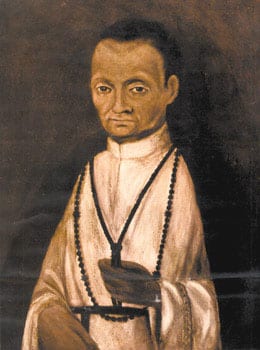
Retrato de San Martín de Porres (anonymous portrait in the Monasterio de Santa Rosa de las Monjas, Lima), Anonymous, Lima school, 17th century; held to have been painted in his lifetime or very soon after his death in 1639 AD Anonymous, Lima school, Monasterio de Santa Rosa de las Monjas, Lima, Peru; reproduction on Wikimedia Commons The infirmary of the convent of the Rosary was put into his hands, and he worked there as barber, surgeon and infirmarian. He had studied surgery as a youth and practised it free of charge for the poor of the city.
The provincial, Fr. Agustín Vega, forbade him to treat anyone inside the convent, and one night he carried a wounded man to his own cell. Called to account for it, St. Martin de Porres defended himself in a single sentence.
“verdad es que llevé ese pobre herido, y le auxilié en mi celda; pero lo hice por la urgencia del caso, puesto que, cuando la caridad obliga, debe preferirse esta á la obediencia. (It is true that I brought that poor wounded man in and helped him in my cell; but I did it because the case was urgent, since when charity obliges, it must be preferred to obedience.)”
St. Martin de Porres to The provincial, Fr. Agustín Vega -
1603–1633 AD
Contempt, and an offer to be sold
Abused in his own house for his colour, St. Martin de Porres offered the prior to sell him when the house had no money for the infirmary.
Friars of the convent abused him for his colour, and told him he belonged in a prison rather than a religious house. The black workers of the estate at Limatambo knew him by the blood he left in the olive grove where he scourged himself.
When the house had no money for the infirmary, he went to the prior and offered himself for sale as a slave. The prior wept and sent him away, saying God had already relieved the need.
“Padre prior, no se aflija vuesa paternidad por la urgente necesidad del convento. Yo soy esclavo de la religión, y vendiéndome se socorrerá. Es tan pequeño mi servicio, que no compensa lo que gravo a la comunidad en alimentos y demás auxilios. (Father prior, let not your paternity be distressed by the convent's urgent need. I am a slave of the religion, and by selling me the need will be met. My service is so small that it does not repay what I cost the community in food and other help.)”
St. Martin de Porres to The prior of the convent of the Rosary, the prior having no money for the infirmary -
November 3, 1639 AD
The night of November 3
St. Martin de Porres died in the convent infirmary at Lima, in the sixtieth year of his age, while the community prayed at his bed.
In his last illness animals were killed on the physicians' orders to make remedies for him, and he asked them to stop. He received Viaticum and the last sacraments, in the sixtieth year of his age.
The community of the convent of the Rosary gathered round him and chanted the prayers of the rite. He let the image of his Redeemer fall on his breast and died at about nine in the evening of November 3, 1639 AD.
“¿Para qué quitan la vida á esas criaturas de Dios, puesto que no me han de aprovechar las medicinas, porque es voluntad divina que yo muera? (Why do they take the life of those creatures of God, since the medicines cannot help me, because it is the divine will that I should die?)”
St. Martin de Porres, November 1639 AD -
1641–1962 AD
From Lima to Saint Peter's
The Order entered his name in its own records within two years, and three centuries later the Church declared him a saint.
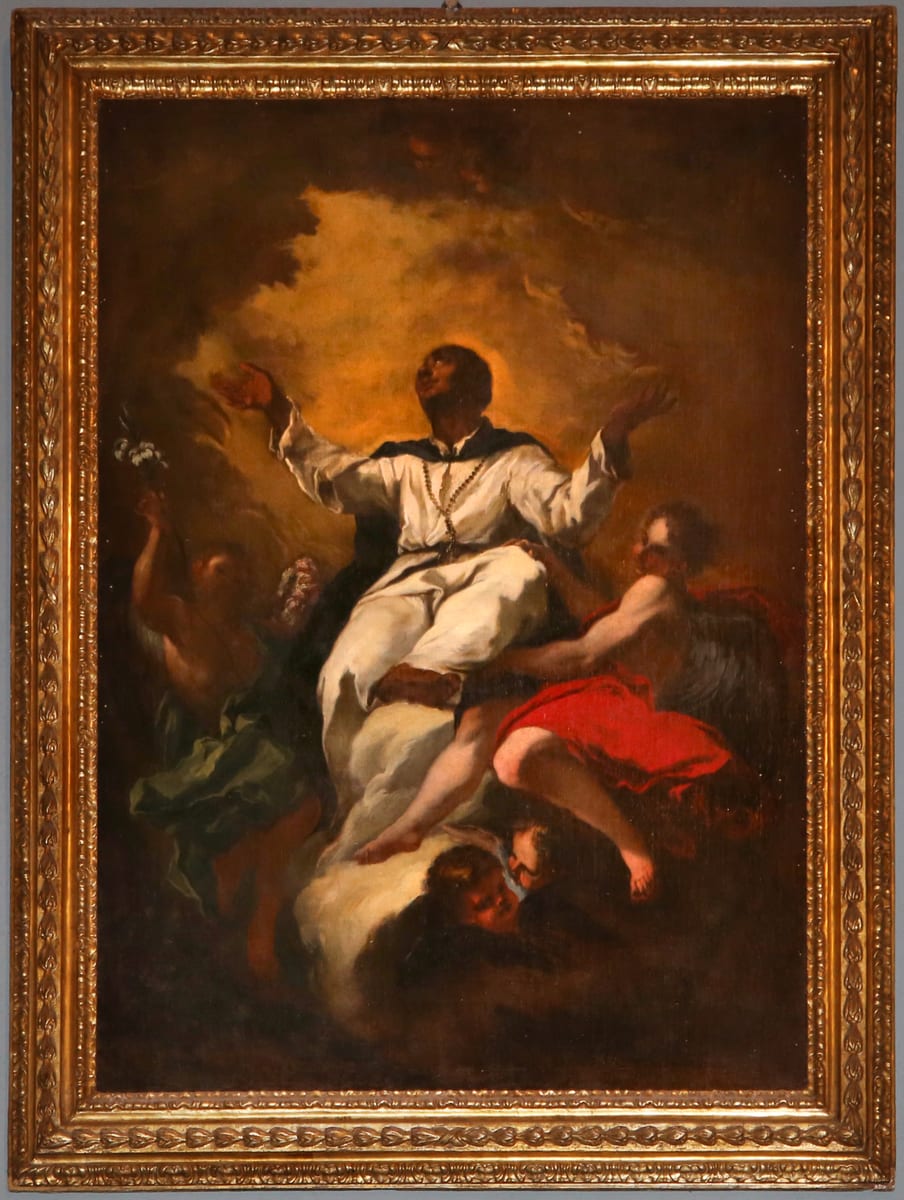
Gloria di san Martino de Porres, Anonymous, Italian, 18th century Anonymous, Italian, Chiesa di Santa Caterina (Dominican), Livorno, Italy; photograph by Sailko on Wikimedia Commons Two years after his death the Dominican province of Peru entered an act in his praise, and the Order's general chapter carried his obituary in 1642 AD. The Ordinary of Lima opened the judicial process in 1660 AD with seventy-five witnesses. On a March night in 1664 AD his bones were lifted before the Viceroy of Peru, and physicians who examined the body from head to foot found no sign of corruption.
Pope Gregory XVI beatified him in the Vatican basilica on October 29, 1837 AD. Pope John XXIII canonized him in Saint Peter's Basilica on May 6, 1962 AD, and the homily he preached that day is read in the Office on November 3.
“He did not blame others for their shortcomings. Certain that he deserved more severe punishment for his sins than others did, he would overlook their worst offenses. He was tireless in his efforts to reform the criminal, and he would sit up with the sick to bring them comfort. For the poor he would provide food, clothing and medicine. He did all he could to care for poor farmhands, blacks, and mulattoes who were looked down upon as slaves, the dregs of society in their time. Common people responded by calling him, "Martin the charitable."”
Pope John XXIII, in the homily at the canonization, read in the Office of Readings on his memorial, May 6, 1962 AD


Pray with the Church
Collect for the Memorial of Saint Martin de Porres
The Collect the Church prays on his memorial, November 3, in the Liturgy of the Hours
O God, who led Saint Martin de Porresby the path of humility to heavenly glory,grant that we may so follow his radiant example in this lifeas to merit to be exalted with him in heaven.Through our Lord Jesus Christ, your Son,who lives and reigns with you in the unity of the Holy Spirit,God, for ever and ever.
All 3 reports on Saint Martin de Porres

About this picture
AI-generated image, in the manner of a seventeenth-century viceregal Lima oil painting on canvas, from the paper's reference portrait based on Retrato de San Martín de Porres (Anonymous, Lima school, 17th century, Monasterio de Santa Rosa de las Monjas, Lima) View source artwork.
Saint Martin de Porres, ten, confirmed as his father sails for Panama

St. Martin de Porres walks down to the flooding Rímac at Lima

About this picture
AI-generated image, in the manner of a seventeenth-century viceregal Lima oil painting on canvas, from the paper's reference portrait based on Retrato de San Martín de Porres (Anonymous, Lima school, 17th century, Monasterio de Santa Rosa de las Monjas, Lima) View source artwork.